

Company Formation in Mumbai: Which Business Structure Should You Choose?
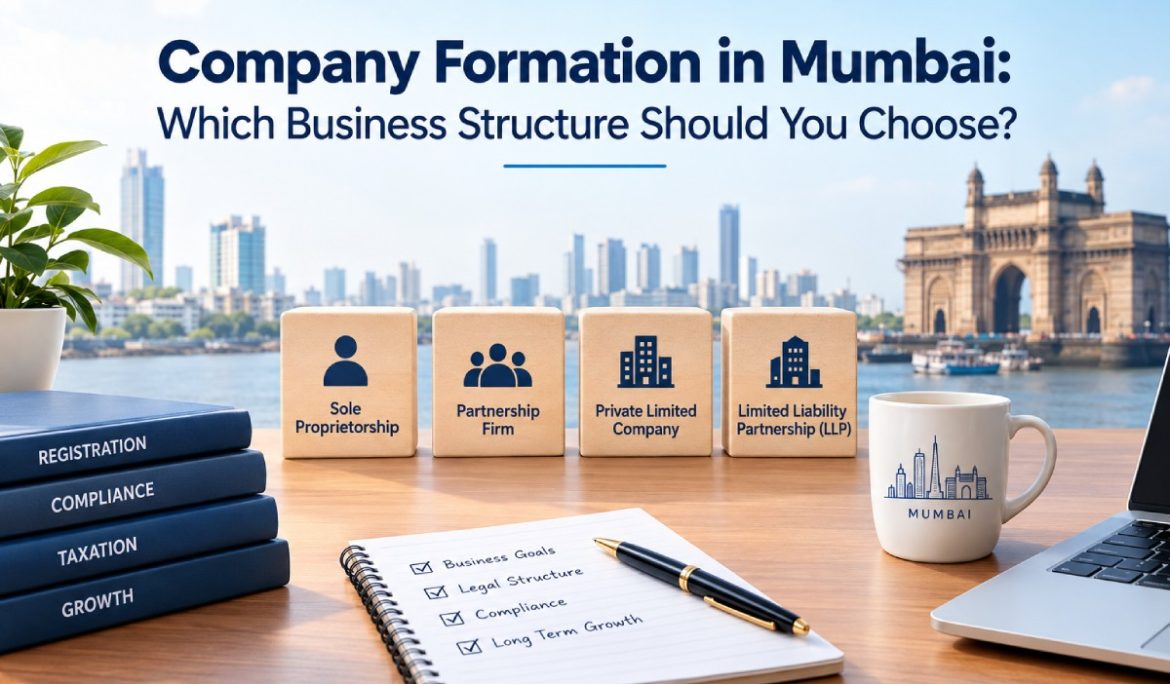
For company formation in Mumbai, choose your structure based on liability, funding plans, number of founders, and how much compliance you can manage. A private limited company suits businesses that plan to raise investment or scale. An LLP suits professional firms and partners who want limited liability with lighter compliance.
A One Person Company (OPC) works for a single founder who wants a company structure. A proprietorship or partnership is simplest but gives no protection for personal assets. Most businesses benefit from speaking to a CA for company registration before registering, because changing structure later costs time and money.
Why the Structure Decision Matters
The structure you register is not just a formality.
It decides:
- Whether your personal assets are at risk if the business owes money
- How profits are taxed and how you can take money out
- Whether investors can come in, and how easily
- How many filings, audits and meetings you must handle every year
- How banks, large customers and vendors view you
A founder who starts as a proprietor and later needs investment has to form a new entity and move the business into it. That means new registrations, new bank accounts, reassigning contracts, and sometimes tax on the transfer. Getting the choice right at the start avoids most of this.
Business Structures Available in Mumbai
Sole proprietorship
The business and the owner are the same person in law. There is no separate registration for a proprietorship itself. It is recognised through other registrations required for business registration Mumbai, such as GST, Udyam, and a Shop and Establishment registration or intimation under the Maharashtra Shops and Establishments Act. It is quick and cheap to start, but the owner is personally liable for all business debts, and profits are taxed at the owner’s individual slab rates.
Partnership firm
Two or more people run the business under a partnership deed. In Maharashtra, registering the firm with the Registrar of Firms is advisable, because an unregistered firm faces restrictions on filing suits to enforce its contracts. Partners are jointly and personally liable for the firm’s debts.
Limited Liability Partnership (LLP)
An LLP is a separate legal entity registered with the Ministry of Corporate Affairs (MCA). Partners’ liability is limited to their agreed contribution. It needs at least two designated partners, and at least one must be resident in India. There is no minimum capital.
LLP compliance is lighter than a company’s: no board meetings or AGMs, and a statutory audit applies only if turnover exceeds ₹40 lakh or contribution exceeds ₹25 lakh.
One Person Company (OPC)
An OPC is a company with a single member, who must be an Indian citizen and resident, and a nominee. It gives a solo founder limited liability and a company structure without needing a second shareholder. It can later be converted into a private limited company when more shareholders join.
Private limited company
A private limited company needs at least two directors and two shareholders (the same people can be both), with at least one director resident in India. It is a separate legal entity with limited liability, and shares can be issued to investors or employees.
This is the structure most investors, venture funds, and larger clients expect. It also carries the most compliance: board meetings, an annual general meeting, statutory audit regardless of turnover, and annual ROC filings. Many smaller companies qualify as a “small company”, which eases some requirements. From 1 December 2025, that limit is paid-up capital up to ₹10 crore and turnover up to ₹100 crore.
Business Structures Compared
| Factor | Proprietorship | Partnership | LLP | OPC | Private limited |
| Separate legal entity | No | No | Yes | Yes | Yes |
| Owner liability | Unlimited | Unlimited | Limited to contribution | Limited to shares | Limited to shares |
| Minimum people | 1 | 2 | 2 designated partners | 1 member + nominee | 2 directors, 2 shareholders |
| Registered with | No single registration | Registrar of Firms (advisable) | MCA | MCA | MCA |
| Income tax | Individual slab rates | Firm rate | Firm rate | Company rates | Company rates |
| Statutory audit | No (tax audit above limits) | No (tax audit above limits) | Above ₹40 lakh turnover or ₹25 lakh contribution | Yes | Yes |
| Raising equity investment | Not possible | Not practical | Limited | Limited | Designed for it |
| Compliance load | Lowest | Low | Moderate | Moderate to high | Highest |
| Typically suits | Freelancers, small traders | Family and small businesses | Professional firms, partner-run businesses | Solo founders | Startups and scaling businesses |
Tax rates change with each Finance Act, so confirm the current rates for your expected profit with a tax adviser before deciding.
How to Choose: Six Questions to Ask Yourself
- Do I want to protect my personal assets? If yes, rule out proprietorship and unregistered partnership. Choose an LLP, OPC, or private limited company.
- Will I raise money from investors? If you expect angel, venture, or strategic investment, a private limited company is the practical choice. Investors buy shares, and LLPs and OPCs do not suit that.
- How many founders are there? One founder points to a proprietorship or OPC. Two or more can choose a partnership, LLP, or private limited company.
- How will profits be used? If profits will mostly be reinvested, company tax rates may work well. If partners will withdraw most profits, an LLP can be simpler, because an LLP’s share of profit is not taxed again in the partners’ hands.
- How much compliance can I manage? A private limited company needs regular board meetings, minutes, a statutory audit, and ROC filings. If that feels heavy for a small professional practice, an LLP may be a better fit.
- Who are my customers? Large corporations and government bodies sometimes prefer or require vendors to be companies or LLPs.
Two common examples:
- A two-founder tech startup planning company formation in Mumbai and raising seed funding will almost always register a private limited company, so shares can be issued to investors and employees through an ESOP pool.
- Three Chartered Accountants or architects setting up a practice in Thane often choose an LLP for limited liability, simpler compliance, and flexibility in sharing profits.
Private Limited Company Registration: The Process
Private limited company registration is done online through the MCA portal using the SPICe+ form. For company registration Mumbai, the application is processed centrally by the MCA, and a company with its registered office in Mumbai then falls under the Registrar of Companies (RoC), Mumbai.
- Digital Signature Certificates (DSC): required for private limited company registration, as each proposed director needs a DSC to sign the forms.
- Name reservation: apply for the company name through SPICe+ Part A. The name must not be identical or too similar to an existing company or trademark.
- SPICe+ Part B: file the incorporation details, directors’ details (Director Identification Numbers are allotted through the same form), registered office proof, capital, and subscribers.
- MoA and AoA: the Memorandum and Articles of Association are filed electronically along with SPICe+.
- AGILE-PRO-S: this linked form covers EPFO and ESIC registration, Profession Tax registration for companies in Maharashtra, and opening the company’s bank account. GST registration can be applied for through it, optionally.
- Certificate of Incorporation: once approved, private limited company registration results in a certificate with the Corporate Identification Number (CIN), PAN, and TAN.
Documents usually needed:
company registration Mumbai includes PAN and Aadhaar of directors, address proof, photographs, proof of the registered office (rent agreement or ownership document, a recent utility bill, and a no-objection certificate from the owner), and the proposed business activity.
The timeline depends mainly on name approval and document quality. Straightforward cases often complete within one to three weeks.
LLP Registration in Mumbai: The Process
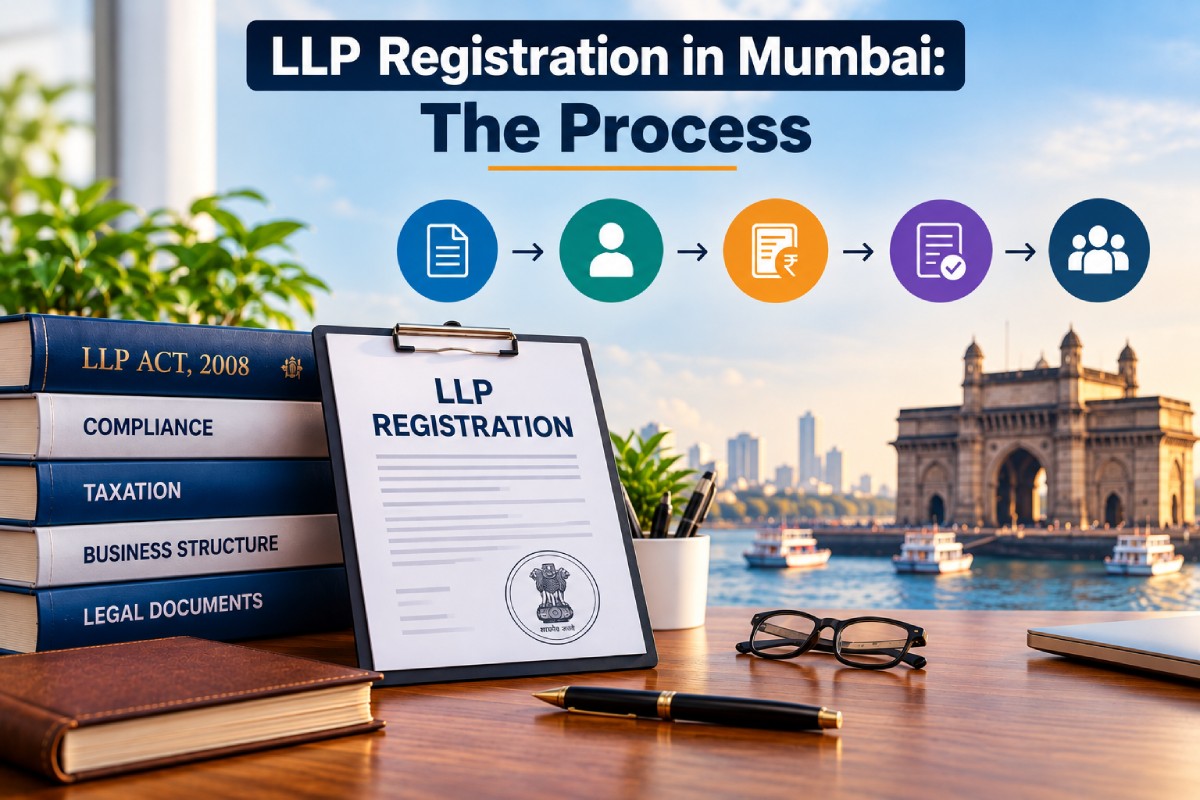
LLP registration Mumbai also happens online through the MCA portal.
- DSC for the designated partners.
- Name reservation through RUN-LLP or as part of the incorporation form.
- FiLLiP form for incorporation, with partner details, registered office proof and the proposed contribution. Designated Partner Identification Numbers can be allotted through this form.
- Certificate of Incorporation with the LLPIN.
- LLP agreement: after LLP registration Mumbai, file the agreement setting out capital, profit sharing, duties and exit terms with the MCA within 30 days of incorporation.
Take the LLP agreement seriously. It is the document partners rely on when there is a disagreement, a new partner joins, or someone leaves.
Registrations You May Need After Incorporation
Business registration in Mumbai does not end with the certificate.
Depending on your activity, you may also need:
- GST registration if turnover will cross ₹40 lakh for goods or ₹20 lakh for services, or earlier if you sell inter-state or through e-commerce platforms
- Profession Tax registration (covered through AGILE-PRO-S for new companies in Maharashtra; applied for separately for other structures)
- Shop and Establishment registration or intimation under the Maharashtra Shops and Establishments Act
- Udyam registration to access MSME benefits
- Import Export Code (IEC) if you import or export
- Startup India (DPIIT) recognition for eligible businesses completing startup registration Mumbai
On startup registration Mumbai: many founders think of business registration Mumbai and “startup registration” as separate legal forms. It is not. You first register a private limited company, LLP, or registered partnership, and then apply for DPIIT recognition if you meet the conditions, which include age and turnover limits and an innovative business model. Recognition can open up certain tax and compliance benefits, subject to their own conditions.
Compliance After Formation: The First Year
Many founders completing business registration Mumbai focus on getting the certificate and forget what follows. A missed early filing can lead to penalties from the start.
| Requirement | Private limited / OPC | LLP |
| First auditor | Appointed by the board within 30 days | Appointed where audit applies |
| Commencement of business | Declaration filed within 180 days | Not applicable |
| LLP agreement | Not applicable | Filed within 30 days |
| Board meetings | Required throughout the year (OPCs have relaxed rules) | Not required |
| Books of account | Required from day one | Required from day one |
| Annual ROC filings | Financial statements and annual return | Statement of Account and Solvency, and annual return |
| Income tax return | Required every year | Required every year |
Setting up accounting services and a compliance calendar at the time of formation is far easier than reconstructing records at year-end.
Common Mistakes When Registering a Business
- Choosing a proprietorship to save costs, then needing investment within a year. Converting later costs more than registering a company at the start.
- Picking a name without checking trademarks. MCA approval does not protect you from a trademark dispute.
- Using a residential address without proper documents. Registered office proof is a frequent cause of rejection.
- Ignoring the shareholding split. Founders often split shares equally without thinking about vesting or future dilution.
- Skipping the LLP agreement details. A template agreement rarely covers exit, deadlock, or capital calls properly.
- Forgetting post-incorporation filings. The commencement of business declaration and first auditor appointment are commonly missed.
Why Use a CA for Company Registration
Online portals make company formation services and filing possible for anyone, but filing is the easy part.
A CA for company registration adds value in the decisions around it:
- Comparing structures using your actual numbers, not generic rules
- Advising on share capital, shareholding and founder agreements
- Planning the tax position of the new entity from day one, including through tax planning and advisory
- Getting GST, Profession Tax and other registrations right the first time
- Setting up accounting and a compliance calendar before the first deadline arrives
If you are comparing firms, our guide on how to choose a Chartered Accountant in Mumbai lists the questions to ask.
How Whitespace Consultancy Supports Company Formation
Whitespace Consultancy is a CA firm in Mulund West that supports company formation in Mumbai and works with founders and businesses across Mumbai, Thane, and Navi Mumbai. Its company formation services cover structure advice, private limited company, OPC, and LLP incorporation, and the registrations that follow. After incorporation, the team can handle ROC compliance and ongoing corporate filings along with accounting, GST, and income tax, so the new entity starts with clean records.
Frequently Asked Questions
What is the best business structure for a startup in Mumbai?
For a startup completing startup registration Mumbai that plans to raise investment, a private limited company is usually the right choice, because investors subscribe to shares and expect a company structure. It also allows ESOPs for employees. If the business will be run by a few partners without outside investors, an LLP may offer similar liability protection with lighter compliance.
How long does company formation in Mumbai take?
For company formation in Mumbai, a private limited company or LLP with correct documents and an available name often completes registration within one to three weeks. Delays usually come from name rejections, unclear office address proof, or mismatched details in identity documents. Post-incorporation registrations following company registration Mumbai, such as GST, may take additional time.
Is LLP registration in Mumbai cheaper than a private limited company?
For LLP registration Mumbai, the government fees and professional charges for incorporation are broadly comparable. The bigger difference is ongoing cost: a private limited company needs a statutory audit every year and more ROC compliance, while an LLP needs an audit only above ₹40 lakh turnover or ₹25 lakh contribution. See our guide on CA fees in Mumbai.
Can I register a company from my home address in Mumbai?
Yes, a residential address can be used as the registered office, provided you have valid proof such as a rent agreement or ownership document, a recent utility bill, and a no-objection certificate from the owner. Check that your housing society or lease terms do not restrict business use.
Can I convert my proprietorship into a private limited company later?
Yes. A proprietorship’s business can be taken over through company formation services and a newly formed company, and a partnership firm can be converted into a company or LLP. The process involves new registrations, transfer of assets and contracts, and tax conditions that must be met to avoid capital gains on the transfer. It is more work than registering the right structure at the start.
Do I need a CA for company registration?
It is not legally required for every step, but the incorporation forms need professional certification, and a CA can advise on structure, capital, and tax at the same time. Most founders find that combining registration with setup of accounting and compliance saves problems in the first year.
The Bottom Line
Company formation in Mumbai is quick once the structure is decided. The decision is where the real thinking goes. Match the structure to your liability risk, funding plans, number of founders, and appetite for compliance. If you are still unsure, a short conversation with a CA before you file will usually save a costly change later. To discuss the right structure for your business, contact Whitespace Consultancy.