

Why a Flat 50% Festive Discount Is Not a Growth Strategy. It Is a Working Capital Trap.
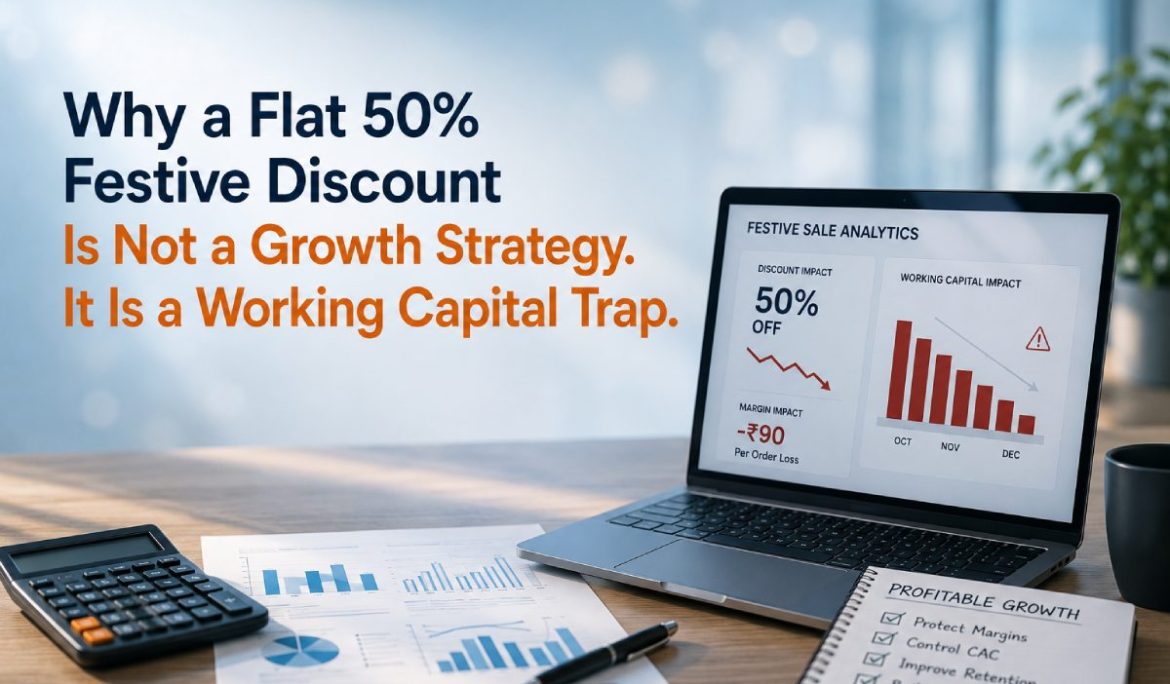
Founders walk into festive planning sessions thrilled about deep discounts driving top-line growth. Here is what the numbers actually say when you do the maths properly.
Every festive season, we have the same conversation with founders. They walk into planning meetings with energy, a deck full of GMV projections, and a single big idea: run a flat 50 percent discount, flood the top line, and declare the season a success.
And every time, our job at Whitespace Consultancy is to slow that down. Not because growth is the wrong goal. But what looks like a growth strategy on a marketing slide is often a working capital disaster hiding behind an impressive revenue number.
The maths does not lie. And the maths on a flat 50 percent discount, run without a clear view of your true contribution margin, is almost always brutal.
The Real Cost of a 50% Discount. Let Us Do the Actual Maths.
Most founders look at a 50 percent discount and see the revenue it will generate. What they are not looking at is what it actually costs to generate that revenue once all the real expenses are accounted for.
When you factor in Customer Acquisition Cost, the performance marketing spend required to drive a festive sale, and then layer in India’s typically high Return to Origin rates, which can run between 20 and 40 percent for D2C brands, the picture changes completely. Here is what a representative scenario looks like.
TRUE CONTRIBUTION MARGIN ON A DISCOUNTED FESTIVE ORDER
| Selling Price after 50% | discount: Rs 500 |
| Cost of Goods Sold | Rs 300 deducted |
| Shipping and Packaging | Rs 80 deducted |
| Customer Acquisition Cost | Rs 150 deducted |
| RTO Loss at blended 25% | rate, Rs 60 deducted |
| True Contribution Margin | Rs 90 negative |
You did not just break even. You paid Rs 90 for the privilege of making a sale. Multiply that across thousands of festive orders, and you have not run a campaign. You have run a very organised way of destroying working capital at scale.
The uncomfortable truth: A flat 50 percent discount is not a top-line strategy. It is a subsidy that your business is self-financing, often funded by working capital you cannot recover if the customer does not return for a second purchase.
Why the “They Will Come Back and Make It Worth It” Logic Breaks Down
The standard defence of deep discounting is the lifetime value argument. Yes, we lose money on the first order, but the customer will return, and we will recover it over three to five years. This logic has a serious problem in the Indian market. The data does not support it.
The average Indian D2C consumer switches brands within six months. Brand loyalty at the mass market level is extremely low, especially among customers acquired through a discount. A customer who came to your brand because you were 50 percent off has not chosen your brand. They have chosen your price. When someone else offers a better price, they will leave. You cannot build a five-year payback model on a customer with a 180-day attention span.
180
Days before the average Indian D2C consumer switches brands
20 to 40%
Typical RTO rates are eating into festive campaign margins
0
VCs still underwriting negative contribution margins in 2025
“The growth at all costs era is over. If your festive strategy only works with outside capital absorbing the losses, it is not a strategy. It is a dependency.”
The 3-Step Playbook for Engineering Profitable Growth This Season
If a flat 50 percent discount is off the table, what actually works? Here is the framework Whitespace Consultancy uses with clients to protect working capital while still running festive campaigns that drive real, sustainable revenue growth.
Shift from Discounting to Bundling and Protect Your AOV
AVERAGE ORDER VALUE · MARGIN PROTECTION · BRAND POSITIONING
Stop offering 50 percent off a single Rs 1,000 item. Once you deduct shipping, CAC, and cost of goods, you are losing money on every order. Instead, build a Rs 2,500 bundle and offer 25 percent off. The customer perceives a strong deal, and you have protected your brand’s price positioning while creating enough margin buffer to actually absorb your performance marketing costs.
Bundling raises your Average Order Value, reduces the per-unit cost of fulfilment as a percentage of revenue, and protects perceived brand value. A brand that never goes below 25 percent off retains pricing power. A brand that runs 50 percent off trains its customers to wait for discounts indefinitely.
Track: Average Order Value on bundled SKUs vs single-item orders
Weaponise the 6-Month Window and Build Retention Inside 180 Days
CUSTOMER RETENTION · WHATSAPP MARKETING · REPEAT PURCHASE · LTV
Stop building five-year LTV models. If the market data says a customer will leave in six months, your entire retention strategy must happen within that 180-day window. Every rupee spent acquiring a new customer at a loss should be matched by a structured plan to drive a second purchase within 45 days.
This means shifting capital from acquisition toward retention, specifically into WhatsApp and email sequences triggered immediately after the first purchase. A well-built 45-day post-purchase flow offering a relevant upsell at full price is worth more to your unit economics than any festive discount campaign. The second full-price purchase is where the margin actually lives.
Track: Second purchase rate within 45 days of acquisition
Change Your North Star Metric to What VCs Actually Want to See
UNIT ECONOMICS · REPEAT PURCHASE RATE · SUSTAINABLE GROWTH
VCs in 2025 do not care about discounted festive GMV. They have stopped valuing top-line revenue generated through subsidised customer acquisition. What they want to see is sustainable unit economics, proof that the business can grow without burning capital on every order.
Stop tracking the volume of discounted orders during the festive window. Start tracking your 60-day repeat purchase rate on full-priced items. That single metric tells the story of whether you have a real business with loyal customers, or a discount-dependent machine that only functions when prices are slashed. One of these gets funded. The other does not.
Track: 60-day repeat purchase rate on full-price orders
Profitable Growth Is Engineered, Not Discounted Into Existence
WHY THIS MATTERS BEYOND A SINGLE FESTIVE SEASON
The brands building durable businesses in India right now are not the ones with the deepest discounts. They are the ones that have done the harder work of understanding their true contribution margin, designing acquisition strategies that do not destroy working capital, and building retention systems that extract value from every customer within the window they actually have.
This is not a conservative approach to growth. It is actually more aggressive, because it compounds. Every full-price repeat purchase improves unit economics. Every improvement in unit economics gives more capital to reinvest in acquisition. That is a growth flywheel. A 50 percent discount campaign is not a flywheel. It is a tap left running.
The shift in one sentence: Stop asking how you can drive the most orders this season, and start asking how you can make this season’s customers worth acquiring. Those are very different questions, and only one of them builds a business.
A note from Whitespace Consultancy: The numbers in this post are illustrative based on common D2C cost structures in India. Your actual CAC, RTO rate, and COGS will differ. The right starting point is always a true contribution margin audit specific to your business before any campaign is planned. That is exactly where we begin with every client.
The growth at all costs era is behind us. The founders who understand that first and build their festive strategies around profitable unit economics rather than vanity GMV are the ones who will still be standing two festive seasons from now.
Are you engineering profitable growth this season, or financing a very expensive exercise in buying revenue?
If you want to audit your true contribution margin, redesign your festive strategy around profitable growth, or get your financial reporting automated so the numbers are always clear before a campaign launches, Whitespace Consultancy is here to help.