

Virtual CFO vs Full-Time CFO: What Should a Growing Business Consider?
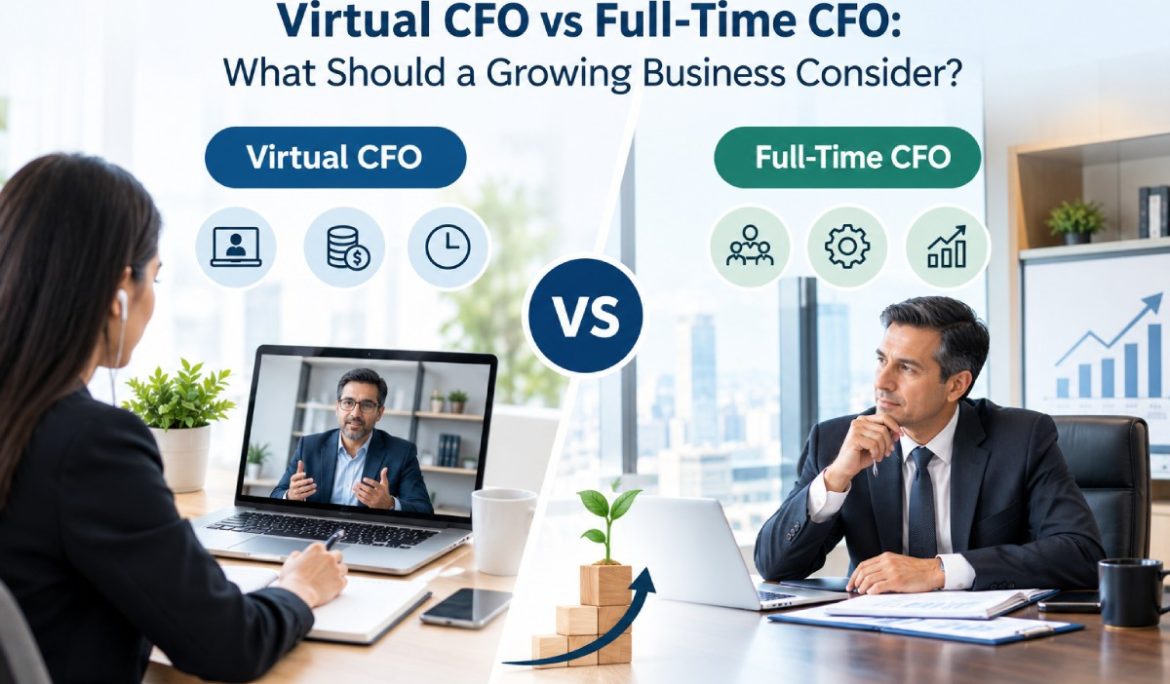
In the virtual CFO vs full time CFO decision, the main factors are the size and complexity of your business, how much senior finance time you actually need, and your budget. A virtual CFO works part-time or on a retainer and suits startups and SMEs that need strategic finance support without a senior full-time salary. A full-time CFO suits larger businesses with complex operations, a big finance team, frequent fundraising, or board and investor demands every week. Many companies begin with virtual CFO services and later move to a full-time hire once the workload justifies it.
What Does a CFO Actually Do?
Before comparing the two options, it helps to be clear about the job. A Chief Financial Officer is responsible for the financial direction of the business, not just its accounts.
The work typically covers:
- Planning: budgets, forecasts, and financial models for decisions such as hiring, pricing, or expansion
- Cash and working capital: making sure the business can pay its bills, and managing receivables, payables, and inventory
- Reporting: monthly MIS, board packs and investor updates that show how the business is really doing
- Funding: preparing for equity or debt raises, dealing with banks and investors, and supporting due diligence
- Controls: approval processes, internal checks and systems that reduce errors and fraud
- Team and systems: overseeing the accounting team, software and the relationship with auditors and tax advisers
In a small business, the founder often does parts of this job alone. The question is when that stops working, and what kind of CFO support should replace it.
What Is a Virtual CFO?
A virtual CFO is an experienced finance professional, often a Chartered Accountant, who performs the CFO role for your business part-time. Businesses looking for virtual CFO services typically engage the CFO on a monthly retainer with a defined scope, such as a monthly review meeting, MIS, a rolling cash-flow forecast, and support for strategic financial decisions.
You will also hear related terms:
- Outsourced CFO: broadly the same idea. An outsourced CFO provides the CFO function through an external firm rather than as an employee, giving businesses access to senior financial expertise without hiring full-time.
- Fractional CFO: A fractional CFO provides only a portion of a CFO’s time, such as two days a week or a fixed number of hours every month, making this model ideal for growing businesses.
The labels overlap, and firms use them differently. What matters is the scope: how many hours or meetings you get, which reports are included, and who does the underlying accounting.
Virtual CFO services usually work best when the accounting is already in order, or when the same firm handles both. A CFO cannot produce reliable forecasts from books that are three months behind.
What Is a Full-Time CFO?
A full-time CFO is a senior employee who joins your leadership team. They work on your business every day, manage the finance team directly, and are available for board meetings, investor calls, bank negotiations, and internal decisions as they come up. The advantages are depth and availability. The trade-offs are cost, the time it takes to hire the right person, and the risk of a poor fit at a senior level.
Virtual CFO vs Full Time CFO: Side-by-Side
| Factor | Virtual CFO | Full-time CFO |
| Engagement | Part-time retainer or fixed hours | Full-time employee |
| Cost structure | Monthly fee for a defined scope | Salary, bonus, often ESOPs, plus recruitment cost |
| Time to start | Usually weeks | Often months to recruit |
| Availability | Scheduled meetings and agreed response times | Every day, in the office |
| Depth of involvement | Focused on priority areas | Involved in all financial decisions |
| Team management | Guides your accountant or the firm’s team | Builds and manages an in-house team |
| Experience range | Draws on work across many businesses | Deep knowledge of one business |
| Flexibility | Scope can go up or down | Harder to change |
| Best suited to | Startups and SMEs, typically without a large finance team | Larger or complex businesses with daily CFO-level demands |
How to Think About Cost
This comparison is often decided on cost, so it is worth doing properly rather than on gut feel.
For a full-time CFO, the true cost includes:
- Fixed salary and performance bonus
- ESOPs or equity, common in startups
- Recruitment fees, which can be a significant share of annual salary
- Benefits, office costs, and support staff
- The cost of a wrong hire, which at CFO level is high
For a virtual CFO, the cost is usually a monthly retainer tied to scope. Our CA fees in Mumbai guide lists indicative ranges for Virtual CFO and advisory engagements.
The fair comparison is not “fee versus salary”. It is “what does the business need, and what is the cheapest way to get that level of support reliably?” If you need senior finance input for two or three days a month, a full-time salary buys time you will not use. If you need it every day, a part-time arrangement will leave gaps.

When a Virtual CFO Makes More Sense
A virtual CFO is usually the better fit when:
- Revenue is growing, but not yet large enough to justify a full-time CFO salary.
- The founder is making finance decisions without enough information, such as hiring or expanding without a cash-flow forecast.
- You have an accountant but no one senior reviewing the numbers or planning.
- You are preparing for a first fundraise and need a financial model, clean MIS, and support through due diligence.
- Banks or investors are asking for reports your current team cannot produce.
- You want CFO-level input on specific projects, such as pricing, a new location, or a cost-reduction exercise.
Example: a Mumbai-based D2C brand with ₹8 crore in annual revenue has an in-house accountant and outsources GST and income tax. Cash is tight every month despite growing sales. A virtual CFO sets up a 13-week cash-flow forecast, reviews inventory and payment terms, and prepares a monthly MIS for the founders. The business gets senior finance input through a fractional CFO without adding a full-time senior salary.
When a Full-Time CFO Makes More Sense
A full-time CFO becomes the right choice when:
- Finance decisions come up every day, and waiting for a scheduled meeting slows the business down.
- The finance team is large and needs a leader on site.
- The business has multiple entities, locations or countries with complex consolidation, tax, and treasury needs.
Fundraising, M&A, or debt negotiations are continuous rather than occasional. - Investors or the board expect a dedicated CFO, which is common after larger funding rounds.
- You are preparing for a listing, where governance and reporting demands increase sharply.
CFO Services for Startups: What Changes by Stage
The right answer changes as a startup grows. This is a rough guide, not a rule.
| Stage | Typical finance needs | Usual CFO model |
| Early stage, pre-revenue or first revenue | Bookkeeping, compliance, a simple budget, cash runway tracking | Accountant plus light virtual CFO support |
| Seed to early growth | Financial model, investor reporting, unit economics, due diligence support | Virtual CFO |
| Post Series A or scaling SME | Monthly MIS, budgeting, controls, board packs, bank relationships | Virtual CFO services with more hours, or a fractional CFO |
| Larger growth stage | Multi-entity finance, treasury, continuous fundraising, larger team | Full-time CFO, often with external advisers |
CFO services for startups work best when they start before the first serious investor conversation. Investors look closely at the quality of your numbers, and cleaning them up during due diligence is stressful and slow.
A Common Path: Virtual CFO First, Full-Time CFO Later
Many businesses do not choose one model forever.
A practical sequence is:
- Start with a virtual CFO to build the basics: accurate books, monthly MIS, budgets, cash-flow forecasts, and controls.
- Increase the scope as the business grows, adding board reporting, fundraising support, or more time.
- Hire a full-time CFO when the workload clearly needs one, with the virtual CFO helping define the role and hand over systems. For many growing businesses, this is the natural progression in the virtual CFO vs full time CFO journey.
This path means the full-time CFO joins a business with clean numbers and working processes, rather than starting with a clean-up.
What to Look For in a Virtual CFO
Whether you call it a virtual, outsourced, or fractional CFO arrangement,
ask these questions before you sign:
- Who exactly will be my CFO? Check their qualification and experience with businesses of your size and sector.
- What is included each month? Meetings, reports, forecasts, availability for calls, and a clear hour or meeting count.
- Who does the accounting? If it is your team, how will the CFO review it? If it is the firm’s team, how is quality checked?
- What reports will I receive, and when? Ask for a sample MIS or board pack.
- How do you handle urgent requests? Such as a bank query or a sudden investor request.
- How does the engagement scale up or down?
Common Mistakes When Choosing Between the Two
- Hiring a full-time CFO too early, then paying a senior salary for work that is mostly bookkeeping and compliance.
- Waiting too long for any CFO support, and discovering cash-flow problems only when salaries cannot be paid on time.
- Treating a virtual CFO as an accountant. A virtual CFO should be planning and advising, not only recording entries.
- Not fixing the accounting first. Good CFO work needs reliable, up-to-date books.
- Leaving the scope vague. Without a clear scope, both sides end up disappointed.
Virtual CFO in Mumbai: How Whitespace Consultancy Works
Whitespace Consultancy is a CA firm in Mulund West, providing Virtual CFO Mumbai solutions for startups and SMEs across Mumbai, Thane, and Navi Mumbai. Its Virtual CFO Mumbai offerings include financial planning and budgeting, forecasting, monthly MIS, cash-flow forecasting, working-capital management, and profitability analysis through experienced outsourced CFO professionals. Because the firm also provides accounting services, tax and GST compliance, the CFO work can be built on books the same team keeps up to date. For decisions beyond day-to-day finance, such as restructuring or fundraising, the firm also offers business advisory support.
Frequently Asked Questions
What is the difference between a virtual CFO and a full-time CFO?
A virtual CFO provides senior finance support part-time, usually on a monthly retainer with a defined scope. A full-time CFO is a senior employee who works on the business every day and manages the finance team directly. When comparing virtual CFO vs full time CFO, the virtual model offers flexibility and cost savings, while a full-time CFO provides greater day-to-day involvement and leadership.
Is a fractional CFO the same as a virtual CFO?
Broadly, yes. Both describe part-time CFO support from an external professional. “Fractional” usually refers to a share of a CFO’s time, such as days per month, while “virtual” or “outsourced CFO” is often used for a retainer-based service from a firm. Compare the actual scope rather than the label.
When should a startup hire a virtual CFO?
Ideally before the first serious fundraise, or as soon as the founder is making hiring and spending decisions without a proper cash-flow forecast. CFO services for startups can build the financial model, establish monthly reporting, and prepare the business for investor due diligence.
Can a virtual CFO work alongside my in-house accountant?
Yes, and this is a common setup. The accountant handles day-to-day entries and compliance, while the virtual CFO reviews the numbers, prepares MIS and forecasts, and advises on decisions. The CFO should also set review routines so that errors are caught each month, not at year-end.
How much do virtual CFO services cost in Mumbai?
It depends on the scope: the number of meetings or hours, the reports included, and whether accounting is part of the engagement. Most firms charge a monthly retainer. Ask for a written scope and compare it with what a full-time hire would cost your business in total.
The Bottom Line
The virtual CFO vs full time CFO choice comes down to how much senior finance attention your business needs today and how that will change over the next two to three years. For businesses evaluating Virtual CFO Mumbai providers, choosing the right finance partner is just as important as deciding between a virtual and full-time finance leader. For most startups and SMEs, a virtual CFO gives the right level of support at a sensible cost. When finance decisions become daily and complex, a full-time CFO is worth the investment. To discuss what kind of CFO support fits your business and determine the right virtual CFO vs full time CFO approach, contact Whitespace Consultancy.