

When Should a Business Outsource Its Accounting Services? Signs, Benefits & Costs (2026 Guide)
Accurate accounting is the foundation of every successful business. Whether you’re a startup managing your first customers or an established company handling multiple revenue streams, maintaining reliable financial records is essential for compliance, informed decision-making, and sustainable growth.
Yet, many business owners struggle to manage accounting internally. As operations expand, financial transactions become more complex, GST and Income Tax compliance requirements increase, and management needs timely financial reports to make strategic decisions.
This is where outsourced accounting services become valuable. Instead of building an in-house accounting department, many businesses now partner with professional accounting firms to manage bookkeeping, financial reporting, tax compliance, payroll support, and management reporting. This approach provides access to experienced accounting professionals while allowing business owners to focus on growth and day-to-day operations.
One of the most common questions entrepreneurs ask is:
When should a business outsource its accounting services?
The answer depends on several factors, including the size of the business, transaction volume, compliance requirements, available internal resources, and long-term growth plans.
In this comprehensive guide, we’ll explain:
- What does accounting outsourcing mean
- When businesses should consider outsourcing
- Warning signs that indicate it’s time to outsource
- Benefits of outsourced accounting services
- Which accounting functions can be outsourced
- Real business examples
- Frequently asked questions
- Common mistakes to avoid
- Best practices for selecting the right accounting partner
Whether you’re a startup, SME, or established business, this guide will help you determine if outsourced accounting is the right solution for your organisation.
Quick Answer: When Should a Business Outsource Its Accounting Services?
A business should consider outsourcing its accounting services when managing financial records internally becomes time-consuming, costly, or difficult to scale. Common indicators include rapid business growth, increasing compliance requirements, delayed financial reporting, lack of in-house accounting expertise, or the need for better financial visibility.
Outsourcing accounting allows businesses to access professional expertise, improve reporting accuracy, strengthen compliance, and reduce administrative burden without maintaining a large internal accounting team.
What Are Outsourced Accounting Services?
Outsourced accounting services involve engaging an external accounting firm or financial advisory partner to manage some or all of a business’s accounting and financial reporting responsibilities. Rather than recruiting and managing a full in-house accounting department, businesses work with experienced accounting professionals who provide structured financial support using standardised processes and technology.
Depending on business requirements, outsourced accounting services may include:
- Outsourced Bookkeeping
- Financial reporting
- Accounts payable and receivable management
- GST compliance
- Income Tax support
- Payroll assistance
- Bank reconciliations
- Budgeting and forecasting
- MIS reporting
- Cash flow monitoring
- Financial analysis
- Virtual CFO support
The scope of services can be customised based on the business’s size, complexity, and growth stage.
Why More Businesses Are Outsourcing Their Accounting
Business owners today face increasing regulatory requirements while also trying to grow their organisations.
Managing accounting internally often means:
- Hiring qualified staff
- Investing in accounting software
- Training employees
- Monitoring compliance deadlines
- Reviewing financial reports
- Managing staff turnover
For many businesses, this creates unnecessary operational pressure. By outsourcing accounting functions to experienced professionals, businesses can improve financial management while allowing internal teams to focus on sales, operations, customer service, and business development. As a result, outsourced accounting has become increasingly popular among startups, SMEs, and rapidly growing businesses.
Why Accurate Accounting Matters
Accounting is much more than recording income and expenses.
Reliable accounting helps businesses:
- Monitor profitability
- Track cash flow
- Prepare financial statements
- Meet statutory compliance requirements
- Support GST and Income Tax filings
- Make informed business decisions
- Identify financial risks
- Improve budgeting and forecasting
- Strengthen investor confidence
- Support loan and funding applications
Without accurate accounting, management decisions are often based on incomplete or outdated financial information.
Signs Your Business Should Outsource Accounting Services
Every business reaches a stage where internal accounting processes become difficult to manage efficiently. Below are some common indicators that it may be time to outsource.
1. Your Business Is Growing Rapidly
Business growth brings new financial responsibilities.
As customer numbers increase, so do:
- Sales invoices
- Vendor payments
- Employee payroll
- GST transactions
- Bank reconciliations
- Compliance requirements
- Financial reporting needs
A small internal accounting setup that worked during the early stages may no longer be sufficient. Outsourcing helps businesses scale their financial operations without significantly increasing administrative overhead.
2. You’re Spending Too Much Time on Accounting
Many founders begin by managing accounting themselves.
Initially, this may involve:
- Creating invoices
- Recording expenses
- Reconciling bank statements
- Tracking GST
- Preparing basic reports
However, as the business grows, these tasks consume valuable time that could otherwise be spent on:
- Sales
- Customer relationships
- Product development
- Team management
- Strategic planning
If accounting is taking time away from business growth, outsourcing may be a practical solution.
3. Financial Reports Are Always Delayed
Timely financial information is essential for making informed business decisions.
If monthly reports are consistently delayed, management may struggle to:
- Monitor profitability
- Control expenses
- Manage working capital
- Forecast cash flow
- Plan investments
Professional accounting support helps ensure that financial reports are prepared accurately and on schedule.
4. Compliance Requirements Are Becoming More Complex
As businesses expand, compliance obligations also increase.
These may include:
- GST return filing
- TDS compliance
- Income Tax Return filing
- Payroll reporting
- ROC filings
- Audit preparation
- Financial statement reporting
Managing these requirements internally can become increasingly challenging. Outsourcing helps reduce compliance risks while improving accuracy and consistency.
5. You Lack an Experienced Accounting Team
Not every business requires a full-time finance department. Hiring experienced accountants can be expensive, particularly for startups and SMEs. Outsourced accounting provides access to experienced professionals without the cost of recruiting, training, and retaining a large in-house team.
6. Cash Flow Is Difficult to Track
Many profitable businesses experience financial stress because they lack visibility into cash flow.
Without structured accounting processes, it becomes difficult to answer questions such as:
- Which customers have overdue payments?
- Which suppliers need to be paid?
- How much working capital is available?
- What are the upcoming tax liabilities?
- Are operating expenses increasing?
Regular financial reporting helps management identify potential issues before they become significant problems.
7. You’re Planning to Expand Your Business
Growth often involves:
- Opening new locations
- Hiring employees
- Launching new products
- Entering new markets
- Seeking investment
- Applying for business loans
Each of these milestones requires reliable financial information. Professional accounting support provides the financial clarity needed for confident decision-making.
Which Businesses Benefit Most from Outsourced Accounting?
Outsourcing is not limited to large corporations. Businesses of all sizes can benefit depending on their operational requirements.
Startups
Startups often need professional accounting support without the cost of building an internal finance department.
Small Businesses
Small businesses benefit from structured bookkeeping, compliance management, and timely financial reporting.
SMEs
Growing businesses require more sophisticated accounting processes, MIS reports, budgeting, and cash flow analysis.
Manufacturing Companies
Manufacturers often manage inventory, production costs, multiple suppliers, and GST compliance, making professional accounting particularly valuable.
Service Businesses
Consulting firms, agencies, IT companies, healthcare providers, and professional service firms require accurate revenue recognition, expense management, and financial reporting.
E-commerce Businesses
Online businesses deal with multiple payment gateways, inventory movements, GST implications, marketplace settlements, and returns, creating additional accounting complexity.
Common Misconceptions About Accounting Outsourcing
Despite its growing popularity, several misconceptions still prevent businesses from considering outsourced accounting.
Only Large Companies Outsource Accounting
In reality, startups and SMEs are among the biggest users of outsourced accounting services because they gain access to experienced professionals without building an expensive internal finance team.
Outsourcing Means Losing Control
Professional accounting firms work collaboratively with business owners. Management continues to make financial decisions while the accounting partner provides accurate records, reports, and compliance support.
Accounting Outsourcing Is Only About Bookkeeping
Modern outsourced accounting extends far beyond bookkeeping.
It often includes:
- Financial reporting
- GST compliance
- Income Tax support
- MIS reporting
- Cash flow management
- Budgeting
- Business analytics
- Virtual CFO services
This makes outsourcing a strategic business decision rather than simply an administrative one.
Why Businesses Are Moving Towards Advisory-Led Accounting
Today’s businesses expect more than accurate books of accounts. They need financial insights that support growth, improve profitability, and reduce business risks.
Modern accounting firms increasingly combine compliance with advisory services by helping businesses:
- Interpret financial reports
- Improve operational efficiency
- Optimise costs
- Strengthen internal controls
- Plan future investments
- Monitor business performance
This shift from transactional accounting to strategic financial advisory is one of the biggest reasons why businesses choose outsourced accounting partners.
Benefits of Outsourcing Accounting Services
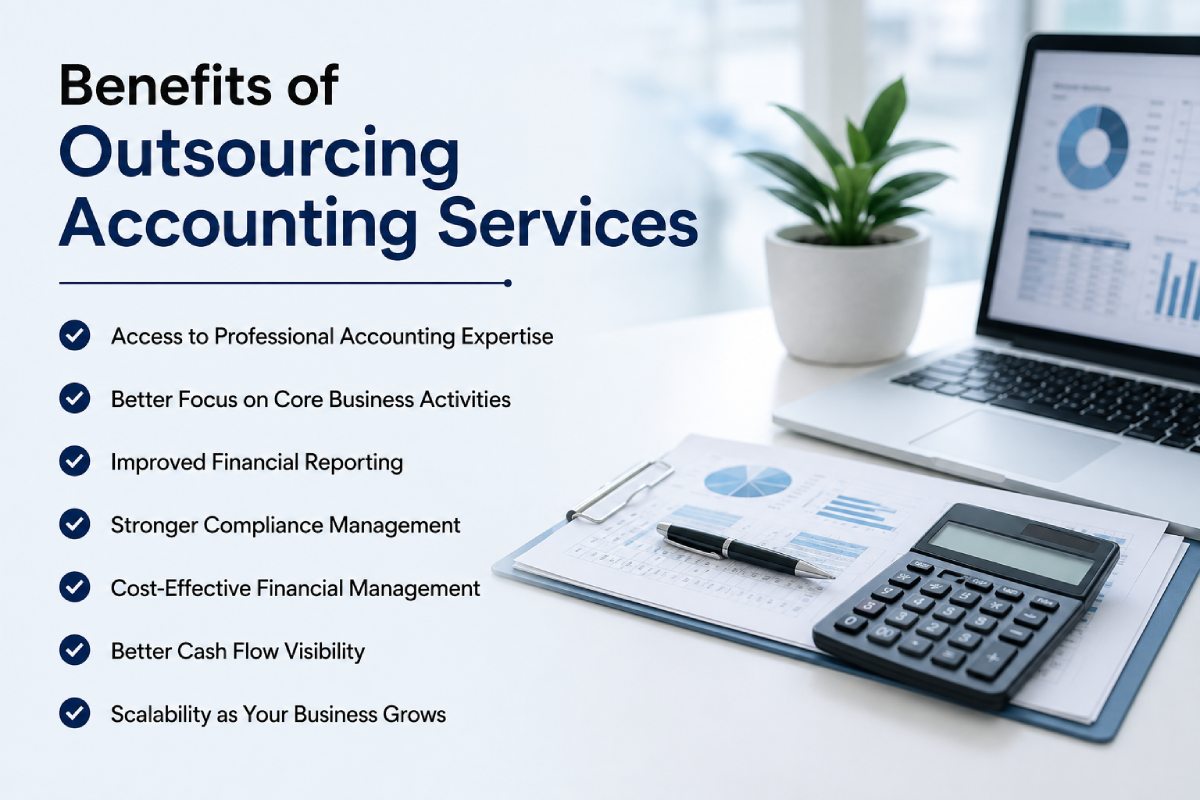
Outsourcing accounting is no longer just a cost-saving strategy; it has become a strategic business decision. Modern businesses require accurate financial information, timely compliance, and actionable insights to remain competitive. Partnering with a professional accounting firm allows businesses to strengthen financial management without building and maintaining a large in-house finance team.
Whether you’re a startup, SME, or established company, outsourced accounting provides access to specialised expertise, structured processes, and technology-driven reporting that supports long-term business growth.
1. Access to Professional Accounting Expertise
One of the biggest advantages of outsourcing accounting is gaining access to experienced finance professionals without having to recruit an internal team.
Professional accounting firms bring expertise across:
- Financial accounting
- Bookkeeping
- GST compliance
- Income Tax compliance
- Financial reporting
- MIS reporting
- Budgeting
- Cash flow management
- Regulatory compliance
Instead of depending on one employee, businesses benefit from a team with diverse experience across industries and financial functions.
2. Better Focus on Core Business Activities
Business owners should spend their time growing the business, not reconciling bank statements or preparing tax reports.
When accounting responsibilities are outsourced, management can focus on:
- Business development
- Customer acquisition
- Product improvement
- Team leadership
- Operations
- Strategic planning
- Market expansion
This improves productivity while ensuring accounting continues to operate efficiently in the background.
3. Improved Financial Reporting
Good decisions require reliable financial information.
Professional accounting firms prepare structured financial reports that help businesses understand:
- Revenue trends
- Expense patterns
- Profitability
- Cash flow
- Working capital
- Outstanding receivables
- Business performance
Instead of waiting until year-end, management receives timely financial insights that support proactive decision-making.
4. Stronger Compliance Management
Every growing business must comply with multiple statutory requirements.
These may include:
- GST returns
- Income Tax Return filing
- TDS compliance
- Payroll compliance
- ROC filings
- Financial statement preparation
- Audit support
Missing deadlines or making filing errors can lead to penalties, notices, and unnecessary business disruption. Outsourcing accounting helps businesses establish structured compliance processes while reducing the risk of missed deadlines and reporting inaccuracies.
5. Cost-Effective Financial Management
Hiring a full in-house accounting team involves much more than salary costs.
Businesses also incur expenses related to:
- Recruitment
- Employee benefits
- Training
- Accounting software
- Office infrastructure
- Staff turnover
- Performance management
Outsourcing provides access to experienced accounting professionals without many of these overhead costs, making it an attractive option for startups and SMEs.
6. Better Cash Flow Visibility
Cash flow is often a greater challenge than profitability. A business may generate strong sales but still experience financial stress if cash inflows and outflows are not managed effectively.
Professional accounting support helps businesses monitor:
- Customer collections
- Supplier payments
- Monthly operating expenses
- Upcoming tax liabilities
- Cash reserves
- Working capital requirements
Timely cash flow reports enable management to make informed financial decisions before problems arise.
7. Scalability as Your Business Grows
Business requirements change over time. A startup processing 50 invoices per month may eventually handle 2,000 invoices across multiple locations.
Outsourced accounting services can scale alongside business growth by supporting:
- Higher transaction volumes
- Additional reporting requirements
- Multi-location operations
- New compliance obligations
- Business expansion
- Investor reporting
This flexibility eliminates the need to repeatedly restructure an internal finance department.
In-House Accounting vs Outsourced Accounting
Many business owners wonder whether they should hire an accountant or outsource the accounting function. The answer depends on the size of the business, operational complexity, and long-term objectives.
| In-House Accounting | Outsourced Accounting |
| Requires recruitment and training | Immediate access to experienced professionals |
| Higher fixed employment costs | Flexible service model based on business needs |
| Limited expertise depending on team size | Multi-disciplinary accounting and tax expertise |
| Internal resources manage compliance | Dedicated professionals monitor compliance requirements |
| Scaling often requires additional hiring | Services can expand as the business grows |
| Management supervises day-to-day accounting operations | Structured processes with partner-level oversight |
Many growing businesses choose outsourced accounting because it provides broader expertise while reducing administrative complexity.
What Accounting Functions Can Be Outsourced?
Modern accounting firms provide far more than bookkeeping.
Depending on business requirements, organisations may outsource:
Bookkeeping
- Recording financial transactions
- Maintaining ledgers
- Bank reconciliations
Financial Reporting
- Profit & Loss Statements
- Balance Sheets
- Cash Flow Statements
- Financial analysis
Accounts Payable & Receivable
- Vendor management
- Customer invoicing
- Payment tracking
- Collection monitoring
GST Compliance
- GST registration
- Return filing
- GST reconciliations
- GST advisory
Income Tax Compliance
- Tax planning
- Income Tax Return filing
- TDS management
- Tax assessments
Payroll Support
- Salary processing
- Payroll compliance
- Employee reimbursements
- Statutory deductions
MIS Reporting
Management Information System (MIS) reports help business owners monitor:
- Sales performance
- Department profitability
- Budget vs actual performance
- Cost analysis
- Business KPIs
Budgeting & Forecasting
Professional accounting teams assist businesses in preparing:
- Annual budgets
- Revenue forecasts
- Expense planning
- Financial projections
- Business growth plans
Virtual CFO Services
As businesses grow, they often require strategic financial guidance without hiring a full-time Chief Financial Officer.
Virtual CFO support may include:
- Financial strategy
- Business planning
- Investor reporting
- Cash flow planning
- Profitability analysis
- Risk management
Real Business Examples
Example 1: Startup Technology Company
A software startup initially manages accounting using spreadsheets.
As the customer base grows, the founders struggle to:
- Track invoices
- Monitor GST
- Prepare investor reports
- Manage payroll
- Forecast cash flow
The company outsources its accounting to a professional firm.
As a result:
- Monthly reports become available on time.
- Compliance improves.
- Investors receive structured financial information.
- Founders spend more time growing the business.
Example 2: Manufacturing Business
A manufacturing company experiences rapid growth.
The internal accounts team becomes overwhelmed with:
- Inventory accounting
- Vendor reconciliations
- GST compliance
- Financial reporting
By outsourcing accounting support, the company strengthens financial controls while improving reporting accuracy and operational efficiency.
Example 3: Digital Marketing Agency
A marketing agency serves clients across India and overseas.
Its accounting requirements include:
- Foreign currency transactions
- GST on export of services
- Revenue tracking
- Payroll
- Client billing
Partnering with an experienced accounting firm simplifies compliance while providing management with accurate monthly performance reports.
Example 4: Retail Business
A retail company operates multiple stores.
Management needs:
- Daily sales reports
- Inventory reconciliation
- Store-wise profitability
- Cash flow reports
An outsourced accounting partner implements structured reporting processes, enabling management to make faster operational decisions.
Common Mistakes Businesses Make When Outsourcing Accounting
Outsourcing can deliver significant value, but only when implemented thoughtfully.
Some common mistakes include:
Choosing a Firm Based Only on Price
The lowest-cost provider may not always offer the expertise or support required for your business.
Instead, evaluate:
- Industry experience
- Service quality
- Reporting capabilities
- Technology
- Partner involvement
- Communication
Failing to Define Responsibilities
Businesses should clearly define:
- Scope of services
- Reporting frequency
- Compliance responsibilities
- Approval workflows
- Communication channels
Clear expectations reduce misunderstandings and improve efficiency.
Not Sharing Information on Time
Accounting quality depends on timely information.
Delays in providing:
- Bank statements
- Purchase invoices
- Sales records
- Expense bills
- Payroll data
can delay reporting and compliance activities.
Ignoring Technology
Modern accounting relies on cloud-based systems, automation, and secure document sharing. Businesses should work with firms that leverage technology to improve accuracy, collaboration, and reporting speed.
How to Choose the Right Accounting Firm
Selecting an accounting partner is an important business decision.
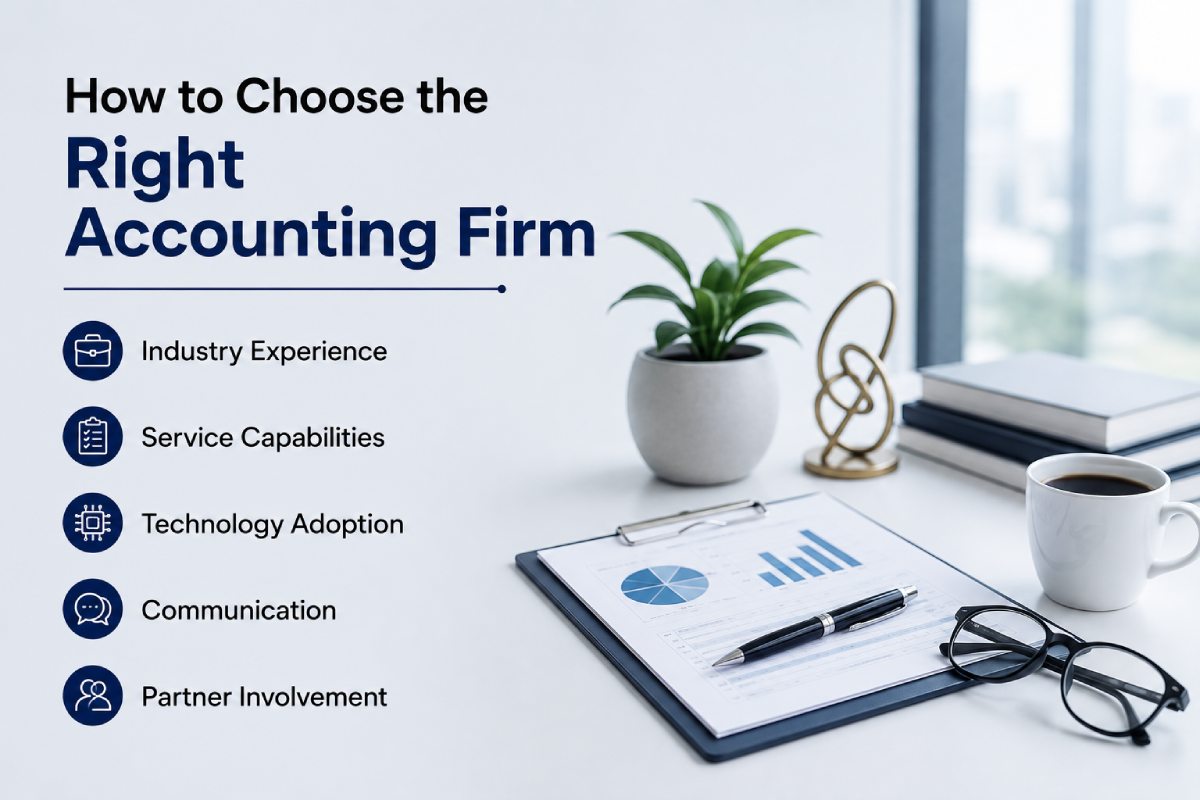
Before making a choice, consider the following factors:
Industry Experience
Choose a firm that understands your industry and its accounting requirements.
Service Capabilities
Ensure the firm can support your current and future needs, including taxation, compliance, reporting, and advisory.
Technology Adoption
Look for firms that use secure accounting software, cloud platforms, and digital workflows.
Communication
Regular meetings, timely reporting, and proactive advice are essential for a successful partnership.
Partner Involvement
Businesses often benefit from direct access to experienced Chartered Accountants who provide strategic guidance alongside routine accounting support.
Best Practices for Successful Accounting Outsourcing
- Maintain organised financial records.
- Share documents on a regular schedule.
- Review monthly financial reports.
- Monitor cash flow and key business metrics.
- Conduct periodic compliance reviews.
- Use cloud-based accounting tools where appropriate.
- Schedule quarterly meetings with your accounting partner to discuss business performance, upcoming compliance obligations, and growth opportunities.
Industry-Wise Examples of Outsourced Accounting Services
Every business has different accounting requirements. While the fundamentals remain the same, the complexity of financial management varies depending on the industry, transaction volume, compliance obligations, and growth stage.
Let’s look at how outsourced accounting services help different types of businesses.
Example 1: Startup Business
A technology startup begins operations with a small team and limited financial resources.
Initially, the founders managed bookkeeping themselves using spreadsheets. As the business grows, they begin facing challenges such as:
- Preparing monthly financial reports
- Managing GST compliance
- Tracking investor funding
- Monitoring cash flow
- Filing Income Tax Returns
- Managing payroll
Instead of hiring a full finance department, the startup outsources its accounting functions.
As a result:
- Financial reports become more accurate.
- Compliance deadlines are met consistently.
- Investors receive structured financial information.
- Founders spend more time acquiring customers and growing the business.
Key Learning: Outsourced accounting provides startups with professional financial support without the cost of building an internal accounting team.
Example 2: Manufacturing Company
A manufacturing company handles:
- Raw material purchases
- Inventory management
- Vendor payments
- Production costs
- GST compliance
- Financial reporting
As operations expand, accounting becomes increasingly complex. The company partners with an accounting firm to manage bookkeeping, reconciliations, MIS reporting, and statutory compliance.
Management now receives timely reports on:
- Inventory valuation
- Production costs
- Department-wise profitability
- Cash flow
- Working capital
Key Learning: Structured accounting improves operational visibility and supports better production planning.
Example 3: E-commerce Business
An online retailer sells products through multiple marketplaces and its own website.
The business deals with:
- Payment gateway settlements
- Marketplace commissions
- Customer refunds
- Inventory movement
- GST reconciliation
- Multi-state transactions
Outsourced accounting simplifies financial management by integrating sales records, reconciling payments, and preparing accurate monthly reports.
Key Learning: E-commerce businesses benefit from specialised accounting processes that address high transaction volumes and complex GST requirements.
Example 4: Professional Services Firm
A consulting firm serving domestic and international clients requires accurate revenue tracking, foreign currency accounting, and regular financial reporting.
The business outsources accounting to improve:
- Revenue recognition
- Expense management
- GST compliance
- Export of services reporting
- Cash flow forecasting
With professional accounting support, management gains better visibility into project profitability and business performance.
Example 5: Retail Business
A retailer operates several outlets across Mumbai. Each store generates hundreds of daily transactions, making it difficult to monitor sales, inventory, and cash flow.
An outsourced accounting partner prepares:
- Store-wise profitability reports
- Sales analysis
- Inventory reconciliations
- Cash flow reports
- Monthly management reports
These insights help management optimise stock levels, control expenses, and improve profitability.
Accounting Outsourcing Checklist for Businesses
Before outsourcing your accounting, evaluate whether your business is ready.
Use this practical checklist:
- Financial records are organised and up to date.
- Bank accounts are reconciled regularly.
- Sales and purchase invoices are properly maintained.
- GST records are complete.
- Payroll information is documented.
- Compliance deadlines are tracked.
- Management reporting requirements are defined.
- Accounting software access is available.
- Roles and responsibilities are clearly documented.
- Confidentiality and data security measures are in place.
A structured onboarding process ensures a smooth transition to outsourced accounting.
Common Myths About Outsourced Accounting
Many businesses hesitate to outsource because of common misconceptions. Let’s separate fact from fiction.
Myth 1: Outsourcing Is Only for Large Companies
Reality
Businesses of every size, from startups and freelancers to SMEs and established enterprises, can benefit from outsourced accounting services.
Myth 2: Outsourcing Means Losing Control
Reality
Business owners continue making financial decisions. The accounting partner manages record-keeping, reporting, compliance, and advisory services, while management retains complete oversight.
Myth 3: Outsourced Accounting Is Only Bookkeeping
Reality
Modern accounting firms provide comprehensive services, including:
- Financial reporting
- GST compliance
- Income Tax support
- Payroll assistance
- Budgeting
- Cash flow forecasting
- MIS reporting
- Virtual CFO services
Myth 4: Hiring an In-House Accountant Is Always Better
Reality
The right solution depends on your business. For many startups and SMEs, outsourcing provides broader expertise and greater flexibility than maintaining a small in-house team.
Myth 5: Outsourcing Is Not Secure
Reality
Professional accounting firms use secure cloud-based accounting systems, access controls, confidentiality agreements, and structured processes to protect financial information.
Frequently Asked Questions (FAQs)
When should a business outsource its accounting services?
A business should consider outsourcing accounting when financial management becomes time-consuming, compliance requirements increase, reporting is delayed, or specialised accounting expertise is needed to support growth.
Is outsourced accounting suitable for small businesses?
Yes. Small businesses often benefit significantly because outsourcing provides access to experienced accountants without the cost of hiring a full finance department.
What services can be outsourced?
Businesses commonly outsource:
- Bookkeeping
- Financial reporting
- GST compliance
- Income Tax compliance
- Payroll support
- MIS reporting
- Cash flow management
- Budgeting
- Virtual CFO services
Is outsourced accounting secure?
Professional accounting firms implement secure systems, controlled access, and confidentiality procedures to protect client financial information.
Will outsourcing reduce business costs?
Outsourcing can help businesses optimise accounting costs by reducing recruitment, training, infrastructure, and software management expenses while improving operational efficiency.
Can outsourced accountants help with GST and Income Tax?
Yes. Many accounting firms provide integrated support for GST compliance, Income Tax Return filing, TDS, financial reporting, and statutory compliance.
Do startups need outsourced accounting?
Many startups choose outsourced accounting because it allows them to focus on growth while experienced professionals manage financial reporting and compliance.
How often should businesses review financial reports?
Management should ideally review financial reports every month to monitor profitability, cash flow, expenses, and overall business performance.
When should a business outsource its accounting services?
A business should outsource its accounting services when managing financial records internally becomes inefficient, compliance requirements increase, or professional financial reporting is needed. Outsourcing gives businesses access to experienced accountants, improves financial accuracy, supports GST and Income Tax compliance, and allows business owners to focus on growth instead of administrative tasks.
How Whitespace Consultancy Supports Businesses with Accounting Services
Managing accounting today requires more than maintaining books of accounts. Businesses need accurate financial information, timely compliance, reliable reporting, and practical financial insights that support informed decision-making.
At Whitespace Consultancy, we provide Accounting Services in Mumbai tailored to the needs of startups, SMEs, professional firms, manufacturers, retailers, and growing businesses.
Our accounting services include:
- Bookkeeping and statutory books of accounts
- Financial reporting
- Virtual accounting and outsourced accounting services
- Budgeting and financial planning
- Cash flow forecasting
- MIS reporting
- Project reports
- Financial analysis
- SAP/ERP migration advisory
- Group financial statement consolidation
- GST and Income Tax coordination
- Partner-led financial advisory
Our objective is to simplify financial management while helping businesses improve operational efficiency and maintain complete compliance.
Related Services You May Find Helpful
Businesses looking for comprehensive financial support can also explore:
- Accounting Services in Mumbai – Professional bookkeeping, outsourced accounting, MIS reporting, and financial reporting.
- Income Tax Services – Tax planning, return filing, TDS compliance, notices, and assessments.
- GST Registration & Compliance Services – GST registration, return filing, reconciliations, and advisory.
- Audit & Assurance Services – Statutory audits, internal audits, due diligence, and compliance reviews.
- Business Advisory Services – Virtual CFO services, financial strategy, budgeting, and business growth planning.
- Chartered Accountants in Mumbai – Learn about our experienced leadership team and advisory approach.
- Contact Us – Schedule a consultation to discuss your accounting requirements.
Key Takeaways
Outsourcing accounting is not simply about reducing workload; it is about building a stronger financial foundation for your business. As organisations grow, they need accurate bookkeeping, reliable financial reporting, timely compliance, and strategic insights to make confident business decisions.
Whether you’re a startup looking to control costs, an SME expanding operations, or an established business seeking better financial visibility, outsourced accounting provides access to experienced professionals without the overhead of maintaining a large in-house finance team. Choosing the right accounting partner can improve compliance, strengthen cash flow management, enhance reporting accuracy, and support long-term business growth.
Ready to Outsource Your Accounting?
Managing your business finances shouldn’t take your focus away from growing your business. Whether you need day-to-day bookkeeping, outsourced accounting, financial reporting, or strategic financial guidance, our experienced Chartered Accountants are here to help.
At Whitespace Consultancy, we provide reliable Accounting Services in Mumbai that combine compliance expertise with practical business advisory to help you operate with confidence.
Speak with Our Accounting Experts Today
Let’s discuss how professional accounting support can improve your financial processes, strengthen compliance, and provide the clarity you need to make better business decisions.
Schedule an Accounting Consultation