

Annual ROC Compliance for Private Limited Companies: Forms, Due Dates and Penalties
Quick answer
Annual ROC compliance for private limited company requirements in India includes holding board meetings and an annual general meeting, followed by filing financial statements in Form AOC-4 and annual returns in Form MGT-7 or MGT-7A with the Registrar of Companies (ROC). Depending on the company, it may also need to file ADT-1, DPT-3 and MSME-1. Late filings attract a fee of ₹100 per day per form, with no upper limit, and can lead to director disqualification.
Annual ROC compliance for private limited company requirements is an important part of running a business that founders often overlook until a compliance notice arrives. The filings themselves are routine. The trouble is that annual MCA filings follow linked deadlines, so missing one requirement (the AGM, for example) can push every subsequent filing out of time. This checklist explains the annual requirements for private limited companies in Mumbai and Thane and why professional ROC compliance services can help businesses manage these obligations.
What Is Annual ROC Compliance for Private Limited Company?
ROC compliance means the filings and records a company must maintain with the Ministry of Corporate Affairs (MCA) under the Companies Act, 2013. For a company registered in Maharashtra, the filings go to the Registrar of Companies, Mumbai, through the MCA portal.
Annual compliance has two parts:
- Event-based records you keep internally: board meetings, minutes, statutory registers, director disclosures.
- Forms you file with the ROC: financial statements, annual return, auditor appointment, and a few return-type forms.
A company’s financial year runs from April to March. Understanding annual ROC compliance for private limited company deadlines helps businesses manage their FY 2025–26 filings, which generally run from April 2026 to November 2026.
Annual ROC compliance checklist
Not every form applies to every company, and the annual MCA filings depend on the company’s size, activities, and financial obligations. This annual ROC compliance for private limited company checklist helps you identify the applicable requirements using the ‘Applies to’ column.
| Requirement | Form | Due date | Applies to |
| Board meetings | Minutes (no filing) | At least 4 a year, gap of not more than 120 days | All private companies, except small companies (see below) |
| Directors’ disclosure of interest | MBP-1 (kept with company) | First board meeting of the financial year | All companies |
| Directors’ non-disqualification | DIR-8 (kept with company) | Each year, before appointment or re-appointment | All companies |
| Annual general meeting | Notice and minutes | Within 6 months of year-end, so by 30 September | All private companies (OPCs are exempt) |
| Auditor appointment | ADT-1 | Within 15 days of the AGM where the auditor is appointed | Companies appointing or re-appointing an auditor (usually every 5 years) |
| Financial statements | AOC-4 (or AOC-4 XBRL) | AOC-4 due date: Within 30 days of the AGM | All companies |
| Annual return | MGT-7 or MGT-7A | MGT-7 due date: Within 60 days of the AGM | MGT-7A for small companies and OPCs; MGT-7 for others |
| Return of deposits | DPT-3 | 30 June | Companies with outstanding loans or money not treated as deposits |
| MSME dues | MSME-1 | 30 April (Oct–Mar) and 31 October (Apr–Sep) | Companies owing payments to micro or small suppliers beyond 45 days |
| Director KYC | Revised KYC intimation | Once every three years (see below) | Every director with a DIN |
Board meetings and the AGM
Board meetings
A private company must hold its first board meeting within 30 days of incorporation. After that, the general rule is at least four board meetings a year, with no more than 120 days between two meetings.
Small companies and OPCs have a lighter requirement: at least one board meeting in each half of the calendar year, with a gap of at least 90 days between the two.
Keep proper minutes, signed within 30 days of each meeting. During due diligence or a bank review, missing minutes are one of the first problems found.
Annual general meeting
The AGM must be held within six months of the financial year-end, which means by 30 September for most companies. The first AGM can be held within nine months of the end of the company’s first financial year.
The financial statements are approved, and the auditor is appointed or ratified at the AGM. If the AGM can’t be held on time, the company can apply to the ROC for an extension of up to three months, but only for special reasons. It is not a routine extension.
AOC-4 and MGT-7: the two core filings
AOC-4: financial statements
AOC-4 carries the audited balance sheet, profit and loss account, cash flow statement (where applicable), auditor’s report, and directors’ report. Understanding the AOC-4 due date is essential for timely annual filing. It is due within 30 days of the AGM. If the AGM is held on 30 September, AOC-4 is due by 30 October. Larger companies that meet the XBRL criteria file AOC-4 XBRL instead.
MGT-7 and MGT-7A: annual return
The annual return records the shareholding, directors, meetings held, and other company details as at the year-end. Companies must track the MGT-7 due date to avoid late filing fees. It is due within 60 days of the AGM, so by 29 November if the AGM is on 30 September. Small companies and OPCs file the simpler MGT-7A. All other companies file MGT-7.
Who qualifies as a small company?
From 1 December 2025, the MCA raised the small company limits.
A private company is now a small company if both of these apply:
- Paid-up share capital of not more than ₹10 crore, and
- Turnover of not more than ₹100 crore in the previous financial year.
Some companies can’t be small even if they meet these numbers, such as holding or subsidiary companies, companies registered under Section 8, and companies governed by a special Act. Check these conditions before assuming your company qualifies. Being a small company means fewer board meetings, MGT-7A instead of MGT-7, and lower penalties for some defaults.
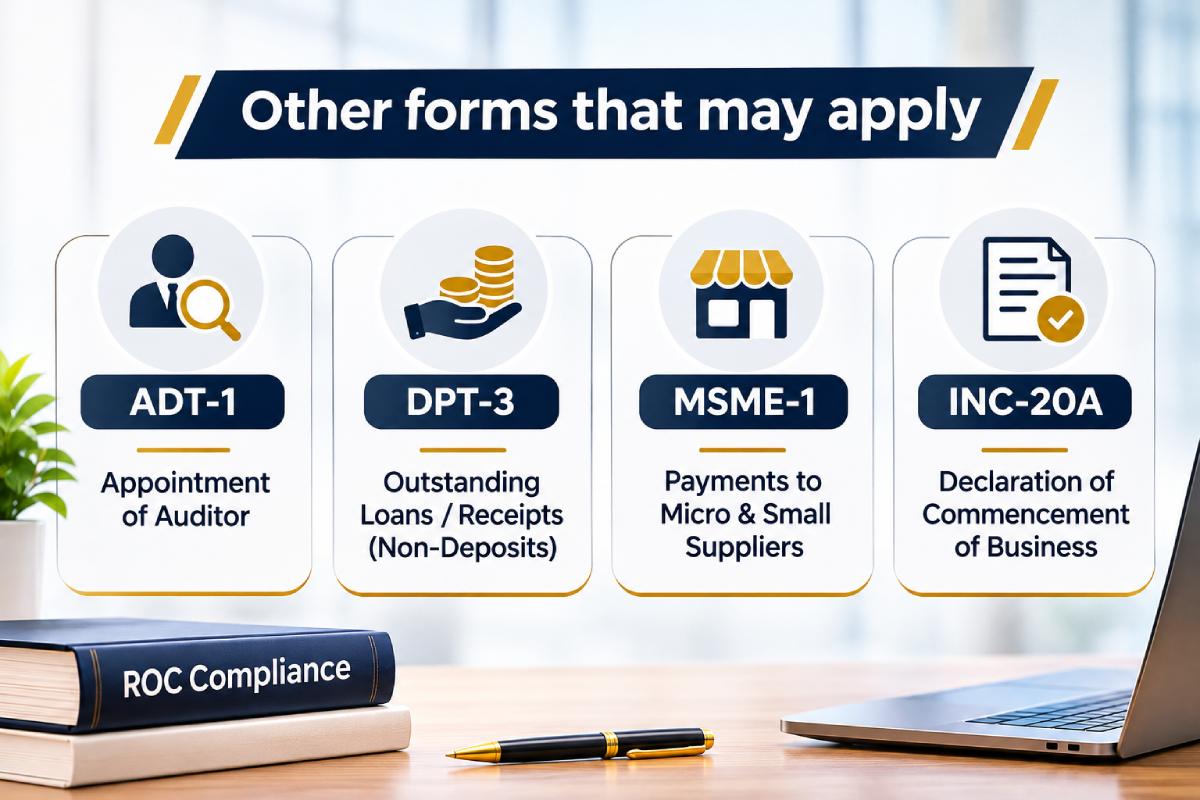
Other forms that may apply
- ADT-1: The first auditor is appointed by the board within 30 days of incorporation. After that, an auditor is appointed at the AGM, normally for five years. ADT-1 is filed within 15 days of the meeting.
- DPT-3: Due by 30 June for companies that have outstanding loans or receipts of money that are not treated as deposits, such as loans from directors. Many small companies miss this one.
- MSME-1: A half-yearly return listing amounts owed to micro and small suppliers that are unpaid beyond 45 days. This links to the income-tax rule on MSME payments, which is a separate requirement.
- INC-20A: A one-time declaration of commencement of business, due within 180 days of incorporation for companies with share capital. Missing it can lead to the company being struck off.
The new director KYC rule
Until 2025, every director with a DIN had to file DIR-3 KYC every year by 30 September. The MCA has replaced this with a simpler KYC intimation once every three years, effective from 31 March 2026.
Directors who have already completed KYC have their next filing due by 30 June 2028. Remove the annual DIR-3 KYC reminder from your compliance calendar, but add the three-year date for each director.
Penalties for missing ROC filings
- Late fee on forms: For AOC-4 and MGT-7/7A, ₹100 per day of delay per form, with no maximum. Timely ROC compliance services can help companies avoid these additional costs. A year’s delay on both forms is over ₹70,000 in late fees alone.
- Penalties on the company and officers: Separate penalties apply under the Companies Act for not holding the AGM or not filing the annual return.
- Director disqualification: If a company fails to file its financial statements or annual return for three continuous years, its directors can be disqualified for five years from being directors of any company.
- Strike-off: Companies that don’t file for long periods can be struck off the register by the ROC.
A worked example: a Thane startup catching up
A two-year-old private limited company in Thane filed its incorporation forms but nothing after that. The founders were focused on getting customers, and nobody owned the compliance.
Here’s what the catch-up involved:
- Holding the missed board meetings and recording minutes properly from that point on.
- Getting the accounts for both years audited, then holding the overdue AGMs.
- Filing ADT-1 for the auditor, then AOC-4 and MGT-7A for both years with late fees.
- Filing the missed INC-20A and DPT-3 (the founders had lent the company money).
The total late fees ran into lakhs, far more than two years of routine compliance would have cost. The founders also had to explain the delays to an investor who was midway through due diligence.
Common mistakes we see
- Holding the AGM late, which makes AOC-4 and MGT-7 late as well.
- Missing DPT-3 when directors have lent money to the company.
- Treating the company as a small company without checking the holding/subsidiary exclusion.
- Keeping the annual DIR-3 KYC reminder after the 2026 change, and missing the new three-year date.
- Not maintaining minutes and registers, which causes problems in bank reviews and funding rounds.
Frequently asked questions
What are the annual ROC compliances for a private limited company?
The core annual MCA filings include board meeting records, an AGM by 30 September, Form AOC-4 within 30 days of the AGM, and Form MGT-7 or MGT-7A within 60 days. Depending on the company, ADT-1, DPT-3, and MSME-1 also apply, along with the director KYC intimation every three years.
What Is the AOC-4 Due Date and MGT-7 Due Date?
The AOC-4 due date is within 30 days of the AGM, while the MGT-7 or MGT-7A filing deadline is within 60 days. If the AGM is held on 30 September, AOC-4 is due by 30 October and MGT-7 by 29 November.
What is the penalty for late ROC filing?
The late fee is ₹100 per day of delay for each of AOC-4 and MGT-7/7A, with no upper limit. Other penalties may apply under the Companies Act, and three years of non-filing can disqualify the directors.
Do small companies have fewer ROC compliances?
Yes. Small companies need only two board meetings a year, file the shorter MGT-7A, and face lower penalties for some defaults. They still need an AGM, audited accounts, and AOC-4.
Keep ROC compliance on a calendar, not in memory
Annual ROC compliance for private limited company requirements is predictable, with most forms following the same filing schedule every financial year. Problems arise when you treat compliance as an annual scramble instead of a calendar with assigned owners and dates. Professional ROC compliance services help businesses maintain this schedule.
Whitespace Consultancy supports annual ROC compliance for private limited companies and LLPs across Mumbai and Thane, from board minutes and AGM paperwork to AOC-4, MGT-7, and catch-up filings. Discuss your annual ROC filing requirements with our team. Our ROC compliance services cover annual ROC filings, statutory documentation, and overdue compliance requirements for businesses operating in Mumbai and Thane.
Related reading: Company formation in Mumbai: which structure to choose · Business compliance calendar 2026–27
This article is general information, not legal advice for your company. Check the latest MCA notifications and your company’s facts before acting.