

Cash Flow Forecasting for SMEs: How to Build a 13-Week Cash Flow Forecast

Quick answer
A cash flow forecast for small business is a week-by-week view of the cash you expect to receive and pay over the next quarter. Each week starts with the opening bank balance, adds expected receipts, subtracts expected payments (salaries, suppliers, rent, GST, TDS, advance tax, loan EMIs), and ends with a closing balance.
Strong business cash flow management starts with understanding when money enters and leaves the business. You update it every week by replacing the first week with actuals and adding a new week at the end. Its job is simple: show a cash shortfall weeks before it happens, while there’s still time to fix it.
Most SMEs we work with in Mumbai and Thane are profitable on paper and still short of cash at least once a quarter. Usually the reason isn’t a bad business. It’s timing: a large customer pays late, GST and advance tax fall in the same week, or a big raw material order goes out before the matching sales come in.
A 13-week forecast doesn’t change any of that, but it shows you the problem early enough to do something about it. A cash flow forecast for small business owners helps identify these timing gaps before they affect daily operations.
This guide explains why profit and cash differ, how to structure the forecast, how to build and update it, what to do when it shows a gap, and the mistakes that make forecasts unreliable. A 13 week cash flow forecast also helps business owners make informed decisions about upcoming expenses and working capital requirements.
Why profit and cash are not the same
Your profit and loss statement records income when you invoice and expenses when you incur them. Your bank account only moves when money actually comes in or goes out.
The gap between the two comes from a few predictable places:
| Item | Effect on profit | Effect on cash |
| Credit sales | Counted when invoiced | Received 30–120 days later |
| Stock purchases | Expensed only when sold | Paid when the supplier is paid |
| GST collected | Not income | Paid to the government by the 20th |
| Loan principal repaid | Not an expense | Reduces cash every month |
| Capital expenditure | Spread through depreciation | Paid upfront |
| Advance tax | Not an expense in the P&L | Paid quarterly |
This is why a monthly profit figure is a poor guide to whether you can pay salaries on the 1st. Combining budgeting and cash flow management helps businesses understand both expected profitability and actual cash availability. Cash flow management for a small business needs its own forecast.
Why 13 weeks?
A 13 week cash flow forecast covers one quarter, making it easier to track upcoming collections, statutory payments, and customer payment cycles. Weekly columns matter because a monthly forecast can look comfortable while hiding a week in the middle where the balance goes negative.
Effective cash flow management for small business operations requires regular monitoring of receipts, payments, and available funds. For longer horizons, an annual budget or a 12-month monthly forecast does the planning. The 13-week forecast is the working tool.
While annual budgets support long-term planning, budgeting and cash flow management together provide better control over short-term financial commitments. A cash flow forecast for small business operations provides better visibility into upcoming financial commitments and working capital requirements.
The structure of a 13-week cash flow forecast
Every week has the same rows:
| Row | What goes in it |
| Opening balance | Closing balance of the previous week (actual bank balance for week 1) |
| Receipts | |
| Customer collections | By customer for the large ones, grouped for the rest |
| Other receipts | Interest, refunds, asset sales, capital introduced |
| Payments | |
| Salaries and wages | Including PF, ESI and profession tax deducted |
| Suppliers | By major supplier, based on agreed terms |
| Rent and utilities | On their actual due dates |
| GST | Net GST payable, by the 20th |
| TDS | Deposit by the 7th |
| Advance tax | 15 June, 15 September, 15 December, 15 March |
| Loan EMIs and interest | On the actual debit dates |
| Capital expenditure | Machines, fit-outs, vehicles |
| Other payments | Professional fees, insurance, subscriptions |
| Net cash flow | Total receipts minus total payments |
| Closing balance | Opening balance plus net cash flow |
| Overdraft or CC limit | Available working capital limit |
| Headroom | Closing balance plus unused limit |
The structure of a 13 week cash flow forecast should provide a clear picture of weekly cash movements. A reliable cash flow forecast for small business should include the following components to track weekly cash movements.
The last two rows are the ones to watch. Headroom tells you how close you are to running out, not just whether the balance is positive. This information makes business cash flow management easier by showing how much working capital is available each week.
How to build the forecast, step by step
Preparing a cash flow forecast for small business starts with understanding the actual cash available across all business bank accounts.
- Start with today’s actual bank balance across all current accounts. Don’t use the balance in your accounting software until it’s reconciled.
- List expected receipts by week. Take your debtors list and assign each invoice to the week you realistically expect payment, based on how that customer actually pays, not the terms on the invoice.
- Add receipts from sales you haven’t invoiced yet, using the sales pipeline and typical payment delays. Be conservative.
- List fixed payments first: salaries, rent, EMIs and statutory payments. These dates rarely move.
- Add supplier payments from your creditors list and planned purchases, on the dates you actually intend to pay.
- Add GST, TDS and advance tax. Estimate GST from expected sales and purchases, TDS from salaries and vendor payments, and advance tax from projected profit.
- Add one-off items: capex, bonuses, annual insurance, professional fees, festival advances.
- Calculate closing balance and headroom for each week, and highlight any week where headroom falls below a minimum buffer you’re comfortable with, say two weeks of fixed costs.
The first version usually takes a few hours. After that, the weekly update takes 30–45 minutes. Integrating budgeting and cash flow management allows owners to compare planned expenses with expected cash payments. This process makes cash flow management for small business more structured and helps owners plan payments.
The weekly update: forecast vs actual
A forecast you build once and never update stops being useful within a fortnight. Regular variance reviews are an important part of business cash flow management because they highlight recurring collection and spending issues. Updating your 13 week cash flow forecast regularly helps keep future cash projections realistic.
The weekly routine is:
- Replace week 1 with actuals from the bank statements.
- Compare actual against forecast for that week, line by line.
- Note the reason for any large difference: a customer paid late, a supplier was paid early, an unexpected expense came up.
- Roll forward: drop the completed week and add a new week 13.
- Re-forecast collections based on what you’ve learned about each customer.
Over a few months, the variance review is where most of the value sits. It shows which customers are consistently late, which costs are always underestimated, and how reliable your own forecasting is. A virtual CFO usually reviews this with the founders every week or fortnight.
A business owner can also understand the differences between outsourced financial support and an in-house finance professional through this guide on Virtual CFO vs Full-Time CFO. Reviewing your cash flow forecast for small business every week helps identify differences between projected and actual cash movements.
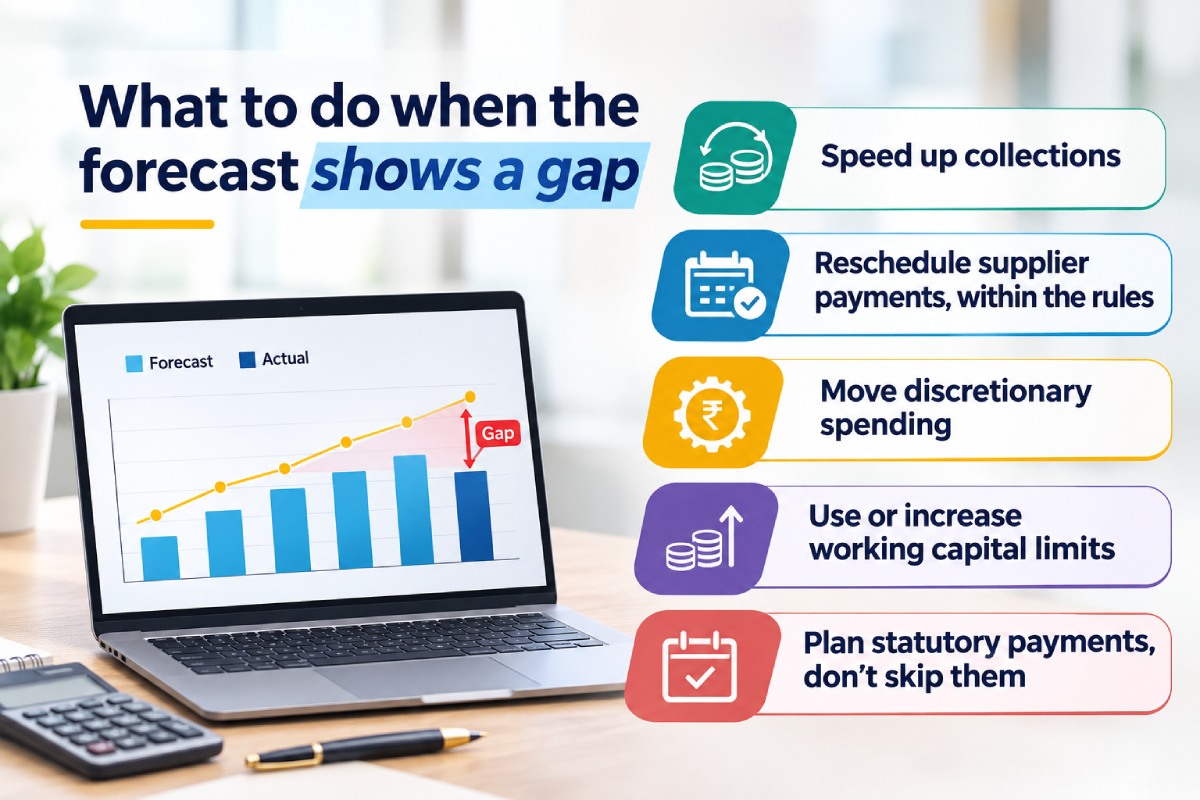
What to do when the forecast shows a gap
Seeing a shortfall six weeks out gives you options. In rough order of preference:
Speed up collections
- Call the customers behind the largest overdue amounts first.
- Offer a small discount for early payment on large invoices, if the margin allows.
- Use TReDS for invoices raised on large corporate buyers, if you’re a registered MSME.
- Tighten terms for new orders from customers who consistently pay late.
Reschedule supplier payments, within the rules
Agree revised dates with suppliers in advance rather than simply paying late. Be careful with micro and small suppliers: payments beyond 45 days (or the agreed term, if shorter) can’t be deducted as an expense in that year under the income-tax rules, and they carry interest under the MSMED Act. Read our guide to the MSME 45-day payment rule before stretching these.
Move discretionary spending
Shift capex, hiring and non-essential spending to a week when the forecast shows surplus.
Use or increase working capital limits
If the gap is structural, because the business is growing faster than its cash, a higher cash credit or overdraft limit may be the right fix. Banks will ask for projections, and a well-maintained forecast makes that conversation much easier.
Read our guide to CMA data for bank loans for what the bank will need. An experienced cash flow management company can assist with working capital planning and financial projections.
Plan statutory payments, don’t skip them
GST, TDS and advance tax should never be the payments you delay. Interest and penalties add up quickly, and a missed TDS deposit can make the related expense partly disallowable.
An example from practice
A Thane-based engineering components manufacturer with about ₹25 crore turnover built its first 13-week forecast in early September. Reported profit was healthy, and the bank balance looked comfortable. The forecast showed a problem in week 6.
A large raw material order, paid in advance to secure a price, fell in the same week as GST, the second advance tax instalment, and the monthly salary run. Two large customers who normally paid in 75 days were due to pay only in weeks 8 and 9. Headroom, including the unused cash credit limit, dropped to under ₹10 lakh for that week.
With six weeks’ warning, the company agreed to split the raw material payment into two parts, called the two customers to bring forward part-payments, and delayed a planned machine purchase by a month. Week 6 closed with comfortable headroom, and nothing had to be paid late.
Common mistakes that make forecasts unreliable
- Missing GST and TDS. These are often the largest payments after salaries, and they fall on fixed dates.
- Forgetting advance tax. The September and December instalments catch many businesses out.
- Using invoice terms instead of actual payment behaviour. If a customer pays in 90 days on 30-day terms, forecast 90.
- Leaving out annual and irregular items: bonuses, Diwali advances, insurance renewals, audit fees.
- Ignoring loan principal. EMIs include principal, which doesn’t appear as an expense in the P&L.
- Not updating weekly. A stale forecast is worse than none, because it gives false comfort.
- Being optimistic on receipts and precise on payments. Do the opposite.
A simple template layout
| Week 1 | Week 2 | Week 3 | … | Week 13 | |
| Opening balance | Actual | = W1 closing | = W2 closing | ||
| Customer collections | |||||
| Other receipts | |||||
| Total receipts | |||||
| Salaries and statutory deductions | |||||
| Suppliers | |||||
| Rent and utilities | |||||
| GST / TDS / advance tax | |||||
| EMIs and interest | |||||
| Capex and one-offs | |||||
| Total payments | |||||
| Net cash flow | |||||
| Closing balance | |||||
| Unused CC/OD limit | |||||
| Headroom |
You can build this in Excel or Google Sheets in an hour. We can share our template, with formulas and a forecast-vs-actual tab, as part of a free review. The forecast also feeds directly into your monthly reporting; see our MIS report format for SMEs. Use this cash flow forecast for small business template to monitor weekly receipts, payments, and available working capital.
Frequently asked questions
What is a 13-week cash flow forecast?
It’s a week-by-week projection of cash receipts and payments for the next 13 weeks, starting from the actual bank balance. It’s updated weekly, and its main purpose is to show cash shortfalls early enough to act.
How is a cash flow forecast different from a budget?
A budget plans income and expenses for the year, usually monthly, on an accrual basis. A cash flow forecast tracks actual cash in and out, usually weekly, over a shorter period. Good budgeting and cash flow management use both.
How often should a small business update its cash flow forecast?
Weekly. Replace the completed week with actuals, review the differences, and add a new week at the end so the forecast always looks 13 weeks ahead.
What should be included in a cash flow forecast for a small business in India?
Opening balance, customer collections, other receipts, salaries, supplier payments, rent, GST, TDS, advance tax, loan EMIs, capex and one-off payments, plus the closing balance and unused working capital limits.
Can a virtual CFO manage cash flow forecasting?
Yes. Building and reviewing the 13-week forecast is one of the core weekly tasks of a virtual CFO. Read what a virtual CFO does for the full scope.
Start with one forecast
You don’t need software or a finance team to start. The company started using a 13 week cash flow forecast to understand its upcoming financial commitments. One honest forecast, updated every week, will tell you more about your business’s cash than a year of monthly P&Ls. Choosing a cash flow management company with SME experience can help businesses improve financial visibility and planning
Whitespace Consultancy sets up and runs 13-week cash flow forecasts for SMEs across Mumbai and Thane as part of our virtual CFO services, with weekly reviews and early warning on shortfalls. Choosing a cash flow management company with SME experience can help businesses improve financial visibility and planning. Get a 13-week cash flow forecast set up for your business.
This article is general information. The example is illustrative, with details changed to protect confidentiality.