

Can I claim home office expenses as a business deduction?

Having a home office will help cut costs, but it will also expose you to an important tax issue: Do you have the ability to deduct your home office costs from your business?
The answer is YES, provided the following conditions are met. Many small business owners and each of these groups, including some freelancers, consultants, startup founders, and business owners, forfeit deductible expenses just because they are not certain what kinds of expenses are deductible or how to record them correctly.
For sole proprietors, professional consultants, or companies that have increased in size, you need to know more about the home office deduction to ensure that you keep more of your money and end up more legally tax compliant with the taxation system.
As the Best CA firm in Mumbai, we often help entrepreneurs, professionals, and small businesses identify which deductions they can claim, maintain proper records, and file accurate tax returns. Beyond the money-saving aspect of proper tax planning, you will also have the ability to protect your business when it is assessed for the future.
In this Guide, you will find:
- So what is a home office anyway?
- What are some of the deductible office expenses?
- Office expenses examples
- Some universal mistakes to steer clear of
- Documentation requirements
- What is received is a list of some very familiar tax-related questions.
- Professionally savvy tax counselors need to be consulted when it is recommended.
What is a home office deduction?
When your business is operated from home, you might get a bit of your living costs back if you take them as a home office deduction, and you can prove that they’re incurred entirely or exclusively for your business. This tax advantage makes a home office a great solution for freelancers, consultants, startup founders, digital agencies, and other home-based professionals.
Not all rooms in your home are automatically considered, however. Mostly, the workspace will get used on a regular basis for work-related activities and documented appropriately. Documents such as invoices, utility bills, and expense records can aid in substantiation of your claim when filing and when assessed at tax time.
Home-office deductibles are:
- Rent
- Electrical
- Cable Internet
- Office maintenance and repair
- Office equipment.
How much you can claim will vary with your business use and tax rules.
They may include the following costs:
- Business-use portion of rent
- Energy expenses and costs, electricity, and utility bills
- Internet and broadband charges
- Office furniture
- Restorations of the designated area.
- Business equipment
- The decorations of the office for working
It is advisable to first get an opinion from the Best CA firm in Mumbai before deducting a home office charge, as it is important to work out the calculations, documentation, etc., with the tax laws prevailing at the time of the tax claim.
The Importance of Home Office Tax Deductions
A lot of business owners start their businesses with a minimum expense achieved by starting from home. Electricity, Internet, office furniture, equipment purchases, repairs, and maintenance are, however, recurring business expenses over the course of time. You could find yourself settling the tax burden higher than necessary if you are not claiming the eligible deductions.
The well-documented home office deduction can help you:
- Decrease taxable business profits
- Generate more cash on an annual basis
- Increase business profitability
- Ensure sound accounting documents are maintained.
- Demonstrate financial discipline
- Analyze & craft reliable financing statements to lenders/investors
Finally, legitimate deductions are part of responsible finance administration and not tax avoidance.
Home Office Expenses Checklist:
List Expenses which consider as Home office expenses that can be claimed:
Utilities and Communication Expenses
If you’re operating from your house, you may end up paying more for your utilities and phone line bills. Costs for electricity, internet, and cell phone use for business use may count as deductions.
However, where such services are used for both personal and business reasons, only the business use would normally be allowable. For instance, if you spend 70% of your time at the office using your internet connection for client meetings, online research, cloud applications, and business communications, those perhaps can be included in your taxable income.
Typical deductible expenses for utilities are:
- Electricity bills
- Internet / WiFi charges can be paid after use
- The costs of using a business cell phone.
- The cost of a landline for the sake of running a business.
- Cloud communication platforms
- Video conferencing subscriptions
By maintaining monthly business bills and receipts, you can effectively document the business use of these expenses and make year-end tax preparation a breeze.
Office Furniture and Equipment
While some people make do with cheaper equipment and furnishings, others invest in more expensive equipment and furnishings that will improve their business. When made for use as a business, these transactions are usually treated as business assets.
You might be a consultant talking to clients online or a designer working on a high-performance system, but here are some of those finishing touches you don’t want to miss when it comes to keeping invoices for those purchases, so you can claim your deductions successfully.
Examples of office equipment are:
- Laptop or desktop computer.
- Office desk
- Ergonomic chair
- Printer and scanner
- External monitor
- Filing cabinets
- Shelving units
- Different battery sizes or UPS/power backup devices
Depending on the tax value and tax treatment guidelines for both large and/or other depreciable purchases, professional advice may be appreciated.
Office supplies and stationery
It’s easy to see how an item such as everyday office supplies can add up to a substantial expense over a financial year. These are normal expenses that need to be incurred as part of the day-to-day running of your business and must be kept track of every year.
Examples include:
- Printer paper
- Pens and notebooks
- Sticky notes
- Files and folders
- Ink cartridges
- Mailing supplies
- Business cards
- Packaging materials
When purchasing invoices for filing, it can be helpful to maintain a record both electronically and on paper, so that these costs will not be forgotten.
Business Software and Digital Subscriptions
Every business in the modern-day utilizes software to a great degree in order to handle tasks and collaborate with colleagues, communicate with clients, and maintain financial documentation. Software purchases to support a business are often a legitimate business cost.
Examples include:
- Accounting software
- CRM platforms
- Project management tools
- Graphic design software
- Cloud storage services
- Website hosting
- Business email platforms
- Productivity applications
Audit your subscriptions annually to pay only for resources your business uses.
Professional Services
Professional services can save time, boost compliance, and minimize monetary risks. Generally, any cost incurred to try to earn an income from activities that relate directly to your business is a deductible operating expense.
They can provide the following services:
- Chartered Accountant fees
- Tax advisory services
- Bookkeeping
- Legal consultation
- Payroll processing
- Business consulting
- Financial planning
Partnering with the Best CA firm in Mumbai can make you discover more potential eligibility waivers in your tax filings, and may also help with making sure they are correct and up to standard.
Claiming home office expenses guidelines
Yes, but not all expenses are eligible. One popular mistake that’s made is the assumption that all expenses related to working from home are deductible. The space is usually required to be used primarily and regularly for business purposes as per the requirements of tax authorities.
Generally, you will be eligible if your work desk is private and cozy. The workspace should be clearly separated from other family members and designated as an office, separate from the family room. You regularly conduct business activities
Examples include:
- Client meetings
- Online consultations
- Accounting work
- Design work
- Software development
- Business administration
- Inventory management
- Professional services
- Costs are related to business activity
The expenses are usually deductible only if they relate to operating the business.
Which people are eligible to claim home office expenses?
The eligibility is usually based on what you are a company of.
Sole Proprietors
Small businesses that are run by individuals usually get more chances of claiming their deductible costs as a taxpayer.
- Consultants
- Architects
- Chartered accountants
- Designers
- Marketing
- Content creators
- Freelancers
- Coaches
Self-Employed Professionals
Independent professionals can deduct costs that are related to their work activities.
- Lawyers
- Doctors
- Tax consultants
- Engineers
- Financial consultants
Small Business Owners
Business owners who run their companies at a small scale while they are still developing often have expenses that can be considered to be deductible from their taxable income.
- Online retailers
- Digital
- Software startups
- Import-export businesses
- Professional service
Remote Business Owners
Many entrepreneurs now operate entirely online.
- Businesses such as
- Digital marketing
- IT consulting
- E-commerce businesses
- Accounting
- Education platforms
usually have their own office space at home to work from regularly.
Office Expenses Examples
| Expense | Usually Deductible? | Business Use Consideration |
| Laptop | Yes | Business use |
| Office Desk | Yes | Fully business use |
| Printer | Yes | Business use |
| Internet | Partial | Business Percentage |
| Electricity | Partial | Office area proportion |
| Air Conditioner | Partial | Office use |
| Stationery | Yes | Business use |
| Business Software | Yes | Business use |
| Office Repairs | Yes | If exclusive to the office |
| Office Chair | Yes | Business use |
What’s important about documentation?
Legitimate deductions may also be doubtful, with no proof available to them.
Maintain records such as
- Utility
- Rent agreements
- Purchase invoices
- Equipment
- Internet
- Bank statements
- Payment receipts
- Business registration documents
- Accounting records
Digitally backed-up data is usually more accessible for filing taxes and/or audit purposes than physical backups of a similar nature.
What is a deduction for your home office?
Determining how much you can claim as a house office expense correctly counts for maximizing deductions & compliance at once. It varies according to what is allowed by local laws & regulations; however, it’s basically about claiming those costs that are used for a company’s purpose rather than individual ones.
Actual Expense Method
With it, compute what percent is devoted towards a company’s use, then multiply by how much costs are covered by families’ expenditures within those parameters only.
For example
Total home area: 1,500 sq.
Dedicated office area: 150 sq. ft.
Office space dedicated to me: 150 sq.
150 ÷ 1,500 = 10
If your annual electricity bill is ₹60,000, the business-use portion may be
60,000 × 10% = ₹6,000
If your annual electricity bill is ₹60,000, the business-use portion may be.
60,000 × 10 % = ₹6,000.
The same computation may also apply for similar eligible indirect costs like Property maintenance, Cleaning services, and water charges. Always retain bills, receipts, and calculations to support your claim if questioned by tax authorities.
Exclusive vs Shared Workspace
The key issue that affects how much you can claim as an expense on renting out space at work, it’s entirely devoted to doing what businesses do and not anything else, like relaxing.
Exclusive Business Use:
Generally speaking, tax authorities want your claim of land that has an actual function for its ownership, as well as being used frequently, along with appropriate records/documents. Knowing this distinction will prevent making false statements, as well as justify costs for a company properly. Understanding the difference can help you avoid incorrect claims and ensure your business expenses are justifiable.
The workplace, where you are doing your job, isn’t necessarily an ideal candidate for qualifying as a home office. Your company must not use this space, but rather work there exclusively.
Some examples of private offices are
- Office of an accountant at home.
- Home office for a Chartered Accountant
- A graphic designer’s office, an architectural firm.
- E-learning course, online classroom.
- Photojournalism company, photography studio.
- Meeting space, conference hall for clients’ consultations.
Shared Workspace:
A private space, such as an office building, can be used for this purpose, which will help you compute your allowable costs of running any company properly.
Using a separate room or a clearly designated office area also makes it easier to calculate eligible business expenses and maintain accurate records.
Shared space refers to a place of work as well as residence. You can use them sometimes, but they don’t qualify to claim an entire office space. While you may work from these spaces occasionally, they may not meet the requirements for claiming a full home office deduction.
- Work desk, dining room for meals at home.
- Workstation from the living room couch.
- Living room sofa used as a workstation
- The office room as well as the bedroom is available to me.
- Bedroom used for both sleeping and office work
Because they aren’t exclusively for use by a company, claiming related costs is harder to do properly and may not qualify as allowable under tax rules.
Good practice: if your job is done remotely, then set up an office room for yourself. A clearly delineated sector of operation, as well as documents like billings/invoices/records, are helpful for a better defense against taxes. A clearly defined business area, along with proper bills, invoices, and records, can strengthen your claim and make tax compliance much easier.
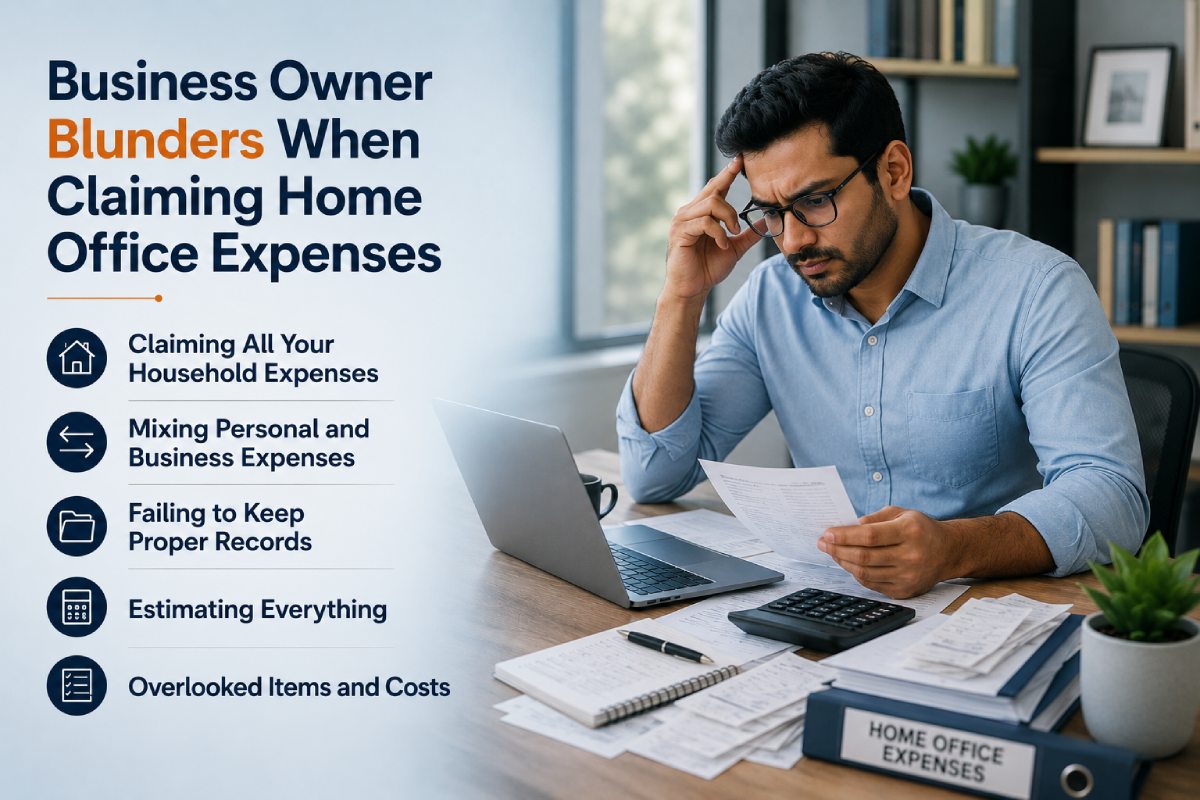
Business Owner Blunders When Claiming Home Office Expenses
Even the most successful business owners often slip up when it comes to home office tax deductions. Here are 7 of the most common pitfalls and how to avoid them.
Claiming All Your Household Expenses
Is your entire home used exclusively for business? If not, then don’t claim every single household expense on your taxes. You must calculate the portion of each household cost that relates to your business.
Mixing Personal and Business Expenses
Are you using your business’s account to pay for personal expenses, or vice versa? That’s going to make accounting a nightmare and, of course, complicate your tax reporting process. Open up separate business checking and credit card accounts.
Failing to Keep Proper Records
It’s much harder to prove your business expenses and qualify for deductions without documentation. Start scanning receipts and invoices and storing them digitally. Alternatively, you can organize by month and try to set up a small, organized filing system or invest in accounting software.
Estimating Everything
Even if you measure your home office, it doesn’t always mean your estimations for other things (like internet or utilities) should be just guesswork. Make sure your calculations are reasonable and can be defended if audited.
Overlooked Items and Costs
Those little purchases won’t make much difference to the bottom line of any given purchase, but the sum of several a year can definitely impact your total tax burden.
Examples of small but potentially important items that you may overlook:
- USB Drives
- Printer ink
- Stationery supplies
- Mailing supplies
- Extension cord
- Surge protector
What the Experts Can Do for You
Your business is constantly subject to tax changes and varying eligibility requirements, all depending on the business model you operate with, your local jurisdiction, etc. Working with experts assures you that the deductions you apply are both legitimate and that they are able to be supported if audited.
If you are looking for Top CA Firms in Thane, a Chartered Accountant Near me, look for those that have capabilities in:
- Tax Planning (not just in season),
- Business accounting and bookkeeping,
- Compliance with local GST and government regulations
- Audit Support
- Financial Statements Preparation
- Advice on maximizing the allowed deduction
Tax planning can improve cash flow significantly for any business.
Deducting Home Office Expenses by Business Type
Depending on the type of business you conduct, many of the same home office deductions apply, but some may differ. Here is an illustration of the deductibility of these expenses by profession:
| Business Type | Common Deductible Expenses |
| Freelancer | Internet, laptop, software, office furniture |
| Chartered Accountant | Accounting software, printer, office supplies, and internet |
| Digital Marketing Agency | Computers, design tools, subscriptions, and electricity |
| IT Consultant | Workstation, cloud services, internet, hardware |
| Graphic Designer | Design software, monitor, tablet, office desk |
| Online Retailer | Packaging materials, storage shelves, internet, shipping supplies |
| Consultant | Office setup, communication tools, stationery |
Always ensure that expenses are directly related to business use and supported by proper documentation.
The Difference Between Business vs. Non-Deductible Expenses
The ability to accurately report taxes requires knowing the distinction between business expenses and personal expenses.
| Deductible Expenses | Non-Deductible Expenses |
| Office desk | Living room furniture |
| Office chair | Television for personal use |
| Business laptop | Personal gaming console |
| Internet (business portion) | Personal streaming subscriptions |
| Business software | Personal shopping expenses |
| Office repairs | Kitchen renovation |
| Printer | Home entertainment system |
| Stationery | Household groceries |
| Office lighting | Decorative items for personal spaces |
Hire a Chartered Accountant: What is the Best time?
As a business owner, you might manage the bookkeeping of your business all by yourself when your venture is small and new. Nevertheless, as your enterprise grows, the requirements of tax compliance will become quite tedious and complicated for you to manage on your own.
You need to get the help of a chartered accountant near me or a tax professional if:
- Your business is registered.
- Your income comes from a variety of sources.
- You have employed some employees for your company.
- You frequently purchase assets for your business.
- You need the services for GST and regulatory compliance.
- You desire to avail maximum possible deductions to lower your income.
- You have been given a tax notice or an assessment.
- You don’t recognize how you can categorize some expenses.
Use these search terms if you are looking for assistance from any local tax experts: chartered accountant near me, tax advisors near me.
Conclusion
Home-based work offers freedom, but there are a variety of ways to benefit your business through strategic tax planning. You can save significantly by understanding how to claim the home office deduction, the most common home office expense deductions, and how to properly track them. However, it’s easy to get confused by complex tax codes and varying regulations based on your business’s legal structure. Don’t guess what applies.
If you’re looking for the Best CA Firm in Mumbai. If you need help with your tax strategy, bookkeeping, or business compliance, consider partnering with our chartered accountant near me. Let our experienced team help you with accurate bookkeeping, compliance, and the best tax planning strategies to strengthen your financial future.
Let’s work together! Schedule a consultation today with our experienced Chartered Accountants and get your business expenses analyzed, your tax strategy optimized, and your tax return prepared with confidence and efficiency.
Frequently Asked Questions
1. Can I claim home office expenses if I work from home only a few days a week?
That will certainly depend upon the particular tax guidelines, your circumstances, and whether the office you use for the task at home matches the qualifications to be classified as a home office deduction. Usually, the workplace is going to need to be the space where the task you do will be done most of the time and utilized solely for your organisation’s needs.
2. What are some common office expense examples that may qualify as business deductions?
These are generally some of the typical examples of workplace expenses that you might be able to write off:
- workplace desk & chair
- laptop or computer
- work software
- Internet services for work
- Printer & stationery
- office lighting
- repairing the workspace within your residence
- filing systems and also storage space
Once again, depending on the guidelines in your local jurisdiction and whether you’ve maintained proper documents, you can take many of these types of items.
3. Can freelancers and self-employed professionals claim a home office deduction?
Definitely! This is a typical query. Designers, consultants, IT specialists, accountants, journalists, attorneys, and all types of independent experts and small company owners who do not own an office away from their residence are typically able to assert the deduction, provided that their home office qualifies.
4. Do I need receipts to claim business expenses?
Absolutely! You require proof for every single expenditure that you claim as a company deduction. Keep receipts, invoices, and other comparable evidence to back up your claim if required. Great record-keeping is essential and also makes tax time significantly easier.