

Reverse Charge Mechanism (RCM) Under GST: Complete Guide for Businesses (2026)
GST has significantly simplified India’s indirect tax system by creating a unified taxation framework for goods and services. Under normal GST transactions, the supplier collects GST from the customer and deposits it with the government. However, the GST law also contains a special provision known as the Reverse Charge Mechanism (RCM), where this responsibility shifts from the supplier to the recipient.
Understanding the Reverse Charge Mechanism under GST is essential for businesses because non-compliance can lead to interest, penalties, denial of Input Tax Credit (ITC), and unnecessary disputes with tax authorities. Many businesses unknowingly become liable under RCM under GST when receiving specified goods or services, importing services, engaging transport agencies, or dealing with notified suppliers.
Whether you operate a startup, SME, manufacturing unit, consultancy, professional practice, e-commerce business, or large enterprise, knowing when Reverse Charge GST applies can help you remain compliant while managing your tax liabilities efficiently.
This comprehensive guide explains everything businesses need to know about the Reverse Charge Mechanism under GST, including its meaning, applicability, legal provisions, types of reverse charge, compliance requirements, examples, and practical implications.
Quick Answer: What is the Reverse Charge Mechanism (RCM) under GST?
The Reverse Charge Mechanism (RCM) under GST is a taxation system where the recipient of goods or services, instead of the supplier, is responsible for paying GST directly to the government. The Reverse Charge Mechanism applies only to specified goods, services, and notified transactions under the GST Act. Businesses liable under RCM under GST must comply with GST payment, invoicing, record-keeping, and return filing requirements while remaining eligible to claim Input Tax Credit (ITC), subject to applicable provisions.
What is the Reverse Charge Mechanism (RCM) Under GST?
The Reverse Charge Mechanism under GST is an exception to the normal GST payment process.
Under a regular GST transaction, the supplier:
- Issue a tax invoice.
- Collects GST from the buyer.
- Deposits GST with the government.
- Reports the transaction in GST returns.
However, under GST reverse charge, the supplier does not collect GST. Instead, the recipient becomes legally responsible for calculating, paying, and reporting the applicable GST directly to the government.
This shift in tax liability is known as the Reverse Charge Mechanism. The objective is to improve tax compliance in sectors where tax collection is difficult, reduce tax leakage, and ensure better monitoring of specific transactions notified under the GST law.
Understanding the Reverse Charge Mechanism with a Simple Example
Suppose ABC Pvt. Ltd., a GST-registered company, receives legal services from an advocate.
Under the normal GST system:
- The advocate would collect GST.
- ABC Pvt. Ltd. would pay the invoice, including GST.
However, legal services provided by advocates are covered under the Reverse Charge Mechanism under GST.
Therefore:
- The advocate issues the invoice without charging GST.
- ABC Pvt. Ltd. calculates the applicable GST.
- ABC Pvt. Ltd. deposits GST directly with the government.
- Subject to eligibility, ABC Pvt. Ltd. claims Input Tax Credit (ITC).
In this transaction, the liability shifts from the supplier to the recipient, making it a classic example of RCM under GST.
How Does Reverse Charge GST Work?
The working of the Reverse Charge Mechanism can be understood in five simple steps.
Step 1
The supplier provides notified goods or services covered under RCM under GST.
Step 2
The supplier issues an invoice without collecting GST (where applicable).
Step 3
The recipient calculates the GST payable.
Step 4
The recipient deposits GST directly with the government.
Step 5
The recipient claims Input Tax Credit (ITC) if eligible under GST provisions.
This process differs significantly from normal GST transactions, making it important for businesses to identify transactions where Reverse Charge GST applies.
Why was the Reverse Charge Mechanism Introduced?
The Government introduced the Reverse Charge Mechanism under GST to strengthen tax administration and improve compliance across sectors where tax collection from suppliers is difficult. Some suppliers operate in highly unorganized industries or provide services where monitoring tax collection is challenging. Instead of relying on numerous small suppliers, the government shifts the tax payment responsibility to larger, registered recipients who generally maintain better accounting records and compliance systems.
The major objectives of introducing the Reverse Charge Mechanism include:
- Improving GST compliance.
- Reducing tax evasion.
- Expanding the tax base.
- Ensuring tax collection from the notified sectors.
- Bringing unorganized sectors into the GST ecosystem.
- Simplifying tax administration.
- Increasing transparency in business transactions.
For businesses, understanding GST reverse charge is not only about paying tax but also about maintaining proper documentation, reverse charge invoices, payment vouchers, and GST returns.
Reverse Charge vs Forward Charge Under GST
Many taxpayers confuse the Reverse Charge Mechanism with the normal GST payment process. The key difference lies in who is responsible for paying GST.
| Particular | Forward Charge | Reverse Charge Mechanism (RCM) |
| Who pays GST? | Supplier | Recipient |
| Who deposits GST? | Supplier | Recipient |
| Invoice issued with GST | Yes | Generally No (where applicable) |
| Liability to Government | Supplier | Recipient |
| Applicable to | Most GST transactions | Notified goods, services, and specified cases |
| Input Tax Credit | Available subject to conditions | Available after payment of GST under RCM |
Understanding this distinction helps businesses determine whether a transaction falls under the normal GST framework or the Reverse Charge Mechanism under GST.
Who is Liable to Pay GST Under Reverse Charge?
Under RCM under GST, the recipient of goods or services becomes liable to pay GST instead of the supplier.
Depending on the notified transaction, the recipient may be:
- A company
- Partnership firm
- LLP
- Proprietorship
- Government entity
- Registered business
- E-commerce operator (in specified cases)
The liability arises only when the transaction falls within the provisions of the GST law relating to the Reverse Charge Mechanism.
Legal Provisions Governing the Reverse Charge Mechanism
The Reverse Charge Mechanism under GST is governed by specific provisions of the Central Goods and Services Tax (CGST) Act.
The three important sections are:
Section 9(3)
This section empowers the Government to notify specific categories of goods and services on which GST shall be paid by the recipient under the Reverse Charge Mechanism.
Examples include:
- Legal services
- Goods Transport Agency (GTA)
- Director services
- Insurance agent services
- Recovery agent services
- Certain government services
Section 9(4)
This section deals with specified purchases from unregistered suppliers where the recipient may become liable to pay GST under prescribed circumstances. The applicability of this provision has undergone several amendments over time and currently applies only to notified classes of registered persons. Businesses should verify the latest notifications before determining liability under this provision.
Section 9(5)
Under this section, specified electronic commerce operators become responsible for paying GST on certain services supplied through their digital platforms. Examples include certain transportation and accommodation services notified under GST.
Types of Reverse Charge Mechanism Under GST
Broadly, the Reverse Charge Mechanism under GST can be divided into three categories.
| Type | Applicable Section | Description |
| Reverse Charge on Notified Goods & Services | Section 9(3) | Recipient pays GST on notified transactions. |
| Reverse Charge on Purchases from Specified Unregistered Suppliers | Section 9(4) | Applicable only to notified classes of registered persons. |
| Reverse Charge through E-Commerce Operators | Section 9(5) | E-commerce operator pays GST for specified services supplied through its platform. |
Understanding these three categories is essential because the compliance requirements differ depending on the nature of the transaction.
Objectives of the Reverse Charge Mechanism Under GST
The Reverse Charge Mechanism is not merely a tax collection method; it is an important compliance tool within the GST framework.
Its primary objectives include:
Improving Tax Collection
Ensuring GST is collected efficiently from organized businesses rather than numerous small suppliers.
Reducing Tax Leakage
Minimising tax evasion in sectors where supplier compliance is traditionally low.
Strengthening Compliance
Encouraging businesses to maintain proper documentation and accounting records.
Promoting Transparency
Creating a clear audit trail for transactions covered under Reverse Charge GST.
Expanding the Tax Base
Bringing more transactions within the GST reporting framework.
Is Reverse Charge Applicable to Every Business?
No. A common misconception is that every GST-registered business must pay tax under the Reverse Charge Mechanism.
In reality, RCM under GST applies only when:
- The transaction is specifically notified by the Government.
- The goods or services fall under reverse charge provisions.
- The recipient satisfies the prescribed conditions.
- The transaction falls under Sections 9(3), 9(4), or 9(5) of the CGST Act.
Businesses should therefore review every transaction carefully instead of assuming that Reverse Charge GST applies universally.
Why Businesses Should Understand GST Reverse Charge
Ignoring the provisions relating to the Reverse Charge Mechanism under GST can result in:
- Incorrect GST payments.
- Interest on unpaid tax.
- Penalties for non-compliance.
- Incorrect GST return filing.
- Delayed Input Tax Credit.
- Increased scrutiny during GST assessments or audits.
On the other hand, businesses that understand RCM under GST can improve compliance, maintain accurate financial records, avoid unnecessary disputes, and optimise their GST processes.
Goods and Services Covered Under Reverse Charge Mechanism (RCM) Under GST
Understanding which transactions are covered under the Reverse Charge Mechanism (RCM) under GST is one of the most important aspects of GST compliance. Many businesses mistakenly assume that RCM under GST applies only to a few specialised transactions. In reality, the Government has notified several categories of goods and services where the recipient, rather than the supplier, is responsible for paying GST.
The applicability of Reverse Charge GST depends on the nature of the transaction, the type of supplier, the type of recipient, and the relevant provisions of the CGST Act. Businesses should therefore review every purchase carefully to determine whether the Reverse Charge Mechanism under GST applies.
Goods Covered Under the Reverse Charge Mechanism Under GST
The Government has notified specific goods on which GST is payable under the Reverse Charge Mechanism. These notifications may be amended from time to time, so businesses should always refer to the latest GST notifications before determining liability.
Some commonly notified goods include:
| Goods | Recipient Liable Under RCM |
| Cashew nuts (unprocessed) | Registered recipient |
| Bidi wrapper leaves | Registered recipient |
| Tobacco leaves | Registered recipient |
| Silk yarn | Registered recipient |
| Raw cotton supplied by agriculturists | Registered recipient |
| Lottery supplied by the State Government | Lottery distributor or selling agent |
Although these transactions may not affect every business, companies engaged in manufacturing, trading, agriculture, or commodity businesses should regularly review whether purchases attract GST reverse charge.
Services Covered Under the Reverse Charge Mechanism Under GST
Most Reverse Charge Mechanism under GST transactions relate to services rather than goods. The Government has notified several professional and business services where GST liability shifts from the supplier to the recipient.
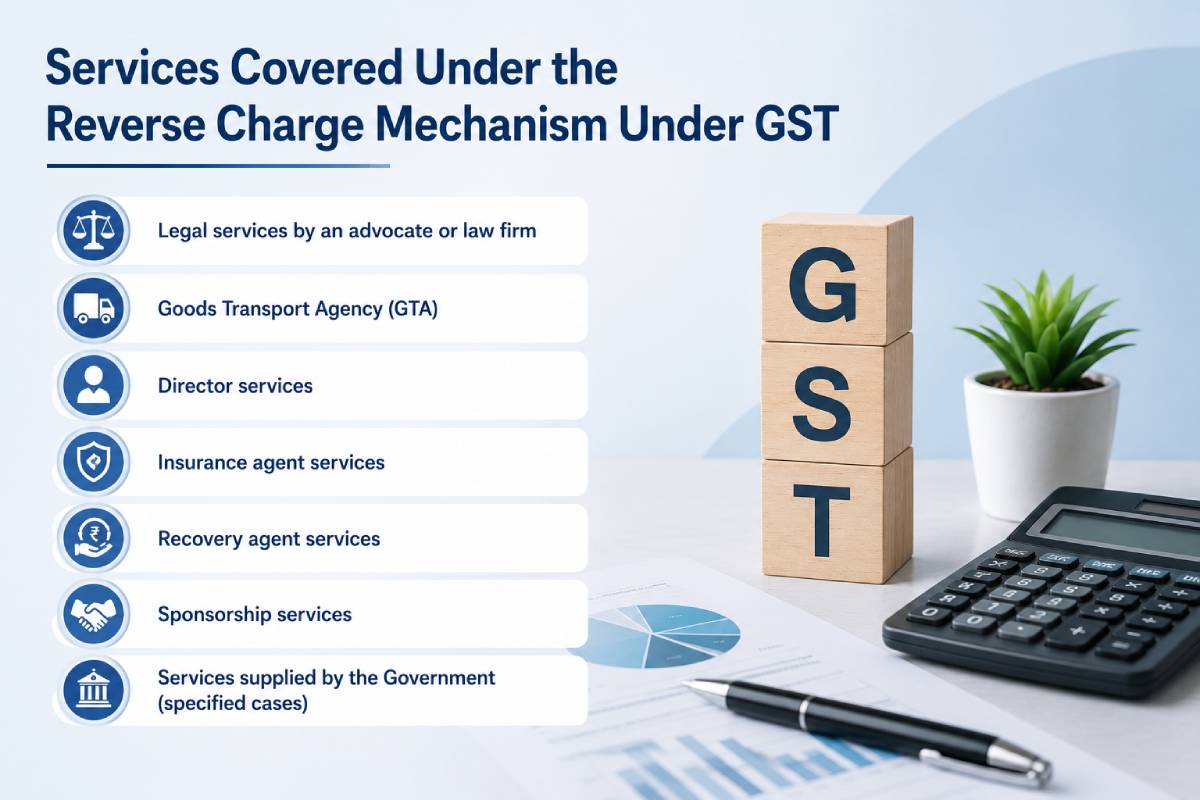
Some of the most common services include:
| Service | Recipient Responsible for GST |
| Legal services by an advocate or law firm | Business entity receiving the service |
| Goods Transport Agency (GTA) | Specified recipients |
| Director services | The company receiving the service |
| Insurance agent services | Insurance company |
| Recovery agent services | Banking company or financial institution |
| Sponsorship services | Business entity receiving sponsorship |
| Services supplied by the Government (specified cases) | Registered recipient |
Businesses should periodically review vendor payments to identify whether any of these services attract RCM under GST.
Reverse Charge on Legal Services
Legal services are one of the most common examples of the Reverse Charge Mechanism under GST. When an advocate or law firm provides legal services to a business entity registered under GST, the advocate generally does not collect GST from the client. Instead, the business receiving the service becomes responsible for paying GST under Reverse Charge GST.
Example
ABC Manufacturing Pvt. Ltd. hires a law firm to draft commercial agreements.
Reverse Charge Invoice Value: ₹1,00,000
GST Charged by Advocate: Nil
Responsibility: ABC Manufacturing Pvt. Ltd. calculates the applicable GST and deposits it directly with the government under the Reverse Charge Mechanism. Subject to eligibility, the company can subsequently claim Input Tax Credit (ITC).
Reverse Charge on Goods Transport Agency (GTA)
The Goods Transport Agency (GTA) sector is one of the most frequently encountered Reverse Charge Mechanism under GST transactions. Where notified conditions are satisfied, specified recipients become liable to pay GST instead of the transporter.
Examples of recipients include:
- Factories
- Companies
- Partnership firms
- LLPs
- Registered persons
- Societies
- Co-operative societies
Example
A manufacturing company hires a GTA for transporting raw materials.
Freight Charges: ₹50,000
Instead of the GTA paying GST, the manufacturing company pays GST directly under RCM under GST. This is one of the most common GST on reverse charge transactions encountered during GST audits.
Reverse Charge on Director Services
Many companies pay remuneration or sitting fees to directors. Certain director services fall under the Reverse Charge Mechanism under GST. Instead of the director collecting GST, the company receiving the service becomes liable to discharge GST under reverse charge.
Example
Director’s Professional Fees: ₹2,00,000
GST Liability
Company
The company deposits GST directly with the government and claims Input Tax Credit where permitted.
Reverse Charge on Insurance Agent Services
Insurance agents generally provide services to insurance companies. Instead of collecting GST from the insurance company, GST liability shifts to the insurance company under the Reverse Charge Mechanism under GST. This simplifies tax administration because insurers deal with a large network of agents across the country.
Reverse Charge on Recovery Agent Services
Banks and financial institutions often appoint recovery agents for loan recovery activities. These services are covered under GST on reverse charge, meaning the recipient bank or financial institution pays GST instead of the recovery agent.
Reverse Charge on Sponsorship Services
Businesses frequently sponsor events organised by associations, sports bodies, educational institutions, or other organisations. Under notified circumstances, sponsorship services fall within the Reverse Charge Mechanism, making the sponsoring business liable for GST.
Reverse Charge on Government Services
Certain services supplied by the Central Government, State Government, Union Territories, or Local Authorities are also covered under the Reverse Charge Mechanism under GST.
Examples may include:
- Licensing services
- Assignment of rights
- Certain municipal services
- Government support services
However, not every government service attracts a reverse charge. Businesses should always verify the latest GST notifications.
Reverse Charge on Import of Services
Import of services represents another important area where businesses encounter RCM under GST. Whenever a business located in India receives services from a supplier located outside India, GST may become payable under reverse charge, subject to applicable provisions.
Common examples include:
- Software subscriptions
- Foreign consultancy
- Digital marketing services
- Cloud hosting
- Online advertising
- Professional advisory
- Foreign legal services
Example
An Indian IT company purchases project management software from a US-based SaaS provider. Instead of the foreign supplier charging Indian GST, the Indian company pays GST under the Reverse Charge Mechanism and may claim Input Tax Credit, subject to eligibility.
Reverse Charge on E-Commerce Transactions
Section 9(5) of the CGST Act places GST liability on specified electronic commerce operators for certain notified services supplied through their digital platforms.
Examples include:
- Passenger transportation through ride-hailing platforms
- Certain accommodation services
- Other notified services as prescribed by the Government
In these situations, the electronic commerce operator becomes responsible for paying GST instead of the individual service provider.
Is GST Registration Required for the Reverse Charge Mechanism?
Businesses often ask whether GST registration becomes mandatory if they are liable under the Reverse Charge Mechanism under GST. The answer depends on the nature of the transaction and the applicable provisions of the GST law.
Businesses should evaluate:
- Nature of supplies
- Turnover limits
- Registration requirements
- Government notifications
- Section 9(3), 9(4), and 9(5) applicability
Consulting a GST professional helps businesses determine whether registration obligations arise due to GST on reverse charge transactions.
Can Input Tax Credit (ITC) Be Claimed Under Reverse Charge?
One of the major benefits of complying with the Reverse Charge Mechanism is the availability of Input Tax Credit (ITC).
After paying GST under reverse charge, the recipient may claim ITC if:
- GST has been paid to the Government.
- Goods or services are used for business purposes.
- Proper documentation is maintained.
- All GST conditions are satisfied.
This ensures that businesses are not subjected to double taxation while remaining compliant with GST provisions.
Industries Most Affected by the Reverse Charge Mechanism Under GST
Although every business should understand RCM under GST, some industries are more frequently affected.
These include:
- Manufacturing
- Construction
- Logistics
- Healthcare
- Information Technology
- Financial Services
- Legal Services
- Insurance
- Consulting
- Infrastructure
- Real Estate
- E-commerce
Businesses operating in these sectors should periodically review vendor payments to identify transactions covered under the Reverse Charge Mechanism under GST.
Practical Business Scenarios
Scenario 1: Legal Services
A manufacturing company hires a legal consultant. GST is payable by the company under Reverse Charge GST.
Scenario 2: GTA Services
A wholesaler pays freight charges to a Goods Transport Agency. GST liability shifts to the recipient under the Reverse Charge Mechanism.
Scenario 3: Foreign Software Subscription
An Indian startup purchases accounting software from a foreign SaaS company. The startup becomes liable to pay GST under RCM under GST.
Scenario 4: Director Remuneration
A private limited company pays sitting fees to an independent director. The company discharges GST under the Reverse Charge Mechanism under GST.
Common Mistakes Businesses Make
Businesses frequently make compliance errors while dealing with Reverse Charge GST, such as:
- Assuming all purchases attract a reverse charge.
- Ignoring notified services.
- Missing GST payments.
- Failing to issue self-invoices where required.
- Claiming Input Tax Credit without fulfilling conditions.
- Incorrect GST return reporting.
- Missing reverse charge disclosures during audits.
- Not maintaining supporting documentation.
Regular compliance reviews and professional guidance help businesses avoid these mistakes and ensure accurate implementation of the Reverse Charge Mechanism under GST.
Compliance Requirements Under Reverse Charge Mechanism (RCM) Under GST
Understanding the Reverse Charge Mechanism (RCM) under GST goes beyond identifying transactions where the recipient is liable to pay tax. Businesses must also comply with various documentation, invoicing, payment, accounting, and return filing requirements prescribed under the GST law.
Failure to comply with these requirements can lead to penalties, interest, denial of Input Tax Credit (ITC), and increased scrutiny during GST assessments or audits. Whether you are a startup, SME, manufacturer, service provider, or large enterprise, establishing a structured compliance process for RCM under GST is essential to ensure accurate tax reporting and avoid unnecessary financial risks.
Self-Invoice Under Reverse Charge Mechanism
One of the unique requirements under the Reverse Charge Mechanism under GST is the issuance of a self-invoice in specific situations. A self-invoice is prepared by the recipient of goods or services instead of the supplier. It acts as supporting documentation for transactions where GST is payable by the recipient under reverse charge.
A self-invoice generally contains:
- Name and GSTIN of the recipient
- Supplier details
- Invoice number and date
- Description of goods or services
- Taxable value
- Applicable GST rate
- GST amount payable under reverse charge
- Signature or digital authentication
Maintaining accurate self-invoices is important for claiming Input Tax Credit (ITC) and demonstrating compliance during GST assessments.
Payment Voucher Under Reverse Charge
Whenever GST is paid under the Reverse Charge Mechanism, businesses should also issue a payment voucher at the time of making payment to the supplier, wherever applicable.
The payment voucher generally includes:
- Recipient details
- Supplier details
- Date of payment
- Amount paid
- Nature of supply
- GST payable under reverse charge
- Reference to the original reverse charge invoice
Proper documentation supports accurate accounting and helps businesses maintain complete GST records.
Time of Supply Under Reverse Charge GST
Determining the Time of Supply is essential because it establishes when GST becomes payable under the Reverse Charge Mechanism under GST. The applicable time of supply may vary depending on whether the transaction relates to goods or services.
Time of Supply for Goods
Generally, the earliest of the following determines the liability:
- Date of receipt of goods
- Date of payment
- Specified period from the supplier’s invoice, as prescribed under the GST law
Time of Supply for Services
For reverse charge on services covered under GST, liability generally arises based on the earliest applicable event prescribed under the GST provisions, such as the date of payment or within the prescribed time from the supplier’s invoice. Since the time of supply provisions can vary depending on the transaction, businesses should verify the applicable GST rules before determining their tax liability.
Accounting Entries for Reverse Charge Mechanism
Proper accounting ensures accurate financial reporting and smooth GST compliance. Although accounting entries may vary depending on the accounting software and chart of accounts used, a typical Reverse Charge GST transaction involves:
At the time of recording the supplier invoice
Expense Account → Debit
Supplier Account → Credit
At the time of paying GST under Reverse Charge
Reverse Charge GST Payable → Credit
GST Liability Account → Debit
After claiming Input Tax Credit (where eligible)
Input CGST / SGST / IGST → Debit
Reverse Charge GST Paid → Credit
Businesses should ensure these entries are properly reflected in their accounting system to avoid mismatches during GST return filing and audits.
Input Tax Credit (ITC) Under Reverse Charge
One of the significant benefits of complying with the Reverse Charge Mechanism under GST is the ability to claim Input Tax Credit (ITC), subject to the conditions prescribed under the GST law.
A business may claim ITC if:
- GST has been paid under reverse charge.
- The goods or services are used for business purposes.
- The transaction is supported by proper documentation.
- GST returns have been filed correctly.
- The credit is not restricted under the GST Act.
Claiming ITC correctly helps businesses reduce their overall GST liability while maintaining compliance with Reverse Charge GST provisions.
GST Return Filing for Reverse Charge Transactions
Businesses liable under the Reverse Charge Mechanism must ensure that reverse charge transactions are correctly reported in their GST returns. Accurate reporting helps prevent notices, interest, and reconciliation issues during departmental assessments.
Businesses should:
- Report taxable reverse charge transactions correctly.
- Maintain supporting invoices and payment vouchers.
- Reconcile accounting records with GST returns.
- Match reverse charge payments with Input Tax Credit claims.
- Review returns before filing.
Periodic reconciliation between accounting records and GST returns significantly reduces compliance risks.
Step-by-Step Compliance Checklist for Reverse Charge Mechanism
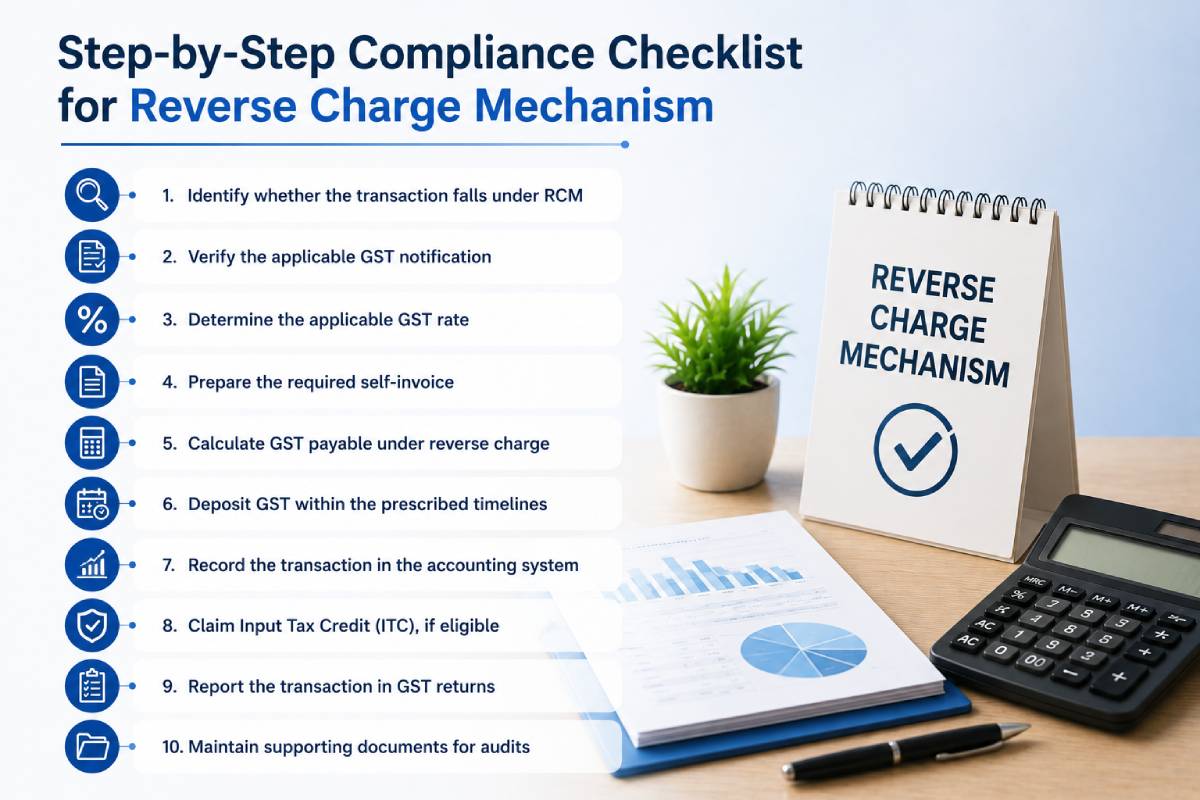
Businesses can follow this practical checklist whenever they receive goods or services that may attract RCM under GST.
Step 1
Identify whether the transaction falls under the Reverse Charge Mechanism under GST.
Step 2
Verify the applicable GST notification and legal provision.
Step 3
Determine the applicable GST rate.
Step 4
Prepare the required self-invoice and supporting documentation where applicable.
Step 5
Calculate GST payable under reverse charge.
Step 6
Deposit GST within the prescribed timelines.
Step 7
Record the transaction correctly in the accounting system.
Step 8
Claim Input Tax Credit (ITC), if eligible.
Step 9
Report the transaction accurately in GST returns.
Step 10
Maintain all supporting documents for future assessments and audits.
Following this structured approach helps businesses remain compliant with the Reverse Charge Mechanism while minimising the risk of errors.
Penalties for Non-Compliance with Reverse Charge GST
Failure to comply with the Reverse Charge Mechanism under GST requirements can have significant financial consequences.
Depending on the nature of non-compliance, businesses may face:
- Interest on delayed GST payment.
- Monetary penalties under the GST Act.
- Denial or delay of Input Tax Credit.
- GST notices from tax authorities.
- Additional scrutiny during GST audits.
- Increased compliance costs due to rectification and litigation.
Businesses should therefore review all reverse charge transactions periodically and maintain complete documentation to demonstrate compliance.
Best Practices for Businesses
Implementing a few practical controls can significantly improve compliance with Reverse Charge GST.
Recommended practices include:
- Maintain a checklist of transactions covered under reverse charge.
- Review vendor invoices before processing payments.
- Reconcile accounting records with GST returns every month.
- Monitor changes in GST notifications.
- Maintain separate records for reverse charge transactions.
- Train finance and accounting teams on RCM provisions.
- Conduct periodic internal GST compliance reviews.
- Consult GST professionals for complex transactions.
These practices help reduce compliance risks while improving the accuracy of GST reporting.
Why Businesses Should Seek Professional GST Advice
The Reverse Charge Mechanism under GST is one of the most technical areas of GST compliance. Frequent amendments, transaction-specific applicability, documentation requirements, and return filing obligations make it challenging for businesses to determine whether the reverse charge applies in every situation.
Professional guidance can help businesses:
- Identify transactions covered under reverse charge.
- Maintain proper documentation.
- Calculate GST accurately.
- File GST returns correctly.
- Maximise eligible Input Tax Credit.
- Reduce the risk of penalties and notices.
- Stay updated with changes in GST regulations.
Partnering with experienced GST professionals enables businesses to remain compliant while focusing on their core operations.
How Whitespace Consultancy Can Help
At Whitespace Consultancy, we help startups, SMEs, professionals, and established businesses understand and comply with the Reverse Charge Mechanism under GST. Our team provides practical guidance on GST applicability, transaction reviews, reverse charge compliance, Input Tax Credit, GST return filing, accounting support, and ongoing regulatory advisory.
Whether you require assistance with a single RCM under GST transaction or comprehensive GST compliance support, we offer partner-led advisory tailored to your business requirements.
Key Takeaways
- The Reverse Charge Mechanism under GST shifts the responsibility for paying GST from the supplier to the recipient for specified transactions.
- RCM under GST applies only to notified goods, services, imports, and specific transactions covered under Sections 9(3), 9(4), and 9(5) of the CGST Act.
- Businesses must maintain proper documentation, issue self-invoices where required, pay GST within prescribed timelines, and report reverse charge transactions accurately in GST returns.
- Eligible businesses can claim Input Tax Credit (ITC) after complying with the applicable GST provisions.
- Regular transaction reviews, timely reconciliations, and professional GST advice help businesses minimise compliance risks and ensure smooth implementation of the Reverse Charge Mechanism.
Frequently Asked Questions (FAQs)
Is the Reverse Charge Mechanism applicable to every GST-registered business?
No. The Reverse Charge Mechanism under GST applies only to notified goods, services, and specified transactions covered under Sections 9(3), 9(4), and 9(5) of the CGST Act. Businesses should evaluate each transaction individually before determining whether the reverse charge applies.
Can the Input Tax Credit be claimed on GST paid under Reverse Charge?
Yes. Businesses can generally claim Input Tax Credit (ITC) on GST paid under the Reverse Charge Mechanism, provided all prescribed conditions under the GST law are satisfied, and the goods or services are used for business purposes.
Is GST registration mandatory for the Reverse Charge Mechanism?
GST registration requirements depend on the nature of the business, applicable turnover thresholds, and specific legal provisions. Businesses involved in transactions covered under RCM under GST should assess their registration obligations carefully and seek professional advice where required.
Can GST payable under Reverse Charge be paid using Input Tax Credit?
No. GST payable under the Reverse Charge Mechanism must generally be discharged in accordance with the applicable provisions of the GST law. Businesses should ensure compliance with the prescribed payment methods before claiming any eligible Input Tax Credit.
Which services are commonly covered under Reverse Charge GST?
Common services include legal services, Goods Transport Agency (GTA) services, specified director services, insurance agent services, recovery agent services, sponsorship services, certain government services, and notified import of services.
What happens if a business fails to pay GST under Reverse Charge?
Failure to comply with Reverse Charge GST provisions may result in interest, penalties, denial of Input Tax Credit, GST notices, and additional scrutiny during assessments or audits.
Is Reverse Charge applicable to imported services?
Yes. Import of services is one of the major areas where the Reverse Charge Mechanism under GST applies. Businesses receiving services from suppliers located outside India should evaluate their GST liability under the applicable provisions.