

What Does a Virtual CFO Do? Scope, Monthly Deliverables, and Cost for SMEs

Quick answer
A virtual CFO is a senior finance professional, usually a Chartered Accountant, who does the CFO’s job for your business part-time. In practice, that means turning your books into decisions: a monthly MIS and review meeting, a rolling cash flow forecast, an annual budget, bank and investor reporting, tax planning, and advice on pricing, hiring, and expansion.
If you’re wondering what does a virtual CFO do for a growing business, the role goes beyond financial reporting to include cash flow management, budgeting, financial planning, and strategic business advice. The accountant records what happened. The virtual CFO tells you what it means and what to do next. Fees depend on scope, meeting frequency, and whether bookkeeping is included.
Most founders we speak to in Mumbai and Thane know they need “someone senior on finance” but aren’t sure what that person would actually do each month. That uncertainty makes it hard to compare proposals or judge whether a virtual CFO is worth paying for. Growing businesses looking for CFO services Mumbai should consider providers who understand local business requirements, taxation, and financial compliance.
Businesses searching for outsourced CFO services near me should evaluate the provider’s industry experience, reporting process, and level of strategic involvement. This guide sets out the work in concrete terms: what you receive weekly, monthly, quarterly, and yearly, the typical engagement levels, what drives cost, and how the first 90 days usually go.
Virtual CFO vs accountant: who does what?
A virtual CFO doesn’t replace your accountant. The two roles sit on top of each other. Understanding what does a virtual CFO do also helps founders distinguish between routine accounting work and the financial guidance needed to make better business decisions.
| Accountant (in-house or outsourced) | Virtual CFO | |
| Main job | Record transactions accurately and on time | Interpret the numbers and guide decisions |
| Typical work | Bookkeeping, invoicing, GST and TDS data, bank reconciliation | MIS review, forecasts, budgets, pricing, funding, controls |
| Looks at | The past month | The next three to twelve months |
| Talks to | Accounts team, suppliers | Founders, board, banks, investors, auditors |
| Time involved | Daily | A few days a month, plus calls when needed |
If your books are already maintained well, a virtual CFO works directly on them. If they aren’t, the first job is fixing that, which is why many firms offer accounting and virtual CFO services together.
Virtual CFO services for small businesses are particularly useful when founders need experienced financial guidance but are not ready to hire a full-time finance head. If you’re still deciding between a part-time and a full-time CFO, read our comparison of virtual CFO vs full-time CFO.
What a virtual CFO delivers: the calendar
This is what a typical engagement looks like over a year.
| Frequency | Deliverable | Why it matters |
| Weekly | Cash position and short-term cash forecast | Avoids surprises on salary day and before large payments |
| Monthly | MIS report within 15–20 days of month-end | Shows profit, margins, receivables, and costs while they can still be acted on |
| Monthly | Review meeting with the founders | Turns the numbers into three to five decisions with owners |
| Monthly | Statutory compliance check (GST, TDS, PF, PT filed and paid) | Catches missed filings before they become notices |
| Quarterly | Forecast update and budget-vs-actual review | Resets targets when the business changes |
| Quarterly | Board or investor pack, if needed | Keeps stakeholders informed in a consistent format |
| Yearly | Annual budget and business plan | Sets targets for revenue, margins, hiring, and spending |
| Yearly | Tax planning review and advance tax estimates | Plans tax within the law instead of reacting at year-end |
| Yearly | Audit coordination | Gets the statutory and tax audits done on time with fewer queries |
| As needed | Bank limits, CMA data, fundraising, due diligence, pricing decisions | Senior support at the moments that matter most |
Well-structured virtual CFO services for small businesses help improve financial visibility through regular reporting, cash flow monitoring, and budget reviews.
Not every business needs every item. A good virtual CFO picks the ones that fit your stage and builds from there. When evaluating what does a virtual CFO do each month, businesses should focus on measurable deliverables such as accurate MIS reports, cash flow forecasts, and regular financial reviews.
Typical engagement levels
Most virtual CFO firms structure their work in tiers. Different virtual CFO firms may offer different engagement models, so businesses should compare the scope of work rather than relying only on package names.
| Level | Usually includes | Suits |
| Foundation | Monthly MIS, one review meeting a month, compliance check, quarterly forecast update | Profitable SMEs that need visibility and discipline |
| Growth | Everything above, plus a 13-week cash forecast, annual budget, KPIs, bank relationship support and tax planning | Growing businesses with working capital pressure or expansion plans |
| Fundraising | Everything above, plus a financial model, investor reporting, data room preparation and due diligence support | Startups and SMEs raising equity or large debt |
Ask any firm you’re considering to describe their tiers in this way: what’s included, how many meetings, and what’s billed separately.
Knowing what does a virtual CFO do at each engagement level makes it easier to select financial support that matches your company’s current requirements. When comparing virtual CFO services for small businesses, check whether the package includes financial forecasting, compliance oversight, and management reporting.
What drives the cost of a virtual CFO
Understanding virtual CFO cost requires looking beyond the monthly fee and considering the reporting, forecasting, and advisory support included. Fees are usually a monthly retainer.
The main things that move the number are:
- Whether bookkeeping is included: A virtual CFO working on clean books costs less than one who also has to maintain them.
- Transaction volume and complexity: Multiple GST registrations, branches, entities, or currencies take more time.
Meeting frequency: One monthly review costs less than weekly calls. - Reporting depth: A one-page dashboard is quicker than a full board pack.
- Fundraising or transaction support: Financial models, investor reporting, and due diligence add significant time.
The overall virtual CFO cost can vary depending on business size, transaction volume, reporting requirements, and the complexity of financial operations.
The useful comparison isn’t fee against fee. It’s the fee against what a full-time finance head would cost, and against the cost of the problems the CFO prevents: missed GST credit, interest on late tax, rejected loan applications, or underpriced contracts. Choosing CFO services Mumbai businesses can rely on requires evaluating financial expertise, industry knowledge, and the quality of ongoing advisory support.
Companies considering outsourced CFO services near me should also check whether financial forecasting and funding support are included in the monthly retainer. Our CA fees in Mumbai guide gives indicative ranges for advisory work. Knowing what does a virtual CFO do before comparing fees helps businesses evaluate the actual financial value and strategic support included in an engagement.
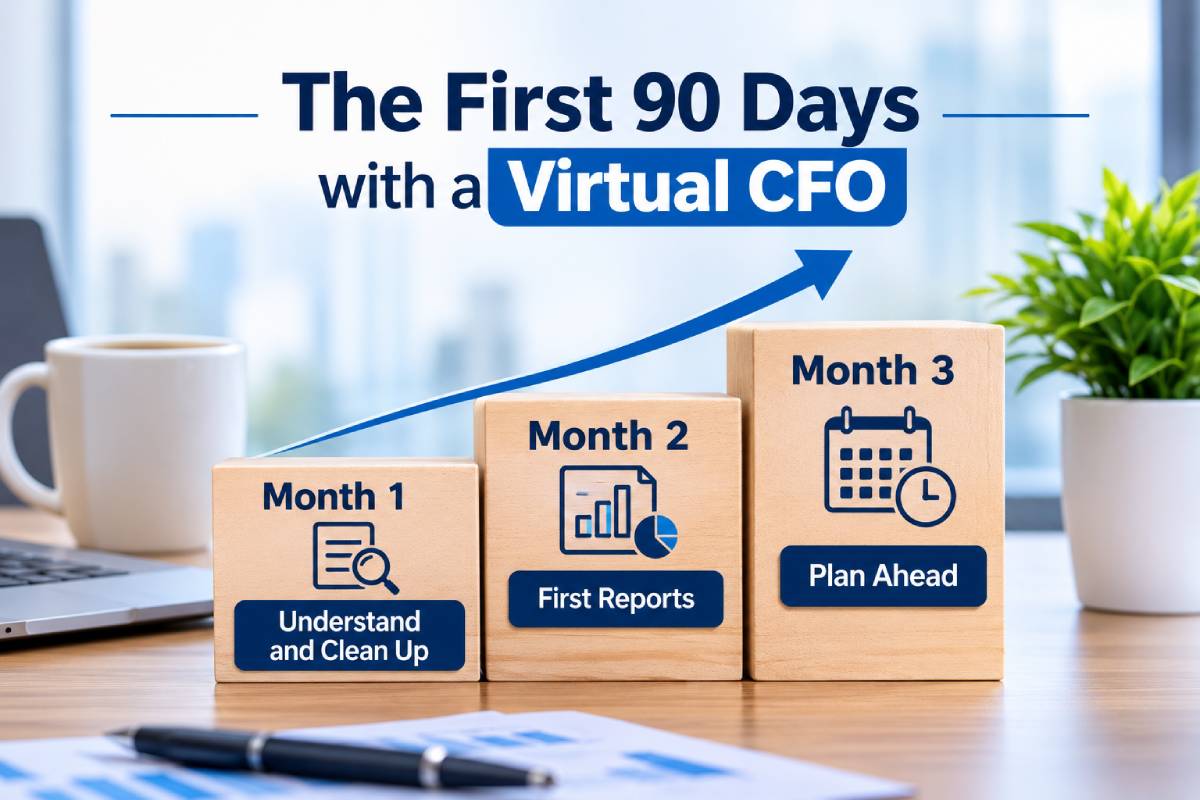
The first 90 days with a virtual CFO
A typical onboarding runs like this:
Month 1: understand and clean up
- Review the last 12–24 months of accounts, GST returns, and bank statements
- Fix the chart of accounts so the numbers can be reported by product, branch, or customer
- Clean up open items: unreconciled bank entries, old debtors, unmatched GST credit
- Agree what the founders want to see each month
Month 2: first reports
- Deliver the first MIS report and hold the first review meeting
- Build a 13-week cash flow forecast
- Set up the compliance tracker for GST, TDS, PF, ESI, and professional tax
Month 3: plan ahead
- Prepare a budget for the rest of the year, or the next year
- Agree five to eight KPIs to track every month
- Identify the first two or three improvements, such as tighter credit control, a pricing review or a bank limit increase
- By the end of month three, you should have a monthly rhythm that runs without the founder chasing it.
What a virtual CFO doesn’t do
Being clear about this avoids disappointment:
- Daily data entry and invoicing: That’s the accountant’s job.
- Signing the statutory audit: The auditor must be independent of the people preparing the accounts.
- Making decisions for you: The CFO recommends; the founders decide.
- Guaranteeing outcomes: A good CFO improves your chances with banks and investors, but can’t promise a sanction or a valuation.
Professional CFO services Mumbai companies use can help founders establish better financial controls and plan their next stage of growth.
An example from practice
A Mumbai-based B2B services company with about ₹15 crore in revenue had an accountant and an outside CA for returns, but the founders only saw monthly numbers at year-end. Cash was always tight, despite healthy reported profit. In the first quarter of a virtual CFO engagement, the monthly MIS showed that three large clients were paying in 110 days on 45-day terms, and that one service line was running at a loss once staff time was allocated properly.
The founders renegotiated payment terms, repriced the loss-making service, and used the new forecast to apply for a higher working capital limit backed by proper CMA data. Within six months, the business was using less of its overdraft and had a monthly report ready by the 18th of every month.
Seven questions to ask before hiring a virtual CFO
- Who exactly will be my CFO? Ask about their qualification and experience with businesses of your size and sector.
- What’s included each month? Reports, meetings, forecasts, and response times.
- Who keeps the books? If it’s your team, how will the CFO review their work?
- Can I see a sample MIS report? With client details removed.
- How do you handle urgent requests? For example, a bank query or a sudden investor call.
- What’s billed separately? Fundraising, valuation, or audit support.
- How does the engagement scale up or down as the business changes?
When evaluating virtual CFO firms, ask for sample financial reports and examples of how their recommendations have helped businesses improve financial performance.
Frequently asked questions
What does a virtual CFO do for a small business?
A virtual CFO provides part-time senior financial management: monthly MIS and review meetings, cash flow forecasting, budgeting, tax planning, compliance oversight, and support with banks and investors. The aim is better decisions, not just accurate books. Virtual CFO services for small businesses can also support working capital planning, expense control, and financial decision-making as operations expand.
How is a virtual CFO different from an accountant?
An accountant records transactions and prepares data for returns. A virtual CFO uses that data to analyse performance, forecast cash, plan budgets, and advise on decisions. Most businesses need both.
How much does a virtual CFO cost in India?
It depends on scope: whether bookkeeping is included, transaction volume, meeting frequency, and any fundraising support. Most firms charge a monthly retainer. Compare proposals by what’s included, not by the headline fee. To estimate virtual CFO cost accurately, businesses should request a proposal that clearly separates recurring services from additional advisory work.
When does a business need a virtual CFO?
Common triggers are growing revenue with tight cash, decisions being made without forecasts, a bank or investor asking for better reporting, or founders spending too much time on finance. Many businesses bring one in once revenue reaches a few crores.
Can a virtual CFO help with fundraising?
Yes. A virtual CFO can build the financial model, prepare investor reporting, organise the data room, and support due diligence. This is usually an add-on or a higher tier of service.
See what a virtual CFO would change in your business
The fastest way to judge whether you need a virtual CFO is to look at your own numbers with one. A short review usually shows where cash is tied up, which reports are missing, and which decisions are being made without data.
Whitespace Consultancy provides partner-led virtual CFO services for startups and SMEs across Mumbai and Thane, from monthly MIS and cash forecasting to budgets, bank limits, and fundraising support. Book a free 30-minute finance review with a Whitespace CFO.
This article is general information. The example is illustrative, with details changed to protect confidentiality.