

Why Small Businesses and Startups in Mulund West Need a Chartered Accountant from Day One
Starting a new business is exciting, but the first year can also be one of the most financially challenging periods for an entrepreneur. Founders are usually focused on acquiring customers, developing products, hiring employees, managing operations, and generating revenue. Financial compliance and accounting often receive attention only when a tax deadline approaches. That can create problems later. Incorrect bookkeeping, missed GST compliance, poorly maintained invoices, incorrect tax calculations, unorganised financial records, and lack of financial reporting can make a growing business unnecessarily difficult to manage.
This is why working with a Chartered Accountant for Small Business from the beginning can provide significant value. A Chartered Accountant can help establish proper accounting systems, understand applicable tax and GST requirements, maintain financial records, plan tax obligations, prepare financial statements, and provide financial guidance as the business grows. For businesses operating in the area, working with a Chartered Accountant in Mulund West can also provide the advantage of accessible local support while allowing businesses to use digital accounting and advisory services.
Do Startups Really Need a Chartered Accountant From Day One?
Yes, many startups and small businesses can benefit from professional accounting and tax guidance from the beginning. However, hiring a CA does not necessarily mean paying for an expensive full-time finance department.
A startup can work with a professional on a:
- Monthly retainer
- Project basis
- Compliance basis
- Accounting outsourcing model
- Virtual CFO model
The important point is to establish the right financial systems before the business becomes complicated.
A good Startup Accountant can help founders understand:
- What records need to be maintained
- Which taxes apply
- Whether GST registration is required
- How invoices should be prepared
- How expenses should be recorded
- How employee payments should be managed
- How financial statements should be prepared
- What information investors or lenders may eventually require
Early professional guidance can prevent small accounting mistakes from becoming larger financial or compliance problems.
Why Small Businesses Often Struggle With Accounting
Small businesses frequently start with a simple approach: “I’ll manage the accounts myself until the business becomes bigger.” This may work temporarily when transaction volumes are low. But as the business grows, financial administration becomes increasingly complex.
A business may suddenly have:
- Multiple customers
- Multiple suppliers
- Business loans
- Employees
- GST registration
- TDS obligations
- Recurring expenses
- Online payments
- Multiple bank accounts
- Inventory
- E-commerce transactions
- Vendor reconciliations
At that point, accounting is no longer simply recording income and expenses. It becomes an important part of business management.
10 Common Accounting Mistakes Startups Make in Their First Year
1. Mixing Personal and Business Expenses
One of the most common mistakes is using the same bank account or payment methods for both personal and business expenses. This makes it difficult to determine the actual profitability of the business.
A professional accounting setup should clearly distinguish between: Business Transactions and Personal Transactions
2. Not Maintaining Books Regularly
Some businesses wait until the end of the financial year to organise their accounts. This creates several problems.
You may not know:
- How much you actually earned
- How much you spent
- Who owes you money
- How much you owe suppliers
- How profitable individual products are
- How much tax may become payable
Monthly bookkeeping provides much better financial visibility.
3. Ignoring GST Compliance
Businesses sometimes assume GST compliance simply means filing a return.
In reality, businesses need to consider:
- GST registration
- Tax invoices
- GST rates
- Input Tax Credit
- GSTR filings
- Reconciliation
- E-invoicing, where applicable
- E-way bills, where applicable
A Chartered Accountant in Mulund West can help businesses understand the GST requirements applicable to their specific operations.
4. Missing Tax Deadlines
Tax compliance involves multiple deadlines throughout the year.
Depending on the business, these may include:
- GST
- TDS
- Advance Tax
- Income Tax
- Audit
- Annual compliance
Missing deadlines can result in interest, late fees, penalties, or unnecessary compliance complications.
5. Not Tracking Cash Flow
Profit does not necessarily mean cash is available.
A business can show accounting profits while still struggling to pay:
- Employees
- Vendors
- Rent
- Taxes
- Loan instalments
Cash-flow monitoring is therefore essential for startups.
6. Not Maintaining Proper Invoices
Invoices are important for both accounting and tax compliance. Businesses should establish a consistent invoicing process from the beginning.
This includes maintaining:
- Invoice numbers
- Customer details
- Dates
- Tax information
- Payment status
- Supporting documentation
7. Treating Accounting as Only a Tax Requirement
Accounting isn’t just about filing an Income Tax Return.
Good financial records help business owners understand:
- Revenue
- Gross margin
- Net profit
- Expenses
- Working capital
- Receivables
- Payables
- Cash flow
This makes accounting a management tool rather than simply a compliance activity.
8. Not Planning Taxes in Advance
- Some businesses calculate their tax liability only when the filing deadline arrives.
- A better approach is to review tax implications throughout the year.
- A Tax Consultant in Mumbai or Chartered Accountant can help identify applicable tax planning opportunities while ensuring compliance with the relevant laws.
9. Choosing Accounting Software Without a Process
Buying accounting software does not automatically create good accounting.
The business also needs:
- Correct chart of accounts
- Proper transaction classification
- Reconciliation
- Documentation
- Review procedures
- Backup processes
A Startup Accountant can help establish these processes.
10. Not Preparing for Growth
- A business may start with ten invoices a month and eventually process hundreds or thousands.
- If financial systems are not scalable, the business may need to rebuild its accounting processes later.
- Establishing good systems from day one is often easier than fixing years of disorganised records.
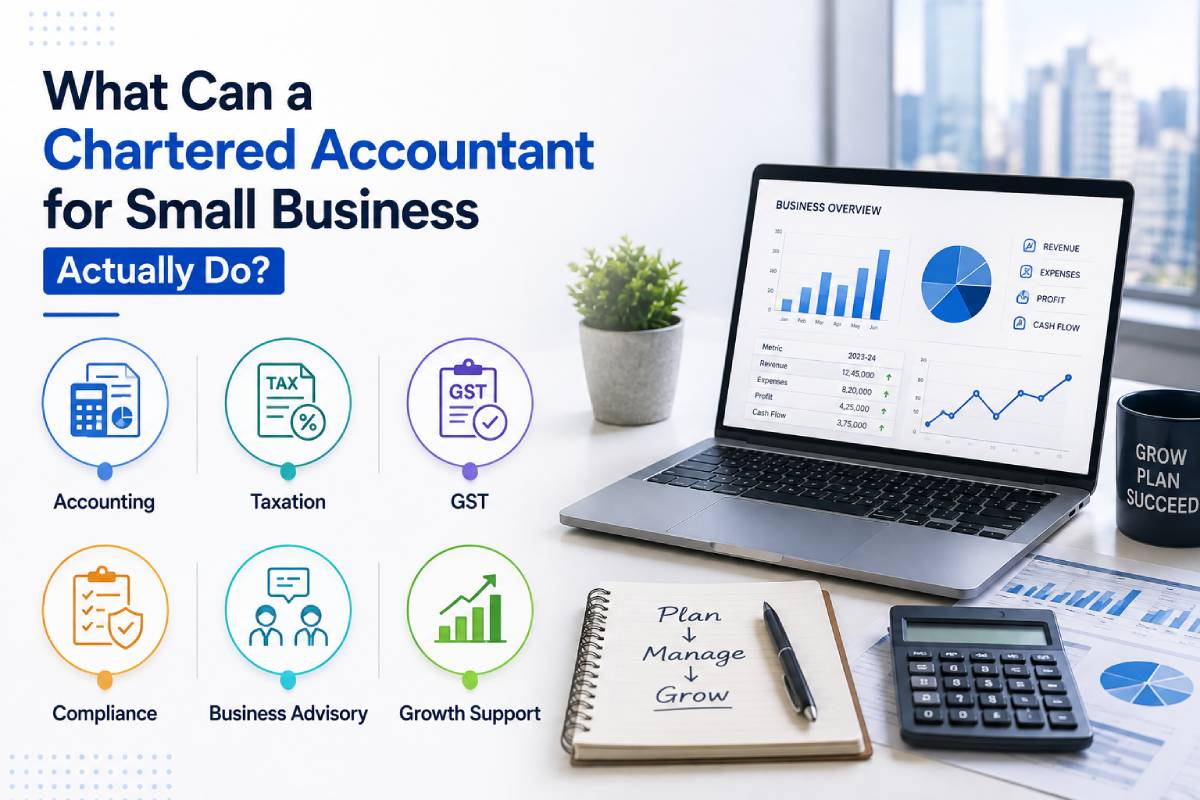
What Can a Chartered Accountant for Small Business Actually Do?
A Chartered Accountant for Small Business can provide much more than annual tax filing.
Depending on the engagement, services may include:
Accounting
- Bookkeeping
- Ledger maintenance
- Bank reconciliation
- Accounts payable
- Accounts receivable
- Financial statements
Taxation
- Income Tax Return Filing
- Tax planning
- Advance tax planning
- Tax computation
- Tax notice assistance
GST
- GST registration
- GST return filing
- ITC reconciliation
- GST advisory
- GST notice assistance
Compliance
- TDS
- ROC/MCA compliance
- Annual filings
- Statutory documentation
Business Advisory
- Budgeting
- Forecasting
- Cash-flow management
- Profitability analysis
- Financial planning
Growth Support
- Funding preparation
- Investor reporting
- Financial modelling
- Virtual CFO support
This integrated approach allows founders to focus on running their businesses while financial professionals manage the accounting and compliance framework.
Accounting Setup: What Should a Startup Establish From Day One?
One of the most valuable contributions a CA can make is helping a startup establish its financial infrastructure correctly.
This can include:
Separate Business Banking
Use dedicated bank accounts for business transactions.
Accounting Software
Choose accounting software based on:
- Business size
- Transaction volume
- GST requirements
- Reporting needs
- Integration requirements
Chart of Accounts
Create appropriate categories for:
- Revenue
- Cost of goods
- Salaries
- Rent
- Marketing
- Professional fees
- Travel
- Technology
- Finance costs
Document Management
Maintain digital copies of:
- Sales invoices
- Purchase invoices
- Expense bills
- Contracts
- Bank statements
- Tax records
Monthly Reconciliation
Regularly reconcile:
- Bank accounts
- GST records
- Customer balances
- Vendor balances
Why Monthly Bookkeeping Matters
A business should ideally not wait until year-end to understand its financial position.
Monthly bookkeeping allows founders to see:
Revenue
How much did the business generate?
Expenses
Where is the money being spent?
Profitability
Which products or services are actually profitable?
Receivables
How much money is still owed by customers?
Payables
How much does the business owe suppliers?
Tax Liabilities
What taxes are likely to become payable?
Cash Flow
Will the business have enough cash to meet upcoming obligations?
These insights can be more valuable than simply knowing the annual profit at the end of the year.
How a CA Helps With GST Registration and Compliance
GST can become complicated when a business begins expanding.
A Chartered Accountant can help determine:
- Whether GST registration is required
- Applicable registration requirements
- Appropriate invoicing procedures
- Return filing requirements
- Input Tax Credit processes
- Reconciliation requirements
- Compliance procedures
For businesses in Mulund West, working with a CA Firm in Mulund West can provide local accessibility while allowing digital accounting and compliance processes.
How a CA Helps With Income Tax Compliance
Income Tax compliance should ideally be planned throughout the year. A Chartered Accountant in Mumbai can help businesses review their tax position throughout the year and maintain organised financial records.
A Chartered Accountant can help with:
- Tax computation
- Advance tax
- Deduction review
- Income Tax Return Filing
- Tax planning
- Capital gains
- Business income
- Tax notices
- Assessments
This can help businesses avoid the common mistake of treating taxation as a once-a-year activity.
Accounting Services in Mumbai for Startups and SMEs
Businesses that don’t want to build an internal finance department can outsource accounting to a professional firm.
Accounting Services in Mumbai may include:
- Bookkeeping
- GST accounting
- Bank reconciliation
- Accounts payable
- Accounts receivable
- Payroll accounting
- Financial reporting
- MIS reporting
- Tax support
For startups, outsourcing can provide access to professional accounting expertise without immediately hiring a full-time finance team. Businesses looking for broader professional support can work with a Chartered Accountant in Mumbai for accounting, taxation, compliance, and financial reporting needs.
Why Outsourcing Can Be Better Than Hiring an Accountant Immediately
A startup may not need a full-time accountant in its early stages.
Hiring internally can involve:
- Salary
- Employee benefits
- Recruitment
- Training
- Software
- Infrastructure
- Management time
Outsourcing allows the business to access professional support based on actual requirements. For businesses with evolving tax requirements, a Tax Consultant in Mumbai can provide ongoing guidance alongside outsourced accounting support.
For example:
Early-stage Startup
Accounting + GST + tax compliance
Growing Startup
Accounting + GST + TDS + payroll + MIS
Funded Startup
Accounting + compliance + MIS + financial modelling + CFO advisory
The level of support can grow alongside the business.
Financial Management, Funding Readiness & Choosing the Right CA
For a startup or small business, accounting should evolve as the business grows. What may begin as a few invoices and a business bank account can quickly become a more complex financial operation involving employees, GST, vendors, customers, loans, investors, and multiple compliance requirements.
This is where ongoing support from a Chartered Accountant for Small Business becomes valuable. A good CA does not simply prepare accounts at the end of the financial year. They can help the business establish financial systems, monitor performance, manage compliance, prepare for funding, and make better financial decisions throughout the year.
Payroll and Employee Compliance for Startups
Hiring employees creates additional financial and compliance responsibilities.
A growing business may need support with:
- Salary calculations
- Payroll accounting
- TDS on salary
- Employee reimbursements
- Provident Fund-related compliance, where applicable
- Professional tax, where applicable
- Payroll records
- Salary certificates
- Employee expense accounting
For a founder managing a growing team, handling payroll manually can quickly become time-consuming. A Startup Accountant can help integrate payroll with the company’s accounting system so that employee costs are accurately reflected in monthly financial reports.
Financial Reporting: Know Where Your Business Stands
Many small businesses know how much money entered their bank account but don’t know whether they are actually profitable. This is one of the biggest reasons startups should establish financial reporting early.
A CA can help prepare reports such as:
- Profit & Loss Statement
- Balance Sheet
- Cash Flow Statement
- Accounts Receivable Report
- Accounts Payable Report
- Expense Analysis
- Revenue Analysis
- Gross Margin Analysis
- Monthly MIS
These reports can answer important questions.
- Is revenue increasing?
- Are expenses growing faster than revenue?
- Which products or services generate the highest margin?
- Which customers have outstanding payments?
- How much cash is available?
- How much tax liability is expected?
Without reliable financial reporting, business decisions are often based on assumptions rather than actual numbers. Professional Accounting Services in Mumbai can help businesses maintain accurate financial reports and use them for informed decision-making.
Why Startups Should Review Financial Statements Monthly
Annual financial statements are important for compliance, but waiting until year-end to review them is not ideal for a growing business. Monthly reviews allow founders to identify issues earlier.
For example:
- January: Revenue ₹10 lakh, expenses ₹7 lakh
- February: Revenue ₹11 lakh, expenses ₹8 lakh
- March: Revenue ₹12 lakh, expenses ₹10 lakh
Revenue appears to be increasing. However, expenses are increasing faster. A monthly financial review can highlight this trend early enough for management to investigate the reason.
Perhaps:
- Employee costs increased
- Marketing spending increased
- Gross margins declined
- Vendor prices increased
Without monthly reporting, the problem might only become obvious during year-end financial statement preparation.
Cash-Flow Management for Small Businesses
One of the most important areas where a Chartered Accountant for Small Business can add value is cash-flow management. A profitable business can still experience cash shortages.
For example: A company invoices customers ₹20 lakh during a month but receives only ₹8 lakh.
At the same time, it has to pay:
- ₹5 lakh salaries
- ₹3 lakh suppliers
- ₹1 lakh rent
- ₹1 lakh taxes
- ₹2 lakh other expenses
The business may appear profitable on paper but face a cash-flow problem.
A CA can help management monitor:
- Receivables
- Payables
- Working capital
- Upcoming tax liabilities
- Loan obligations
- Operating expenses
- Cash reserves
Budgeting and Forecasting
Startups should not operate entirely on historical financial information. They should also plan for the future. A Business Consultant in Mumbai can work alongside the CA to help founders evaluate budgets, growth scenarios, and operational priorities.
A Chartered Accountant can assist with:
Annual Budgets
Estimate:
- Revenue
- Expenses
- Salaries
- Marketing
- Technology
- Rent
- Capital expenditure
Cash-Flow Forecasts
Estimate:
- Expected receipts
- Expected payments
- Tax obligations
- Loan payments
- Cash requirements
Scenario Planning
For example:
- What happens if revenue increases by 30%?
- What happens if revenue falls by 20%?
- Can the business afford five additional employees?
- How much working capital will be required?
This type of analysis helps founders make informed decisions.
Preparing Your Startup for Funding
If your startup plans to raise external funding, proper accounting becomes even more important.
Investors may want to understand:
- Revenue
- Gross margin
- Operating expenses
- EBITDA/profitability metrics
- Cash burn
- Cash runway
- Customer receivables
- Outstanding liabilities
- Historical financial performance
- Financial projections
Poorly maintained books can make due diligence more difficult. A Tax Consultant in Mumbai can also help ensure tax records and compliance documentation are properly reviewed before the funding process begins. A Startup Accountant can help establish organised financial records and reporting processes before the fundraising process begins.
Why Investors Care About Financial Records
Suppose two startups have similar revenue.
Startup A
- Proper books
- Reconciled bank accounts
- Organised invoices
- GST compliance
- TDS compliance
- Monthly financial statements
- Clear financial projections
Startup B
- Missing invoices
- Unreconciled bank accounts
- Personal and business expenses mixed
- Delayed GST filings
- No reliable monthly reports
Even if both companies generate similar revenue, Startup A may be easier for an investor to evaluate. Good accounting therefore isn’t only about tax compliance. It can contribute to funding readiness and business credibility.
Business Growth Planning
Once a business establishes reliable financial records, a CA can help management use that information for strategic planning. For businesses planning expansion or restructuring, a Business Consultant in Mumbai can also provide practical guidance on financial planning and growth decisions.
For example:
Expansion
Should the business open another location?
Hiring
Can the business afford ten additional employees?
Pricing
Are current prices generating sufficient margins?
Investment
Can the business invest in new equipment or technology?
Borrowing
How much debt can the business reasonably service?
Profitability
Which products or services should receive more investment?
This moves the relationship from routine accounting to genuine business advisory.
When Should a Startup Hire an Internal Accountant?
An internal accountant may become appropriate when the business has:
- High transaction volume
- Multiple business locations
- Large finance operations
- Significant payroll
- Complex inventory
- Frequent financial reporting requirements
- A dedicated finance department
However, even businesses with internal accounting staff may continue working with a Chartered Accountant for:
- Taxation
- Audit
- GST advisory
- Tax planning
- Regulatory matters
- Financial review
- Business advisory
When Is Outsourced Accounting Better?
Outsourcing may be more practical when:
- The business is in its early stage.
- Transaction volume is manageable.
- A full-time accountant isn’t financially justified.
- The founder wants professional tax support.
- The company needs accounting + GST + tax together.
- Management wants access to experienced professionals.
- The business is growing but doesn’t yet need a full finance department.
This can provide access to professional expertise without the fixed cost of building a larger internal team.
In-House Accountant vs Outsourced CA Firm
| Factor | In-House Accountant | Outsourced CA Firm |
| Monthly Bookkeeping | ✓ | ✓ |
| GST Compliance | Depends on expertise | ✓ |
| Income Tax Expertise | Depends on expertise | ✓ |
| Audit Support | Usually external | ✓ |
| Tax Planning | Depends on experience | ✓ |
| Senior CA Advisory | — | ✓ |
| Recruitment Cost | Higher | Lower |
| Employee Benefits | Applicable | Not applicable |
| Multiple Specialists | Limited | Usually available |
| Scalability | Requires hiring | Easier to scale |
| Virtual CFO Support | Requires senior hire | Available through suitable firms |
| Founder Support | Internal | External professional team |
For many early-stage businesses, outsourcing provides a practical starting point.
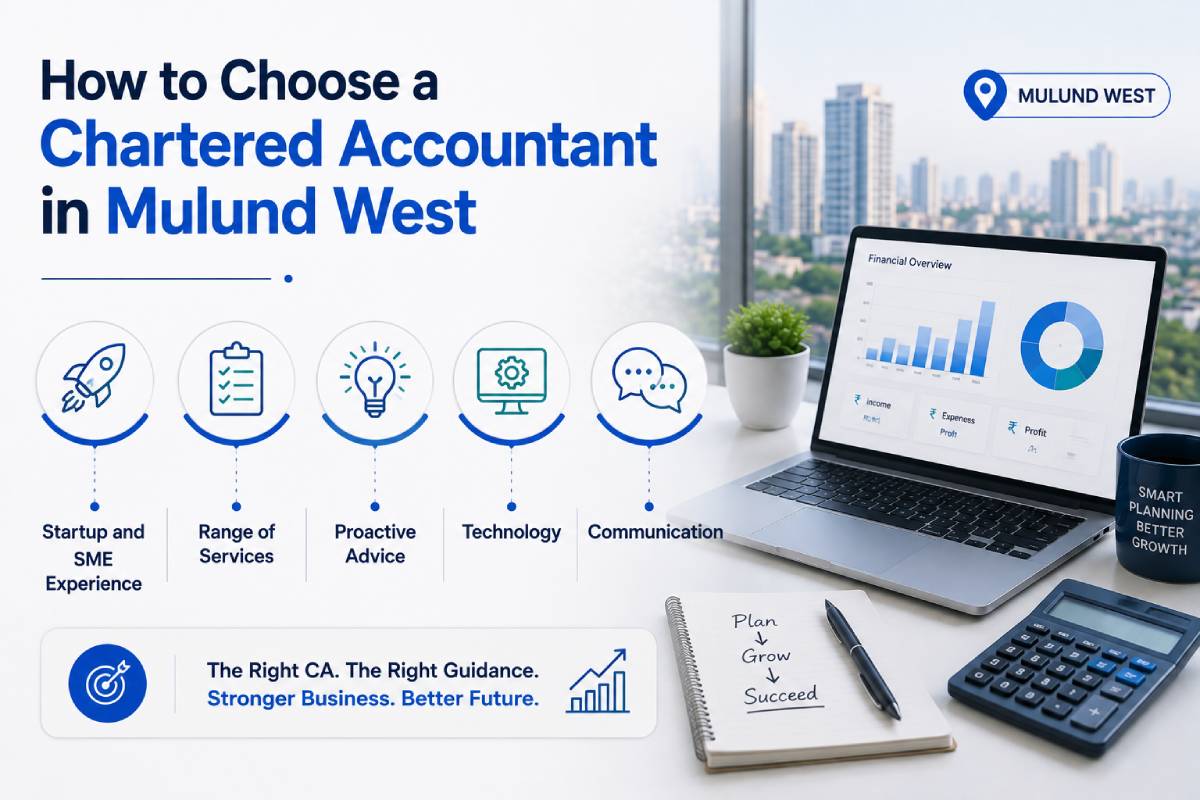
How to Choose a Chartered Accountant in Mulund West
If you’re searching for a Chartered Accountant in Mulund West, don’t choose solely based on proximity or the lowest fee. Consider the following factors.
1. Startup and SME Experience
Ask whether the CA regularly works with:
- Startups
- Small businesses
- SMEs
- Professionals
- Private limited companies
- LLPs
- Partnership firms
Experience with businesses at your stage can be particularly valuable.
2. Range of Services
Ideally, the professional should be able to support multiple financial requirements.
Look for services such as:
- Accounting
- GST
- Income Tax
- TDS
- Audit
- Financial reporting
- Business advisory
This reduces the need to coordinate with multiple service providers.
3. Proactive Advice
A good CA should not only tell you what compliance is due.
They should also help you understand:
- What needs attention
- What financial risks exist
- What deadlines are approaching
- What your numbers indicate
- What decisions may have tax implications
4. Technology
Ask whether the firm uses:
- Cloud accounting
- Digital document sharing
- Online meetings
- Automated reconciliation
- Digital reporting
- Secure document management
Technology can make working with a local CA much easier.
5. Communication
Ask:
- Who is the point of contact?
- How quickly are queries answered?
- How often are financial reports shared?
- Will you receive monthly reviews?
- Who handles urgent compliance matters?
Good communication is particularly important for startups.
Why Choose a CA Firm in Mulund West?
Working with a CA Firm in Mulund West can provide a combination of local accessibility and professional financial support.
For business owners in and around Mulund, local access can make it easier to:
- Schedule in-person meetings
- Discuss financial matters
- Submit or review documents
- Build a long-term professional relationship
At the same time, modern accounting and compliance services can be delivered digitally, allowing businesses to collaborate remotely when required. Therefore, a local CA Firm in Mulund West can support businesses without requiring every interaction to happen in person.
Chartered Accountant in Mulund West vs Online Accounting Service
Both models can work, depending on your requirements.
| Factor | Local CA in Mulund West | Online Accounting Service |
| Local Accessibility | High | Usually limited |
| In-Person Meetings | ✓ | Usually unavailable |
| Digital Accounting | ✓ | ✓ |
| Tax Advisory | ✓ | Depends on provider |
| GST Compliance | ✓ | ✓ |
| Business Advisory | ✓ | Depends on provider |
| Long-Term Relationship | ✓ | Varies |
| Local Business Understanding | Potential advantage | Depends on provider |
The best choice is ultimately the one that provides the right combination of expertise, responsiveness, technology, and value.
Why Choose Whitespace Consultancy for Startup & Small Business Accounting?
Whitespace Consultancy works with startups, small businesses, SMEs, professionals, and established organisations to provide integrated financial and business support. Working with a Chartered Accountant in Mumbai can give growing businesses access to professional guidance as their financial requirements become more complex. Our objective is not simply to complete annual tax filings. We help businesses establish financial processes that can support them as they grow.
Startup & Small Business Support
Our services can include:
- Accounting
- Bookkeeping
- Bank reconciliation
- Financial statements
- MIS reporting
- Accounting outsourcing
GST
- GST registration
- GST return filing
- GST reconciliation
- Input Tax Credit support
- GST advisory
Income Tax
- Income Tax Return Filing
- Tax planning
- Tax computation
- Tax notices
- Assessments
Business Advisory
- Budgeting
- Forecasting
- Cash-flow management
- Profitability analysis
- Virtual CFO services
Compliance
- TDS
- ROC/MCA-related compliance
- Audit coordination
- Financial documentation
This integrated approach allows business owners to work with one professional team across multiple financial requirements.
A Practical Example: Startup From Day One to Growth
Consider a hypothetical startup based in Mulund West.
Stage 1 – Business Formation
The founders establish their entity and need help with:
- Business structure
- Accounting setup
- GST assessment
- Bank account setup
- Basic financial processes
CA Role
Set up the financial foundation correctly.
Stage 2 – First Six Months
The startup begins generating revenue.
It now needs:
- Bookkeeping
- GST compliance
- TDS
- Payroll
- Bank reconciliation
- Monthly financial reporting
CA Role
Maintain compliance and provide financial visibility.
Stage 3 – Business Growth
Revenue increases and the company hires more employees.
Now it needs:
- Budgeting
- Cash-flow forecasting
- Profitability analysis
- MIS
- Tax planning
CA Role
Help management understand financial performance and plan ahead.
Stage 4 – Funding
The startup begins preparing for fundraising.
It needs:
- Historical financial statements
- Financial projections
- Cash-burn analysis
- Investor reporting
- Due diligence support
CA Role
Help organise financial information and support funding readiness.
Stage 5 – Expansion
The company opens new locations or expands operations.
It may now require:
- Multiple GST registrations
- More complex accounting
- Advanced MIS
- Working capital planning
- Virtual CFO support
CA Role
Provide scalable financial and strategic support.
This demonstrates why professional accounting should not be viewed as a once-a-year activity.
A CA Can Grow With Your Business
The ideal relationship should evolve.
At ₹10 lakh turnover
You may need:
Accounting + GST + Tax
At ₹1 crore turnover
You may need:
Accounting + GST + TDS + MIS + Tax Planning
At ₹10 crore turnover
You may need:
Accounting + Audit + Tax Advisory + Financial Planning + CFO Support
Your professional partner should be capable of adapting as your requirements change.
When Should a Startup Hire a CA? Checklist, Mistakes, FAQs & Final Guide
For a startup or small business, the right time to establish professional accounting support is usually before financial complexity becomes a problem. You don’t necessarily need a large finance department from the first day of operations. However, having access to a qualified professional can help you establish the right accounting, taxation, GST, reporting, and compliance processes from the beginning.
A Chartered Accountant for Small Business can therefore become more than a compliance provider. The right professional can act as a financial partner who helps the business understand its numbers, manage risks, and prepare for future growth.
10 Signs Your Startup Needs Professional Accounting Support
Not every startup needs the same level of financial support. However, the following signs indicate that it may be time to work with a professional.
1. You Are Mixing Personal and Business Transactions
If founders regularly use personal accounts or cards for business expenses, financial reporting can become inaccurate. Professional accounting support can help establish clear processes for separating business and personal transactions.
2. You Don’t Know Your Actual Profit
Revenue alone doesn’t tell you whether your business is performing well.
If you don’t have a reliable monthly Profit & Loss statement, you may not know:
- Your gross margin
- Operating expenses
- Net profitability
- Customer profitability
- Cost trends
A CA can help establish regular financial reporting.
3. GST Compliance Is Becoming Difficult
If you’re unsure about:
- GST registration
- Tax invoices
- Input Tax Credit
- Return filing
- Reconciliation
- E-invoicing
Professional GST support can reduce compliance risk.
4. Your Business Has Multiple Income Sources
As businesses expand, they may have:
- Multiple products
- Multiple services
- Multiple locations
- Online sales
- Marketplace sales
- International customers
Accounting becomes more complex as these revenue streams grow.
5. You Have Started Hiring Employees
Once employees are added, businesses may need to manage:
- Payroll
- TDS
- Employee reimbursements
- Salary accounting
- Applicable labour-related compliances
This increases the need for organised financial processes.
6. Customers Are Taking Too Long to Pay
If your revenue is increasing but cash availability is falling, receivables may be the problem.
Regular receivables reporting can help identify:
- Overdue invoices
- Slow-paying customers
- Customer concentration
- Working-capital requirements
7. You Are Planning to Raise Funding
Investors generally expect reliable financial information.
A startup preparing for fundraising should have:
- Proper books
- Reconciled accounts
- Financial statements
- Clear revenue records
- Expense records
- Tax compliance
- Financial projections
Professional accounting support can make this process considerably more organised.
8. You Are Receiving Tax or GST Notices
A tax or GST notice should not simply be ignored.
If your business receives a notice, professional assistance can help you understand:
- What information is being requested
- Why the notice was issued
- Which documents are required
- What response needs to be submitted
- What deadlines apply
9. You Are Spending Too Much Time on Accounts
Founders should focus on:
- Customers
- Sales
- Product development
- Employees
- Operations
- Strategy
If accounting is taking several hours every week, outsourcing may allow management to focus on higher-value activities.
10. Your Business Is Growing Quickly
Rapid growth can expose weaknesses in financial systems. If transaction volumes, employees, GST registrations, or revenue are increasing quickly, it is better to improve financial processes before they become difficult to manage.
First-Year Accounting Checklist for Startups
A startup can use this checklist to establish a strong financial foundation.
Business Setup
- Choose the appropriate business structure
- Establish a dedicated business bank account
- Set up accounting software
- Create a chart of accounts
- Establish an invoice numbering system
- Set up document management
Tax & GST
- Assess GST registration requirements
- Establish GST invoicing procedures
- Track Input Tax Credit
- Monitor GST filing deadlines
- Assess TDS obligations
- Plan Income Tax obligations
- Monitor advance tax requirements where applicable
Accounting
- Record sales regularly
- Record purchases and expenses
- Reconcile bank accounts
- Track receivables
- Track payables
- Maintain supporting documents
- Review accounts monthly
Payroll
- Maintain employee records
- Process salaries correctly
- Track applicable TDS
- Record employee reimbursements
- Maintain payroll documentation
Financial Management
- Prepare monthly Profit & Loss
- Monitor cash flow
- Review expenses
- Track gross margins
- Prepare budgets
- Review financial performance
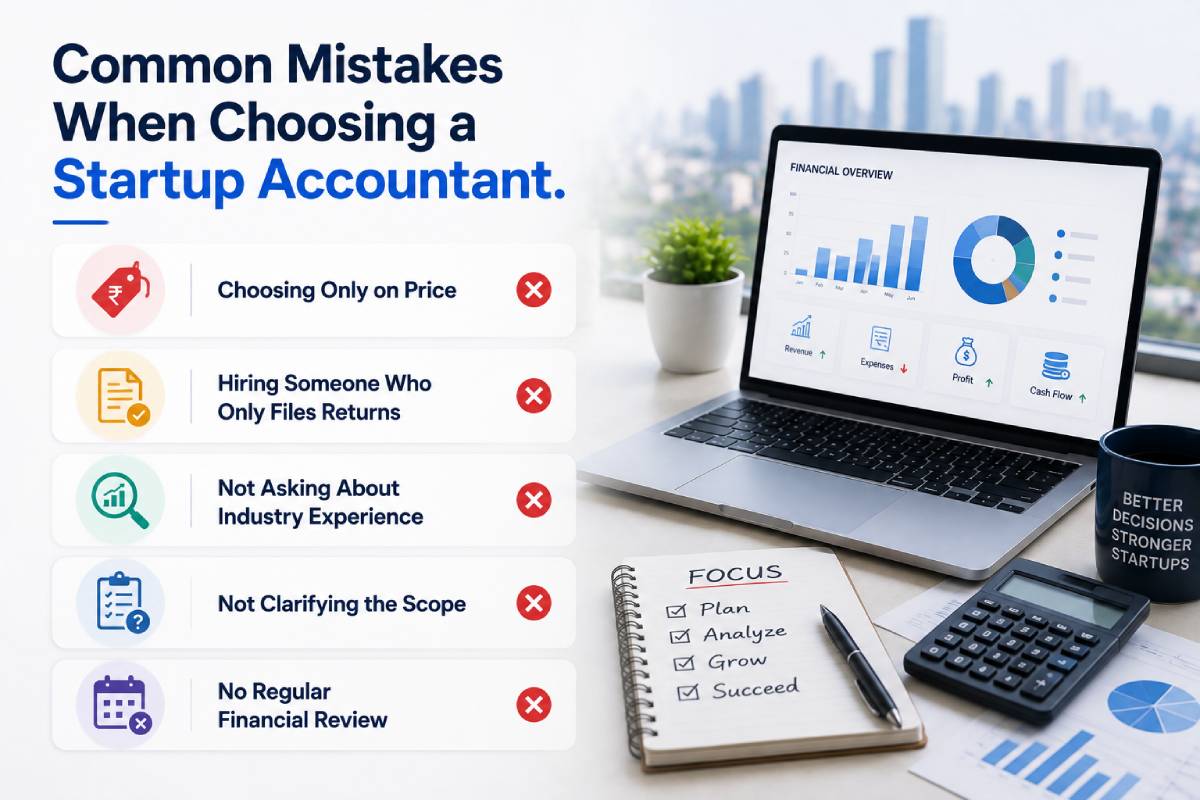
Common Mistakes When Choosing a Startup Accountant
Hiring the first accountant you find may seem convenient, but the wrong professional arrangement can create problems later.
Choosing Only on Price
The cheapest quotation may not include everything your startup needs. Compare the scope before comparing the price.
Hiring Someone Who Only Files Returns
Your startup may eventually need more than annual tax filing.
Consider whether the professional can also support:
- Accounting
- GST
- TDS
- Financial reporting
- Tax planning
- Business advisory
Not Asking About Industry Experience
A technology startup, restaurant, manufacturer, e-commerce company, and professional consultancy can have very different accounting requirements. Ask whether the CA understands your business model.
Not Clarifying the Scope
Get written confirmation of:
- Included services
- Excluded services
- Monthly fees
- Annual fees
- Additional charges
- Notice support
- Audit fees
No Regular Financial Review
If your accountant only contacts you when a return is due, you may be missing valuable financial insights. Consider establishing monthly or quarterly reviews.
Questions to Ask Before Hiring a Chartered Accountant
Before appointing a Chartered Accountant in Mulund West, ask:
1. Do you work with startups and small businesses?
2. What accounting services do you provide?
3. Do you handle GST registration and compliance?
4. Do you manage TDS compliance?
5. Do you provide monthly financial reporting?
6. Can you help with tax planning?
7. Can you support us during tax or GST notices?
8. Can you assist with funding-related financial reporting?
9. Who will actually handle our accounts?
10. Will a senior Chartered Accountant review the work?
11. What technology or accounting software do you use?
12. What is included in the monthly fee?
13. What services are billed separately?
14. How will your services scale as our business grows?
These questions help founders evaluate a CA based on capability and long-term value, rather than only price.
Local Business Example: A Mulund West Startup
Consider a hypothetical startup operating from Mulund West.
The founders initially have:
- 2 employees
- 20 monthly invoices
- One bank account
- Limited expenses
- No GST registration
At this stage, their accounting requirements may be relatively simple.
Six months later, the business grows to:
- 10 employees
- 200 monthly invoices
- GST registration
- Multiple vendors
- Online payments
- ₹1 crore annualised revenue
The financial requirements have changed considerably.
The business now needs:
- Monthly bookkeeping
- GST compliance
- TDS
- Payroll
- Bank reconciliation
- Financial reporting
- Cash-flow management
- Tax planning
This illustrates why the right Chartered Accountant for Small Business should be able to scale the engagement as the business develops.
Why Local Businesses May Prefer a CA in Mulund West
For businesses located in Mulund West, working with a local professional can offer practical advantages.
A Chartered Accountant in Mulund West can provide:
- Convenient local meetings
- Familiarity with local business requirements
- Easier document discussions
- Faster in-person consultations when required
- Long-term professional relationships
At the same time, modern accounting means much of the work can be completed digitally. Documents can be shared securely, meetings can happen online, and financial reports can be reviewed remotely. This gives businesses the convenience of a local CA Firm in Mulund West without depending entirely on physical visits.
Accounting Firm in Mumbai vs Individual Accountant
A business should also understand the difference between hiring an individual accountant and engaging a professional accounting firm.
| Requirement | Individual Accountant | Accounting Firm |
| Bookkeeping | ✓ | ✓ |
| Basic Accounting | ✓ | ✓ |
| GST | Depends on expertise | ✓ |
| Income Tax | Limited/depends on expertise | ✓ |
| Audit | Usually external | ✓ |
| Tax Planning | Depends on expertise | ✓ |
| Business Advisory | Limited | ✓ |
| Senior CA Advice | — | ✓ |
| Scalability | Limited | Higher |
| Multiple Specialists | Usually no | Usually available |
An Accounting Firm in Mumbai can therefore be useful for businesses that need several financial services under one roof.
When Should You Move From a Basic Accountant to a CA Firm?
A business may consider moving to a professional CA firm when:
- Revenue increases substantially.
- Transaction volume increases.
- GST compliance becomes complicated.
- Employees increase.
- Multiple locations are added.
- The company needs monthly MIS.
- Tax planning becomes important.
- The business plans to raise funding.
- Financial decisions require professional advice.
- Tax or GST notices are received.
The transition doesn’t have to happen after a specific turnover threshold. The right time is when the financial complexity of the business exceeds the capacity of its current accounting setup.
Chartered Accountant for Small Business: Cost vs Value
Small businesses sometimes hesitate to hire professional support because they see accounting as an additional expense. However, the real comparison should be: Cost of professional accounting vs cost of poor accounting.
Poor financial management can result in:
- Missed deadlines
- Incorrect tax calculations
- Lost invoices
- Poor cash-flow visibility
- Unreconciled accounts
- Incorrect GST claims
- Financial reporting problems
- Difficulty during audits
- Funding delays
Professional accounting can help prevent or reduce these risks. The objective isn’t simply to minimise accounting costs. It is to establish a financial system that supports sustainable growth.
How Whitespace Consultancy Supports Startups and Small Businesses
Whitespace Consultancy works with startups, SMEs, professionals, and established businesses that require reliable accounting, taxation, GST, compliance, audit, and business advisory support. Our approach focuses on understanding the business first and then designing the appropriate level of professional support.
Accounting Support
We can assist with:
- Bookkeeping
- Accounting outsourcing
- Bank reconciliation
- Financial reporting
- MIS reporting
- Accounting process improvement
Tax Support
Our Income Tax services can include:
- Income Tax Return Filing
- Tax planning
- Tax computation
- Tax notices
- Assessments
- Capital gains advisory
GST Support
We assist businesses with:
- GST registration
- GST return filing
- GST reconciliation
- ITC-related compliance
- GST advisory
- GST notices
Business Advisory
For growing businesses, support can extend to:
- Budgeting
- Forecasting
- Cash-flow management
- Profitability analysis
- Financial planning
- Virtual CFO services
This allows startups to access financial expertise at different stages without immediately building a large internal finance team. A Business Consultant in Mumbai can help growing businesses connect financial insights with practical business decisions.
Frequently Asked Questions
Do small businesses need a Chartered Accountant?
A small business may benefit from a Chartered Accountant for Small Business when it needs professional assistance with accounting, taxation, GST, audits, compliance, financial reporting, or business planning. The level of support can be tailored to the business’s size and complexity.
When should a startup hire a Chartered Accountant?
A startup can consider engaging a Chartered Accountant from the beginning, particularly when setting up its accounting system, assessing tax and GST requirements, establishing compliance processes, or planning for future growth and funding.
What does a Startup Accountant do?
A Startup Accountant can help with bookkeeping, accounting, GST, TDS, payroll accounting, financial reporting, tax compliance, cash-flow tracking, budgeting, and other financial processes depending on the engagement.
Why should startups hire a CA from day one?
Hiring professional support early can help startups establish proper financial systems, separate personal and business transactions, manage tax and GST compliance, maintain accurate records, and prepare reliable financial information for future growth or fundraising.
Can a Chartered Accountant help with GST registration?
Yes. A Chartered Accountant can assist with evaluating GST registration requirements, preparing documentation, completing the registration process, establishing invoicing procedures, and providing ongoing GST compliance support.
Can a CA help a startup prepare for funding?
Yes. A CA can help maintain organised financial records, prepare financial statements, analyse cash flow, develop financial projections, and support financial due diligence. The exact scope depends on the professional engagement.
Should a startup hire an accountant or outsource accounting?
The answer depends on transaction volume, business complexity, internal resources, and budget. Early-stage startups may find outsourced accounting more practical, while larger businesses may eventually require an internal finance team supported by an external CA.
What accounting services do startups usually need?
Common requirements include:
- Bookkeeping
- Bank reconciliation
- GST compliance
- TDS
- Payroll accounting
- Financial reporting
- Income Tax compliance
- Tax planning
As the startup grows, it may also require MIS reporting, budgeting, forecasting, and CFO advisory.
How often should a startup review its financial statements?
Monthly financial reviews are generally useful for growing businesses because they provide timely information about revenue, expenses, profitability, receivables, payables, and cash flow.
What should I look for in a Chartered Accountant in Mulund West?
Look for relevant startup and SME experience, accounting and tax expertise, GST knowledge, clear communication, technology-enabled processes, transparent pricing, and the ability to provide ongoing financial advice as your business grows.
Why choose a CA Firm in Mulund West instead of an online accounting provider?
A local CA Firm in Mulund West can provide convenient in-person access while still offering digital accounting and compliance services. The better choice depends on your need for local interaction, professional expertise, responsiveness, technology, and the scope of services.
Can a Chartered Accountant help with business growth?
Yes. Beyond compliance, a CA can support budgeting, forecasting, cash-flow management, profitability analysis, financial reporting, tax planning, funding preparation, and strategic financial decisions.
Is outsourcing accounting suitable for small businesses?
Yes. Outsourcing can provide access to accounting and tax professionals without the cost of maintaining a complete internal finance team. It can be particularly useful when transaction volumes are still manageable.
Key Takeaways for Startups and Small Businesses
A startup doesn’t need to wait until it becomes a large company before taking accounting seriously. The right financial foundation should begin early.
Remember:
- Separate personal and business finances.
- Maintain books regularly.
- Understand GST obligations.
- Monitor Income Tax requirements.
- Track cash flow.
- Review financial statements monthly.
- Keep invoices and supporting documents organised.
- Plan taxes instead of reacting to deadlines.
- Prepare proper financial records before seeking funding.
- Choose a CA who can scale with your business.
Most importantly, don’t treat accounting as a year-end activity. Good financial management should support your business throughout the year.
Conclusion
Starting a business in Mulund West can be an exciting opportunity, but sustainable growth requires more than sales and operations. Financial discipline matters from the beginning. A Chartered Accountant for Small Business can help establish accounting systems, manage GST and Income Tax compliance, maintain accurate financial records, monitor cash flow, prepare financial reports, and provide guidance as the business grows.
For startups, early professional involvement can also create a stronger foundation for hiring employees, raising funding, expanding operations, and making strategic financial decisions. If you’re looking for a Chartered Accountant in Mulund West, choose a professional partner based on expertise, responsiveness, technology, service scope, and long-term value, not simply the lowest fee. For businesses that also need broader financial support, an experienced Accounting Firm in Mumbai can provide accounting, taxation, GST, audit, and business advisory services under one roof. Need expert accounting and tax guidance? Contact us today.
Need a Chartered Accountant for Your Small Business in Mulund West?
Whitespace Consultancy works with startups, small businesses, SMEs, professionals, and growing organisations across Mulund West and Mumbai.
We provide:
- Accounting Services
- Income Tax Services
- GST Registration & Compliance
- Audit & Assurance
- Business Advisory
- Virtual CFO Services
- Financial Reporting
- Tax Planning
- Business Compliance Support
If you’re starting a new business or your existing accounting requirements are becoming more complex, speak with our team to understand the right level of financial support for your business. Looking for a Chartered Accountant in Mulund West? Contact Whitespace Consultancy to discuss your accounting, taxation, GST, compliance, and business advisory requirements.