

Income Tax Return Filing Checklist for Salaried Employees and Businesses
Filing your Income Tax Return (ITR) is more than just a legal obligation; it’s an important financial activity that helps you report your income accurately, claim eligible deductions, maintain tax compliance, and avoid unnecessary notices from the Income Tax Department. Whether you’re a salaried employee, freelancer, consultant, business owner, startup founder, partnership firm, or company, filing your return becomes much easier when all your financial records and supporting documents are organised before you begin.
Many taxpayers make avoidable mistakes because they start filing without checking their documents. Missing income details, incorrect bank information, unclaimed deductions, or selecting the wrong ITR form can lead to delayed refunds, defective returns, or additional queries from the Income Tax Department. That’s why following a proper ITR Filing Checklist is one of the simplest ways to ensure your return is complete, accurate, and filed on time.
In this comprehensive guide, we’ll explain everything you need to prepare before filing your return, including the documents required for ITR filing in India, bank statement requirements, filing steps for salaried employees and businesses, common mistakes to avoid, and when it’s beneficial to seek assistance from experienced chartered accountant firms near me.
Quick Answer
What Is an Income Tax Return Filing Checklist?
An Income Tax Return Filing Checklist is a structured list of documents, financial records, and verification steps that taxpayers should complete before submitting their Income Tax Return. It helps ensure that all income sources, deductions, tax credits, and supporting documents are correctly reported, reducing the chances of errors, delayed refunds, or notices from the Income Tax Department.
Before filing your Income Tax Return, you should generally:
- Keep your PAN and Aadhaar details updated.
- Collect income-related documents such as Form 16, salary slips, or business financial statements.
- Review Form 26AS and the Annual Information Statement (AIS).
- Verify bank account details.
- Gather investment and deduction proofs.
- Keep home loan or education loan certificates ready, if applicable.
- Organise capital gains and other investment records.
- Select the correct ITR form.
- Review all information carefully before submission. Preparing all the necessary documents before starting your Income Tax Return Filing can save time, reduce errors, and help ensure that your return is processed smoothly.
A little preparation can make the entire ITR Filing process faster, more accurate, and stress-free.
Why Preparing Before Filing Your ITR Is Important
Many taxpayers think income tax filing begins when they log in to the Income Tax portal. In reality, the process starts much earlier, with collecting and verifying your financial information.
Preparing in advance helps you:
- Report income accurately.
- Claim all eligible deductions.
- Reduce the risk of filing errors.
- Avoid unnecessary notices from the Income Tax Department.
- Speed up refund processing where applicable.
- Maintain proper financial records for future reference.
For businesses, organised documentation also simplifies audits, tax assessments, loan applications, and financial reporting.
Who Should Use This ITR Filing Checklist?
This checklist is useful for almost every taxpayer required to file an Income Tax Return in India.
It is particularly beneficial for:
Salaried Employees
Employees with one or more employers should verify salary income, tax deducted at source (TDS), deductions claimed, and employer-issued documents before filing.
Freelancers and Consultants
Professionals earning freelance or consultancy income should reconcile invoices, receipts, expenses, and bank transactions to ensure complete reporting.
Business Owners
Businesses should review financial statements, books of accounts, GST records, and tax computations before filing their returns.
Partnership Firms
Partnership firms should verify income, partner remuneration (where applicable), financial statements, and compliance records before filing.
Companies
Companies should ensure that audited financial statements, tax computations, statutory records, and supporting documentation are complete and consistent.
Investors
Individuals earning income from shares, mutual funds, property, fixed deposits, bonds, dividends, or other investments should organise relevant statements and transaction records before filing.
Essential Personal Documents
Every taxpayer should begin by verifying their basic personal information. Incorrect personal details can delay processing or create unnecessary complications during filing.
Keep the following documents readily available:
- PAN Card
- Aadhaar Card
- Mobile Number linked with Aadhaar
- Email Address
- Updated Residential Address
- Date of Birth
- Bank Account Details
- IFSC Code
- Cancelled Cheque or Passbook (if required for verification)
Ensure that the information entered in your Income Tax Return matches your official records.
Financial Documents You Should Collect Before Filing
The next step is gathering documents related to your income and financial transactions during the relevant financial year.
Depending on your sources of income, you may require:
- Salary Documents
- Bank Statements
- Interest Certificates
- Investment Statements
- Rental Income Records
- Home Loan Certificates
- Capital Gains Statements
- Business Financial Statements
- GST Records (where applicable)
- Tax Deducted at Source (TDS) Certificates
Keeping these documents organised makes the filing process much smoother.
Documents Required for Salaried Employees
For salaried individuals, most information is available through employer-issued documents and banking records.
However, it is important to verify that all details are complete before filing.
The common documents required for ITR filing in India for salaried employees include:
Form 16
Form 16 is one of the most important documents for salary income.
It contains:
- Salary details
- Tax deducted by the employer
- Exemptions
- Deductions
- Tax deposited with the government
Although Form 16 simplifies filing, taxpayers should still verify the information against other tax records.
Salary Slips
Monthly salary slips help verify:
- Gross salary
- Allowances
- Deductions
- Professional tax (where applicable)
- Provident Fund contributions
- Employer deductions
They are particularly useful if you have changed jobs during the financial year.
Form 26AS
Form 26AS provides a consolidated view of taxes deducted, taxes collected, advance tax payments, and certain financial transactions reported against your PAN. Reviewing it before filing helps ensure that tax credits are correctly reflected.
Annual Information Statement (AIS)
The Annual Information Statement contains details of various financial transactions reported to the Income Tax Department.
It may include information relating to:
- Interest income
- Dividend income
- Securities transactions
- Property transactions
- Tax payments
- Other specified financial information
Comparing AIS with your records helps identify any discrepancies before filing.
Bank Statements
Your bank statements help verify:
- Salary credits
- Interest income
- Refunds
- Investment payments
- Loan repayments
- Other financial transactions
Many taxpayers ask, “How many months bank statement required for ITR filing?”
There is no prescribed rule requiring a fixed number of months solely for filing an Income Tax Return. However, it is advisable to maintain bank statements covering the relevant financial year so that you can verify all income and transactions reported in your return. We’ll discuss this in greater detail later in this guide.
Investment Proofs
If you are claiming eligible deductions, keep supporting documents ready.
Examples include:
- Life Insurance Premium Receipts
- Public Provident Fund (PPF) Statements
- ELSS Investment Statements
- National Pension System (NPS) Contributions
- Tax Saving Fixed Deposits
- Tuition Fee Receipts (where applicable)
Supporting documents should match the deductions claimed in your return.
Home Loan Documents
Homeowners should collect:
- Home Loan Interest Certificate
- Principal Repayment Statement
- Loan Account Statement
These documents help support eligible claims relating to housing loans, subject to applicable tax provisions.
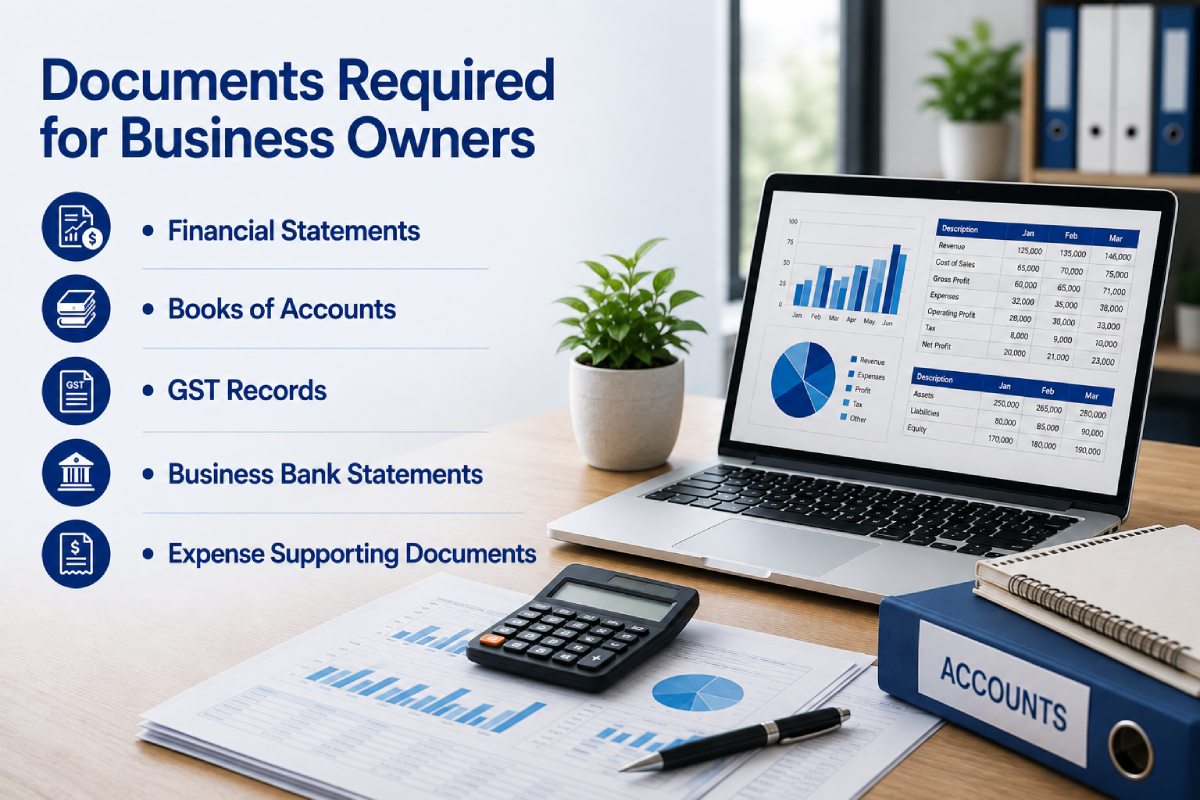
Documents Required for Business Owners
Business taxpayers generally require a wider range of financial documents than salaried employees.
A complete ITR Filing Checklist for businesses may include:
Financial Statements
Businesses should keep updated:
- Profit & Loss Statement
- Balance Sheet
- Trial Balance
- Cash Flow Statement (where applicable)
These statements form the basis of income computation.
Books of Accounts
Maintain organised records such as:
- Cash Book
- Ledger
- Purchase Register
- Sales Register
- Journal
- Stock Register (where applicable)
Proper bookkeeping significantly simplifies return preparation.
GST Records
Businesses registered under GST should reconcile:
- GST Returns
- Sales
- Purchases
- Input Tax Credit
- Annual GST Summary
Consistency between GST records and income tax records helps minimise discrepancies.
Business Bank Statements
Business bank statements help verify:
- Customer receipts
- Vendor payments
- Business expenses
- Loan transactions
- Interest income
Maintaining separate business and personal bank accounts can make tax compliance much easier.
Expense Supporting Documents
Businesses should preserve:
- Purchase Invoices
- Utility Bills
- Office Rent Agreements
- Employee Salary Records
- Professional Fee Bills
- Marketing Expenses
- Travel Bills
- Software Subscription Invoices
Supporting evidence strengthens the accuracy of expense claims.
Choosing the Correct ITR Form
Selecting the correct Income Tax Return form is just as important as gathering the required documents.
The appropriate form depends on factors such as:
- Nature of income
- Employment status
- Business or professional income
- Capital gains
- Rental income
- Foreign assets or overseas income (where applicable)
- Eligibility under the Income-tax Act
Filing the wrong ITR form may result in processing delays or require corrective action later. If you’re uncertain about the appropriate form, consulting experienced professionals or chartered accountant firms near me can help ensure your return is filed correctly from the outset.
Common Preparation Mistakes Before Filing
Many filing errors occur before taxpayers even begin entering information into the Income Tax portal.
Avoid these common mistakes:
- Waiting until the last minute to collect documents.
- Not reviewing Form 26AS or AIS.
- Forgetting income from bank interest or fixed deposits.
- Using outdated bank account details.
- Failing to reconcile business records.
- Claiming deductions without supporting documents.
- Choosing an incorrect ITR form.
- Not verifying personal information such as PAN, Aadhaar, and contact details.
A little preparation can save significant time during the filing process.
Complete Documents Required for ITR Filing in India
Preparing all the necessary documents before starting your ITR Filing can save time, reduce errors, and help ensure that your return is processed smoothly. The exact documents required for ITR filing in India depend on your income sources and taxpayer category. For example, a salaried employee may need Form 16 and investment proofs, while a business owner may also require financial statements, GST records, and books of accounts.
Below is a comprehensive checklist that covers most taxpayers.
1. PAN Card
Your Permanent Account Number (PAN) is one of the most important documents required for filing an Income Tax Return.
Before filing, verify:
- PAN number
- Name
- Date of Birth
- PAN status
- PAN linked with Aadhaar (where applicable)
Incorrect PAN details may delay processing or create issues during verification.
2. Aadhaar Card
Ensure your Aadhaar details are accurate and updated.
Check:
- Name
- Mobile Number
- Address
- Date of Birth
Any mismatch between PAN and Aadhaar details should be corrected before filing.
3. Form 16
For salaried employees, Form 16 is one of the primary documents used for preparing the return.
It contains:
- Salary details
- Tax Deducted at Source (TDS)
- Exemptions
- Deductions
- Tax deposited by the employer
Although Form 16 provides most salary-related information, taxpayers should still compare it with Form 26AS and the Annual Information Statement (AIS).
4. Form 26AS
Form 26AS acts as a consolidated tax statement.
Before filing your return, review it carefully to verify:
- TDS deducted by employers
- TDS deducted by banks
- Advance tax payments
- Self-assessment tax payments
- Tax refunds
- Certain specified financial transactions
Any mismatch should be resolved before submitting the return.
5. Annual Information Statement (AIS)
The Annual Information Statement provides a broader overview of financial transactions reported against your PAN.
It may include information relating to:
- Salary
- Interest Income
- Dividend Income
- Mutual Fund Transactions
- Share Transactions
- Property Purchases
- Property Sales
- Foreign Remittances
- Tax Payments
AIS helps taxpayers ensure that all reportable income has been correctly disclosed.
6. Taxpayer Information Summary (TIS)
The Taxpayer Information Summary (TIS) presents a summarized version of important information available in the AIS. Reviewing both AIS and TIS before filing helps identify discrepancies and reduces the chances of receiving clarification notices later.
7. Salary Slips
Salary slips help verify:
- Monthly salary
- Allowances
- Bonuses
- Deductions
- Provident Fund contributions
- Professional Tax deductions (where applicable)
They are especially useful if you changed jobs during the financial year.
8. Bank Statements
Bank statements play an important role in verifying income and financial transactions.
Review your statements for:
- Salary credits
- Business receipts
- Interest income
- Dividend receipts
- Loan credits
- Investment payments
- Rental income
- Cash deposits
Proper reconciliation helps ensure that all taxable income is correctly reported.
How Many Months Bank Statement Required for ITR Filing?
One of the most frequently searched questions is: “How many months bank statement required for ITR filing?” There is no specific provision that mandates a fixed number of months of bank statements solely for filing an Income Tax Return.
However, taxpayers should ideally maintain bank statements covering the entire relevant financial year, as they help verify:
- Salary receipts
- Business income
- Interest income
- Rental income
- Investment transactions
- Capital gains
- Loan repayments
- Major financial transactions
Keeping complete records makes it easier to prepare an accurate return and respond to any future verification requests, if required.
9. Interest Certificates
If you have earned interest income, collect certificates relating to:
- Savings Accounts
- Fixed Deposits
- Recurring Deposits
- Corporate Deposits
- Bonds
Interest income should be reported appropriately in the Income Tax Return.
10. Investment Proofs
Investment documents support deduction claims and help verify investment income.
Common documents include:
- PPF Statements
- ELSS Statements
- NPS Contributions
- Life Insurance Premium Receipts
- Sukanya Samriddhi Account Statements
- Tax Saving Fixed Deposit Receipts
Maintain these records even after filing your return.
11. Home Loan Documents
Homeowners should keep:
- Interest Certificate
- Principal Repayment Certificate
- Loan Statement
- Possession Letter (where applicable)
These documents support eligible housing-related tax claims.
12. Capital Gains Documents
Taxpayers who have sold investments or property should collect:
- Purchase Documents
- Sale Documents
- Contract Notes
- Demat Statements
- Mutual Fund Statements
- Property Sale Deed
- Property Purchase Deed
- Cost Improvement Records (where applicable)
Proper documentation ensures accurate capital gains computation.
13. Rental Income Records
Property owners should maintain:
- Rent Agreement
- Rent Receipts
- Municipal Tax Receipts
- Interest Certificate for Housing Loan (if applicable)
These documents help calculate taxable rental income accurately.
14. Business Financial Statements
- Businesses should prepare:
- Profit & Loss Statement
- Balance Sheet
- Trial Balance
- Cash Flow Statement (where applicable)
These financial statements form the basis of business income computation.
15. Books of Accounts
Businesses and professionals should maintain:
- Cash Book
- Purchase Register
- Sales Register
- Journal
- General Ledger
- Stock Register (where applicable)
Proper bookkeeping simplifies both tax filing and future assessments.
16. GST Records
Businesses registered under GST should reconcile:
- GST Returns
- GSTR-1
- GSTR-3B
- Annual Return
- GST Liability
- Input Tax Credit
- Purchase Register
- Sales Register
Consistency between GST records and income tax records reduces the likelihood of discrepancies.
Income Tax Return Filing Checklist by Taxpayer Type
Different taxpayers require different documentation.
| Taxpayer | Important Documents |
| Salaried Employee | Form 16, Salary Slips, AIS, Form 26AS, Bank Statements, Investment Proofs |
| Freelancer | Client Invoices, Bank Statements, Expense Records, AIS |
| Consultant | Professional Income Records, GST Returns (if applicable), Expense Proofs |
| Business Owner | Financial Statements, Books of Accounts, GST Records, Bank Statements |
| Partnership Firm | Partnership Deed, Financial Statements, Audit Reports (if applicable) |
| Company | Financial Statements, Statutory Records, Audit Reports, GST Records |
How to File Income Tax Return Online for Salaried Employee
Many first-time taxpayers ask: “How to file income tax return online for salaried employee?”
The filing process becomes much easier if you have already completed your ITR Filing Checklist.
Step 1- Collect All Documents
Keep ready:
- PAN
- Aadhaar
- Form 16
- AIS
- Form 26AS
- Salary Slips
- Bank Statements
- Investment Proofs
Step 2- Verify Personal Details
Confirm:
- Name
- PAN
- Aadhaar
- Mobile Number
- Email Address
- Bank Account
Step 3- Verify Income Details
Check that all income sources are correctly accounted for, including:
- Salary
- Interest Income
- Rental Income
- Capital Gains
- Other Income
Step 4- Verify Tax Credits
Review:
- Form 26AS
- AIS
- TDS Credits
- Advance Tax
- Self-Assessment Tax (if applicable)
Step 5- Claim Eligible Deductions
Before submitting the return, verify all deductions supported by valid documents.
Examples include:
- Eligible investments
- Insurance premiums
- Pension contributions
- Housing loan benefits
- Education loan interest (where applicable)
Step 6- Review Before Submission
Double-check:
- Personal Details
- Income Figures
- Deductions
- Tax Paid
- Bank Details
Even minor errors can delay processing.
Step 7- Complete Verification
After filing, complete the applicable verification process as prescribed by the Income Tax Department to ensure your return is treated as valid.
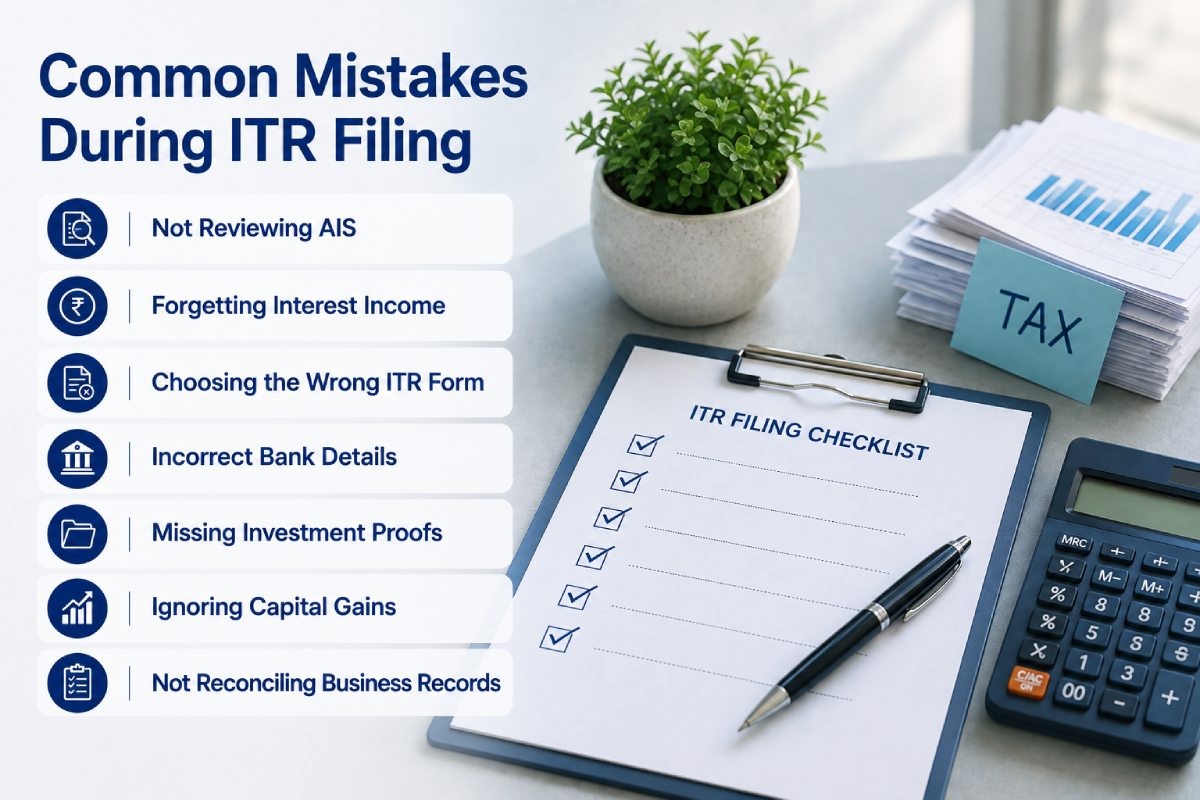
Common Mistakes During ITR Filing
Many taxpayers make avoidable mistakes that can lead to notices, delayed refunds, or defective returns. Avoid these common errors.
Not Reviewing AIS
Some taxpayers rely only on Form 16 and overlook the information available in the Annual Information Statement. Always compare both before filing.
Forgetting Interest Income
Interest earned from savings accounts, fixed deposits, or recurring deposits is often missed. Review all bank statements carefully.
Choosing the Wrong ITR Form
Using an incorrect return form can delay processing and may require corrective action.
Incorrect Bank Details
Refund delays frequently occur because of:
- Incorrect Account Number
- Wrong IFSC Code
- Closed Bank Accounts
Always verify your bank details before submission.
Missing Investment Proofs
Claim deductions only when you have proper supporting documentation.
Ignoring Capital Gains
Taxpayers often overlook gains from:
- Shares
- Mutual Funds
- Property
- Gold
Maintain complete transaction records.
Not Reconciling Business Records
Business owners should ensure consistency between:
- Books of Accounts
- GST Returns
- Financial Statements
- Income Tax Return
Quick Filing Checklist
Before clicking “Submit,” confirm that you have:
- Verified PAN and Aadhaar details
- Reviewed Form 16
- Checked Form 26AS
- Compared AIS and TIS
- Verified all bank accounts
- Reported every income source
- Claimed only eligible deductions
- Verified investment documents
- Selected the correct ITR form
- Reviewed all entries carefully
Final Income Tax Return Filing Checklist Before You Submit Your Return
After collecting all the required documents and completing your Income Tax Return, it is essential to perform one final review before submission. Many taxpayers focus only on entering income and deduction details but overlook small mistakes that can result in delayed refunds, defective returns, or notices from the Income Tax Department.
A final review takes only a few minutes and can help ensure your Income Tax Return Filing is accurate, complete, and compliant. Use the checklist below before submitting your return.
Final Verification Checklist
Before filing your Income Tax Return, verify that you have:
- Checked PAN and Aadhaar details
- Selected the correct Assessment Year
- Chosen the correct ITR Form
- Reported all sources of income
- Verified Form 16 details
- Compared Form 26AS with your return
- Reviewed AIS and TIS information
- Verified bank account details
- Claimed only eligible deductions
- Reported capital gains correctly
- Included interest income from all bank accounts
- Verified rental income (if applicable)
- Reviewed business income calculations
- Attached or preserved all supporting documents
- Reviewed every figure before submission
Completing this checklist can significantly reduce the chances of errors during processing.
ITR Filing Checklist for Salaried Employees
Salaried individuals generally have a straightforward filing process, but they should still review all income and deduction details carefully.
Personal Information
- PAN
- Aadhaar
- Address
- Mobile Number
- Email Address
- Bank Details
Salary Documents
- Form 16
- Salary Slips
- Bonus Statements
- Employer Reimbursements
Tax Documents
- Form 26AS
- AIS
- TIS
Investment Documents
- ELSS Statements
- PPF
- NPS
- Insurance Premium Receipts
- Tax Saving Fixed Deposits
Other Income
- Do not forget to report:
- Savings Account Interest
- Fixed Deposit Interest
- Dividend Income
- Rental Income
- Capital Gains
- Freelance Income (if any)
ITR Filing Checklist for Businesses
Business taxpayers require more comprehensive documentation.
Before filing, ensure you have:
Financial Statements
- Profit & Loss Account
- Balance Sheet
- Trial Balance
- Cash Flow Statement (where applicable)
Accounting Records
- General Ledger
- Cash Book
- Purchase Register
- Sales Register
- Journal Entries
- Stock Records
GST Documents
- GST Returns
- GST Reconciliation
- Input Tax Credit Records
- Annual GST Summary
Banking Records
Business Bank Statements
Loan Statements
Interest Certificates
Supporting Documents
- Purchase Invoices
- Sales Invoices
- Office Rent Agreements
- Employee Salary Records
- Utility Bills
- Professional Expenses
Businesses should also reconcile their accounting records with GST returns and bank statements before filing.
ITR Filing Checklist for Freelancers and Consultants
Freelancers often earn income from multiple clients, making proper record-keeping even more important.
Checklist includes:
- Client Invoices
- Payment Receipts
- Bank Statements
- Expense Records
- Professional Tax Records (where applicable)
- GST Records (if applicable)
- Investment Proofs
- Interest Certificates
Maintaining organised financial records throughout the year simplifies tax filing and future assessments.
ITR Filing Checklist for Partnership Firms
Partnership firms should prepare:
- Partnership Deed
- Profit & Loss Statement
- Balance Sheet
- Capital Account Details
- Partner Remuneration Details
- GST Records
- Audit Report (where applicable)
- Loan Statements
- Investment Records
ITR Filing Checklist for Companies
Companies generally require extensive documentation before filing.
Common records include:
- Audited Financial Statements
- Tax Computation
- Board Resolutions (where applicable)
- GST Returns
- Books of Accounts
- TDS Records
- Fixed Asset Register
- Bank Statements
- Statutory Registers
Maintaining accurate corporate records supports timely and compliant tax filing.
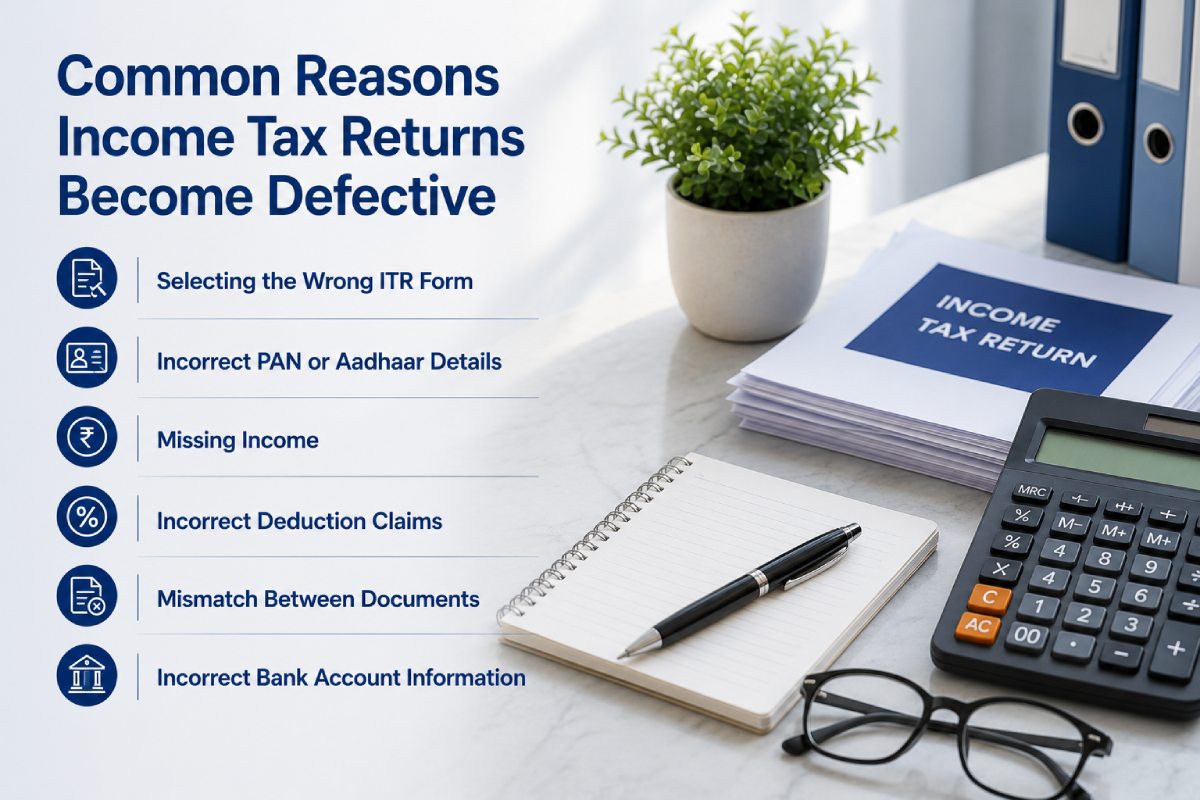
Common Reasons Income Tax Returns Become Defective
Even when filed on time, an Income Tax Return may require further attention if important information is missing or inconsistent.
Common reasons include:
Selecting the Wrong ITR Form
Using an incorrect return form can delay processing and may require corrective action.
Incorrect PAN or Aadhaar Details
Personal information should exactly match official records.
Missing Income
Taxpayers sometimes forget to report:
- Bank Interest
- Dividend Income
- Rental Income
- Capital Gains
- Freelance Income
- Foreign Income (where applicable)
Incorrect Deduction Claims
Claim deductions only when supported by proper documentation.
Mismatch Between Documents
Differences between:
- Form 16
- Form 26AS
- AIS
- Bank Statements
- Business Accounts
may result in further clarification requests.
Incorrect Bank Account Information
Refund processing can be delayed due to incorrect account numbers or IFSC codes.
What Happens After Filing Your Income Tax Return?
Submitting your return is not the final step in the tax filing process. After filing, taxpayers should continue to monitor the status of their return and retain all supporting records.
Typically, the post-filing process includes:
Return Verification
Complete the applicable verification process so that your return is treated as valid.
Return Processing
The Income Tax Department processes the filed return and reviews the information submitted.
Refund or Tax Demand
Depending on the outcome of processing, taxpayers may receive:
- A tax refund, if excess tax has been paid.
- A tax demand, if additional tax is payable.
- An intimation confirming the processing of the return.
Future Reference
Keep copies of:
- Filed ITR
- Acknowledgement
- Form 16
- Form 26AS
- AIS
- Bank Statements
- Investment Proofs
These documents may be useful for future financial, tax, or loan-related requirements.
Why Professional Tax Assistance Makes a Difference
Although many taxpayers can file returns independently, professional guidance becomes valuable in situations involving:
- Multiple income sources
- Business income
- Capital gains
- Foreign assets or overseas income
- Rental properties
- GST reconciliation
- Partnership firms
- Companies
- Tax notices
- Complex deductions
Searching for chartered accountant firms near me or the best CA firm in Mumbai can help you find experienced professionals who can review your return, identify potential issues, and ensure compliance with the latest tax requirements. Professional assistance can also reduce the risk of errors that may lead to delayed refunds or future notices.
Why Choose Whitespace Consultancy?
At Whitespace Consultancy, we help individuals and businesses file accurate and compliant Income Tax Returns while simplifying the overall tax compliance process.
Our services include:
- Income Tax Return Filing
- Tax Planning
- Income Tax Notice Assistance
- Business Tax Compliance
- Accounting Services
- GST Compliance
- Audit & Assurance
- Payroll Support
- Business Advisory
- Virtual CFO Services
Why Clients Trust Us?
Experienced Chartered Accountants
Our team has extensive experience assisting salaried employees, professionals, startups, SMEs, partnership firms, and companies with tax compliance and return filing.
Accurate Documentation
We review financial records carefully to minimise errors and ensure that your return is complete and well-supported.
End-to-End Support
From collecting the documents required for ITR filing in India to reviewing deductions and completing the filing process, we guide clients at every stage.
Timely Compliance
Our structured approach helps clients meet filing deadlines while reducing last-minute stress.
Tailored Solutions
Whether you need help filing a simple salary return or managing complex business taxation, we provide solutions based on your specific requirements.
Frequently Asked Questions (FAQs)
What is an Income Tax Return Filing Checklist?
An Income Tax Return Filing Checklist is a list of documents, financial records, and verification steps that taxpayers should complete before filing their Income Tax Return to ensure accuracy and compliance.
What are the documents required for ITR filing in India?
Common documents required for ITR filing in India include PAN, Aadhaar, Form 16, Form 26AS, AIS, TIS, bank statements, investment proofs, home loan certificates, capital gains statements, and business financial records, depending on the taxpayer’s income sources.
Is Form 16 mandatory for filing an ITR?
No. While Form 16 is a valuable document for salaried employees, taxpayers who do not receive it may still be able to file their return using other relevant income records and supporting documents.
How many months bank statement required for ITR filing?
There is no prescribed requirement for a fixed number of months of bank statements solely for filing an Income Tax Return. However, maintaining statements covering the relevant financial year is recommended for accurate reporting and record-keeping.
How to file income tax return online for salaried employee?
The process generally involves collecting all required documents, selecting the appropriate ITR form, verifying income and tax details, reviewing deductions, submitting the return through the Income Tax Department’s prescribed process, and completing the required verification.
Can I file my Income Tax Return without AIS?
AIS is an important source of information for verifying reported financial transactions. Reviewing it before filing helps ensure that all reportable income has been correctly disclosed.
What if I have multiple bank accounts?
Income and interest from all relevant bank accounts should be considered while preparing your Income Tax Return.
Should business owners maintain GST records before filing?
Yes. Businesses registered under GST should reconcile GST records with their accounting records before filing their Income Tax Return.
Can I revise my Income Tax Return after filing?
The ability to revise a return depends on the applicable provisions of the Income-tax Act and the timelines prescribed for the relevant assessment year.
Why should I hire a Chartered Accountant?
Professional guidance can be beneficial for taxpayers with business income, capital gains, multiple income sources, complex deductions, or tax notices, helping ensure accurate compliance and reducing the risk of errors.
What is an Income Tax Return Filing Checklist?
An Income Tax Return Filing Checklist is a list of documents, financial records, and verification steps that taxpayers should complete before filing their income tax return. It helps ensure accurate reporting of income, deductions, taxes paid, and supporting information while reducing the risk of errors or notices.
What documents are required for ITR filing in India?
The documents required for ITR filing in India may include PAN, Aadhaar, Form 16, Form 26AS, AIS, salary slips, bank statements, investment proofs, home loan certificates, capital gains statements, business financial statements, GST records (where applicable), and other documents relevant to the taxpayer’s income sources.
How many months bank statement required for ITR filing?
There is no fixed rule requiring a specific number of months of bank statements solely for ITR filing. However, taxpayers should maintain bank statements covering the relevant financial year and ensure they can support the income, deductions, and transactions reported in their return. The exact requirement may vary depending on the taxpayer’s circumstances and any subsequent verification.
Key Takeaways
- A well-prepared Income Tax Return Filing Checklist helps ensure that all income, deductions, and tax credits are accurately reported.
- Keeping the documents required for ITR filing in India organised before filing can save time and reduce the likelihood of mistakes.
- There is no fixed requirement regarding how many months bank statement required for ITR filing, but maintaining records for the relevant financial year is a good practice.
- Salaried employees and businesses have different documentation requirements, making a customised checklist essential.
- Consulting experienced chartered accountant firms near me or the best CA firm in Mumbai can simplify the filing process, especially for complex tax situations.
Conclusion
ITR Filing is not just about meeting a statutory deadline, it is an opportunity to review your financial records, claim eligible tax benefits, and maintain long-term compliance. Whether you’re a salaried employee filing your first return or a business managing multiple financial transactions, preparation is the key to a smooth filing experience.
By following a structured Income Tax Return Filing Checklist, reviewing all supporting documents, and verifying your information before submission, you can minimise errors and improve the overall efficiency of the filing process. If your tax situation involves multiple income streams, investments, business operations, or complex deductions, seeking professional advice can provide additional confidence and help ensure your return is accurate and compliant.
Need Help with Income Tax Return Filing?
Preparing and filing your Income Tax Return doesn’t have to be stressful. At Whitespace Consultancy, our experienced Chartered Accountants assist individuals, professionals, startups, SMEs, partnership firms, and companies with:
- Income Tax Return Filing
- Tax Planning
- Business Tax Compliance
- Accounting Services
- GST Compliance
- Audit & Assurance
- Income Tax Notice Assistance
- Virtual CFO Services
If you’re looking for chartered accountant firms near me or the best CA firm in Mumbai, contact Whitespace Consultancy for reliable, timely, and professional tax support.