

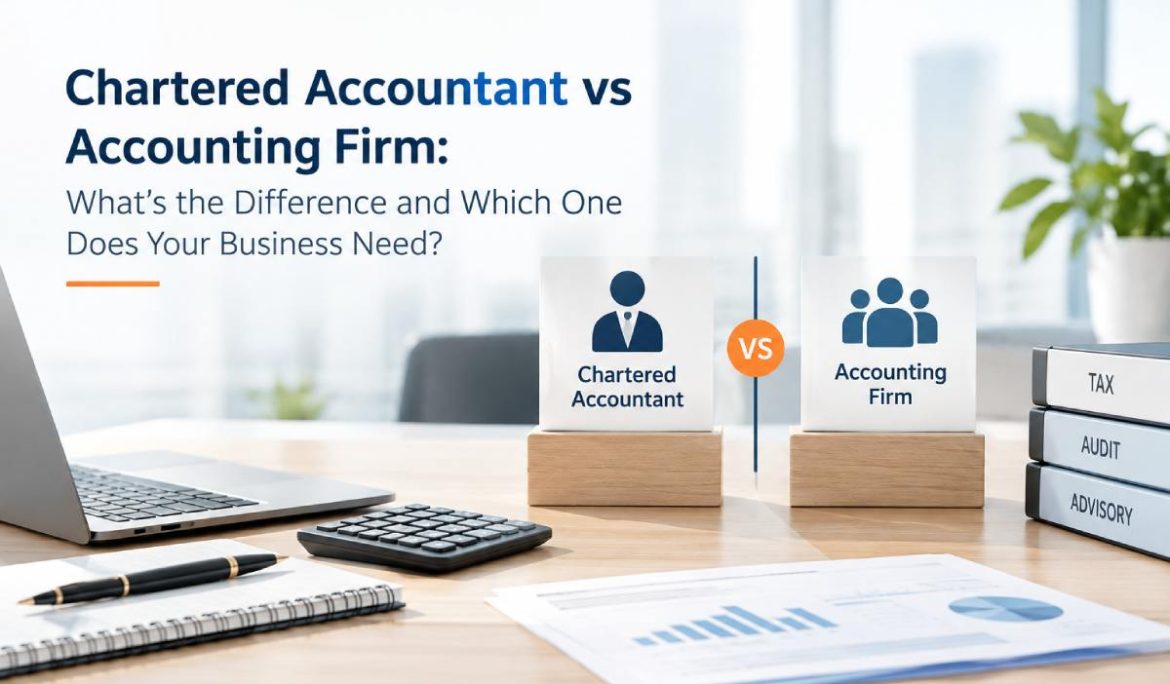
Chartered Accountant vs Accounting Firm: What’s the Difference and Which One Does Your Business Need?
Choosing professional financial support can become confusing as a business grows.
- Should you hire an individual Chartered Accountant?
- Should you work with a CA firm in Mumbai?
- Would an accounting firm in Mumbai be enough for bookkeeping and compliance?
- Or should you choose a firm that provides accounting, taxation, GST, audit and business advisory under one roof?
These options can overlap, but they are not exactly the same.
The biggest difference is that “Chartered Accountant” describes a qualified professional, while an “accounting firm” describes an organisation or service provider offering accounting-related services. A CA may work independently or through a CA firm, while an accounting firm may offer bookkeeping and accounting services with or without providing the full range of regulated CA services.
For a business owner, the right choice depends on the complexity of the business, the services required, the level of advisory needed, and whether the business expects those requirements to grow. This guide explains chartered accountant vs accounting firm, compares the two options, and explains when businesses should choose an individual CA, a CA firm, or an accounting firm.
What Is the Difference Between a Chartered Accountant and an Accounting Firm?
A Chartered Accountant (CA) is a professionally qualified individual who can provide services within the scope of their professional qualifications and applicable regulations. An accounting firm is an organisation that provides accounting-related services, which may include bookkeeping, accounting, payroll, reporting, and financial support. The exact services and professional qualifications available depend on the firm.
In simple terms: A Chartered Accountant is a professional; an accounting firm is a service organisation. A CA can operate independently or as part of a CA firm, while an accounting firm may provide accounting services through a broader team. Therefore, the difference between CA and accounting firm is not always an apples-to-apples comparison.
A more useful comparison is:
- Individual CA.
- CA Firm
- Accounting Firm
Chartered Accountant vs Accounting Firm: Quick Comparison
| Factor | Chartered Accountant | Accounting Firm |
| Accounting & Bookkeeping | ✓ | ✓ |
| Income Tax | ✓, within applicable scope | Depends on firm |
| GST | ✓ | Depends on expertise |
| Audit | ✓, where appropriately engaged | Depends on professionals and scope |
| Tax Planning | ✓ | Depends on expertise |
| Business Advisory | ✓ | Depends on firm |
| Virtual CFO | Possible | Depends on firm |
| Partner-Level Advice | Depends on practice | Depends on firm |
| Scalability | Individual capacity may vary | Usually broader team capacity |
| Multiple Services | Depends on practice | Often available |
| Suitable For | Individuals and businesses | Businesses needing accounting support |
The table provides a general comparison. The actual services available depend on the professional, firm’s structure, qualifications, registrations and engagement scope.
Chartered Accountant vs Accounting Firm Difference: Why It Matters
The chartered accountant vs accounting firm difference becomes important when a business moves beyond basic bookkeeping.
For example, a business may initially need:
- Recording transactions
- Bank reconciliation
- Invoicing
- Accounts payable
- Accounts receivable
An accounting service provider may be able to handle these requirements.
But as the business grows, it may also need:
- Income Tax
- GST advisory
- Tax planning
- Audit
- Financial reporting
- Tax notice assistance
- Business restructuring
- Funding support
- Virtual CFO services
At that point, the business needs to evaluate whether its provider has the appropriate professional expertise and service capacity.
Individual Chartered Accountant vs CA Firm vs Accounting Firm
Before choosing one, understand the three common models.
1. Individual Chartered Accountant
A business accountant Mumbai businesses rely on can help maintain day-to-day financial records while the CA focuses on professional matters. You work directly with one CA.
This can be suitable when you value:
- Direct communication
- Personal attention
- Straightforward requirements
- Individual tax work
- Small business support
- Specific advisory assignments
The potential limitation is capacity.
If the business suddenly requires:
- High-volume bookkeeping
- Multiple GST registrations
- Payroll
- MIS
- Audit coordination
- CFO advisory
one individual may not have the same team capacity as a larger firm.
2. CA Firm
A CA firm in Mumbai typically operates with one or more qualified professionals and support staff.
Depending on the firm’s capabilities, it may provide:
- Accounting
- GST
- Income Tax
- TDS
- Audit
- Tax planning
- Financial reporting
- Business advisory
- Virtual CFO
- Tax notice assistance
The main advantage can be the breadth of expertise and scalability. A growing business may be able to obtain multiple financial services through one professional relationship.
3. Accounting Firm
An accounting firm generally focuses on accounting and related financial operations.
Services may include:
- Bookkeeping
- Accounting
- Bank reconciliation
- Accounts payable
- Accounts receivable
- Payroll processing
- Financial statements
- Management reporting
However, the exact scope varies considerably. Some accounting firms may also have qualified tax professionals or CAs.
Others may focus primarily on accounting operations. Therefore, don’t assume that every accounting firm provides the same tax, audit or advisory services as a CA practice.
What Does an Individual Chartered Accountant Do?
A Chartered Accountant can support businesses across several financial areas, depending on professional scope and engagement.
Typical areas can include:
Accounting
- Financial accounting
- Review of books
- Financial statements
Taxation
- Income Tax
- Tax computation
- Tax planning
- Tax notices
GST
- GST compliance
- GST advisory
- ITC review
- GST reconciliation
Audit
- Statutory audit
- Tax audit
- Other applicable audit/assurance assignments
Advisory
- Financial planning
- Business restructuring
- Cash-flow management
- Business advisory
The advantage of working directly with a CA is that you can receive professional advice directly from the qualified individual.
What Does an Accounting Firm Do?
An accounting firm generally focuses on maintaining and managing financial records.
Its services may include:
Bookkeeping
Recording:
- Sales
- Purchases
- Expenses
- Receipts
- Payments
Reconciliation
- Bank reconciliation
- Vendor reconciliation
- Customer reconciliation
Accounts Receivable
Monitoring:
- Outstanding invoices
- Customer balances
- Collections
Accounts Payable
Tracking:
- Supplier invoices
- Payment schedules
- Outstanding liabilities
Payroll
Depending on the firm’s scope:
- Salary calculations
- Payroll accounting
- Employee records
- Payroll reports
Financial Reporting
Preparing:
- Profit & Loss
- Balance Sheet
- Trial Balance
- Management reports
For businesses primarily looking for accounting operations, an accounting firm may be an appropriate choice.
CA Firm vs Accounting Firm: The Important Distinction
The CA firm vs accounting firm comparison becomes clearer when you look at the broader service scope.
A CA firm may be positioned to provide:
- Accounting
- Taxation
- GST
- Audit
- Tax Planning
- Business Advisory
An accounting firm may primarily provide:
- Accounting
- Bookkeeping
- Reporting
- Payroll
However, this is not an absolute distinction.
Some accounting firms offer broader tax and advisory services, while some individual CAs may focus on a narrow practice area. Therefore, evaluate the actual services and qualifications of the provider, not just the label used on its website.
Can One Firm Provide Both Accounting and CA Services?
Yes, depending on the firm’s structure and professional capabilities. This can be an attractive model for businesses because accounting and professional advisory are closely connected.
For example:
Daily Accounting
↓
GST Reconciliation
↓
Tax Computation
↓
Financial Statements
↓
Audit
↓
Tax Planning
↓
Business Advisory
When these functions are coordinated, the CA can work with financial information already maintained by the accounting team. This can reduce duplication and improve financial visibility.
Why Integrated Accounting + CA Services Can Be Useful
Imagine an SME that uses:
- One accountant for bookkeeping
- Another consultant for GST
- Another CA for Income Tax
- Another auditor
- Another advisor for financial planning
The business may have to coordinate information across several providers. An integrated firm can potentially simplify this.
The flow can become:
Accounting Team
↓
GST & Tax Team
↓
CA Review
↓
Audit
↓
Advisory
The actual structure depends on the firm’s team and engagement model, but the advantage is that the business can have a more connected financial process.
When Should You Hire an Individual Chartered Accountant?
An individual CA may be a good fit when your requirements are relatively focused.
For example:
Individual Tax Filing
You need assistance with:
- ITR
- Capital gains
- Tax computation
- Tax planning
Small Business
You have:
- Limited transactions
- Simple operations
- Few employees
- Straightforward GST requirements
Specific Advisory
You need advice regarding:
- Business structure
- Tax planning
- A particular transaction
- Financial decision
Direct Communication
You prefer working directly with one professional.
For these situations, an individual CA can provide highly focused support.
When Should You Choose a CA Firm?
A CA firm in Mumbai may be more suitable when your business requires multiple services.
For example:
- Accounting
- GST
- Income Tax
- TDS
- Audit
- Financial reporting
- Tax planning
- Business advisory
A CA firm can also be beneficial when the business is growing and needs more than one person to manage financial activities.
When Is an Accounting Firm Better?
An accounting firm can be suitable when your primary requirement is financial operations.
For example:
You Need Daily Bookkeeping
Your business has hundreds of monthly transactions.
Your Internal Team Is Overloaded
Your existing employees cannot keep up with bookkeeping.
You Need Monthly Accounts
You want regular:
- P&L
- Balance Sheet
- Cash-flow reports
You Need Outsourced Accounting
You don’t want to build a large internal finance team.
Your Tax Matters Are Straightforward
You can use a separate qualified professional for tax and audit requirements where needed.
What Should Startups Choose?
Startups often ask: Should we hire a Chartered Accountant or an accounting firm? The answer depends on the startup stage.
Early-Stage Startup
A startup may initially need:
- Business formation
- Accounting setup
- GST
- Tax planning
- Basic bookkeeping
An individual CA or small CA firm may be sufficient.
Growing Startup
Once the startup begins generating significant revenue, it may need:
- Monthly accounting
- GST reconciliation
- TDS
- Payroll
- Financial reporting
- Cash-flow management
An integrated CA/accounting firm can become more useful.
Funded Startup
A funded startup may require:
- Financial statements
- MIS
- Investor reporting
- Budgeting
- Financial projections
- Due diligence
- Tax compliance
A firm with broader accounting and advisory capabilities may be more suitable.
Scale-Up
A rapidly growing startup may eventually need:
- Virtual CFO
- Financial modelling
- Working-capital planning
- Strategic finance
- Internal controls
At this stage, service capacity becomes increasingly important.
What Should Small Businesses Choose?
A small business should first identify its actual requirements.
If You Need:
- Only bookkeeping → An accounting provider may be sufficient.
- Bookkeeping + GST + Tax → Consider a CA or integrated accounting/CA firm.
- Accounting + GST + Tax + Audit + Advisory → A CA firm may be more suitable.
- Accounting + CFO-level support → Consider an accounting/CA firm offering Virtual CFO services.
The important point is to avoid paying for services you don’t actually need while also avoiding under-investing in critical financial functions.
What Should SMEs Choose?
SMEs generally have more complex financial requirements.
They may deal with:
- Large transaction volumes
- Multiple employees
- Inventory
- Loans
- Multiple GST registrations
- Multiple locations
- Significant receivables
- Audit requirements
An SME may therefore benefit from a broader service model:
Accounting
↓
GST
↓
TDS
↓
Income Tax
↓
Audit
↓
MIS
↓
Tax Planning
↓
Business Advisory
This is where a CA firm vs accounting firm decision should focus heavily on the firm’s ability to provide integrated support.
What Should Established Businesses Choose?
An established company may require a more sophisticated finance function.
Potential requirements include:
- Statutory audit
- Tax planning
- Financial reporting
- Internal controls
- Cash-flow forecasting
- Working-capital management
- Financial modelling
- Business valuation
- Transaction support
- CFO advisory
An established business should therefore evaluate not just whether a provider can “do accounting,” but whether it can support the company’s broader financial requirements.
Chartered Accountant or Accounting Firm: Decision Table
| Your Requirement | Recommended Option |
| Individual ITR | Individual CA |
| Simple tax planning | Individual CA |
| Small business bookkeeping | Accounting firm or CA |
| GST + accounting | CA/accounting firm with GST expertise |
| Accounting + tax | CA or integrated firm |
| Audit | Appropriate CA/audit professional |
| High-volume bookkeeping | Accounting firm/team |
| Accounting + GST + Tax + Audit | CA firm |
| Monthly MIS | Accounting/CA firm |
| Tax notice assistance | CA |
| Startup fundraising | CA firm with advisory capability |
| Virtual CFO | CA/advisory firm with suitable expertise |
| Complex SME finance | CA firm/integrated finance provider |
| Strategic financial advisory | CA/advisory firm |
How to Choose Between a CA and Accounting Firm
A business accountant Mumbai businesses should be assessed alongside the wider accounting and professional support they require. Instead of asking: “Which one is better?” ask: “Which service model matches my business?”
Use these five questions.
Question 1: What Do I Actually Need?
List your requirements:
- Bookkeeping
- Accounting
- GST
- Income Tax
- TDS
- Audit
- Financial reporting
- Tax planning
- Advisory
Then compare providers against that list.
Question 2: How Complex Is My Business?
Consider:
- Turnover
- Transactions
- Employees
- GST registrations
- Locations
- Inventory
- Loans
- Tax complexity
Greater complexity usually requires broader professional capability.
Question 3: Do I Need Advisory or Just Execution?
This is one of the most important distinctions.
Execution
“Please maintain my books and file my returns.”
Advisory
- “Should we expand?”
- “How should we structure this transaction?”
- “Why is our cash flow declining?”
- “How much working capital will we need?”
If you need the second type of support, evaluate CA and advisory capabilities carefully.
Question 4: How Much Scalability Do I Need?
A business with 50 transactions a month has different requirements from one with 5,000.
Ask:
- Can this provider handle my business if transaction volumes double?
- Can they support additional GST registrations?
- Can they provide monthly reporting?
- Can they add advisory support later?
Question 5: Who Will Actually Work on My Account?
Don’t just ask: “Do you provide CA services?”
Ask:
- Who handles bookkeeping?
- Who reviews GST?
- Who handles Income Tax?
- Who handles audit?
- Who reviews complex matters?
- Who is my primary contact?
- Will a senior CA be involved?
This tells you much more about the actual service.
What Does “Best CA Firm in Mumbai” Actually Mean?
Businesses often search for the best CA firm in Mumbai. But “best” is subjective. The largest firm may not be the best choice for a small business. The cheapest firm may not provide the required level of advisory. A highly specialised firm may not offer the broad accounting services you need.
Instead, define “best” according to:
- Relevant experience
- Service scope
- Communication
- Professional expertise
- Technology
- Pricing transparency
- Responsiveness
- Scalability
- Business understanding
The best provider is ultimately the one that fits your business requirements.
How Much Does the Choice Cost?
The cost of a CA or accounting firm can vary significantly.
Factors include:
- Transaction volume
- Turnover
- Number of GST registrations
- Number of employees
- Accounting complexity
- Tax requirements
- Audit requirements
- Reporting frequency
- Advisory requirements
For example:
A freelancer needing annual ITR filing has very different requirements from a ₹10 crore SME with 60 employees, inventory, multiple GST registrations, and monthly MIS reporting. Therefore, don’t compare providers purely on monthly fees.
Compare: Scope + Expertise + Service Level + Reporting + Advisory + Scalability
Common Mistakes When Choosing Between a CA and Accounting Firm
Mistake 1: Choosing Based Only on Price
The lowest fee may not provide the services your business actually needs.
Mistake 2: Assuming Every Accounting Firm Provides CA Services
Always verify the actual qualifications and professional scope of the people handling tax, audit, and advisory work.
Mistake 3: Hiring a CA Only for Annual Filing
A business may miss valuable opportunities for proactive tax planning and financial review.
Mistake 4: Ignoring Technology
Manual accounting processes can become inefficient as transaction volumes grow.
Mistake 5: Not Asking Who Handles the Account
The person selling the service may not be the person actually managing your financial records.
Mistake 6: Not Checking Scalability
Your provider should ideally be capable of supporting the business as its requirements increase.
Red Flags to Watch For
Be cautious if a provider:
- Cannot clearly explain the scope.
- Makes unrealistic tax-saving promises.
- Offers no documentation process.
- Doesn’t explain additional charges.
- Has no clear communication channel.
- Cannot explain who will handle your account.
- Has no process for reviewing financial records.
- Treats every client exactly the same.
- Focuses only on filing rather than understanding the business.
Can a CA Firm Also Provide Accounting Services?
Yes. A CA firm may provide or coordinate accounting and bookkeeping services alongside taxation, GST, audit and advisory, depending on its team, practice structure and engagement scope.
This can be useful for businesses that want:
One Financial Partner
for:
- Accounting
- GST
- Tax
- Audit
- Reporting
- Advisory
However, businesses should confirm exactly what is included in the engagement.
Can an Accounting Firm Also Work With Chartered Accountants?
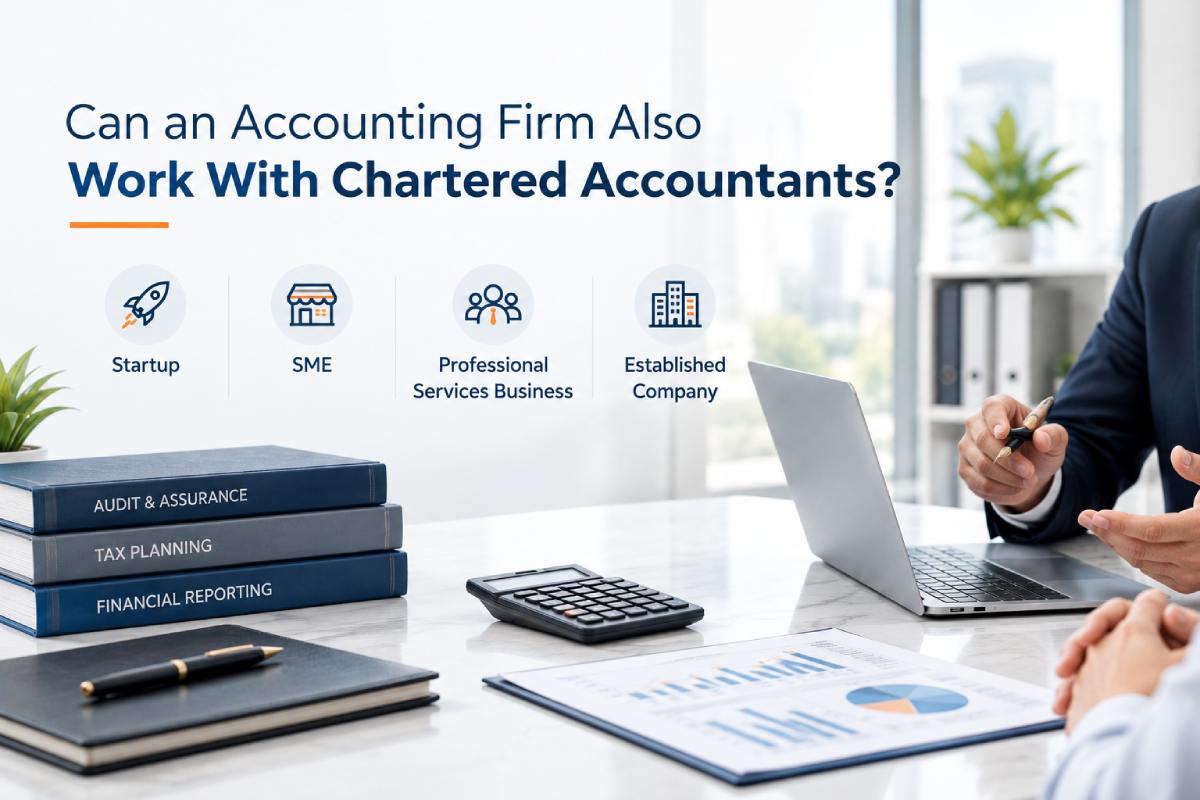
Yes. An accounting firm can have Chartered Accountants as part of its team or work alongside external CAs and other professionals. The important question is not the label.
The important question is: Does the provider have the right professional expertise for the work you are asking it to perform?
Real Business Example: Startup
A business accountant Mumbai startups can work with may support bookkeeping and financial reporting as transaction volumes increase.
Consider a Mumbai startup with:
- ₹1 crore annual revenue
- 12 employees
- GST registration
- Online sales
- Multiple vendors
The founder initially needs:
- Accounting
- GST
- TDS
- Income Tax
- Payroll
Later, investors request:
- Monthly MIS
- Financial projections
- Cash-flow forecasts
An integrated CA/accounting firm may now be more suitable than a basic bookkeeping provider.
Real Business Example: SME
The business can also compare a business accountant Mumbai provider with an integrated professional finance model.
An SME has:
- ₹15 crore turnover
- 70 employees
- Inventory
- Bank loans
- Multiple GST registrations
- Significant receivables
Its requirements include:
- Monthly accounting
- GST reconciliation
- TDS
- Audit
- Tax planning
- MIS
- Cash-flow management
For this business, an integrated CA firm in Mumbai may provide a broader solution than a bookkeeping-focused accounting provider.
Real Business Example: Professional Services Business
A consultant operates a small business with:
- Few employees
- Limited transactions
- No inventory
- Straightforward GST
- Simple tax structure
The business may only require:
- Bookkeeping
- GST
- ITR
- Annual tax review
An individual CA or small accounting/CA provider may be sufficient. There is no reason to purchase a complex CFO package simply because it is available.
Real Business Example: Established Company
An established company has:
- Multiple departments
- Several locations
- Large transaction volumes
- Significant working capital
- Multiple GST registrations
- Regular audits
Management needs:
- Financial reporting
- Tax planning
- Audit
- Cash-flow forecasting
- Business advisory
- Strategic finance
At this stage, the ability to provide multiple integrated services becomes much more important.
The Best Choice Depends on Your Business Stage
There is no universal winner in the chartered accountant vs accounting firm difference comparison.
Individual CA
Best suited to:
Focused professional requirements
Accounting Firm
Best suited to:
Accounting operations and outsourced finance support
CA Firm
Best suited to:
Integrated accounting, tax, GST, audit and advisory requirements
CA + Accounting Team
Best suited to:
Growing businesses requiring both operational accounting and senior financial expertise
The right answer is the one that matches your actual needs.
Chartered Accountant vs Accounting Firm – Services, Cost, Scalability & Business Requirements
The biggest mistake businesses make when comparing a chartered accountant vs accounting firm difference is assuming that one option is automatically better than the other. The better question is: Which provider has the right professional expertise, service scope, team capacity and technology for your business?
A freelancer with 20 monthly transactions does not need the same financial setup as an SME with ₹15 crore turnover, 50 employees, inventory, multiple GST registrations and bank financing. The following comparison will help you evaluate the options based on actual business requirements.
Chartered Accountant vs Accounting Firm: Service-by-Service Comparison
The difference becomes clearer when individual services are compared.
| Service | Individual Chartered Accountant | Accounting Firm | CA Firm |
| Bookkeeping | ✓ | ✓ | ✓ |
| Accounting | ✓ | ✓ | ✓ |
| Bank Reconciliation | ✓ | ✓ | ✓ |
| Accounts Payable | ✓ | ✓ | ✓ |
| Accounts Receivable | ✓ | ✓ | ✓ |
| GST Filing | ✓ | Depends on expertise | ✓ |
| GST Advisory | ✓ | Depends on expertise | ✓ |
| ITC Reconciliation | ✓ | Depends on expertise | ✓ |
| Income Tax Filing | ✓ | Depends on expertise | ✓ |
| Tax Planning | ✓ | Depends on expertise | ✓ |
| TDS Compliance | ✓ | Depends on expertise | ✓ |
| Statutory Audit | Subject to applicable professional requirements | Depends on professionals | ✓ |
| Tax Audit | ✓, where applicable | Depends on professionals | ✓ |
| Financial Reporting | ✓ | ✓ | ✓ |
| MIS Reporting | Possible | ✓ | ✓ |
| Tax Notice Assistance | ✓ | Depends on expertise | ✓ |
| Business Advisory | ✓ | Depends on expertise | ✓ |
| Virtual CFO | Possible | Depends on service model | Possible |
| Financial Modelling | Possible | Depends on expertise | ✓/Possible |
| Funding Support | Possible | Depends on expertise | ✓/Possible |
The important point is that not every provider offers every service simply because it uses the words “CA,” “accounting,” or “finance” in its branding. Always verify the actual service scope and the professionals responsible for the work.
1. Accounting and Bookkeeping
Accounting is where the services of a CA and accounting firm often overlap.
Both may provide:
- Recording sales
- Recording purchases
- Recording expenses
- Bank reconciliation
- Vendor reconciliation
- Customer reconciliation
- Journal entries
- Ledger maintenance
- Trial balance
- Financial statements
A chartered accountant or accounting firm may be particularly useful when the business needs a team to handle a high volume of routine accounting work. An individual CA may be more suitable when the business has a smaller accounting workload and wants direct professional involvement.
2. GST Services
GST can involve much more than filing a monthly or quarterly return.
Businesses may need:
- GST registration
- GST return filing
- GSTR-2B reconciliation
- Input Tax Credit review
- GST classification
- Reverse Charge Mechanism
- E-invoicing
- E-way bills
- GST notices
- GST advisory
If GST is an important part of your business, check whether the provider has specific GST expertise. A business should not assume that every accounting provider can handle complex GST matters.
3. Income Tax Services
An individual CA or CA firm can provide broader Income Tax support, depending on the engagement.
This may include:
- ITR filing
- Tax computation
- Advance tax
- Tax planning
- Capital gains
- Tax audit
- Income Tax notices
- Assessment support
- Business tax advisory
An accounting firm may also provide tax support, but the exact level of expertise should be verified.
4. TDS Compliance
Businesses making payments to employees, professionals, contractors, vendors or other parties may have TDS obligations.
A professional provider may assist with:
- TDS applicability
- Deduction calculations
- TDS deposits
- TDS returns
- Reconciliation
- TDS certificates
- Correction statements
- TDS notices
If TDS is becoming difficult to manage internally, this can be an important consideration when comparing a CA firm vs accounting firm.
5. Audit Services
Audit is another area where professional qualifications and regulatory requirements matter.
Depending on the assignment, businesses may require:
- Statutory audit
- Tax audit
- Internal audit
- Stock audit
- Compliance audit
- Due diligence
When an audit is required, businesses should ensure that the professional or firm handling the engagement is appropriately qualified and permitted to undertake the relevant assignment. A basic bookkeeping provider should not automatically be assumed to provide the same audit capabilities as a CA practice.
6. Tax Planning
Tax planning is different from simply filing an Income Tax Return. Tax planning involves considering applicable provisions before financial decisions are made.
For example:
- Business structure
- Investments
- Capital expenditure
- Asset purchases
- Business expansion
- Ownership changes
- Capital gains
- Timing of transactions
If your business needs proactive tax advice, this is an area where a Chartered Accountant in Mumbai may provide significant value.
7. Financial Reporting
An accounting firm may be particularly useful for preparing regular financial reports.
These can include:
- Profit & Loss
- Balance Sheet
- Cash Flow
- Trial Balance
- Accounts Receivable
- Accounts Payable
- Expense analysis
- Revenue reports
A CA can then use this financial information for:
- Tax planning
- Financial analysis
- Business advisory
- Audit
- Strategic planning
This is why an integrated accounting + CA model can be valuable for growing businesses.
8. MIS Reporting
Management Information System reporting helps business owners understand what is happening financially.
A monthly MIS may include:
| Report | Business Question |
| Revenue | How much are we selling? |
| Gross Margin | Are we making enough margin? |
| Expenses | Where is money being spent? |
| Receivables | Who owes us money? |
| Payables | What do we owe? |
| Cash Flow | How much cash is available? |
| Budget vs Actual | Are we meeting our plan? |
| Profitability | Which activities are profitable? |
If management requires these reports every month, an accounting firm with a dedicated reporting team or a CA firm offering MIS can be more suitable than a purely annual tax-filing relationship.
9. Business Advisory
This is where the difference between routine accounting and strategic financial support becomes particularly clear.
- Accounting answers: What happened?
- Advisory also asks: Why did it happen?
- And: What should we do next?
For example: Revenue increased by 30%. But cash decreased. A basic accounting report may show the numbers.
A business advisor may analyse:
- Receivables
- Inventory
- Supplier payments
- Working capital
- Margins
- Debt
and help management understand the reason for the cash-flow pressure.
10. Virtual CFO Services
A growing business may not be ready to hire a full-time CFO. A Virtual CFO arrangement can provide access to senior financial expertise without necessarily building a complete internal finance leadership team.
Services can include:
- Budgeting
- Forecasting
- Cash-flow management
- MIS
- Financial analysis
- Working-capital management
- Financial modelling
- Investor reporting
- Strategic financial planning
When comparing an accounting firm in Mumbai with a CA firm, ask whether either provider can offer CFO-level support as your business grows.
Accounting Firm vs CA Firm: Scalability
Scalability is one of the most important considerations for growing businesses.
Imagine your company currently has:
- 300 transactions/month
- 5 employees
- 1 GST registration
After two years:
- 3,000 transactions/month
- 30 employees
- 3 GST registrations
- Inventory
- Bank loans
Your financial requirements have changed dramatically.
A provider should ideally be able to scale from:
Basic Accounting
to:
Accounting + GST + Tax
to:
Financial Reporting + Advisory
to:
CFO-Level Support
without forcing you to rebuild the entire financial system.
Individual CA vs Firm: Scalability Comparison
| Requirement | Individual CA | Larger Firm |
| Small client base | ✓ | ✓ |
| Personal attention | Usually strong | Depends |
| High transaction volume | Capacity dependent | Usually stronger |
| Multiple specialists | Limited | Usually broader |
| Multiple GST registrations | Depends | Usually easier |
| Large accounting team | Limited | ✓ |
| Advanced reporting | Depends | Usually stronger |
| Virtual CFO | Possible | Possible |
| Business expansion | Capacity dependent | Usually easier |
| Backup resources | Limited | Usually broader |
This doesn’t mean a larger firm is automatically better. A small CA practice may provide excellent service and senior attention. The key is to assess capacity relative to your requirements.
Technology: What Should You Look For?
Modern accounting should not depend entirely on spreadsheets and email attachments.
When evaluating a chartered accountant or accounting firm, ask about:
- Cloud accounting
- Digital document collection
- Automated bank feeds
- Bank reconciliation
- GST integrations
- Payroll systems
- Digital approvals
- Secure document sharing
- MIS dashboards
- Accounting software integrations
Technology becomes particularly important when transaction volumes increase.
Cloud Accounting
Cloud accounting allows authorised users and professionals to access financial information from different locations.
This can be useful for:
- Remote teams
- Multi-location businesses
- Startup founders
- Businesses with outsourced accounting
- Management reporting
However, technology alone doesn’t guarantee good accounting.
The combination matters: Good Technology + Accurate Processes + Professional Review
Partner-Level Advice: Why It Matters
When comparing the difference between CA and accounting firm, ask: Who will actually advise me? For routine bookkeeping, a junior accountant may handle the work.
But for:
- Tax planning
- Business restructuring
- Funding
- Major transactions
- Tax notices
- Cash-flow problems
you may want access to a senior CA or experienced advisor.
Ask the provider:
- Who handles my daily accounting?
- Who reviews my accounts?
- Who handles complex tax matters?
- Can I speak directly with a senior CA?
- Who will advise me on major financial decisions?
Pricing: Chartered Accountant vs Accounting Firm
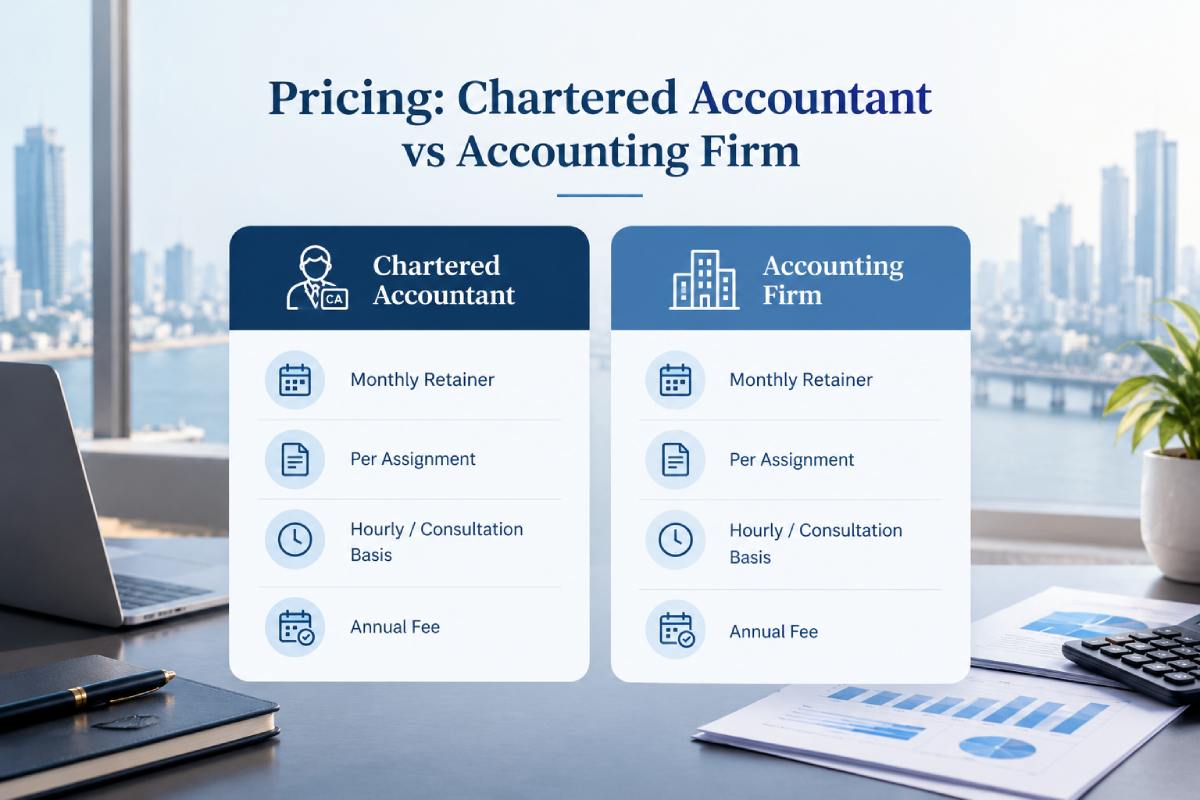
There is no universal pricing structure.
Fees may be based on:
Monthly Retainer
Common for:
- Accounting
- GST
- TDS
- Payroll
- Monthly reporting
Per Assignment
Common for:
- Company incorporation
- Tax filing
- Audit
- Specific advisory projects
Hourly/Consultation Basis
May be used for:
- Tax consultation
- Specific financial advice
- One-time professional opinions
Annual Fee
May apply to:
- Annual tax filing
- Audit
- Certain compliance assignments
What Affects the Cost?
Whether you choose an individual CA, CA firm in Mumbai, or accounting firm, pricing can depend on:
- Turnover
- Number of transactions
- Number of employees
- Number of GST registrations
- Accounting complexity
- Inventory
- Audit requirements
- Tax complexity
- Reporting frequency
- Advisory requirements
- Partner involvement
Therefore: Do not compare fees without comparing scope. A ₹5,000 monthly service and a ₹20,000 monthly service may be providing completely different levels of support.
Example: Why the Cheapest Option May Not Be the Best
Suppose:
Provider A
₹8,000/month
Includes:
- Basic bookkeeping
- GST filing
Provider B
₹18,000/month
Includes:
- Bookkeeping
- GST
- TDS
- Monthly MIS
- Bank reconciliation
- Tax planning review
- Quarterly financial review
For a very small business, Provider A might be perfectly adequate. For a growing SME, Provider B may provide substantially more value. The right choice depends on what your business actually needs.
Outsourcing vs In-House Finance Team
Businesses also need to decide whether to build an internal finance team or outsource accounting and professional finance services
In-House Finance Team
An internal team provides:
- Daily availability
- Direct operational control
- Business-specific knowledge
- Immediate access to records
But it can also involve:
- Salaries
- Recruitment
- Training
- Employee benefits
- Software
- Management overhead
- Additional hiring as the business grows
Outsourced Accounting/CA Firm
An outsourced model can provide:
- Professional expertise
- Flexible service scope
- Potentially lower fixed infrastructure
- Access to multiple specialists
- Scalable support
- External review
This can be particularly useful for startups and SMEs.
When Should You Outsource?
Outsourcing can make sense when:
- You don’t have enough accounting workload for a full-time team.
- Your finance team is overloaded.
- You need specialist tax knowledge.
- You need monthly financial reporting.
- You want to reduce administrative overhead.
- You need access to CA/advisory expertise.
- You want the ability to scale services.
When Should You Build an Internal Team?
An internal finance team may become appropriate when:
- Transaction volumes are very high.
- Finance operations are complex.
- You require daily on-site finance management.
- The business has multiple departments.
- Management requires constant internal financial support.
- The organisation has reached a scale where a dedicated finance function is justified.
Even then, many businesses continue using external CAs for audit, taxation, specialised advisory and independent review.
What Should a Startup Choose?
For most early-stage startups, the decision should focus on flexibility.
Stage 1
Individual CA / Small Firm
For:
- Formation
- Tax
- GST
- Accounting setup
Stage 2
Outsourced Accounting + CA
For:
- Bookkeeping
- GST
- TDS
- Payroll
- Monthly reporting
Stage 3
Integrated CA/Accounting Firm
For:
- Financial reporting
- Tax planning
- MIS
- Cash-flow
- Funding support
Stage 4
CA/Advisory + Internal Finance Team
For:
- CFO
- Strategic finance
- Financial modelling
- Investor reporting
- This allows the startup to increase professional support as it grows.
What Should an SME Choose?
An SME often benefits from an integrated financial model.
For example:
Accounting
↓
GST
↓
TDS
↓
Income Tax
↓
Audit
↓
MIS
↓
Tax Planning
↓
Business Advisory
Instead of managing each function independently, the SME can work with a provider capable of coordinating the financial information. This is where a CA firm in Mumbai may have an advantage over a narrowly focused accounting provider.
What Should an Established Business Choose?
An established company should focus on:
Expertise
Does the provider understand complex financial requirements?
Capacity
Can it manage high transaction volumes?
Reporting
Can management receive timely MIS?
Advisory
Can the provider support strategic decisions?
Tax
Can it handle complex tax matters?
Audit
Can it coordinate applicable audit requirements?
Scalability
Can the relationship continue as the business expands?
At this stage, the choice should be based on the complete finance ecosystem, not just bookkeeping.
10 Questions to Ask Before Hiring an Accounting or CA Firm
Before signing an engagement, ask:
1. What exactly is included?
Request a written scope.
2. Who will maintain the accounts?
Know whether the work is handled internally, by a dedicated team or outsourced further.
3. Who will review the accounts?
Ask whether a senior professional reviews the work.
4. Who handles GST?
Clarify whether GST filing and advisory are included.
5. Who handles Income Tax?
Understand whether tax computation, filing and planning are included.
6. Is audit included?
If your business requires an audit, clarify the scope separately.
7. Are monthly reports included?
Don’t assume MIS is part of basic bookkeeping.
8. What happens if I receive a notice?
Ask whether notice assistance is included or billed separately.
9. How are additional services charged?
Get clarity on:
- Certifications
- Consultations
- Notices
- Additional GST registrations
- Special assignments
10. Can you scale with my business?
Ask what happens when:
- Revenue increases
- Employees increase
- GST registrations increase
- Transaction volumes increase
- Funding occurs
A Simple Decision Tree
Use this framework:
Do you only need bookkeeping?
→ An accounting firm may be enough.
Do you need accounting + GST + Income Tax?
→ Consider an individual CA or integrated CA/accounting firm.
Do you need accounting + tax + GST + audit?
→ Consider a CA firm.
Do you need monthly MIS and financial analysis?
→ Look for an accounting/CA firm with reporting capabilities.
Do you need strategic financial advice?
→ Look for a CA/advisory firm.
Do you need CFO-level support?
→ Consider Virtual CFO services.
Do you need all of the above?
→ An integrated CA firm with accounting and advisory capabilities may be the most practical model.
How to Evaluate an Accounting Firm in Mumbai
If you are specifically looking for an accounting firm, evaluate:
Accounting Capability
Can they manage your transaction volume?
Software
What accounting platform do they use?
Reconciliation
Do they regularly reconcile bank, customer, and vendor balances?
Reporting
Will you receive monthly financial statements?
GST
Can they handle GST reconciliation?
Tax
Do they have appropriate tax expertise?
Team
Who will actually work on the account?
Communication
How quickly can you get support?
Security
How are financial documents protected?
Scalability
Can they support you when the business doubles?
How to Evaluate a CA Firm in Mumbai
When evaluating a CA firm in Mumbai, additionally consider:
- Professional qualifications
- Relevant industry experience
- Tax expertise
- GST expertise
- Audit capabilities
- Advisory experience
- Senior CA involvement
- Notice representation capability
- Financial reporting
- Virtual CFO capabilities
- Pricing transparency
The goal is to determine whether the firm’s expertise matches your current and future needs.
Why Location Alone Shouldn’t Decide Your Choice
Searching for an accounting Provider or CA firm can help you find local providers, but location should not be the only deciding factor.
A good professional relationship also depends on:
- Communication
- Technology
- Responsiveness
- Expertise
- Industry knowledge
- Service scope
- Transparency
A digitally enabled firm can support businesses across Mumbai even when much of the accounting process is conducted online.
Which One Should You Choose? Final Decision Guide, FAQs & SEO Setup
The difference between CA and accounting firm decision ultimately comes down to one question: What level of financial support does your business actually need today-and what will it likely need as it grows? There is no universal answer. An individual Chartered Accountant can be ideal for a professional, freelancer, or small business with straightforward requirements.
Accounting services in Mumbai can be a better fit when the primary need is high-volume bookkeeping, accounting operations, and regular financial reporting. A CA firm can be particularly suitable when the business needs a combination of accounting, GST, taxation, audit, and advisory.
For a growing company, an integrated model can provide the best of both worlds: Accounting Team → CA Review → Tax & GST → Financial Reporting → Business Advisory
Chartered Accountant vs Accounting Firm: Which One Is Better?
Neither is automatically better. The right choice depends on your requirements.
| Business Requirement | Individual CA | Accounting Firm | CA Firm |
| Individual ITR | ⭐⭐⭐ | ⭐⭐ | ⭐⭐⭐ |
| Basic Bookkeeping | ⭐⭐ | ⭐⭐⭐ | ⭐⭐⭐ |
| Small Business Accounting | ⭐⭐⭐ | ⭐⭐⭐ | ⭐⭐⭐ |
| GST Compliance | ⭐⭐⭐ | ⭐⭐ | ⭐⭐⭐ |
| Complex Tax Planning | ⭐⭐⭐ | ⭐ | ⭐⭐⭐ |
| Audit | ⭐⭐⭐ | Depends | ⭐⭐⭐ |
| Monthly MIS | ⭐⭐ | ⭐⭐⭐ | ⭐⭐⭐ |
| High-Volume Accounting | ⭐ | ⭐⭐⭐ | ⭐⭐⭐ |
| Business Advisory | ⭐⭐⭐ | ⭐⭐ | ⭐⭐⭐ |
| Virtual CFO | ⭐⭐ | Depends | ⭐⭐⭐ |
| Startup Support | ⭐⭐⭐ | ⭐⭐⭐ | ⭐⭐⭐ |
| SME Support | ⭐⭐ | ⭐⭐⭐ | ⭐⭐⭐ |
| Large Business | Depends on capacity | ⭐⭐⭐ | ⭐⭐⭐ |
The ratings are a practical framework rather than a statement that every provider offers the same services. Always verify the actual scope, qualifications and engagement terms before making a decision.
Which Option Should a Freelancer Choose?
A freelancer or individual professional may have:
- Limited transactions
- One or two bank accounts
- Simple expenses
- Straightforward tax requirements
- No employees
In this situation, an individual CA may be sufficient.
You may need:
- ITR filing
- Tax computation
- Tax planning
- Basic accounting
- GST, if applicable
There may be little value in paying for a large outsourced finance operation.
Best Fit
Individual CA or small CA/accounting practice
Which Option Should a Startup Choose?
Startups usually have changing requirements.
At incorporation, they may need:
- Company formation
- Accounting setup
- GST
- Tax planning
After launching, they may need:
- Bookkeeping
- Payroll
- TDS
- GST
- Income Tax
Once they start growing:
- MIS
- Cash-flow reporting
- Budgeting
- Financial projections
During fundraising:
- Investor reporting
- Due diligence
- Financial modelling
Therefore, startups should prioritise scalability.
Best Fit
CA firm or integrated accounting + CA provider
This allows the scope of services to increase as the startup grows.
Which Option Should a Small Business Choose?
A small business should first identify whether its main problem is accounting execution or financial and tax advisory.
If the Problem Is:
“We cannot keep our books updated.”
An accounting firm may be appropriate.
If the Problem Is:
“We need help with accounting, GST, tax, and compliance.”
A CA or CA firm may be more suitable.
If the Problem Is:
“We need financial reports and advice to make business decisions.”
An integrated CA/accounting provider may be a better fit.
Best Fit
Depends on the complexity of the business.
Which Option Should an SME Choose?
For an SME, the financial requirements are usually broader.
An SME may require:
- Accounting
- GST
- TDS
- Income Tax
- Audit
- MIS
- Financial reporting
- Cash-flow management
- Tax planning
- Business advisory
At this stage, using separate providers for every function can create unnecessary coordination. A CA firm in Mumbai with an integrated service model may be able to coordinate more of these requirements.
Best Fit
CA firm or integrated finance provider
Which Option Should an Established Company Choose?
Established businesses should evaluate providers based on:
- Technical expertise
- Team capacity
- Reporting
- Tax expertise
- Audit capabilities
- Advisory
- Technology
- Scalability
The business may also need:
- Financial modelling
- Budgeting
- Forecasting
- Working-capital management
- Strategic planning
- Virtual CFO services
Best Fit
CA firm + internal finance team, or an integrated CA/advisory model.
The external CA can continue to provide specialised professional services even when routine accounting is handled internally.
Can You Use an Accounting Firm and Chartered Accountant Together?
Yes. In fact, this can be a very practical structure for growing businesses.
For example:
Accounting Firm
Handles:
- Daily bookkeeping
- Bank reconciliation
- Accounts payable
- Accounts receivable
- Payroll
- Routine reporting
Chartered Accountant
Handles:
- Tax planning
- GST advisory
- Income Tax
- Audit
- Tax notices
- Complex transactions
- Business advisory
This creates a two-level financial structure.
Accounting Operations
↓
Professional CA Review & Advisory
This can work particularly well when a business has significant accounting volume but also needs senior professional advice.
What Is an Ideal Outsourced Finance Model?
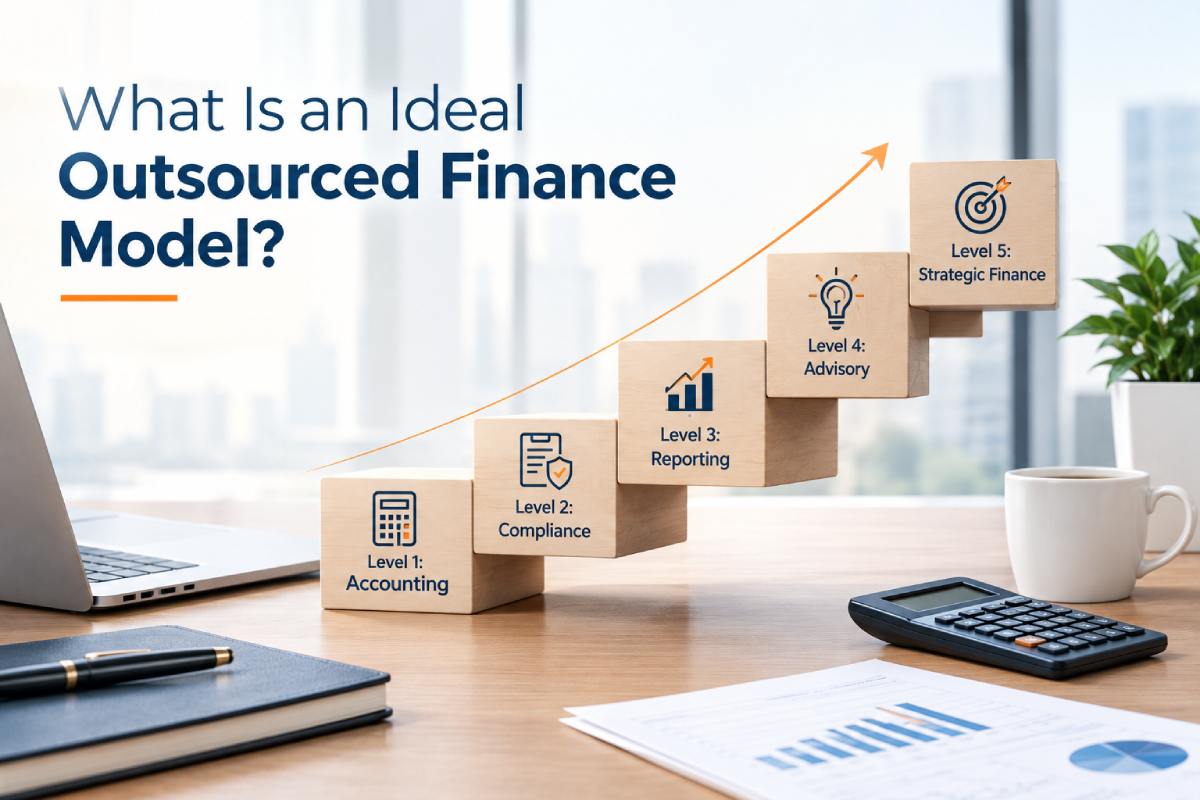
For many startups and SMEs, an outsourced finance function can be structured in stages.
Level 1: Accounting
- Bookkeeping
- Bank reconciliation
- Receivables
- Payables
Level 2: Compliance
- GST
- TDS
- Income Tax
- Other applicable compliance
Level 3: Reporting
- P&L
- Balance Sheet
- Cash Flow
- MIS
- Budget vs Actual
Level 4: Advisory
- Tax planning
- Cash-flow planning
- Working capital
- Financial analysis
Level 5: Strategic Finance
- Virtual CFO
- Financial modelling
- Funding support
- Investor reporting
- Business planning
This model lets a business pay for the level of support it actually needs.
Why an Integrated Financial Partner Can Be Valuable
Suppose your accounting team identifies a major increase in receivables. The accounting team can report: “Receivables increased from ₹40 lakh to ₹75 lakh.” But management may also need to understand: Why?
A CA/advisory team can analyse:
- Customer payment terms
- Collection cycles
- Credit policies
- Revenue growth
- Working capital
- Cash requirements
The result is more than bookkeeping.
It becomes: Accounting → Information → Analysis → Decision
That is where professional financial support can provide greater business value.
Chartered Accountant vs Accounting Firm: Final Decision Matrix
Use this matrix before making your decision.
| If Your Business Needs… | Consider |
| Simple ITR filing | Individual CA |
| Personal tax advice | Individual CA |
| Basic bookkeeping | Accounting firm |
| High-volume bookkeeping | Accounting firm |
| Accounting + GST | CA/accounting firm |
| Accounting + GST + Tax | CA firm |
| Audit | Appropriate CA professional/firm |
| Tax planning | CA |
| Tax notice support | CA |
| Monthly MIS | Accounting/CA firm |
| Cash-flow management | CA/advisory firm |
| Funding support | CA/advisory firm |
| Virtual CFO | CA/advisory firm |
| Complete outsourced finance | Integrated CA/accounting firm |
| Growing SME | CA firm/integrated provider |
| Established business | CA firm + internal finance team |
A 10-Point Checklist Before You Hire
Before choosing an chartered accountant or accounting firm, CA or CA firm, ask:
1. What exactly do I need?
Write down the services you require.
2. Who will actually perform the work?
Know the people responsible for your account.
3. Who reviews the work?
Understand the senior-level review process.
4. What qualifications does the team have?
Especially for tax, audit and professional advisory work.
5. Is GST expertise available?
Important for GST-registered businesses.
6. Is tax planning included?
Don’t assume filing automatically includes planning.
7. Will I receive monthly reports?
Ask specifically about MIS and financial reporting.
8. How are additional services billed?
Clarify:
- Notices
- Certifications
- Special consultations
- Additional registrations
- Additional assignments
9. What technology do you use?
Ask about:
- Cloud accounting
- Digital document management
- GST reconciliation
- Reporting
10. Can you scale with me?
This is especially important for startups and SMEs.
Questions to Ask a Chartered Accountant
If you’re specifically evaluating a Chartered Accountant in Mumbai, ask:
- What type of businesses do you typically work with?
- Do you provide accounting along with tax and GST services?
- Who handles my day-to-day accounting?
- Will a CA review my accounts?
- Can you assist with GST notices?
- Can you provide monthly MIS?
- Do you provide tax planning?
- Do you offer Virtual CFO services?
- How do you charge for additional advisory work?
- Can your services scale as the business grows?
The answers will help you determine whether the CA is suitable for your business stage.
Questions to Ask an Accounting Firm in Mumbai
If you’re evaluating an accounting firm, ask:
- How many transactions can your team handle?
- Which accounting software do you support?
- Do you perform monthly bank reconciliation?
- Do you reconcile receivables and payables?
- Do you provide monthly financial statements?
- Do you support GST reconciliation?
- Do you have qualified tax professionals available?
- Can you coordinate with my Chartered Accountant?
- Who reviews the accounts?
- What happens when transaction volumes increase?
These questions help distinguish a basic bookkeeping provider from a full outsourced finance partner.
How to Evaluate the Best CA Firm in Mumbai for Your Business
If you’re searching for the best CA firm in Mumbai, avoid relying solely on search rankings, reviews or the lowest quotation. Instead, evaluate the firm on six factors.
1. Relevant Experience
Does the firm understand businesses similar to yours?
2. Service Range
Can it handle:
- Accounting
- GST
- Income Tax
- TDS
- Audit
- Advisory?
3. Communication
Will you receive timely responses?
4. Senior Involvement
Will experienced professionals be involved when complex decisions arise?
5. Technology
Does the firm use modern accounting and reporting systems?
6. Scalability
Can the relationship continue when your business grows?
The best CA firm in Mumbai for one company may not be the best choice for another. Fit matters more than a generic ranking.
Why Businesses Should Not Choose Based Only on “CA” vs “Accounting”
The label alone does not tell you enough. A CA may specialise in tax and audit but provide limited bookkeeping. An accounting services in Mumbai may have an excellent accounting team but limited tax advisory capabilities.
Another firm may combine:
- Accounting
- GST
- Income Tax
- Audit
- MIS
- Advisory
- Virtual CFO
Therefore, the better question is: What capabilities does this specific provider have, and which of those capabilities does my business need?
Common Questions About Chartered Accountant vs Accounting Firm
What is the main difference between a Chartered Accountant and an accounting firm?
The chartered accountant vs accounting firm difference is that a Chartered Accountant is a qualified professional, whereas an accounting firm is an organisation providing accounting and potentially other financial services. A CA can operate independently or through a firm, while an accounting firm may have accountants, CAs and other financial professionals depending on its structure.
Is a CA firm the same as an accounting firm?
Not necessarily. A CA firm is generally structured around Chartered Accountant professional practice, while an accounting firm may primarily provide accounting and bookkeeping services. However, some firms offer both accounting and CA services, so the actual service scope should be checked.
Should I hire a Chartered Accountant or accounting firm?
Choose based on your requirements.
- If you need primarily bookkeeping, an accounting firm may be sufficient.
- If you need taxation, audit, GST advisory or professional financial advice, a CA or CA firm may be more suitable.
- If you need both high-volume accounting and professional advisory, an integrated provider may be ideal.
What is the difference between a CA and accounting firm for a startup?
A startup may need accounting operations as well as tax, GST and business advisory. An accounting firm can handle bookkeeping and financial operations, while a CA can handle professional tax and financial matters. For a growing startup, an integrated CA firm + accounting service model can provide broader support.
Is a CA firm better than an accounting firm?
Not automatically. A CA firm may provide broader tax, audit and advisory capabilities, while an accounting firm may be particularly strong in bookkeeping and finance operations. The better choice depends on your business requirements.
Can an accounting firm handle GST?
Some accounting firms can handle GST compliance, but the scope and expertise vary.
Before hiring one, confirm whether it handles:
- GST registration
- Return filing
- ITC reconciliation
- GST notices
- GST advisory
Can a Chartered Accountant provide bookkeeping?
Yes. Depending on the practice and engagement, a CA can provide or oversee accounting and bookkeeping services. Some CAs focus more heavily on taxation and audit, while others offer broader accounting services.
Is an accounting firm cheaper than a CA?
Not necessarily.
Pricing depends on:
- Scope
- Transaction volume
- Tax complexity
- GST requirements
- Reporting
- Audit
- Advisory
- Team involvement
Compare the total service scope rather than simply comparing monthly fees.
Should an SME hire a CA firm or accounting firm?
An SME often needs more than bookkeeping. If it requires accounting, GST, Income Tax, TDS, audit, tax planning and advisory, a best CA firm in Mumbai or integrated financial services provider may be more suitable. If the primary need is accounting operations, accounting services in Mumbai may be enough.
What should a growing company look for in an accounting provider?
Look for:
- Scalable accounting
- GST expertise
- Tax expertise
- Financial reporting
- MIS
- Cloud accounting
- Senior professional review
- Advisory
- Cash-flow management
The provider should ideally be capable of supporting the business as its financial complexity increases.
Do I need both an accountant and a Chartered Accountant?
Not always. One integrated firm may be able to provide both accounting operations and CA-level services.
Alternatively, a business may use:
- Accounting Team
- External CA
This depends on the company’s size, internal finance capabilities, and professional requirements.
What should I look for in a CA firm in Mumbai?
Look for:
- Relevant business experience
- Qualified professionals
- Accounting capabilities
- GST expertise
- Income Tax expertise
- Audit capabilities
- Tax planning
- Financial reporting
- Advisory
- Technology
- Transparent pricing
- Good communication
What should I look for in an accounting firm in Mumbai?
Evaluate:
- Bookkeeping quality
- Accounting software
- Transaction capacity
- Bank reconciliation
- Receivables/payables management
- Financial reporting
- GST capabilities
- Team structure
- Data security
- Scalability
Final Verdict: Chartered Accountant vs Accounting Firm
There is no single winner in the chartered accountant vs accounting firm comparison. The right choice depends on what your business actually needs.
Choose an Individual Chartered Accountant When:
- Your requirements are relatively focused.
- You want direct professional advice.
- You need tax planning.
- You need specific tax or compliance assistance.
- You have a relatively simple business.
Choose an Accounting Firm When:
- Bookkeeping is your primary requirement.
- Transaction volumes are high.
- You need a dedicated accounting team.
- You need regular financial reporting.
- You want to outsource finance operations.
Choose a CA Firm When:
- You need accounting + GST + tax.
- Audit is required.
- Tax planning is important.
- You need professional advisory.
- You need tax notice support.
- Your business is growing.
Choose an Integrated CA + Accounting Provider When:
- You need both accounting operations and professional CA expertise.
- You want one financial partner.
- Your business is growing.
- You need monthly MIS.
- You expect to need advisory or CFO services later.
The most important thing is not whether the provider calls itself a Chartered Accountant, CA firm, or accounting firm.
The important question is: Can the provider handle your current financial requirements accurately and support your business as those requirements become more complex?
How Whitespace Consultancy Can Help
Whitespace Consultancy can support businesses that need a combination of accounting, taxation, GST and financial advisory services.
Depending on business requirements, support can include:
Accounting Services
- Bookkeeping
- Financial accounting
- Bank reconciliation
- Accounts payable
- Accounts receivable
- Financial reporting
GST Services
- GST registration
- GST return filing
- GST reconciliation
- Input Tax Credit review
- GST compliance
- GST advisory
Income Tax Services
- Income Tax Return filing
- Tax computation
- Tax planning
- Tax compliance
- Tax notice assistance
Audit & Compliance
- Audit support
- Tax audit
- Statutory compliance
- Financial review
Business Advisory
- MIS reporting
- Cash-flow planning
- Budgeting
- Financial analysis
- Business advisory
- Virtual CFO support
This integrated approach can be particularly useful for startups, small businesses and SMEs that don’t want to manage multiple financial service providers.
Looking for a CA Firm or Accounting Firm in Mumbai?
If you’re currently comparing an accounting services in Mumbai, CA firm in Mumbai, or individual Chartered Accountant in Mumbai, start by identifying exactly what your business needs.
Ask yourself:
- Do I need only bookkeeping?
- Do I need GST and tax compliance?
- Do I need audit and tax planning?
- Do I need monthly financial reporting?
- Do I need business advisory?
- Will my requirements increase over the next three to five years?
Once you know the answers, choosing the right professional becomes considerably easier. Looking for integrated accounting, taxation, GST and business advisory support? Contact Whitespace Consultancy to discuss your business requirements.