

When Should You Hire a Chartered Accountant in Mumbai? 12 Situations Businesses Should Know

Many entrepreneurs don’t hire a Chartered Accountant when they actually need one.
Instead, they wait until:
- A tax deadline is approaching.
- GST compliance becomes confusing.
- Their accounting records are incomplete.
- A tax notice arrives.
- Their business starts growing rapidly.
- An investor asks for financial statements.
By that point, correcting financial and compliance problems can be considerably more difficult than establishing the right systems from the beginning. Knowing when to hire a CA depends less on turnover and more on your business’s accounting, taxation, compliance, and financial management needs.
It is more about recognising when your business has reached a level of financial, tax, compliance, or strategic complexity where professional support can add value.
- A startup may need a CA when it is being incorporated.
- A small business may need one when GST and bookkeeping become difficult.
- An SME may need ongoing financial reporting, tax planning and advisory.
- A growing company may eventually need CFO-level financial guidance.
This guide explains 12 situations when to hire a CA, what a Chartered Accountant can do in each situation, and how businesses in Mumbai can determine the right level of professional financial support.
When to Hire a CA for Your Business
There is no universal revenue threshold at which every business must hire a Chartered Accountant.
The right time depends on:
- Business structure
- Turnover
- Transaction volume
- GST requirements
- Number of employees
- Tax complexity
- Number of locations
- Financial reporting requirements
- Funding plans
- Business growth
- Compliance obligations
A useful rule is: If financial complexity is increasing faster than your ability to manage it accurately, it may be time to hire a CA.
12 Situations When You Should Hire a Chartered Accountant
| Situation | Why You May Need a CA |
| Starting a business | Structure, registration and financial setup |
| GST registration is required | GST compliance and registration |
| Accounting has become difficult | Bookkeeping and financial reporting |
| Tax deadlines are being missed | Proactive tax compliance |
| Business is growing rapidly | Financial systems and planning |
| You receive a tax notice | Professional review and response |
| Planning to raise funding | Financial statements and projections |
| Need reliable financial reports | MIS and management reporting |
| Considering restructuring | Tax and financial implications |
| Expanding to another state | GST and financial compliance |
| Need tax planning | Legitimate tax efficiency |
| Need CFO-level guidance | Strategic financial management |
Let’s examine each situation in detail.
1. You’re Starting a Business
One of the clearest answers to when to hire a Chartered Accountant is when you are planning to start a business.
Many founders think: “I’ll hire a CA after the business starts making money.”
That can be too late. Financial and compliance decisions made during the setup stage can affect the business for years. A CA can help entrepreneurs understand the implications of different business structures and establish the appropriate financial processes from the beginning.
What Can a CA Help With During Business Setup?
Depending on the engagement, professional support may include:
- Business structure guidance
- Company incorporation support
- LLP formation
- Partnership-related accounting
- PAN/TAN-related requirements
- GST applicability
- Accounting setup
- Business banking guidance
- Initial compliance planning
For example, an entrepreneur may be deciding between:
- Proprietorship
- Partnership
- LLP
- Private Limited Company
The appropriate structure depends on the business, ownership, liability, tax, compliance, and funding considerations.
A CA can help explain the financial and tax implications so the entrepreneur can make an informed decision.
2. Your Business Needs GST Registration
Another important answer to when to hire a chartered accountant is when GST registration or ongoing GST compliance becomes relevant. GST isn’t simply a matter of obtaining a registration certificate.
A registered business may need to manage:
- Tax invoices
- GST returns
- Input Tax Credit
- GSTR-2B reconciliation
- E-invoicing, where applicable
- E-way bills, where applicable
- Reverse Charge Mechanism
- GST notices
A Business Accountant Mumbai can help determine the applicable GST requirements and establish a process for ongoing compliance.
Why GST Errors Can Become Expensive
Consider a business that records purchases incorrectly for six months.
The problem may affect:
- Input Tax Credit
- GST returns
- Financial statements
- Vendor reconciliation
Correcting six months of records can be much more difficult than implementing the correct process from the beginning.
3. Your Accounting Has Become Difficult to Manage
A business may start with ten transactions a month.
Eventually it may have:
- Hundreds of invoices
- Multiple vendors
- Employee expenses
- Online payments
- Multiple bank accounts
- Inventory
- Loans
- GST
- TDS
At this point, maintaining accounts manually can become increasingly difficult, making a CA for small business valuable for managing bookkeeping, tax compliance, and financial reporting.
Signs Your Accounting Has Become Too Complex
You may need professional support if:
- Books are always behind.
- Bank accounts aren’t reconciled.
- You don’t know your actual profit.
- Customer receivables aren’t tracked.
- Vendor balances are unclear.
- Personal and business expenses are mixed.
- Financial statements aren’t prepared regularly.
Accounting services for small business can help establish the following processes to keep financial records accurate and up to date:
- Bookkeeping
- Bank reconciliation
- Accounts receivable
- Accounts payable
- Financial statements
- Monthly reporting
4. You’re Missing Tax Deadlines
Tax compliance involves more than filing an annual Income Tax Return.
Depending on the business, there may be recurring requirements involving:
- Income Tax
- GST
- TDS
- Advance Tax
- Audit
- Corporate compliance
If the founder or internal team is repeatedly asking: “What is the next deadline?” professional support may be appropriate. A tax consultant Mumbai businesses work with can help establish a compliance calendar and monitor applicable deadlines.
Why Proactive Tax Compliance Matters
Missing deadlines can potentially result in:
- Interest
- Late fees
- Penalties
- Notices
- Additional administrative work
A professional should ideally help you become proactive rather than constantly reacting to deadlines.
5. Your Business Is Growing Rapidly
Rapid growth is a good problem to have, but it can expose weaknesses in financial systems.
For example:
Year 1
- Revenue: ₹50 lakh
- Employees: 5
- Transactions: 500
Year 3
- Revenue: ₹5 crore
- Employees: 35
- Transactions: 5,000+
The financial system required at ₹50 lakh turnover may no longer be adequate at ₹5 crore.
A growing business may need:
- Monthly financial reporting
- Budgeting
- Cash-flow forecasting
- Working-capital management
- Tax planning
- Financial controls
- MIS reporting
As a business grows, business accounting services can extend beyond routine compliance to include financial reporting, cash-flow forecasting, budgeting, and planning for future expansion.
6. You Receive an Income Tax or GST Notice
This is one situation where professional assistance can become particularly important. If your business receives a tax or GST notice, don’t assume it is simply a routine message.
First determine:
- Which authority issued it?
- Which section is mentioned?
- What information is being requested?
- What is the response deadline?
- Which financial records are relevant?
- Is any tax liability involved?
A Chartered Accountant can help review the notice and determine the appropriate response.
Depending on the matter, professional support may involve:
- Reviewing accounting records
- Reconciling tax information
- Collecting documents
- Preparing a response
- Assisting with submissions
- Supporting applicable proceedings
7. You’re Planning to Raise Funding
A startup may initially focus almost entirely on:
- Product
- Customers
- Revenue
- Hiring
But once external funding becomes a possibility, financial documentation becomes increasingly important.
Investors may want to review:
- Revenue
- Expenses
- Profitability
- Cash burn
- Cash runway
- Financial statements
- Tax compliance
- Working capital
- Financial projections
A CA for startup can help establish organised financial records before due diligence begins.
Why Financial Records Matter During Fundraising
Consider two startups with similar revenue.
Startup A
- Monthly accounts
- Reconciled books
- Proper invoices
- GST compliance
- Tax records
- Financial projections
Startup B
- Unreconciled accounts
- Missing invoices
- Mixed personal/business expenses
- Delayed compliance
- No reliable financial statements
The first company is likely to be much easier to evaluate financially. This is why founders should not wait until an investor asks for financial statements before organising their accounts.
8. You Need Reliable Financial Reports
If the only financial number you know is: “We had ₹2 crore in sales this year,” you don’t have enough information to manage the business effectively.
Management may also need to know:
- Gross profit
- Net profit
- Operating expenses
- Receivables
- Payables
- Cash position
- Working capital
- Tax liabilities
- Product profitability
A CA can help establish regular financial reporting.
Monthly Management Reporting
A monthly MIS can include:
| Metric | Purpose |
| Revenue | Track sales |
| Gross Margin | Understand profitability |
| Expenses | Identify cost trends |
| Receivables | Monitor collections |
| Payables | Monitor obligations |
| Cash Flow | Monitor liquidity |
| Budget vs Actual | Measure performance |
This helps management make decisions based on current financial information rather than assumptions.
9. You’re Considering Business Restructuring
Businesses sometimes need to reconsider their structure because of:
- Growth
- New partners
- Investors
- Tax considerations
- Ownership changes
- Mergers
- Acquisitions
- Succession
- Business expansion
For example, a business may begin as a proprietorship and later consider a company or LLP structure. The financial and tax implications should be evaluated before making such changes.
A CA can help review the relevant accounting and tax considerations and coordinate with other professionals where legal advice is also required.
10. You’re Expanding Into Another State
Expansion can introduce additional GST and accounting considerations.
For example, a Mumbai-based company begins operations in:
- Maharashtra
- Gujarat
- Karnataka
- Delhi
The business may need to evaluate:
- GST registration requirements
- Place-of-supply rules
- Inter-state transactions
- Stock transfers
- Branch accounting
- Invoicing
- E-way bills
- E-invoicing, where applicable
A Business Accountant Mumbai can help the business evaluate the financial and GST implications before expansion.
11. You Need Tax Planning
One important time to hire a CA for tax planning is when taxation becomes financially significant, and your business needs help evaluating applicable deductions, advance tax, and other tax obligations. Tax planning should not mean trying to avoid tax illegally. It means understanding the applicable rules and organising financial decisions efficiently within the law.
A CA may help review:
- Business structure
- Eligible deductions
- Advance tax
- Capital expenditure
- Investment decisions
- Capital gains
- Tax timing
- Applicable tax provisions
Tax Planning vs Tax Evasion
These are completely different.
Tax Planning
Legally organising financial affairs to use applicable provisions and improve tax efficiency.
Tax Evasion
Concealing income, falsifying records or deliberately violating tax laws.
A professional tax consultant Mumbai businesses engage should focus on compliant tax planning rather than risky or unlawful methods.
12. You Need CFO-Level Financial Guidance
This is often the point at which a business has outgrown basic accounting.
Management may start asking:
- Should we expand?
- Can we afford another 20 employees?
- Why is cash flow falling despite increasing revenue?
- Should we take a business loan?
- Which product has the highest margin?
- How much working capital will we need?
- Are we ready for fundraising?
These are not basic bookkeeping questions. They require financial analysis and strategic thinking.
A CA may provide or coordinate Virtual CFO support involving:
- Budgeting
- Forecasting
- Cash-flow management
- MIS
- Financial analysis
- Working-capital planning
- Financial modelling
- Business performance reviews
- Investor reporting
This can provide businesses with access to senior financial expertise without immediately hiring a full-time CFO.
When to Hire a CA: Quick Decision Framework
Use this simple framework:
Are you starting a business?
Yes → Consider CA support now.
Are you registering for GST?
Yes → Professional GST support may be valuable.
Are your accounts becoming difficult?
Yes → Consider accounting/CA support.
Are tax deadlines being missed?
Yes → Establish professional compliance support.
Is your business growing rapidly?
Yes → Review financial systems and reporting.
Did you receive a tax notice?
Yes → Consider professional review immediately.
Are you raising funding?
Yes → Organise financial records before due diligence.
Do you need monthly financial reports?
Yes → Consider professional accounting/MIS support.
Are you restructuring or expanding?
Yes → Obtain financial and tax advice before proceeding.
Is tax becoming a significant cost?
Yes → Consider proactive tax planning.
Are strategic financial decisions becoming difficult?
Yes → Consider Virtual CFO or business advisory support.
Choosing the Right CA – Full-Time vs Outsourced, Costs, Engagement & Business Scenarios
Knowing when to hire a chartered accountant is only half the decision. The next question is: Do you need a full-time Chartered Accountant, an external CA, or an outsourced accounting and advisory firm?
For most startups and small businesses, hiring a full-time CA immediately may not be necessary. What matters is having access to the right level of financial expertise for the complexity of the business.
Do You Need a Full-Time Chartered Accountant?
Not necessarily. A full-time CA may make sense when a business has a large and complex finance function requiring continuous senior-level involvement. For an early-stage startup or small business, however, a full-time CA can be an unnecessary fixed cost.
Instead, the business may work with an external CA for:
- Accounting
- GST
- Income Tax
- TDS
- Audit
- Financial reporting
- Tax planning
- Business advisory
As the business grows, the scope of professional support can increase.
Full-Time CA vs Outsourced CA Services
| Factor | Full-Time CA | Outsourced CA/Firm |
| Salary Cost | Higher | Usually lower fixed cost |
| Employee Benefits | Applicable | Not applicable |
| Recruitment | Required | Not required |
| Accounting | ✓ | ✓ |
| Tax Compliance | ✓ | ✓ |
| GST | ✓ | ✓ |
| Audit | Usually external support still needed | ✓ |
| Senior Advisory | ✓ | Available depending on firm |
| Multiple Specialists | Limited to internal team | Potentially available |
| Scalability | Requires additional hiring | Easier to scale |
| Virtual CFO | Requires senior hire | Available through suitable firms |
| Startup Friendly | Depends on budget | Often suitable |
| SME Friendly | ✓ | ✓ |
For many early-stage businesses, outsourced CA services provide a practical way to access professional expertise without immediately building a large finance department.
Accountant vs Chartered Accountant: Which One Do You Need?
Understanding the difference between an accountant and a Chartered Accountant can help you decide when to hire a CA based on your business’s accounting, taxation, and advisory requirements.
An accountant may be sufficient for routine financial activities such as:
- Bookkeeping
- Recording transactions
- Bank reconciliation
- Accounts payable
- Accounts receivable
- Basic financial reports
A Chartered Accountant can provide broader professional support, including:
- Income Tax
- GST advisory
- Tax planning
- Audit
- Financial reporting
- Compliance
- Tax notice assistance
- Business advisory
- Financial strategy
Simple Rule
If your primary requirement is: “Someone needs to maintain our books.” An accountant may be sufficient.
If your requirement is: “We need someone to help us understand taxation, compliance, financial risks, and business decisions.” A Chartered Accountant may be more appropriate.
When Your Existing Accountant Is No Longer Enough
Many businesses start with an accountant and continue with the same arrangement as the business grows. That isn’t necessarily a problem. However, watch for these signs.
1. Books Are Always Delayed
If your accounts are consistently several weeks or months behind, management is operating without current financial information.
2. You Don’t Receive Financial Statements
If you cannot easily obtain:
- Profit & Loss
- Balance Sheet
- Cash Flow
- Receivables
- Payables
You may need a more structured accounting process.
3. Tax Advice Is Missing
Your accountant may maintain records but not provide professional tax planning or advice.
4. GST Reconciliation Is Becoming Difficult
Increasing transaction volumes and supplier mismatches can require specialist GST knowledge.
5. You Are Receiving Notices
If your business starts receiving Income Tax or GST notices, professional CA support can become important.
6. You’re Planning Funding
Investors may require financial statements, projections and due diligence support.
7. You’re Expanding
New states, new locations, new employees and new business activities can increase compliance complexity.
8. Management Needs Better Financial Information
If the founder is asking: “Why are sales increasing but cash decreasing?”
Basic bookkeeping may no longer be enough. You may need financial analysis and advisory.
CA for Startup: When Is It Worth Hiring One?
A CA for startup can be valuable from the beginning, particularly when founders need help establishing the financial foundation.
However, the level of engagement should match the startup’s stage.
Stage 1: Idea and Formation
Potential requirements:
- Business structure
- Incorporation
- Accounting setup
- GST assessment
- Tax planning
Engagement
Project/consultation basis
Stage 2: Early Operations
Potential requirements:
- Bookkeeping
- GST
- TDS
- Income Tax
- Payroll accounting
Engagement
Monthly accounting + compliance
Stage 3: Growing Startup
Potential requirements:
- Monthly financial reporting
- Cash-flow management
- Budgeting
- Tax planning
- MIS
Engagement
Monthly financial management
Stage 4: Fundraising
Potential requirements:
- Financial projections
- Investor reporting
- Due diligence
- Financial modelling
Engagement
Project + ongoing advisory
Stage 5: Scale-Up
Potential requirements:
- Virtual CFO
- Strategic finance
- Working-capital planning
- Financial controls
- Business advisory
Engagement
Ongoing CFO/advisory relationship
This model allows the startup to access professional expertise without paying for services it doesn’t currently need.
CA for Small Business: When Should You Hire One?
A CA for small business can be particularly useful when the owner is managing several responsibilities simultaneously.
For example, a small business owner may handle:
- Sales
- Customers
- Employees
- Suppliers
- Operations
- Banking
- Marketing
Managing accounting, GST, TDS, and tax compliance alongside daily operations can become difficult. Small business accounting services can help owners maintain organised financial records and manage recurring compliance requirements while focusing on business growth.
CA for SMEs: What Changes as the Business Grows?
An SME usually has more complex financial requirements than a very small business.
It may have:
- Multiple employees
- Larger vendor networks
- Significant receivables
- Inventory
- Loans
- Multiple GST registrations
- Multiple locations
- Regular audits
A CA for SMEs may therefore provide:
- Monthly accounting
- GST
- TDS
- Tax planning
- Audit support
- Financial reporting
- MIS
- Budgeting
- Cash-flow forecasting
- Business advisory
The CA’s role increasingly becomes part of the company’s financial management system.
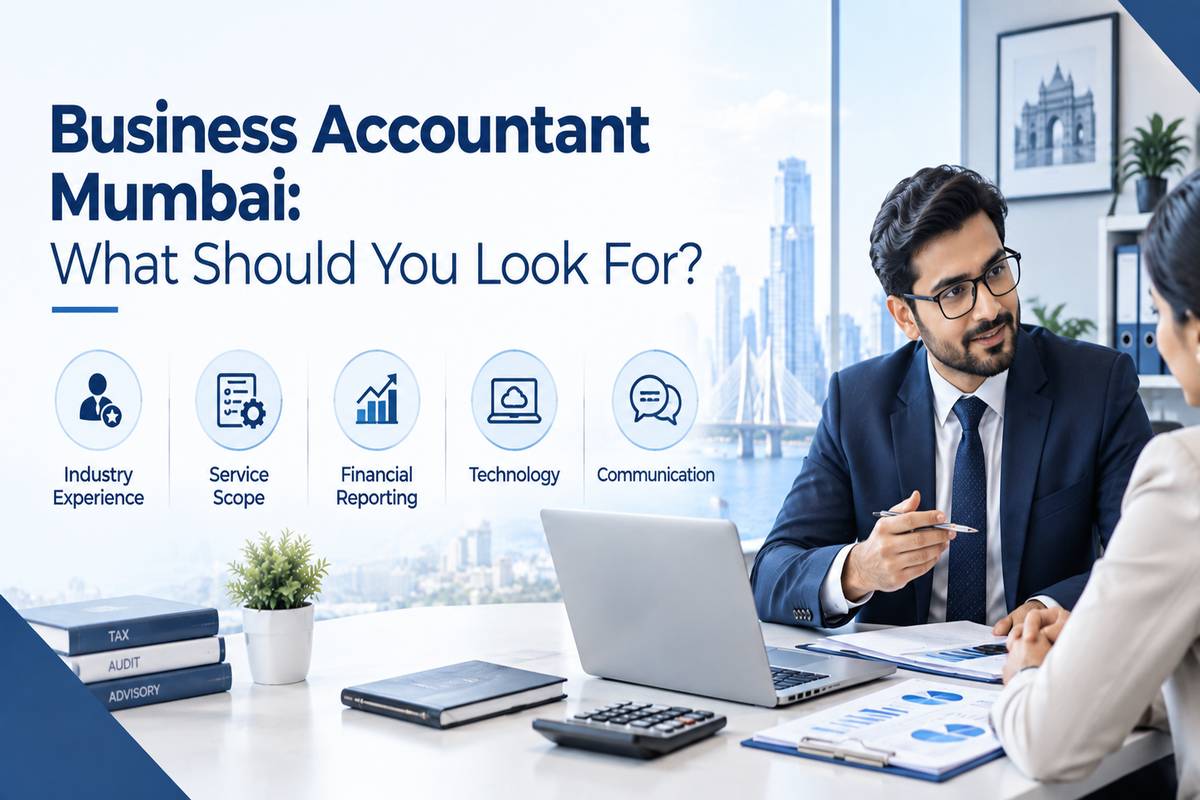
Business Accountant Mumbai: What Should You Look For?
If you are searching for a business accountant Mumbai that companies can work with, don’t compare professionals only on bookkeeping fees.
Evaluate:
Industry Experience
Does the professional understand your business model?
Service Scope
Can they handle accounting, GST, tax and compliance?
Financial Reporting
Will you receive monthly reports?
Technology
Do they use cloud accounting and digital processes?
Communication
How quickly do they respond?
Senior Involvement
Will a qualified CA review complex matters?
Scalability
Can the service grow with your business?
Transparency
Are fees and deliverables clearly documented?
How Much Does It Cost to Hire a CA?
There is no single standard price for every business.
Fees can vary based on:
- Business structure
- Transaction volume
- Turnover
- Number of GST registrations
- Number of employees
- Accounting complexity
- Audit requirements
- Tax complexity
- Frequency of reporting
- Advisory requirements
- Partner involvement
For example, a freelancer requiring annual ITR filing has very different requirements from a company with ₹10 crore turnover and hundreds of monthly transactions. Therefore, comparing CA fees without comparing scope can be misleading.
Cost vs Value: How Should Businesses Evaluate CA Fees?
Instead of asking: “What is the cheapest CA?” ask: “What am I actually getting for the professional fee?” For example, one provider may charge a lower monthly fee for bookkeeping alone.
Another may charge more but include:
- Accounting
- GST
- TDS
- Monthly reporting
- Tax planning
- Financial review
- Advisory
The second provider may offer greater value depending on the business’s requirements. The objective should be appropriate professional support at a transparent and reasonable cost, not simply the lowest quotation.
How Often Should You Work With a CA?
The ideal frequency depends on the business.
Annual
May be suitable for:
- Simple individual tax matters
- Certain low-complexity assignments
- Specific annual compliance work
Quarterly
May suit:
- Smaller businesses
- Stable operations
- Lower transaction volumes
- Periodic tax planning
Monthly
Often appropriate for:
- Growing businesses
- SMEs
- GST-registered businesses
- Businesses with significant transactions
- Businesses requiring MIS
- Businesses requiring cash-flow monitoring
As Needed
Some businesses may need professional support for specific events such as:
- Business formation
- Funding
- Restructuring
- Tax notices
- Major transactions
- Expansion
The right engagement should be based on actual financial complexity rather than a fixed formula.
Questions to Ask Before Hiring a CA
Before choosing a CA firm in Mumbai, ask:
About Experience
- Do you work with businesses similar to mine?
- Do you work with startups or SMEs?
- Do you understand my industry?
About Services
- Do you handle accounting?
- Do you provide GST services?
- Do you handle Income Tax?
- Do you provide audit support?
- Can you assist with tax notices?
- Do you provide financial reporting?
- Do you offer Virtual CFO services?
About Communication
- Who will be my primary contact?
- How quickly are queries answered?
- Will I receive monthly financial reports?
- How are compliance deadlines communicated?
About Fees
- What is included in the fee?
- What is billed separately?
- Are government/statutory fees included?
- Are notice or additional consultation charges separate?
About Growth
- Can your services scale as my business grows?
- Can you support funding, expansion or restructuring later?
These questions can help you identify whether you’re hiring a routine compliance provider or a long-term financial partner.
Real Business Scenario 1: New Startup
A founder in Mumbai is launching a technology company.
Initially, the company needs:
- Incorporation
- Accounting setup
- GST assessment
- Bank/accounting setup
Recommended CA Support
Project-based CA engagement
As revenue begins:
- Monthly bookkeeping
- GST
- TDS
- Income Tax
can be added.
When funding becomes a priority:
- Financial modelling
- Projections
- Due diligence
can be added.
The founder doesn’t necessarily need a full-time CA from day one.
Real Business Scenario 2: Small Retail Business
A retail business has:
- 8 employees
- ₹2 crore turnover
- Multiple suppliers
- GST registration
- Daily transactions
The owner currently maintains accounts manually.
The business is struggling with:
- GST reconciliation
- Supplier balances
- Cash flow
- Monthly profitability
Recommended Support
A combination of: Accounting + GST + TDS + Financial Reporting + Tax Planning
would likely be more appropriate than basic bookkeeping alone.
Real Business Scenario 3: Growing SME
An SME has:
- ₹15 crore turnover
- 70 employees
- Multiple locations
- Large receivables
- Bank borrowing
The finance team handles daily accounting, but management lacks strategic financial information.
Recommended Support
The business may benefit from:
- Financial review
- MIS
- Cash-flow forecasting
- Budgeting
- Tax planning
- Audit support
- Virtual CFO/advisory
Here, the CA’s role is no longer just compliance. It becomes financial management and business advisory.
Real Business Scenario 4: Business Receiving a Tax Notice
A company receives an Income Tax notice asking for additional information.
The founder is unsure:
- What triggered the notice?
- Which documents are required?
- What deadline applies?
- Whether the notice indicates additional tax?
This is a situation where professional review is appropriate. A CA can examine the notice, review the relevant records and help determine the appropriate response.
Real Business Scenario 5: Company Expanding to Another State
A Mumbai-based company is expanding into Karnataka.
Before starting operations, management needs to evaluate:
- GST requirements
- Inter-state transactions
- Invoicing
- Branch accounting
- Tax implications
- Compliance
Professional advice before expansion can help prevent avoidable structural and compliance problems.
The Right Time to Hire a CA Is Before the Problem Becomes Expensive
One of the biggest misconceptions is: “I’ll hire a CA when something goes wrong.”
A better approach is: “I’ll involve a CA when the financial complexity becomes significant enough that professional advice can prevent problems.”
For example:
- Before funding → Organise financial records
- Before expansion → Review GST and tax implications
- Before restructuring → Understand financial consequences
- Before a major transaction → Review tax and accounting implications
- Before year-end → Plan tax and accounting requirements
This proactive approach can be more valuable than trying to correct problems after they occur.
When You May Not Need a Full-Service CA
Not every business needs a large monthly CA engagement.
For example, a very small business with:
- Few transactions
- No employees
- Simple income
- Limited compliance
- Straightforward accounting
may need only periodic professional support.
The goal isn’t to buy the maximum number of services. The goal is to obtain the right professional support for the business’s actual needs.
When to Hire a Chartered Accountant in Mumbai – Decision Checklist, FAQs & Final Guide
The decision to hire a Chartered Accountant should not be based only on turnover. A business may need professional support at ₹20 lakh turnover if its transactions, GST, taxation or business structure are complicated. Another business with a higher turnover may manage routine accounting internally but still need a CA for audit, tax planning or strategic financial advice.
The better question is:
Has your business become financially or compliantly complex enough that professional expertise can save you time, reduce risk and improve decision-making?
If the answer is yes, it may be time to hire a CA.
Do I Need a Chartered Accountant? Quick Self-Assessment
Use this checklist to evaluate your current situation.
| Question | Yes | No |
| Are you starting a new business? | ☐ | ☐ |
| Are you registering for GST? | ☐ | ☐ |
| Are your accounting records becoming difficult to manage? | ☐ | ☐ |
| Are GST reconciliations taking too much time? | ☐ | ☐ |
| Have you missed tax or compliance deadlines? | ☐ | ☐ |
| Are your financial statements delayed? | ☐ | ☐ |
| Is your business growing rapidly? | ☐ | ☐ |
| Are you hiring more employees? | ☐ | ☐ |
| Are you expanding into another state? | ☐ | ☐ |
| Have you received an Income Tax or GST notice? | ☐ | ☐ |
| Are you planning to raise funding? | ☐ | ☐ |
| Are you considering restructuring? | ☐ | ☐ |
| Do you need regular financial reports? | ☐ | ☐ |
| Is cash flow becoming difficult to manage? | ☐ | ☐ |
| Do you need proactive tax planning? | ☐ | ☐ |
| Do you need CFO-level financial guidance? | ☐ | ☐ |
How to Interpret the Checklist
- If you answered Yes to only one or two questions, you may need limited or periodic professional assistance.
- If you answered Yes to several questions, consider an ongoing CA engagement.
- If you answered Yes to questions involving notices, funding, restructuring, expansion or strategic financial decisions, professional advice may be particularly important before proceeding.
CA vs Accountant vs Outsourced Accounting Firm
One of the most common questions businesses have is whether they need a Chartered Accountant or simply an accountant. The answer depends on the work that needs to be done.
| Requirement | Accountant | Chartered Accountant | Outsourced Accounting/CA Firm |
| Bookkeeping | ✓ | ✓ | ✓ |
| Daily Accounting | ✓ | ✓ | ✓ |
| Bank Reconciliation | ✓ | ✓ | ✓ |
| Accounts Payable/Receivable | ✓ | ✓ | ✓ |
| GST Return Support | Depending on expertise | ✓ | ✓ |
| Income Tax | Limited/depends on expertise | ✓ | ✓ |
| Tax Planning | — | ✓ | ✓ |
| Statutory Audit | — | ✓ | ✓ |
| Tax Audit | — | ✓ | ✓ |
| Tax Notice Support | Limited | ✓ | ✓ |
| Financial Reporting | ✓ | ✓ | ✓ |
| Business Advisory | Limited | ✓ | ✓ |
| Virtual CFO | — | Depending on practice | Available through suitable firms |
| Financial Modelling | Limited | ✓ | ✓ |
| Funding Support | Limited | ✓ | ✓ |
Simple Decision
- Need bookkeeping? → An accountant may be enough.
- Need accounting + taxation + GST + audit + advisory? → Consider a Chartered Accountant.
- Need a complete finance function without building a large internal team? → Consider an outsourced accounting/CA firm.
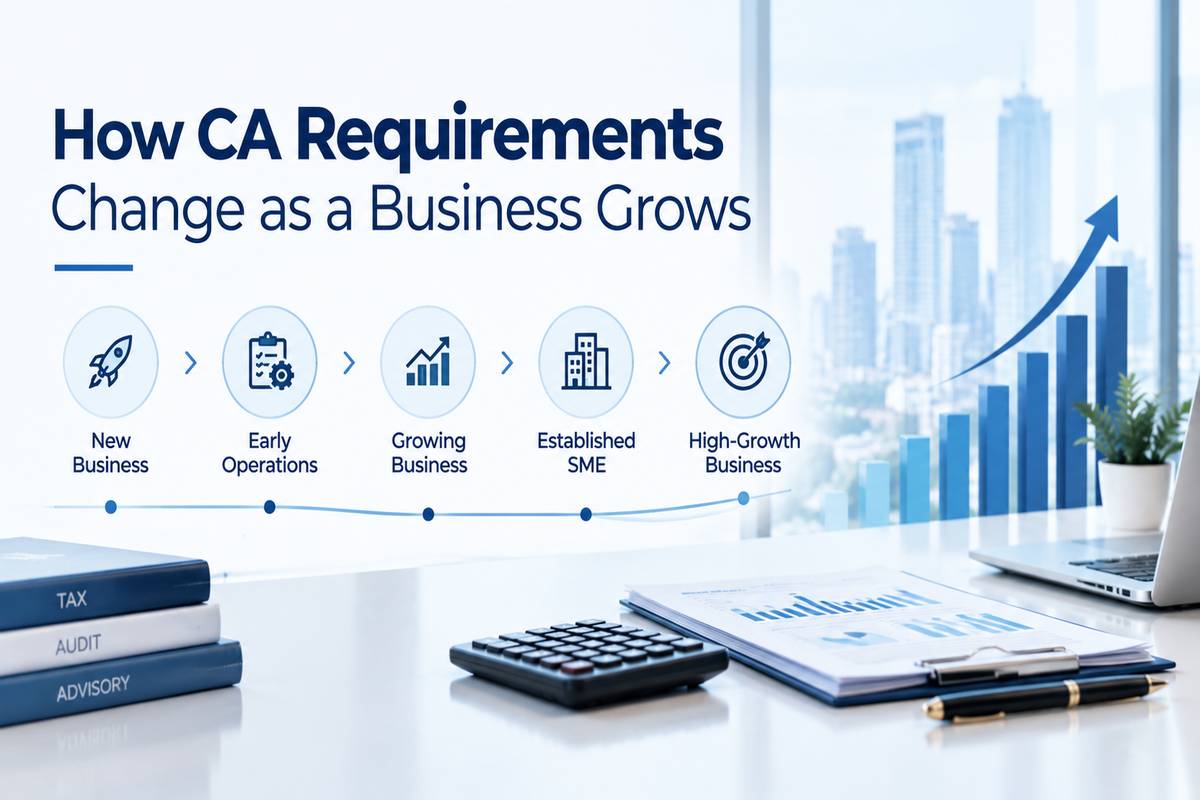
How CA Requirements Change as a Business Grows
A business’s financial needs often evolve through several stages.
Stage 1: New Business
Main Requirement
Setup + Compliance
Potential services:
- Business structure
- Incorporation
- Accounting setup
- GST
- Tax planning
Stage 2: Early Operations
Main Requirement
Accounting + Compliance
Potential services:
- Bookkeeping
- GST
- TDS
- Income Tax
- Payroll accounting
Stage 3: Growing Business
Main Requirement
Financial Visibility
Potential services:
- Monthly accounts
- MIS
- Cash-flow management
- Budgeting
- Tax planning
Stage 4: Established SME
Main Requirement
Financial Management
Potential services:
- Audit
- Tax advisory
- Financial reporting
- Working-capital management
- Business advisory
Stage 5: High-Growth Business
Main Requirement
Strategic Finance
Potential services:
- Virtual CFO
- Financial modelling
- Investor reporting
- Funding support
- Valuation
- Transaction advisory
This progression demonstrates why when to hire a chartered accountant should be evaluated based on business complexity rather than a single turnover number.
When to Hire a CA: A Practical Timeline
A business can use the following timeline as a general framework.
Before Starting
Discuss:
- Business structure
- Tax implications
- Accounting setup
- GST applicability
During Setup
Complete:
- Incorporation
- Accounting systems
- Registrations
- Compliance calendar
Every Month
Review:
- Accounting
- GST
- TDS
- Cash flow
- Receivables
- Payables
Every Quarter
Review:
- Profitability
- Tax position
- Cash flow
- Budget vs actual
- Business performance
Before Major Decisions
Consult your CA before:
- Expansion
- Funding
- Restructuring
- Major asset purchases
- Business acquisitions
- Significant transactions
At Year-End
Review:
- Financial statements
- Tax planning
- Audit requirements
- Income Tax
- Annual compliance
This makes the CA relationship proactive rather than purely reactive.
Red Flags When Choosing a Chartered Accountant
Hiring a CA is important, but choosing the right professional is equally important.
Be cautious if a provider:
1. Focuses Only on Price
The cheapest quote may not provide the level of expertise your business requires.
2. Cannot Clearly Explain the Scope
You should know exactly what services are included.
3. Doesn’t Understand Your Business
A professional should understand at least the basic financial and operational characteristics of your industry.
4. Provides No Clear Communication Process
You should know:
- Who handles your account?
- Who answers questions?
- Who handles urgent matters?
- Who reviews complex issues?
5. Doesn’t Provide Financial Reporting
If your business requires monthly financial visibility, basic annual compliance may not be enough.
6. Makes Unrealistic Tax Promises
Be cautious of anyone promising: “We can eliminate your tax.” Professional tax planning should be based on applicable law and documented transactions.
7. Has No Scalable Service Model
If your business grows significantly, you should not have to immediately find another provider simply because your requirements became more complex.
How to Compare Two Chartered Accountant Firms
If you are comparing multiple firms, don’t compare only their monthly quotation. Use a structured checklist.
| Evaluation Criteria | Firm A | Firm B |
| Relevant Industry Experience | ☐ | ☐ |
| Qualified Chartered Accountants | ☐ | ☐ |
| Accounting Services | ☐ | ☐ |
| GST Compliance | ☐ | ☐ |
| Income Tax Services | ☐ | ☐ |
| TDS Compliance | ☐ | ☐ |
| Audit Support | ☐ | ☐ |
| Tax Planning | ☐ | ☐ |
| Financial Reporting | ☐ | ☐ |
| Business Advisory | ☐ | ☐ |
| Tax Notice Assistance | ☐ | ☐ |
| Partner/Senior CA Involvement | ☐ | ☐ |
| Technology & Cloud Accounting | ☐ | ☐ |
| Monthly Financial Reviews | ☐ | ☐ |
| Transparent Pricing | ☐ | ☐ |
| Scalability | ☐ | ☐ |
| Communication Process | ☐ | ☐ |
| Client References/Reviews | ☐ | ☐ |
The objective is not to find the firm with the longest list. It is to find the firm whose service scope matches your actual business requirements.
Why Ongoing CA Support Can Be Better Than Year-End Filing
A business that contacts a CA only once a year may miss opportunities for proactive financial management. Compare the two approaches.
Year-End Approach
Transactions
↓
Wait 12 Months
↓
Prepare Accounts
↓
File Returns
↓
Discover Problems
This is primarily compliance-driven.
Ongoing Approach
Monthly Accounting
↓
GST/TDS Compliance
↓
Financial Reporting
↓
Quarterly Tax Review
↓
Cash-Flow Monitoring
↓
Year-End Tax Planning
↓
Annual Compliance
This gives management more opportunities to identify problems earlier.
What Can a Chartered Accountant Help You Prevent?
A proactive CA relationship can help businesses identify issues such as:
- Incorrect accounting treatment
- Missed tax deadlines
- GST reconciliation problems
- Unnecessary tax exposure
- Poor cash-flow visibility
- Inadequate financial records
- Weak internal controls
- Funding documentation problems
- Compliance gaps
Professional advice cannot eliminate every business risk, but it can help management identify and address financial and compliance issues earlier.
Why Mumbai Businesses May Need Professional CA Support
Mumbai has a diverse business environment ranging from:
- Startups
- Freelancers
- Traders
- Manufacturers
- Service providers
- E-commerce companies
- Professionals
- Real estate businesses
- SMEs
- Private companies
- Established enterprises
Their accounting and taxation requirements can vary significantly.
- A small professional-services business may primarily need: Accounting + GST + Income Tax
- A growing SME may need: Accounting + GST + Tax + Audit + MIS
- A high-growth company may need: Accounting + Tax + GST + Financial Reporting + Virtual CFO + Business Advisory
This is why businesses should look for a Chartered Accountant in Mumbai who understands their specific requirements instead of selecting a professional based only on location or price.
Frequently Asked Questions
When should I hire a Chartered Accountant?
You should consider hiring a CA when your business has financial, tax, GST, accounting or compliance requirements that have become difficult to manage accurately. Common triggers include starting a business, GST registration, rapid growth, tax notices, fundraising, expansion, restructuring, tax planning and the need for financial advisory.
When should I hire a CA for my small business?
A CA for small business can be useful when bookkeeping, GST, TDS, Income Tax or financial reporting becomes difficult to manage internally. You may also benefit from CA support when the business starts growing, hiring employees, taking loans or making significant financial decisions.
When should a startup hire a CA?
A CA for startup can be involved from the business formation stage for accounting setup, taxation, GST and compliance planning. As the startup grows, the CA can also support financial reporting, tax planning, fundraising documentation and strategic financial management.
Do startups need a full-time CA?
Not necessarily. Many startups can use outsourced CA and accounting services during their early stages. A full-time CA may become appropriate later when the business develops a larger and more complex internal finance function.
Is an accountant enough for a small business?
An accountant may be sufficient for routine bookkeeping and financial record-keeping. However, if the business requires tax planning, audit, GST advisory, complex compliance, tax notice assistance or strategic financial advice, a Chartered Accountant may be more appropriate.
What is the difference between an accountant and a CA?
An accountant generally focuses on recording and maintaining financial transactions and preparing routine financial information. A Chartered Accountant can provide broader professional services involving taxation, audit, financial reporting, compliance and business advisory, subject to the applicable professional scope.
When should an SME hire a CA?
A CA for SMEs can become particularly valuable when an SME has substantial transaction volumes, multiple employees, GST complexity, inventory, loans, multiple locations, audit requirements or a need for regular financial reporting and business advisory.
Can a CA help with GST?
Yes. Depending on the engagement, a Chartered Accountant can assist with GST registration, return compliance, Input Tax Credit reconciliation, GST advisory, RCM, GST notices and other GST-related requirements.
When should I hire a tax consultant?
Consider professional tax support when your tax affairs become complex, tax liabilities are significant, you have multiple income sources, your business is growing, you are planning a major transaction or you need assistance responding to a tax notice. A tax consultant Mumbai businesses work with can help with applicable tax compliance and planning.
Can a CA help with tax planning?
Yes. A CA can help analyse applicable tax provisions and organise business and financial decisions in a tax-efficient and compliant manner. Tax planning should always be distinguished from tax evasion.
When should a business hire a Virtual CFO?
A business may consider Virtual CFO services when basic accounting is no longer sufficient and management needs support with:
- Cash-flow management
- Budgeting
- Forecasting
- MIS
- Financial modelling
- Working capital
- Investor reporting
- Strategic financial decisions
How often should I meet my Chartered Accountant?
It depends on the complexity of the business. A small business may need quarterly or periodic reviews, while a growing SME may benefit from monthly financial reviews. Businesses dealing with major transactions or strategic financial decisions may require more frequent interaction.
How much does a Chartered Accountant charge?
CA fees vary based on the scope and complexity of the engagement.
Factors can include:
- Turnover
- Transaction volume
- GST registrations
- Number of employees
- Accounting requirements
- Audit
- Tax complexity
- Reporting frequency
- Advisory requirements
- The correct comparison is therefore scope and value, not simply the lowest quotation.
How do I choose a Chartered Accountant in Mumbai?
Look for:
- Relevant industry experience
- Appropriate qualifications
- Service range
- Communication
- Senior professional involvement
- Technology
- Transparent pricing
- Financial reporting capability
- Ability to scale with your business
You should also understand exactly what is included in the engagement.
Can a CA help after receiving an Income Tax notice?
Yes. Depending on the matter, a CA can review the notice, identify the information requested, examine the relevant records, organise supporting documentation and assist with preparing an appropriate response. For complex matters, professional representation may also be appropriate depending on the circumstances.
Is it better to hire a CA monthly or annually?
There is no universal answer. Annual support may be appropriate for relatively simple requirements.
Monthly support can be more valuable for businesses requiring:
- Regular accounting
- GST
- TDS
- Financial reporting
- Cash-flow monitoring
- Tax planning
The frequency should match the business’s actual needs.
Final Decision: When Should You Hire a CA?
You don’t need to wait until your business reaches a particular turnover.
Consider hiring a CA when one or more of these situations apply:
Starting
You are establishing a new business and need the right financial structure.
Compliance
GST, TDS or tax compliance is becoming difficult.
Accounting
Your books are delayed or unreliable.
Growth
Your transaction volume, employees or revenue are increasing rapidly.
Tax
Your tax position is becoming more complicated or financially significant.
Notices
You have received an Income Tax or GST notice.
Funding
Investors, lenders or partners require reliable financial information.
Expansion
You are entering new states, locations or business activities.
Restructuring
You are changing the ownership or structure of the business.
Reporting
Management needs reliable monthly financial information.
Advisory
You need help making financially significant business decisions.
CFO Support
You need strategic financial guidance without immediately hiring a full-time CFO.
The right time to hire a Chartered Accountant is therefore when professional financial expertise can meaningfully improve compliance, financial visibility, risk management or business decision-making.
Why Choose Whitespace Consultancy?
Whitespace Consultancy works with businesses that need more than basic year-end accounting. The objective is to provide practical financial support that can evolve as the business grows.
Depending on requirements, businesses can access support across:
Accounting
- Bookkeeping
- Financial accounting
- Bank reconciliation
- Accounts receivable/payable
- Financial statements
- Monthly reporting
Taxation
- Income Tax Return Filing
- Tax computation
- Tax planning
- Advance tax
- Tax notice assistance
GST
- GST registration
- GST return filing
- ITC reconciliation
- GST advisory
- RCM
- GST notice assistance
Audit & Compliance
- Audit support
- Tax audit
- Statutory compliance
- Financial review
Business Advisory
- Budgeting
- Cash-flow forecasting
- MIS
- Financial analysis
- Virtual CFO
- Strategic financial planning
This allows the level of professional involvement to change as your business changes.
A startup may initially need basic compliance. A growing SME may require monthly financial management. An established company may need CFO-level advisory. The objective is to provide the right level of support at the right stage.
Need Help Deciding Whether You Need a CA?
If you’re unsure whether your business needs a Chartered Accountant, start by evaluating:
- Your accounting workload
- GST requirements
- Tax complexity
- Compliance deadlines
- Financial reporting needs
- Business growth
- Funding plans
- Expansion plans
- Cash-flow challenges
- Strategic financial requirements
You may not need a full-time CA. You may simply need the right outsourced professional support.
Looking for a Chartered Accountant in Mumbai? Contact Whitespace Consultancy to discuss your accounting, GST, taxation, audit, or business advisory requirements.