

What Happens If You Don’t File Your Income Tax Return on Time?

Filing an Income Tax Return (ITR) is one of the most important annual compliance requirements for taxpayers in India. Whether you’re a salaried employee, freelancer, business owner, startup, or company director, filing your return within the prescribed due date helps you remain compliant with the Income Tax Act while avoiding unnecessary penalties, notices, and financial complications.
However, many taxpayers miss the filing deadline due to incomplete documentation, delayed tax calculations, lack of awareness, business commitments, or simply assuming that filing later won’t have any consequences.
One of the most common questions people ask is:
What happens if I don’t file my Income Tax Return on time?
The answer is not as simple as paying a late fee.
Missing the ITR filing deadline may lead to several consequences, including:
- Late filing fees
- Interest on outstanding tax liability
- Delay in receiving tax refunds
- Restrictions on carrying forward certain losses
- Increased chances of receiving notices from the Income Tax Department
- Additional compliance requirements in certain situations
The exact impact depends on factors such as your income, tax liability, filing status, and the applicable provisions of the Income Tax Act.
In this comprehensive guide, we’ll explain:
- Why filing your Income Tax Return on time is important
- What happens immediately after missing the due date
- The difference between a regular return, a belated return, and an updated return
- Financial and legal consequences of delayed filing
- Practical examples
- Frequently asked questions
- Common mistakes to avoid
- Best practices for staying compliant
Whether you’ve already missed the deadline or want to avoid future compliance issues, this guide will help you understand your options and make informed decisions.
Quick Answer: What Happens If You Don’t File Your Income Tax Return on Time?
If you miss the due date for filing your Income Tax Return, you may still be able to file it under the provisions of the Income Tax Act, depending on your circumstances and the applicable timelines.
However, delayed filing may result in:
- Late filing fees under applicable provisions.
- Interest on unpaid tax liability.
- Delay in processing tax refunds.
- Loss of certain tax benefits, such as carrying forward eligible losses.
- Increased likelihood of notices or compliance queries from the Income Tax Department.
- Additional procedures if the prescribed filing window has already expired.
Taking timely action after missing the deadline can help minimise the impact and keep your tax affairs in order.
What Is an Income Tax Return (ITR)?
An Income Tax Return (ITR) is a document through which taxpayers report their income, eligible deductions, taxes paid, and tax liability to the Income Tax Department for a financial year.
Depending on the taxpayer’s profile, an ITR may include details such as:
- Salary income
- Business or professional income
- Rental income
- Capital gains
- Interest income
- Dividend income
- Foreign income (where applicable)
- Deductions claimed under the Income Tax Act
- Tax deducted at source (TDS)
- Advance tax payments
- Self-assessment tax
After filing, the Income Tax Department processes the return and determines whether additional tax is payable or a refund is due.
Why Filing Your ITR on Time Matters
Many taxpayers believe that filing an Income Tax Return is simply a yearly formality. In reality, timely filing offers several practical and financial advantages beyond meeting legal obligations.
Filing your return on time helps you:
- Demonstrate tax compliance.
- Avoid late filing fees and interest.
- Receive tax refunds sooner.
- Maintain accurate financial records.
- Carry forward eligible business or capital losses, where permitted.
- Reduce the likelihood of notices arising from non-filing.
- Support applications for loans, visas, tenders, and financial due diligence.
- Build a stronger financial profile for future business and personal requirements.
For businesses, timely ITR filing also supports better financial governance and smoother interactions with banks, investors, and regulatory authorities.
Who Is Required to File an Income Tax Return?
The requirement to file an Income Tax Return depends on various factors prescribed under the Income Tax Act and may include:
- Total income.
- Nature of income.
- Residential status.
- Business or professional activities.
- Specified financial transactions.
- Other statutory conditions.
Taxpayers commonly required to evaluate their filing obligations include:
- Salaried employees.
- Business owners.
- Proprietorships.
- Partnership firms.
- Limited Liability Partnerships (LLPs).
- Private Limited Companies.
- Professionals.
- Freelancers.
- Trusts.
- Individuals with capital gains or foreign assets, where applicable.
Even when there is no tax payable, filing an ITR may still be beneficial in certain situations.
What Is the Due Date for Filing an Income Tax Return?
The Income Tax Department prescribes different due dates for different categories of taxpayers.
The applicable due date depends on factors such as:
- Type of taxpayer.
- Whether accounts require an audit.
- Nature of business.
- Applicable statutory provisions.
Since due dates may change through government notifications or extensions, taxpayers should always verify the latest filing deadlines announced by the Income Tax Department. Planning and preparing documentation early can help avoid last-minute filing issues.
What Happens Immediately After You Miss the ITR Due Date?
Missing the due date does not necessarily mean that you lose the opportunity to file your return immediately. Instead, the next course of action depends on the provisions available under the Income Tax Act.
Broadly, taxpayers should:
- Review whether they are still eligible to file a belated return.
- Calculate any applicable interest or late filing fees.
- Determine whether additional tax is payable.
- Gather all relevant financial documents.
- File the return as soon as possible to minimise further consequences.
Delaying action after the due date can make the compliance process more complicated.
Can You Still File Your Income Tax Return After the Due Date?
Yes, in many cases. The Income Tax Act provides mechanisms that may allow taxpayers to file a return even after missing the original due date, subject to prescribed conditions and timelines.
The appropriate option depends on factors such as:
- Whether a return has already been filed.
- The applicable statutory deadlines.
- The taxpayer’s circumstances.
- The relevant provisions of the Income Tax Act.
Understanding these options helps taxpayers take corrective action without unnecessary delays.
What Is a Belated Return?
A Belated Return is an Income Tax Return filed after the original due date but within the time permitted under the Income Tax Act. This provision allows taxpayers to comply even after missing the initial deadline.
However, filing a belated return may have certain consequences, including:
- Applicable late filing fees.
- Interest on outstanding tax.
- Restrictions on certain tax benefits.
- Delayed refund processing.
The earlier a belated return is filed, the better the chances of minimising additional compliance issues.
What Is an Updated Return (ITR-U)?
An Updated Return (ITR-U) is another mechanism available under the Income Tax Act that allows eligible taxpayers to update their tax position in specified circumstances after the normal filing timelines have passed.
The purpose of an updated return is to encourage voluntary tax compliance by allowing taxpayers to correct omissions or report previously undisclosed income, subject to the applicable conditions and additional tax requirements. Not every taxpayer or situation qualifies for filing an updated return, so professional advice is often recommended before proceeding.
Regular Return vs Belated Return vs Updated Return
Understanding the difference between these return types helps taxpayers choose the correct compliance path.
| Regular Return | Belated Return | Updated Return (ITR-U) |
| Filed within the prescribed due date | Filed after the due date but within the permitted timeline | Filed under specific provisions after the normal filing period, subject to eligibility |
| No late filing implications if filed on time | May attract late fees and interest | Subject to additional conditions and applicable taxes |
| Enables timely processing and compliance | Helps taxpayers regularise delayed filing | Intended for voluntary correction in eligible cases |
Choosing the correct type of return depends on your individual circumstances and the applicable provisions of the Income Tax Act.
Common Reasons People Miss the ITR Filing Deadline
Missing the filing deadline is more common than many people realise.
Some of the most frequent reasons include:
- Waiting for Form 16 or financial statements.
- Incomplete bookkeeping or accounting records.
- Delay in collecting investment proofs.
- Confusion regarding tax provisions.
- Incorrect assumptions about filing requirements.
- Business workload during the filing season.
- Technical issues close to the deadline.
- Forgetting the due date altogether.
While these situations are understandable, delaying your return can increase compliance risks and financial costs.
Why You Shouldn’t Ignore a Missed Deadline
Some taxpayers assume that if they have missed the due date, they can simply wait until the next financial year. This can be a costly mistake.
Ignoring the filing requirement altogether may lead to:
- Higher financial implications.
- Delayed refunds.
- Increased scrutiny from tax authorities.
- Additional compliance procedures.
- Reduced ability to claim certain tax benefits.
Acting promptly after missing the deadline is usually the best way to minimise consequences and maintain good tax compliance.
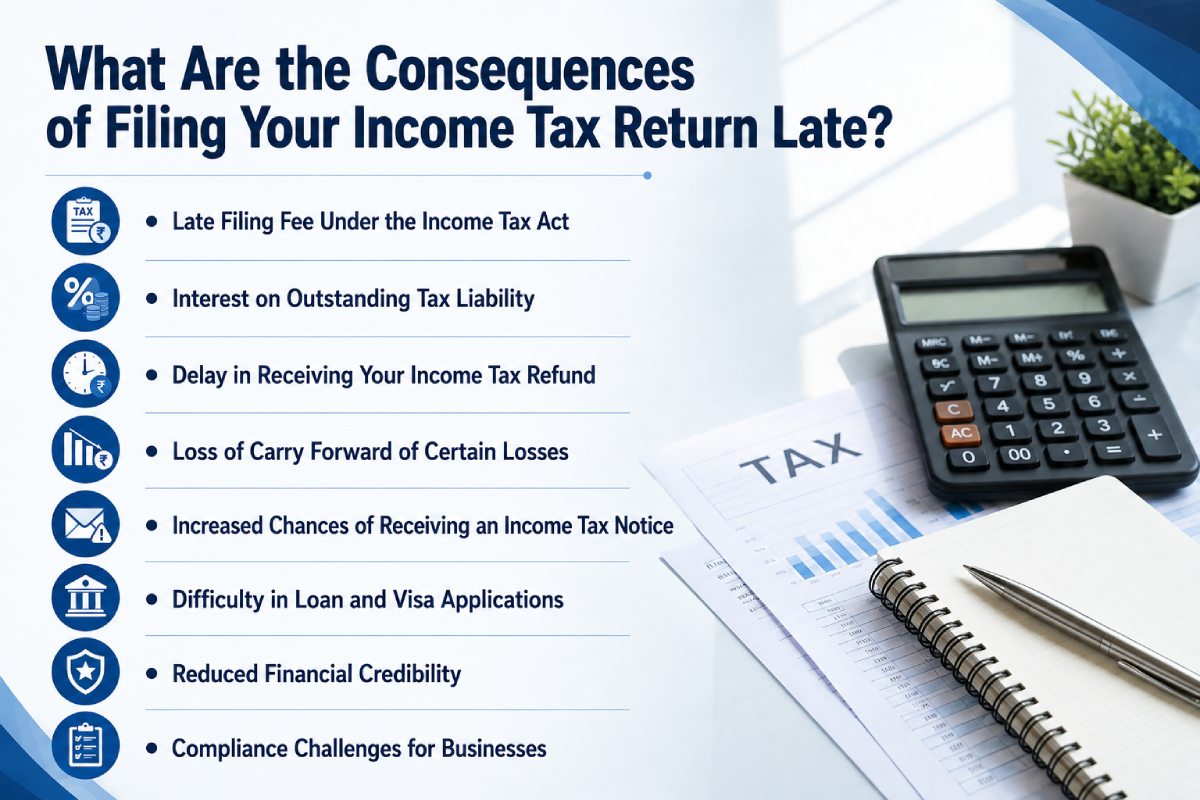
What Are the Consequences of Filing Your Income Tax Return Late?
Missing the Income Tax Return (ITR) due date does not necessarily mean you cannot file your return. However, delaying the filing process can result in several financial, legal, and compliance-related consequences depending on your tax liability and individual circumstances.
Some consequences are immediate, such as late filing fees and interest, while others may affect your future tax planning, refund processing, or eligibility to claim certain tax benefits. Understanding these implications helps taxpayers take timely corrective action and minimise unnecessary costs.
1. Late Filing Fee Under the Income Tax Act
One of the first consequences of missing the ITR due date is the possibility of a late filing fee under the applicable provisions of the Income Tax Act.
The amount of the fee depends on factors such as:
- Total taxable income
- Applicable provisions of the Income Tax Act
- Date of filing
- Eligibility under the prescribed rules
Since the late filing fee may change through amendments to tax laws, taxpayers should always verify the latest provisions before filing a belated return. The earlier you file after the due date, the easier it becomes to regularise your tax compliance.
2. Interest on Outstanding Tax Liability
If any tax remains unpaid after considering:
- TDS
- Advance Tax
- Self-Assessment Tax
- Tax Credits
Interest may become applicable under various provisions of the Income Tax Act.
The applicable interest depends on factors such as:
- Outstanding tax liability
- Delay in payment
- Nature of the default
- Relevant statutory provisions
Even if the delay seems minor, postponing the filing process may increase the overall tax cost because interest continues to accrue until the liability is settled.
Understanding Sections 234A, 234B & 234C
Many taxpayers hear these section numbers but are unsure what they mean.
Here’s a simple overview:
| Section | Purpose |
| Section 234A | Interest for delay in filing the Income Tax Return where applicable. |
| Section 234B | Interest relating to short payment of Advance Tax in specified situations. |
| Section 234C | Interest for deferment of Advance Tax instalments where applicable. |
These provisions operate independently, and in some cases, more than one section may apply simultaneously depending on the taxpayer’s circumstances.
3. Delay in Receiving Your Income Tax Refund
Many taxpayers expect their refund shortly after filing the return. However, if the return itself is filed late, refund processing may also be delayed.
This can affect:
- Salaried employees expecting excess TDS refunds.
- Freelancers with advance tax adjustments.
- Businesses entitled to tax refunds.
- Professionals with excess tax deductions.
For individuals and businesses relying on timely refunds for cash flow, delayed filing can create unnecessary financial strain.
4. Loss of Carry Forward of Certain Losses
This is one of the most significant consequences for business owners, investors, and taxpayers with capital losses. Subject to the provisions of the Income Tax Act, certain losses may need to be reported through a return filed within the prescribed time to be eligible for carry forward.
Examples include:
- Business losses.
- Capital losses.
- Certain other eligible losses under the Act.
Losing the ability to carry forward eligible losses may increase future tax liability because those losses may no longer be available for set-off in subsequent years.
Example
Suppose a business incurs a significant eligible business loss during a financial year. If the return is filed within the prescribed timeline and all applicable conditions are satisfied, the business may be able to carry forward that loss in accordance with the Income Tax Act. If the return is filed after the permitted time, where such benefit is not available, the business could lose the opportunity to reduce taxable income in future years.
This demonstrates why timely filing is particularly important for startups, SMEs, and growing businesses.
5. Increased Chances of Receiving an Income Tax Notice
Not every taxpayer who files late will receive a notice. However, delayed filing or non-filing may increase the likelihood of compliance queries from the Income Tax Department, especially where there are discrepancies between tax records and reported income.
Examples include:
- High-value financial transactions.
- Significant TDS credits reflected in Form 26AS.
- Income appearing in the Annual Information Statement (AIS).
- Property purchases.
- Share transactions.
- Large bank deposits.
- Foreign income disclosures.
If tax information is available with the department but no corresponding return is filed, further verification may be initiated.
6. Difficulty in Loan and Visa Applications
An Income Tax Return is more than a tax document; it also serves as proof of financial credibility.
Banks, financial institutions, embassies, and government authorities often request ITR acknowledgements while evaluating:
- Home loan applications.
- Business loans.
- Personal loans.
- Vehicle finance.
- Education loans.
- Visa applications.
- Immigration processes.
- Tender participation.
Late or missing ITR filings may delay these processes or require additional documentation.
7. Reduced Financial Credibility
For business owners, regular ITR filing reflects disciplined financial management. Investors, lenders, strategic partners, and government agencies often review tax compliance before making important decisions.
Consistent filing helps strengthen:
- Business credibility.
- Financial transparency.
- Investor confidence.
- Creditworthiness.
- Regulatory compliance.
8. Compliance Challenges for Businesses
Businesses have more complex compliance obligations than individual taxpayers.
Late filing of Income Tax Returns can affect:
- Financial statement finalisation.
- Tax audits.
- Statutory reporting.
- Loan documentation.
- Investor due diligence.
- Regulatory filings.
Maintaining an annual compliance calendar helps businesses avoid cascading delays across multiple statutory requirements.
What Should You Do If You Miss the ITR Deadline?
Missing the due date is not the end of the compliance process. The most important step is to act promptly rather than ignore the situation.
A practical approach includes:
Step 1
Review whether you are still eligible to file a belated return.
Step 2
Collect all financial documents, including:
- Form 16
- Form 26AS
- AIS
- Bank statements
- Investment proofs
- Business financial statements
Step 3
Calculate your tax liability, including any applicable interest or late filing implications.
Step 4
File the return through the appropriate provision under the Income Tax Act.
Step 5
Verify the filed return within the prescribed timeline.
Step 6
Retain all supporting records for future reference. Taking action early generally results in a smoother compliance process.
Practical Examples
Example 1: Salaried Employee
A salaried employee forgets to file the ITR due to work commitments. Although all taxes were deducted through TDS, the employee files the return after the due date. The return is accepted under the applicable provisions, but refund processing is delayed compared to timely filed returns.
Example 2: Freelancer
A freelance graphic designer receives payments from multiple clients throughout the year. Because bookkeeping is incomplete, the return is filed late. The freelancer must review tax liability carefully and ensure all income is accurately reported before filing.
Example 3: Startup Company
A startup delays the finalisation of its financial statements. As a result, the Income Tax Return is filed after the prescribed due date. Apart from possible financial implications, the company also faces challenges in presenting updated financial records during investor discussions.
Example 4: Small Manufacturing Business
A manufacturing business postpones tax filing because GST reconciliations are incomplete. Instead of waiting indefinitely, the business works with its Chartered Accountant to complete reconciliations, calculate tax liability, and regularise the filing process as early as possible.
This proactive approach reduces the risk of additional compliance complications.
Common Mistakes Taxpayers Make After Missing the Deadline
Many taxpayers make the situation worse by delaying action even further.
Common mistakes include:
Assuming There Is No Need to File
Some taxpayers believe that once the due date has passed, filing is no longer possible. In many situations, provisions such as belated or updated returns may still be available, subject to eligibility.
Ignoring Income Tax Notices
Delaying or ignoring notices can increase compliance challenges. Every communication from the Income Tax Department should be reviewed carefully and responded to within the prescribed timelines.
Filing Without Reviewing AIS and Form 26AS
Mismatches between reported income and tax records are a common reason for notices.
Always reconcile your return with:
AIS
Form 26AS
Form 16
TDS certificates
Bank records
before filing.
Waiting Until the Last Available Date
Many taxpayers continue delaying even after missing the original due date. Filing earlier usually helps minimise interest, improves refund timelines, and reduces unnecessary stress.
Best Practices to Stay Compliant
- Maintain financial records throughout the year.
- Reconcile AIS, Form 26AS, and TDS statements before filing.
- Finalise the books of accounts well before the due date.
- Track statutory deadlines using a compliance calendar.
- File returns as soon as financial information is available.
- Consult a Chartered Accountant for business income, capital gains, foreign income, or complex tax matters.
- Periodically review your overall tax position instead of waiting until the filing deadline.
Real-Life Scenarios: What Happens If You File Your ITR Late?
Understanding how late filing affects different taxpayers makes it easier to appreciate why timely compliance is so important. Below are some common situations that individuals and businesses encounter.
Scenario 1: Salaried Employee Waiting for a Tax Refund
A salaried employee has sufficient TDS deducted by their employer throughout the financial year and is expecting a tax refund. Because of travel commitments, the employee misses the ITR filing due date.
Although the return may still be filed under the applicable provisions, the refund processing is delayed compared to returns filed within the prescribed timeline. This postpones the receipt of funds that could otherwise have been available for personal financial planning.
Key Learning: Filing on time helps ensure faster processing of eligible refunds.
Scenario 2: Startup Seeking Investment
A technology startup is in discussions with potential investors.
During due diligence, investors request:
- Income Tax Returns
- Financial statements
- GST returns
- Compliance records
The startup has delayed filing its Income Tax Return, creating concerns about financial governance and regulatory compliance. While the issue can often be resolved, delayed compliance may affect investor confidence and slow the investment process.
Key Learning: Timely tax compliance strengthens business credibility.
Scenario 3: Business Owner with Carry-Forward Losses
A manufacturing company incurs an eligible business loss during the financial year. The management postpones ITR filing because the accounts are still being finalised. As a result, the company may lose the opportunity to carry forward certain eligible losses if the applicable legal conditions are not met. This could increase the company’s tax liability in future years.
Key Learning: Filing within the prescribed timeline can help preserve important tax benefits.
Scenario 4: Freelancer Working with Multiple Clients
A freelance consultant receives income from several domestic and international clients. Because bookkeeping is incomplete, the consultant delays filing the Income Tax Return.
Before filing, they reconcile:
- Form 26AS
- AIS
- Bank statements
- Client invoices
- Foreign remittances
- Advance tax payments
This additional work delays compliance and increases the risk of reporting errors.
Key Learning: Maintaining organised records throughout the year simplifies tax filing.
Compliance Checklist for Timely ITR Filing
Whether you’re an individual or a business owner, following a structured process helps avoid last-minute challenges.
Before filing your Income Tax Return, ensure that:
- PAN details are correct.
- Aadhaar (where applicable) is linked as required.
- Form 26AS has been reviewed.
- The Annual Information Statement (AIS) has been reconciled.
- All sources of income have been reported.
- Eligible deductions are supported by documentation.
- Advance tax and TDS credits have been verified.
- Business financial statements are finalised.
- Capital gains have been accurately calculated.
- Foreign income and assets (where applicable) have been disclosed.
- Bank account details are updated.
- The return is verified within the prescribed timeline after filing.
A simple annual checklist significantly reduces filing errors and improves compliance.
Common Myths About Late ITR Filing
Many taxpayers delay filing because of incorrect assumptions. Let’s separate myths from facts.
Myth 1: If I Miss the Due Date, I Can Never File My ITR
Reality
Not necessarily. The Income Tax Act provides mechanisms such as belated returns and, in eligible situations, updated returns. The available option depends on the applicable provisions and statutory timelines.
Myth 2: I Don’t Need to File an ITR If TDS Has Already Been Deducted
Reality
TDS deduction does not automatically remove your obligation to file an Income Tax Return. Depending on your income and the applicable legal provisions, filing may still be required.
Myth 3: There Are No Consequences If No Tax Is Payable
Reality
Even where no additional tax is payable, delayed filing may affect refund processing, compliance records, and eligibility for certain tax benefits.
Myth 4: Small Businesses Can Ignore ITR Deadlines
Reality
Businesses are expected to maintain regular tax compliance. Late filing may affect audits, financing, statutory reporting, and overall business credibility.
Myth 5: Income Tax Notices Are Issued Only to Large Taxpayers
Reality
Notices may be issued to taxpayers of any size where the department identifies mismatches, non-filing, or other compliance concerns.
How Whitespace Consultancy Helps Taxpayers Stay Compliant
Income Tax compliance involves much more than submitting an annual return. Accurate reporting, reconciliation of financial records, tax planning, and timely filing all play an important role in avoiding future disputes.
At Whitespace Consultancy, we work with individuals, startups, SMEs, professionals, and established businesses to simplify Income Tax compliance through practical, partner-led advisory.
Our Income Tax services include:
- Income Tax Return filing
- Tax planning and optimisation
- Belated and updated return guidance
- Income Tax notice handling
- Tax assessments and scrutiny support
- TDS advisory
- Capital gains advisory
- Business tax planning
- Representation before tax authorities
- Compliance reviews for businesses
Our goal is to help taxpayers remain compliant while making informed financial decisions with confidence.
Related Services You May Find Helpful
If you’re looking for end-to-end tax and compliance support, explore these related services:
Income Tax Services – Return filing, tax planning, assessments, notices, and litigation support.
Accounting Services in Mumbai – Bookkeeping, financial reporting, MIS reporting, and outsourced accounting.
GST Registration & Compliance Services – GST registration, return filing, reconciliations, and advisory.
Audit & Assurance Services – Statutory audits, internal audits, GST audits, and due diligence.
Business Advisory Services – Virtual CFO services, budgeting, forecasting, and financial strategy.
Chartered Accountants in Mumbai – Learn more about our experienced team and partner-led approach.
Contact Us – Schedule a consultation with our tax experts.
Frequently Asked Questions (FAQs)
Can I file my Income Tax Return after the due date?
Yes. Depending on your circumstances and the applicable provisions of the Income Tax Act, you may still be able to file a belated or updated return within the prescribed timelines.
What is a belated return?
A belated return is an Income Tax Return filed after the original due date but within the period permitted under the Income Tax Act.
What is an updated return (ITR-U)?
An Updated Return (ITR-U) allows eligible taxpayers to update their tax position in specified situations after the normal filing period, subject to the applicable conditions and additional tax requirements.
Will I have to pay a penalty for late filing?
Late filing may attract applicable fees and interest depending on your tax liability, filing date, and the relevant provisions of the Income Tax Act.
Will my Income Tax refund be delayed?
In many cases, yes. Since the return is filed later, refund processing may also take longer compared to returns filed within the due date.
Can I receive an Income Tax Notice if I don’t file my ITR?
Non-filing or delayed filing may increase the likelihood of compliance-related communications from the Income Tax Department, especially where financial information is already available through AIS, Form 26AS, or other reporting systems.
Can businesses lose tax benefits by filing late?
Yes. Depending on the applicable provisions, businesses may lose the ability to carry forward certain eligible losses if returns are not filed within the prescribed timelines.
Should freelancers file an Income Tax Return?
Freelancers should evaluate their filing obligations based on their income, applicable provisions, and business activities. Filing on time also helps maintain financial records and supports future loan or visa applications.
Can ITR filing affect my loan application?
Yes. Banks and financial institutions often request Income Tax Returns as proof of income and financial stability when evaluating loan applications.
Is professional assistance recommended?
If you have business income, capital gains, foreign income, multiple income sources, or complex tax matters, consulting an experienced Chartered Accountant can help ensure accurate filing and compliance.
What happens if you don’t file your Income Tax Return on time?
If you don’t file your Income Tax Return on time, you may still be able to file a belated or updated return, depending on the applicable provisions of the Income Tax Act. However, delayed filing can result in late filing fees, interest on outstanding tax, delayed refunds, loss of certain tax benefits, and increased compliance obligations. Taking prompt action helps minimise these consequences.