

GST on Export of Services in India: Rules, Conditions, LUT & Examples (2026 Guide)
India has become a global hub for exporting professional and digital services. From software development and IT consulting to digital marketing, legal advisory, financial consulting, engineering services, and business process outsourcing, thousands of Indian businesses now work with clients across the world.
One of the most common questions these businesses ask is: Is GST applicable to the export of services?
The answer is yes, but not in the way many businesses assume.
Under the Goods and Services Tax (GST) framework, the export of services is treated as a Zero-Rated Supply, which means the transaction remains taxable under GST law but can be supplied without charging GST if the prescribed conditions are fulfilled. Businesses also have the option of paying GST on exports and later claiming a refund, subject to the applicable rules and procedures.
Understanding these provisions is essential because incorrect GST treatment can lead to:
- Incorrect invoicing
- GST notices
- Delayed refund claims
- Compliance issues
- Working capital blockage
- Interest and penalties
Whether you are a freelancer serving overseas clients, an IT company exporting software, a consultancy firm providing international advisory services, or a startup generating revenue from foreign customers, understanding GST on export of services is critical for maintaining compliance and protecting your business.
In this comprehensive guide, we’ll explain:
- Whether GST applies to the export of services
- What qualifies as an export under GST
- The five legal conditions for the export of services
- Zero-Rated Supply explained
- Export with and without LUT
- GST refunds
- Practical business examples
- Common mistakes
- Frequently asked questions
- Compliance checklist
Quick Answer: Is GST Applicable on Export of Services?
Yes, export of services falls under the GST framework. However, qualifying exports are treated as Zero-Rated Supplies under the Integrated Goods and Services Tax (IGST) Act. This means that if the prescribed conditions for export of services are satisfied, businesses can generally export services without charging GST by furnishing a valid Letter of Undertaking (LUT), or they may export on payment of IGST and subsequently claim a refund, subject to applicable provisions.
The correct treatment depends on whether the transaction satisfies the legal conditions for an export of services.
What Is an Export of Services Under GST?
Many businesses believe that providing a service to a foreign client automatically qualifies as an export. This is not always true.
Under the GST law, a transaction is treated as an export of services only if it satisfies all the prescribed legal conditions. If even one condition is not met, the transaction may not qualify as an export and could have different GST implications. This distinction is important because GST benefits available for exports depend on meeting the statutory requirements.
Why Does GST Treat Exports Differently?
GST in India follows the destination-based taxation principle, which means tax is generally intended to be collected where goods or services are consumed rather than where they are produced.
Since exported services are consumed outside India, the GST law provides a special framework to ensure that Indian exports remain globally competitive.
This approach aims to:
- Prevent double taxation
- Promote exports
- Improve international competitiveness
- Encourage foreign exchange earnings
- Avoid embedding domestic taxes in exported services
As a result, qualifying exports receive special treatment under GST as Zero-Rated Supplies.
What Is a Zero-Rated Supply?
One of the most misunderstood concepts under GST is the difference between Zero-Rated Supplies and Exempt Supplies. Although both may result in no GST being charged in certain situations, they are fundamentally different under the law.
A Zero-Rated Supply refers to specified supplies that remain taxable under GST but are eligible for special benefits, such as the ability to claim refunds of eligible input taxes, subject to the applicable provisions. Export of services generally falls into this category when all legal conditions are satisfied.
Zero-Rated Supply vs Exempt Supply
| Zero-Rated Supply | Exempt Supply |
| Covered under specific GST provisions | Exempted from GST through notifications or schedules |
| May be supplied without payment of GST under LUT or with payment of IGST, followed by a refund | GST is generally not charged |
| Eligible businesses may claim refunds of eligible input taxes, subject to the law | Input Tax Credit may be restricted as per the GST provisions |
| Primarily applicable to exports and notified supplies | Applicable to specified exempt goods and services |
Understanding this distinction helps businesses make informed decisions about invoicing, Input Tax Credit, and refund claims.
The Five Conditions for Export of Services
A service qualifies as an export only if all prescribed conditions under the GST law are fulfilled. Let’s examine each condition in detail.
Condition 1: The Supplier of Service Is Located in India
The person or business providing the service must be located in India.
Examples include:
- Software company in Bengaluru
- Digital marketing agency in Mumbai
- Chartered Accountant in Mumbai
- Legal consultancy in Delhi
- IT services company in Pune
If the supplier is located outside India, the transaction will not qualify as an export of services under the relevant Indian GST provisions.
Condition 2: The Recipient of Service Is Located Outside India
The customer receiving the service must be located outside India.
Examples:
- US company
- UK client
- Australian startup
- UAE business
- Singapore-based consultancy
Simply having a foreign citizen as a customer is not enough; the recipient’s location for GST purposes must satisfy the legal requirements.
Condition 3: The Place of Supply Is Outside India
This is one of the most important conditions and often the most misunderstood. GST liability depends not only on where the supplier and recipient are located but also on the Place of Supply, which is determined according to the provisions of the Integrated Goods and Services Tax (IGST) Act.
In many cross-border service transactions, businesses need to carefully analyse the applicable Place of Supply rules before concluding that the service qualifies as an export.
Condition 4: Payment Is Received in Convertible Foreign Exchange (or as Permitted Under RBI Regulations)
Generally, consideration for export of services should be received in convertible foreign exchange or in Indian Rupees, where permitted by the Reserve Bank of India (RBI).
Businesses should retain proper documentation, including:
- Foreign Inward Remittance Certificate (FIRC), where applicable
- Bank advice
- Payment confirmations
- Invoices
- Agreements
- Other supporting records
Maintaining complete documentation is essential when claiming GST benefits available for exports.
Condition 5: Supplier and Recipient Are Not Merely Establishments of the Same Person
The supplier and recipient should not merely be establishments of the same legal person in India and outside India. For example, transactions between certain branches or establishments of the same entity may not qualify as exports, depending on the legal structure and GST provisions.
Businesses operating through overseas branches should carefully evaluate these rules before treating supplies as exports.
Decision Flow: Does Your Service Qualify as an Export?
Use this simple decision framework:
Step 1: Are you located in India? Yes
Step 2: Is your customer located outside India? Yes
Step 3: Is the Place of Supply outside India? Yes
Step 4: Is payment received in convertible foreign exchange or as permitted by the RBI? Yes
Step 5: Are the supplier and recipient not merely establishments of the same person? Yes
The transaction may qualify as an Export of Services, subject to compliance with the applicable GST provisions.
Why Businesses Often Get Confused
Many businesses incorrectly assume that having a foreign client automatically means GST does not apply.
In practice, confusion often arises because of:
- Misunderstanding Zero-Rated Supplies
- Incorrect Place of Supply analysis
- Lack of awareness about LUT requirements
- Improper invoicing
- Missing foreign remittance documentation
- Incorrect refund procedures
- Treating every international service as an export without checking the legal conditions
These mistakes can delay refunds, create compliance issues, and lead to unnecessary notices from the GST authorities.
Industries Commonly Affected
Understanding GST on export of services is particularly important for:
- IT & Software Companies
- SaaS Businesses
- Digital Marketing Agencies
- Chartered Accountants
- Management Consultants
- Architects
- Engineering Consultants
- Legal Professionals
- Freelancers
- Business Process Outsourcing (BPO) Companies
- Design Studios
- Online Education Providers
- Financial Consultants
- Recruitment Agencies
For these businesses, exports often form a significant portion of revenue, making correct GST treatment essential.
Export of Services With LUT vs Payment of IGST
Once a service qualifies as an Export of Services under GST, businesses have two options for complying with GST requirements. Understanding the difference between these options is important because it directly affects your cash flow, refund process, and GST compliance.
The two available methods are:
- Export under Letter of Undertaking (LUT) without payment of IGST.
- Export after payment of IGST and subsequently claim a refund.
Choosing the right option depends on your business operations, working capital requirements, and compliance strategy.
What Is a Letter of Undertaking (LUT)?
A Letter of Undertaking (LUT) is a declaration submitted by an eligible exporter to the GST Department, allowing the export of goods or services without paying Integrated GST (IGST) at the time of supply. Instead of paying GST first and claiming it back later, an exporter who has furnished a valid LUT can issue export invoices without charging IGST, provided all applicable conditions are met.
This mechanism improves cash flow because funds are not blocked in tax payments while waiting for refunds. For most exporters of services, exporting under LUT is the preferred option because it simplifies operations and reduces the working capital burden.
Benefits of Exporting Under LUT
Businesses that export services under a valid LUT may benefit from:
- Improved cash flow by avoiding the upfront payment of IGST.
- Faster business operations without waiting for tax refunds.
- Reduced working capital blockage.
- Simplified export invoicing.
- Better financial planning for startups and SMEs.
- Lower administrative effort compared to the refund route.
For service exporters with regular overseas clients, LUT often provides a more efficient compliance framework.
Export With Payment of IGST
Instead of using LUT, a business may choose to export services after paying IGST on the export invoice.
Under this method:
- GST is charged on the export invoice.
- IGST is paid to the government.
- The exporter files the prescribed GST returns.
- A refund application is submitted for the IGST paid.
- Subject to verification and compliance, the refund is processed by the authorities.
Although legally permissible where applicable, this approach may temporarily block working capital until the refund is received.
LUT vs Payment of IGST
| Export Under LUT | Export With Payment of IGST |
| No IGST paid on export invoice (subject to valid LUT) | IGST paid first, refund claimed later |
| Better cash flow | Working capital may remain blocked until refund |
| Preferred by many service exporters | Used in specific business situations |
| Reduced refund dependency | Refund process becomes an important compliance step |
| Simplified export invoicing | Additional refund documentation may be required |
For most exporters of services, exporting under LUT is generally the more practical option because it reduces unnecessary cash outflow.
When Should You Apply for LUT?
Businesses should ideally obtain a valid LUT before making exports without payment of IGST. Waiting until after export invoices have been issued can create avoidable compliance complications.
Since LUT is generally valid for a financial year, businesses should also remember to renew it within the prescribed timelines where required. Maintaining an internal compliance calendar helps ensure continuity in export operations.
What Documents Are Required for LUT?
While the exact requirements may vary based on procedural updates, businesses should generally keep the following ready:
- GST Registration Certificate
- PAN of the business
- Authorised signatory details
- Business constitution documents
- Supporting declarations, where applicable
Maintaining updated documentation helps streamline the LUT filing process.
GST Refund on Export of Services
One of the major advantages available to exporters is the ability to claim eligible GST refunds, subject to compliance with GST law.
Refunds may arise in situations such as:
- Export under payment of IGST.
- Accumulated eligible Input Tax Credit on zero-rated supplies.
- Excess tax paid.
- Other situations permitted under GST provisions.
Businesses should ensure that refund applications are supported by complete documentation and accurate GST returns.
Documents Commonly Required for GST Refund
A well-prepared refund application generally includes supporting records such as:
- Export invoices
- Foreign inward remittance evidence
- Bank realization documents
- GST returns
- LUT acknowledgment (where applicable)
- Agreements with overseas clients
- Accounting records
- Reconciliation statements
Incomplete documentation is one of the most common reasons for delays in refund processing.
Can You Claim Input Tax Credit (ITC) on Export of Services?
Yes. One of the key benefits of zero-rated supplies is that eligible exporters may claim Input Tax Credit (ITC) on inputs and input services used in providing exported services, subject to the applicable conditions under GST law.
This ensures that taxes paid on business inputs do not become an additional cost while exporting services. Proper accounting and documentation are essential to support ITC claims.
GST Invoice Requirements for Export of Services
Export invoices should contain all mandatory details prescribed under the GST law.
Typically, businesses should ensure that invoices include:
- Exporter’s name, address, and GSTIN
- Invoice number and date
- Name and address of the overseas client
- Description of services
- Value of services
- Currency of payment
- Place of Supply, where applicable
- Appropriate export endorsement, depending on whether the supply is under LUT or with payment of IGST
Businesses should periodically review invoice formats to ensure they remain aligned with the latest GST requirements.
Accounting Treatment for Export of Services
Proper accounting is just as important as GST compliance.
A typical export transaction generally involves:
Step 1
Raise the export invoice.
Step 2
Record revenue in the books of accounts.
Step 3
Record foreign currency realization.
Step 4
Maintain GST documentation.
Step 5
Claim eligible ITC or refund, where applicable.
Maintaining accurate accounting records simplifies GST reconciliations and future assessments.
Practical Examples
Example 1: Software Development Company
A software company in Pune develops a custom application for a client based in the United States.
The company:
- Is located in India.
- Provides services to a client located outside India.
- Receives payment in foreign currency.
- Satisfies the prescribed export conditions.
- Has furnished a valid LUT.
The company exports the service without charging IGST and reports the transaction in its GST returns in accordance with the applicable provisions.
Example 2: Digital Marketing Agency
A digital marketing agency in Mumbai manages advertising campaigns for a business in Australia.
The agency:
- Issues export invoices.
- Receives payment through normal banking channels.
- Maintains client agreements and supporting documents.
- Files GST returns regularly.
- Exports under a valid LUT.
This allows the agency to maintain a healthy cash flow while remaining GST compliant.
Example 3: Management Consultant
A management consultant based in India provides strategic advisory services to a company in Singapore.
Before treating the transaction as an export of services, the consultant verifies:
- Location of supplier.
- Location of the recipient.
- Place of Supply.
- Mode of payment.
- Applicable GST provisions.
Only after confirming that all legal conditions are satisfied does the consultant classify the transaction as an export under GST.
Example 4: Freelancer Serving International Clients
A freelance graphic designer works with clients in Canada and Germany. Many freelancers assume that simply invoicing foreign clients means GST does not apply.
In reality, freelancers should evaluate:
- Whether GST registration is required.
- Whether the services qualify as exports.
- Whether LUT is applicable.
- Documentation requirements.
- GST return obligations.
Seeking professional advice early helps freelancers avoid costly compliance mistakes as their international business grows.
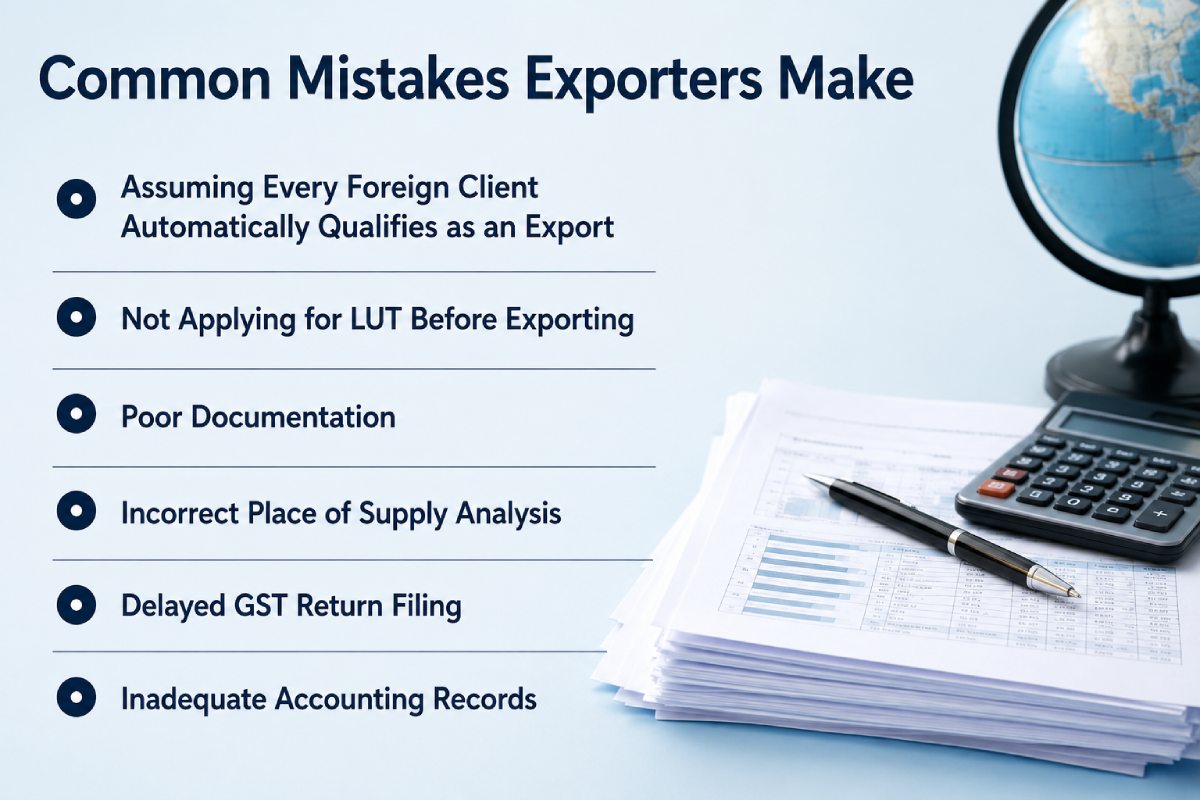
Common Mistakes Exporters Make
Businesses often lose time and money because of avoidable errors.
Some of the most common mistakes include:
Assuming Every Foreign Client Automatically Qualifies as an Export
The five legal conditions must still be satisfied.
Not Applying for LUT Before Exporting
Delays in obtaining LUT can complicate export documentation and compliance.
Poor Documentation
Missing agreements, remittance records, or invoices can delay refund claims and create assessment issues.
Incorrect Place of Supply Analysis
Many disputes arise because businesses assume the Place of Supply without reviewing the applicable IGST provisions.
Delayed GST Return Filing
Refund processing often depends on accurate and timely GST return filing.
Inadequate Accounting Records
Weak accounting controls make GST reconciliations and refund claims more difficult.
Expert Tips for Service Exporters
- Review every overseas contract before raising invoices.
- Determine the Place of Supply before classifying the transaction as an export.
- Apply for LUT before commencing exports without payment of IGST.
- Maintain complete documentation for every export transaction.
- Reconcile GST returns with accounting records regularly.
- Track foreign remittance receipts carefully.
- Conduct periodic GST compliance reviews with an experienced Chartered Accountant to minimise risks and ensure your export structure remains compliant.
Industry-Wise Examples of GST on Export of Services
Every industry provides services differently, and GST implications can vary depending on the nature of the transaction. Understanding practical scenarios helps businesses correctly determine whether their services qualify as exports under GST.
Example 1: Software Development Company
A software company based in Bengaluru develops a custom ERP application for a client in Canada.
The company:
- Is located in India.
- Provides software development services to a client located outside India.
- Receives payment through normal banking channels in convertible foreign exchange.
- Has furnished a valid Letter of Undertaking (LUT).
- Satisfies all prescribed conditions for export of services.
Since all conditions are fulfilled, the transaction qualifies as an export of services and can be supplied without payment of IGST under LUT, subject to compliance with the GST law.
Business Tip: Software companies should maintain project agreements, invoices, payment confirmations, and foreign remittance records to support GST compliance and future refund claims.
Example 2: Digital Marketing Agency
A Mumbai-based digital marketing agency manages SEO and paid advertising campaigns for an Australian e-commerce business.
The agency:
- Issues export invoices.
- Receives payment in foreign currency.
- Maintains signed service agreements.
- Files GST returns on time.
- Operates under a valid LUT.
This enables the agency to export services without charging IGST while preserving a healthy cash flow.
Example 3: Chartered Accountant Providing Advisory Services
A Chartered Accountant in Mumbai provides international taxation advisory services to a company incorporated in the United Kingdom.
Before treating the service as an export, the firm verifies:
- Supplier location
- Recipient location
- Place of Supply
- Payment method
- Applicable GST provisions
Only after confirming that all statutory conditions are satisfied is the transaction treated as an export of services.
Example 4: Freelancer Working with Overseas Clients
A freelance UI/UX designer in India works with clients in Germany, the United States, and Singapore. Many freelancers assume that because they work with foreign clients, GST does not apply.
However, before treating the transaction as an export, they should evaluate:
- GST registration requirements
- Place of Supply
- Nature of services
- Foreign currency realization
- Documentation
- LUT applicability
Maintaining proper documentation from the beginning makes future compliance much easier.
Example 5: SaaS Company
A SaaS company headquartered in India provides subscription-based software to customers in Europe and North America. The company receives recurring subscription payments from overseas clients and invoices them monthly.
Before treating these subscriptions as exports of services, the finance team reviews:
- Customer location
- Place of Supply
- Payment realization
- GST treatment
- Export documentation
Recurring export transactions require strong accounting systems and periodic GST reconciliations.
Compliance Checklist for Exporters of Services
A structured compliance process helps businesses avoid delays, notices, and refund issues.
Before treating any service as an export under GST, ensure the following:
- The supplier is located in India.
- Recipient is located outside India.
- Place of Supply is outside India.
- Payment is received in convertible foreign exchange or as permitted by the RBI.
- Supplier and recipient are not merely establishments of the same legal entity.
- Valid LUT has been furnished (if exporting without payment of IGST).
- Export invoices contain the prescribed details.
- GST returns are filed accurately and on time.
- Foreign remittance records are maintained.
- Agreements with overseas clients are properly documented.
- Accounting records are regularly reconciled with GST returns.
Following this checklist significantly reduces compliance risks and supports smooth GST refund processing.
Common Mistakes Businesses Make While Exporting Services
Even experienced businesses sometimes make avoidable GST mistakes.
Assuming Every Foreign Client Means No GST
Working with a foreign customer alone does not automatically qualify a transaction as an export of services. All prescribed legal conditions must be satisfied.
Ignoring Place of Supply Rules
Many disputes arise because businesses overlook the Place of Supply provisions while determining GST treatment. Incorrect classification can result in tax demands and refund issues.
Delaying LUT Application
Applying for LUT after commencing exports may create compliance complications. Businesses should plan and complete procedural requirements before exporting without payment of IGST.
Poor Documentation
Missing invoices, agreements, remittance records, or reconciliations often delay refund processing and create assessment issues.
Incorrect GST Return Reporting
Mismatch between GST returns and accounting records is a common reason for notices and refund delays. Regular reconciliations help identify issues early.
Assuming Refunds Are Automatic
GST refunds are subject to prescribed procedures and documentation. Businesses should actively monitor the status of refund applications and promptly respond to any queries raised by the authorities.
Common Myths About GST on Export of Services
Understanding the facts helps businesses avoid unnecessary compliance issues.
Myth 1: Export of Services Is Completely Outside GST
Reality
Export of services falls within the GST framework but qualifies as a Zero-Rated Supply when all prescribed conditions are satisfied.
Myth 2: Foreign Clients Never Attract GST Compliance
Reality
Even if the client is located outside India, businesses must evaluate all legal conditions before treating the transaction as an export.
Myth 3: Every Export Requires Payment of GST
Reality
Eligible businesses may export without payment of IGST under a valid LUT, subject to compliance with GST provisions.
Myth 4: Freelancers Don’t Need GST Compliance
Reality
Freelancers providing services to overseas clients should evaluate GST registration requirements, export conditions, invoicing, and documentation like any other business.
Myth 5: GST Refunds Are Guaranteed
Reality
Refunds depend on compliance with procedural requirements, proper documentation, accurate GST returns, and eligibility under GST law.
How Whitespace Consultancy Helps Export Businesses
Managing GST on the export of services involves much more than filing returns. Businesses must correctly interpret GST law, maintain documentation, manage refunds, reconcile accounts, and adapt to evolving regulations.
At Whitespace Consultancy, we help startups, SMEs, IT companies, SaaS businesses, consultants, agencies, and exporters simplify GST compliance through practical, partner-led advisory.
Our services include:
- GST registration and amendments
- LUT filing and renewal
- Export documentation review
- GST return filing
- Input Tax Credit advisory
- GST refund assistance
- Place of Supply analysis
- GST reconciliations
- GST assessments and notices
- Litigation support
- Advisory on cross-border transactions
- Ongoing GST compliance reviews
Our objective is to help businesses remain compliant while improving financial efficiency and supporting international growth.
Related Services You May Find Helpful
If you’re exporting services or managing international business transactions, explore our related services:
- GST Registration & Compliance Services – GST registration, LUT filing, return filing, reconciliations, and advisory.
- Accounting Services in Mumbai – Bookkeeping, financial reporting, foreign currency accounting, and outsourced accounting support.
- Income Tax Services – Tax planning, return filing, international tax support, and assessments.
- Audit & Assurance Services – Statutory audits, GST audits, internal audits, and due diligence.
- Business Advisory Services – Business structuring, Virtual CFO services, financial planning, and growth advisory.
- Chartered Accountants in Mumbai – Learn about our experienced team and partner-led approach.
- Contact Us – Schedule a consultation with our GST specialists.
Key Takeaways
Export of services under GST offers significant benefits, but those benefits are available only when businesses satisfy the prescribed legal conditions and maintain proper compliance. Understanding concepts such as Zero-Rated Supply, Place of Supply, LUT, Input Tax Credit, GST refunds, and documentation is essential for avoiding disputes and maintaining healthy cash flow.
Businesses exporting services should establish structured accounting and compliance processes, review overseas contracts carefully, and reconcile GST records regularly. Seeking professional guidance before expanding internationally can help prevent costly mistakes and support long-term growth.
Need Expert Guidance on GST for Export of Services?
Whether you’re a freelancer working with overseas clients, an IT company exporting software, or a business expanding into international markets, understanding GST on the export of services is critical for compliance and sustainable growth.
At Whitespace Consultancy, our Chartered Accountants provide practical guidance on GST registration, LUT filing, export documentation, refunds, compliance, and cross-border taxation.
Talk to Our GST Experts
Planning to export services or looking to optimise your GST compliance? Schedule a consultation with our experienced team for tailored, business-focused advice.
Frequently Asked Questions (FAQs)
Is GST applicable to the export of services?
Yes. Export of services falls under the GST framework but is treated as a Zero-Rated Supply when all prescribed conditions under the IGST Act are fulfilled.
What is a Zero-Rated Supply?
A Zero-Rated Supply is a taxable supply eligible for specific GST benefits, including the ability to export without payment of IGST under LUT or export on payment of IGST and claim a refund, subject to applicable provisions.
Is LUT mandatory for exporting services?
Businesses intending to export without payment of IGST generally furnish a valid LUT. Alternatively, exports may be made on payment of IGST followed by a refund claim, subject to GST provisions.
Can freelancers export services under GST?
Yes. Freelancers providing services to overseas clients should evaluate whether their transactions satisfy the legal conditions for export and comply with applicable GST requirements.
Is payment in foreign currency mandatory?
Generally, payment should be received in convertible foreign exchange or in Indian Rupees, where permitted by the Reserve Bank of India (RBI), subject to applicable regulations.
Can exporters claim Input Tax Credit?
Eligible exporters may claim Input Tax Credit on inputs and input services used for exporting services, subject to the prescribed conditions.
What happens if one export condition is not satisfied?
If the prescribed conditions for export are not fulfilled, the transaction may not qualify as an export of services and could have different GST implications.
Do software companies need LUT?
Many software companies exporting services choose to operate under LUT to avoid paying IGST upfront and to improve cash flow, provided they satisfy the eligibility conditions.
How often should exporters review GST compliance?
Businesses should review export transactions, GST returns, accounting records, and documentation regularly, preferably every month, to maintain compliance and support refund claims.
Is GST applicable to the export of services in India?
Yes. Export of services is covered under the GST framework but is treated as a Zero-Rated Supply when the prescribed conditions under the IGST Act are satisfied. Eligible exporters can generally export services without payment of IGST by furnishing a valid Letter of Undertaking (LUT) or export on payment of IGST and claim a refund, subject to applicable GST provisions.