

Tax Consultant vs Chartered Accountant: What Is the Difference?
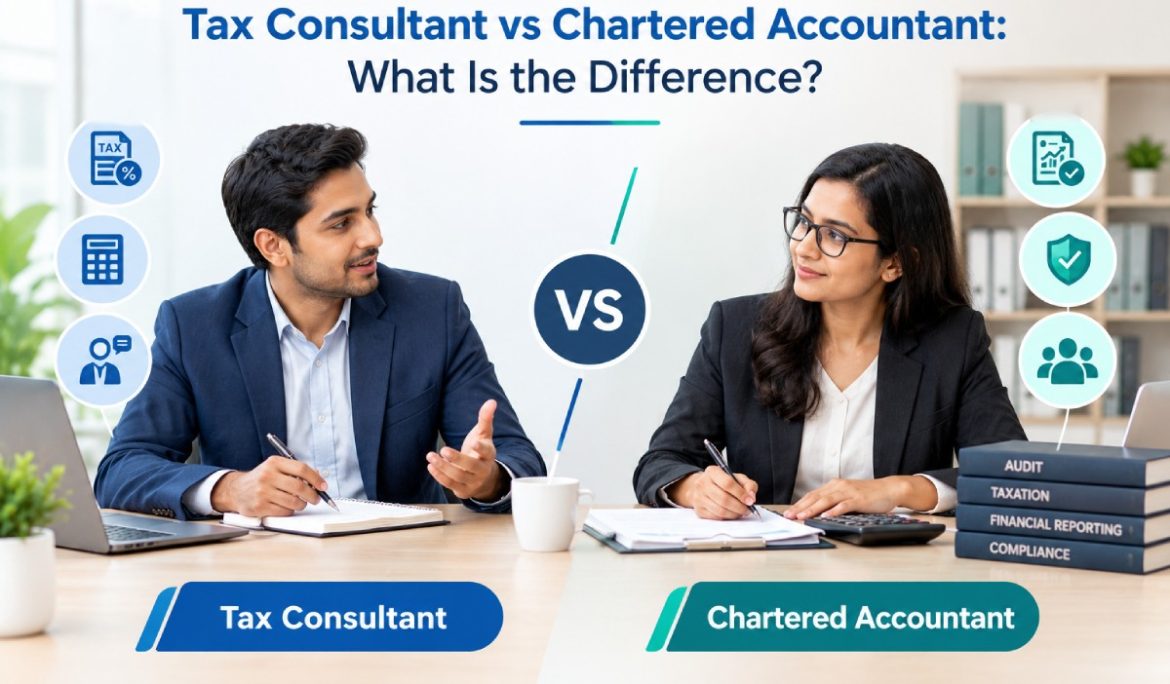
A Chartered Accountant (CA) is a professional qualified and regulated by the Institute of Chartered Accountants of India (ICAI), trained in accounting, audit, taxation, and finance. “Tax consultant” is a broader description for anyone who advises on tax, which may include CAs, advocates, GST practitioners, tax return preparers, and retired tax officers.
The key difference in the tax consultant vs chartered accountant comparison is regulation and scope. When comparing tax advisor vs CA, only a practising CA can sign statutory and tax audit reports, while a CA can combine tax work with accounting, audit, and financial advice. For simple returns, either may do. For business tax, a CA is usually the safer choice.
What Is a Tax Consultant?
A tax consultant is someone who advises individuals or businesses on tax matters, including filing returns, tax planning, TDS, GST, and dealing with the tax department. If you are looking for a tax consultant Mumbai businesses trust, always check the person’s qualifications and experience before choosing a professional. The term is a job description, not a qualification. There is no single body that licenses “tax consultants” as a group.
In practice, the people who offer tax consulting in India include:
- Chartered Accountants who focus on tax work
- Advocates who specialise in tax law, often in litigation and appeals
- GST practitioners enrolled under GST law to file returns and represent clients in GST matters
- Tax return preparers who help individuals and small taxpayers file income tax returns
- Retired tax officers who advise on procedures and assessments
- Commerce graduates and accountants with practical experience in return filing
Some of these are highly skilled specialists, while others have limited training. The label alone tells you very little, which is why the qualification behind the name matters, especially when comparing a tax consultant vs chartered accountant for business or personal tax needs.
What Is a Chartered Accountant?
A Chartered Accountant in Mumbai or anywhere in India is a member of ICAI, which regulates the profession under the Chartered Accountants Act, 1949. To qualify, a CA passes a demanding series of exams and completes practical training. A CA who wants to offer services to the public must also hold a certificate of practice.
A CA’s training covers:
- Accounting and financial reporting
- Direct tax (income tax) and indirect tax (GST)
- Audit and assurance
- Company law and corporate compliance
- Costing and financial management
ICAI also enforces a code of ethics and has a disciplinary process. Clients who have a complaint about a CA can raise it with the Institute. That accountability is one of the practical differences highlighted in the tax consultant vs chartered accountant comparison and an important reason many businesses prefer working with a regulated professional.
Tax Consultant vs Chartered Accountant: Side-by-Side Comparison for Businesses and Individuals
| Factor | Tax consultant (general term) | Chartered Accountant |
| Qualification | Varies: none, graduate, advocate, GST practitioner, CA | ICAI exams and practical training |
| Regulator | Depends on background; no single body | ICAI |
| Code of ethics and disciplinary process | Depends on background | Yes, enforced by ICAI |
| Income tax returns and advance tax | Yes | Yes |
| GST returns | Yes, if qualified to file | Yes |
| Tax audit report | No | Yes (practising CA) |
| Statutory audit of companies | No | Yes (practising CA) |
| Accounting and financial statements | Sometimes | Yes |
| Representation before tax authorities | Depends on qualification | Yes |
| Business advisory, valuation, Virtual CFO | Rarely | Often |
| Typical fee level | Often lower | Often higher, with wider scope |
What Only a Chartered Accountant Can Do
Some work is reserved for practising CAs by law.
If your business needs any of these, a tax consultant who is not a CA cannot do it:
- Tax audit: businesses above the turnover limits must get their accounts audited and file a tax audit report signed by a CA. The limit is generally ₹1 crore of turnover, or ₹10 crore where cash receipts and payments are within 5% of the total.
- Statutory audit: every company, and LLPs above the audit limits, need a statutory audit by a practising CA.
- Certain certifications: several tax and regulatory certificates, such as those required for some foreign remittances, must be issued by a CA.
- Incorporation and ROC certifications: many MCA forms need certification by a practising professional such as a CA or CS.
This is why growing businesses usually end up needing a CA even if a tax consultant handled their early returns. When evaluating a tax advisor vs CA, businesses that require audits, regulatory certifications, and long-term compliance generally benefit from working with a qualified CA.
Where a Tax Consultant Can Be the Right Fit
A CA is not the only good option for every tax question.
A tax consultant may be enough, or even better suited, in situations like these:
- Simple individual returns: a salaried person with one employer and some interest income may not need a CA’s full service.
- Specialised litigation: a tax advocate may be the right person for an appeal before a tribunal or court.
- GST filing for small businesses: an experienced GST practitioner can handle routine returns, though ITC reconciliation and notices benefit from deeper review.
- Specific procedural help: a retired tax officer may give useful guidance on how assessments work in practice.
The question is not “which title is better” but “does this person have the right qualification and experience for my situation?” If you are searching for tax advisors near me, always compare qualifications, experience, and the complexity of your tax requirements before making a decision.
Tax Advisor vs CA: Which One Do You Need?
Use the situation, not the title, to decide. The tax advisor vs CA decision should always depend on your financial complexity, compliance requirements, and future business plans rather than the designation alone.
| Your situation | Who usually fits | Why |
| Salaried individual, one employer | Tax consultant or CA | Low complexity |
| Freelancer or professional with business income | CA or experienced tax consultant | Advance tax, deductions, possible tax audit |
| Small business with GST and TDS | CA | Accounting, GST, TDS and income tax overlap |
| Turnover above tax audit limit | CA (required) | Tax audit must be signed by a CA |
| Private limited company or LLP | CA (required for audit) | Statutory audit and ROC compliance |
| Income tax scrutiny or great demand | CA or tax advocate | Representation and legal analysis |
| Tax appeal before a tribunal or court | Tax advocate, often with a CA | Litigation skills plus accounting evidence |
| Business restructuring or fundraising | CA | Tax, valuation and corporate law together |
For most businesses, the tax advisor vs CA question answers itself once turnover and complexity grow. Choosing a Chartered Accountant in Mumbai can help businesses manage accounting, GST, TDS, income tax, and audit requirements through a single qualified professional. Accounting, GST, TDS, income tax, and audit are connected, and one CA firm handling all of them avoids gaps between advisers.
What About Cost?
A tax consultant Mumbai businesses choose who is not a CA often charges less for routine filings. For a simple return, that can be reasonable, but the right choice depends on your compliance needs and long-term tax requirements.
For a business, compare what you get, not just the fee. A lower-cost filing service may only file what you send. A Chartered Accountant in Mumbai will usually review your books, reconcile GST and TDS, and flag risks before filing.
When comparing tax consultant vs chartered accountant, this broader review is often what helps businesses avoid notices, interest, and costly compliance errors. If a missed reconciliation later leads to a notice, interest, or disallowed expenses, the saving disappears quickly. Our guide to CA fees in Mumbai explains how charges are usually worked out.
How to Check a Tax Consultant or CA Before Hiring
When you search for “tax advisors near me”, you will see a mix of CAs, filing services, and individual consultants.
Before you hand over your financial data:
- Ask about qualifications. Is the person a CA, an advocate, or an enrolled GST practitioner? Ask for the membership or enrolment number.
- Verify a CA. ICAI’s CA Connect portal lists practising CAs and firms by city and service.
- Ask about experience with similar cases. A consultant who handles salaried returns may not be the right person for a business with GST and TDS.
- Ask who represents you if a notice comes. Find out whether they will draft replies and attend hearings, or refer you elsewhere.
- Get the scope in writing. List what is included and what is billed separately.
For a fuller checklist, see our guide on how to choose a Chartered Accountant in Mumbai.
Choosing Between a Tax Consultant and a CA in Mumbai
Mumbai has a wide choice of both. Whether you are searching for a tax consultant Mumbai professional or an income tax consultant Mumbai, compare qualifications, services offered, and experience rather than relying only on the title. Searches for a tax consultant in Mumbai will turn up everything from individual return filers to large CA firms with specialist tax teams.
The practical difference for a business owner is that an income tax consultant Mumbai businesses trust who is also a CA can handle your returns, advance tax, TDS, tax audit, and notices in one place, while also connecting tax decisions with your accounts and GST compliance.
If your business is growing, working with a Chartered Accountant in Mumbai early also means there is no handover later when a tax audit or statutory audit becomes necessary. If you are unsure whether you need tax help at all yet, our guide on when to hire a tax consultant walks through ten common situations.
How Whitespace Consultancy Helps
Whitespace Consultancy is a CA firm in Mulund West serving businesses across Mumbai, Thane, and Navi Mumbai. Its income tax services cover returns, advance tax, TDS compliance, tax audit, and representation on notices. Its tax planning and advisory work looks at the tax effect of business decisions before they are made, within applicable tax laws. Because the same team handles accounting and GST, tax work is based on reconciled numbers rather than figures sent at the last minute.
Frequently Asked Questions
Is a tax consultant the same as a Chartered Accountant?
No. “Tax consultant” describes the work, while Chartered Accountant is a qualification regulated by ICAI. Many tax consultants are CAs, but others may be advocates, GST practitioners, tax return preparers, or experienced accountants. Always ask what qualification sits behind the title.
Can a tax consultant who is not a CA file my income tax return?
Yes. Anyone you authorise can help prepare and file your income tax return, and many people use tax return preparers or filing services for simple returns. What a non-CA cannot do is sign a tax audit report or a statutory audit report. Those need a practising CA.
Who should I hire for an income tax notice, a tax consultant or a CA?
For simple mismatches, an experienced tax consultant may be enough. For scrutiny assessments, great demands or business cases, a CA is usually better, because the reply depends on your books, reconciliations and supporting documents. For appeals before tribunals or courts, a tax advocate often works alongside the CA.
Is a CA more expensive than a tax consultant?
Often, yes, for the same filing. But a CA’s fee usually covers review, reconciliation, and advice as well as filing. For businesses, the more useful comparison is the total cost of tax compliance, including the risk of interest, penalties, and notices from errors.
Do I need a CA if my business has GST registration?
Not by law for filing GST returns, which an enrolled GST practitioner can also do. But once your business also has TDS, income tax, possible tax audit, and input tax credit reconciliation, a CA who can see all of these together usually reduces errors and gaps between advisers.
The Bottom Line
In the tax consultant vs chartered accountant decision, focus on the qualification and scope you need, not the title. If you are comparing tax advisors near me, choose a professional with the right qualifications, relevant experience, and services that match your personal or business requirements.
For simple personal returns, a qualified tax consultant may be enough. For a business with GST, TDS, audits, or growth plans, a CA brings regulated accountability and the ability to connect tax with accounting, audit, and advice. If you would like to discuss your tax requirements, contact Whitespace Consultancy.