

TDS on Residential Rent vs Commercial Rent: What’s the Difference?
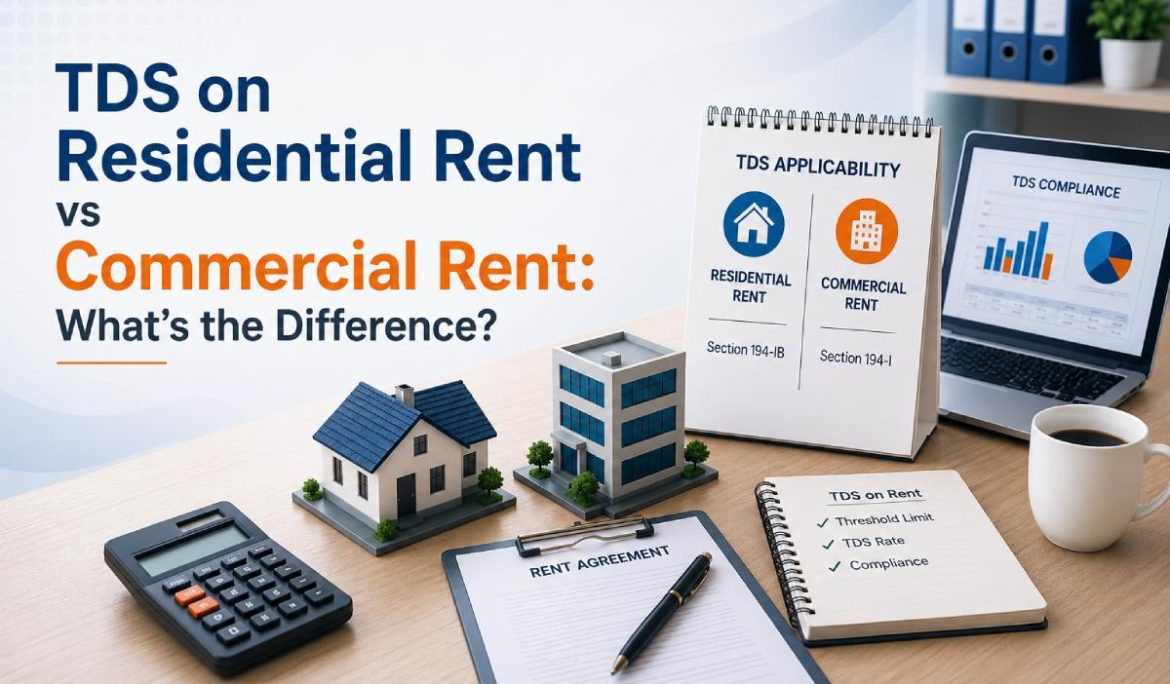
Confused About TDS on Residential Rent vs Commercial Rent? Here’s What Every Tenant and Business Should Know
Understanding TDS on Residential Rent vs Commercial Rent is essential for tenants, landlords, business owners, finance managers, and professionals responsible for tax compliance. While many people assume that TDS rules are based only on whether a property is residential or commercial, the actual provisions under the Income Tax Act are more nuanced. The applicability of TDS depends on several factors, including the nature of the tenant, the type of property, the amount of rent paid, and the relevant section of the Income Tax Act.
Incorrectly deducting, or failing to deduct, TDS on rent can lead to interest, penalties, disallowance of expenses, and notices from the Income Tax Department. Whether you are renting a residential apartment, an office space, a warehouse, a retail shop, or a commercial building, understanding the applicable TDS provisions is crucial to staying compliant.
Businesses often struggle to determine whether TDS on Residential Rent applies in the same way as TDS on Commercial Rent. Individual tenants may also be unsure whether they are required to deduct TDS when paying rent to a landlord. These questions become even more important as tax authorities continue to strengthen compliance and reporting mechanisms.
This comprehensive guide explains TDS on Residential Rent vs Commercial Rent in simple language. You’ll learn when TDS applies, which sections of the Income Tax Act are relevant, how residential and commercial rent differ for tax purposes, applicable thresholds, practical examples, and the most common compliance mistakes to avoid. If you are unsure about your TDS obligations, consulting the Best Chartered Accountant in Mumbai or an experienced Chartered Accountant in Thane can help ensure that your rent payments comply with the latest Income Tax provisions.
Quick Answer: What Is the Difference Between TDS on Residential Rent vs Commercial Rent?
The difference between TDS on Residential Rent vs Commercial Rent is not determined solely by the type of property. Instead, it depends on the applicable section of the Income Tax Act, the status of the tenant, the amount of rent paid, and whether the tenant is required to deduct tax.
Generally:
- TDS on Residential Rent may apply when an individual or Hindu Undivided Family (HUF) pays rent exceeding the prescribed threshold under the applicable provisions of the Income Tax Act.
- TDS on Commercial Rent commonly applies when businesses, companies, partnership firms, LLPs, or specified taxpayers pay rent for offices, factories, warehouses, shops, or other commercial premises, subject to the relevant TDS provisions.
Understanding which provision applies is essential for accurate compliance.
Why Understanding TDS on Rent Matters
Rent is one of the most common business expenses in India. Companies lease offices, warehouses, manufacturing facilities, retail stores, and commercial spaces, while individuals may rent residential properties for personal use. Because rent transactions involve regular payments, the Income Tax Act requires tax deduction at source in specified situations to improve tax compliance and reporting.
Failing to understand TDS on Residential Rent vs Commercial Rent can result in:
- Interest on delayed deduction.
- Penalties under the Income Tax Act.
- Disallowance of business expenses.
- Notices from the Income Tax Department.
- Additional compliance costs.
- Delays in claiming tax credits.
Businesses should therefore establish clear internal processes for determining whether TDS on Residential Rent or TDS on Commercial Rent is applicable before making rental payments. Working with the Best CA Firm in Mumbai can help businesses identify applicable TDS provisions, ensure timely compliance, and reduce the risk of tax disputes.
What Is TDS on Rent?
Tax Deducted at Source (TDS) on rent is a mechanism under the Income Tax Act through which the tenant deducts tax from the rent payable to the landlord before making the payment. Instead of paying the entire rent amount to the landlord, the tenant deducts the applicable TDS, deposits it with the Income Tax Department, and pays the remaining balance to the property owner. The landlord can subsequently claim credit for the TDS while filing their Income Tax Return.
The purpose of TDS on rent is to:
- Improve tax compliance.
- Track rental income.
- Reduce tax evasion.
- Ensure timely collection of tax revenue.
- Create transparent reporting of rental transactions.
Both TDS on Residential Rent and TDS on Commercial Rent follow this principle, although the applicable provisions and compliance requirements may differ.
Which Sections of the Income Tax Act Govern TDS on Rent?
Several provisions of the Income Tax Act govern TDS on rent depending on the nature of the transaction and the person making the payment.
The most commonly applicable provisions include:
Section 194-I
Section 194-I generally applies to specified persons such as companies, partnership firms, LLPs, and certain other taxpayers making rent payments that exceed the prescribed threshold. It covers rent paid for land, buildings, machinery, furniture, and other specified assets, subject to the conditions laid down in the Income Tax Act.
Section 194-IB
Section 194-IB generally applies to certain individuals and Hindu Undivided Families (HUFs) paying residential rent above the prescribed threshold who are not otherwise required to deduct tax under Section 194-I. This provision was introduced to widen the tax base and improve compliance for high-value residential rental transactions. Because different sections may apply depending on the tenant’s status and the nature of the rent, businesses and individuals should review the relevant provisions carefully before making rental payments.
Residential Rent vs Commercial Rent
Before understanding TDS on Residential Rent vs Commercial Rent, it is important to distinguish between residential and commercial properties.
Residential Rent
Residential rent refers to payments made for properties primarily used for residential purposes, such as:
- Apartments
- Flats
- Independent houses
- Residential villas
- Residential societies
- Residential accommodation
These properties are generally occupied for living purposes rather than business operations.
Commercial Rent
Commercial rent refers to payments made for premises used for business or commercial activities, including:
- Office spaces
- Shops
- Retail outlets
- Warehouses
- Industrial premises
- Factories
- Showrooms
- Commercial buildings
- Business centres
Commercial properties are typically leased to carry out business, professional, or industrial activities.
TDS on Residential Rent vs Commercial Rent: Key Differences
Although both involve rental payments, TDS on Residential Rent vs Commercial Rent differs in terms of applicability, tenant category, and compliance requirements.
| Particulars | TDS on Residential Rent | TDS on Commercial Rent |
| Property Type | Residential property | Commercial property |
| Common Users | Individuals, HUFs | Businesses, LLPs, Companies, Firms |
| Purpose | Personal residence | Business operations |
| Applicable Provision | Depends on the tenant and applicable section | Depends on the tenant and applicable section |
| TDS Requirement | Applicable in specified situations | Applicable in specified situations |
| Compliance | Subject to prescribed provisions | Subject to prescribed provisions |
Important Note: The determining factor is not merely whether the property is residential or commercial. The applicable section of the Income Tax Act, the status of the tenant, and the prescribed conditions play a significant role in deciding whether TDS must be deducted.
When Is TDS on Residential Rent Applicable?
TDS on Residential Rent may become applicable when the conditions specified under the relevant provisions of the Income Tax Act are satisfied.
Typically, businesses and individuals should evaluate:
- Who is paying the rent?
- Who owns the property?
- What is the monthly or annual rent?
- Which section of the Income Tax Act applies?
- Is the prescribed threshold exceeded?
Since each transaction may have different tax implications, businesses should review the applicable legal provisions before deducting TDS. For complex rental arrangements, consulting the Best Chartered Accountant in Mumbai or an experienced Chartered Accountant in Thane helps ensure compliance with the latest Income Tax rules.
When Is TDS on Commercial Rent Applicable?
TDS on Commercial Rent generally applies when businesses or specified taxpayers pay rent for commercial premises, and the transaction satisfies the conditions prescribed under the Income Tax Act.
Examples include:
- Office leases.
- Retail shops.
- Warehouses.
- Manufacturing facilities.
- Commercial buildings.
- Business centres.
- Industrial premises.
Businesses paying commercial rent should establish internal controls to ensure that TDS is deducted, deposited, and reported correctly. Failure to comply may lead to additional tax liabilities and penalties.
Practical Examples
Example 1: Residential Rent
An individual rents a residential apartment for personal use. Before making rental payments, the tenant should determine whether the applicable threshold and conditions under the Income Tax Act require TDS on Residential Rent to be deducted.
Example 2: Commercial Rent
A private limited company leases office premises for its corporate operations. Before releasing the monthly rent, the finance team should determine whether TDS on Commercial Rent applies under the relevant provisions of the Income Tax Act and comply with the applicable deduction and reporting requirements.
Example 3: Startup Renting a Co-working Office
A startup operates from a commercial co-working space and pays monthly licence or rental charges. Depending on the contractual arrangement and the applicable provisions of the Income Tax Act, the business should evaluate whether TDS on Commercial Rent is required.
Professional guidance from the Best CA Firm in Mumbai can help startups correctly classify such transactions and maintain compliance.
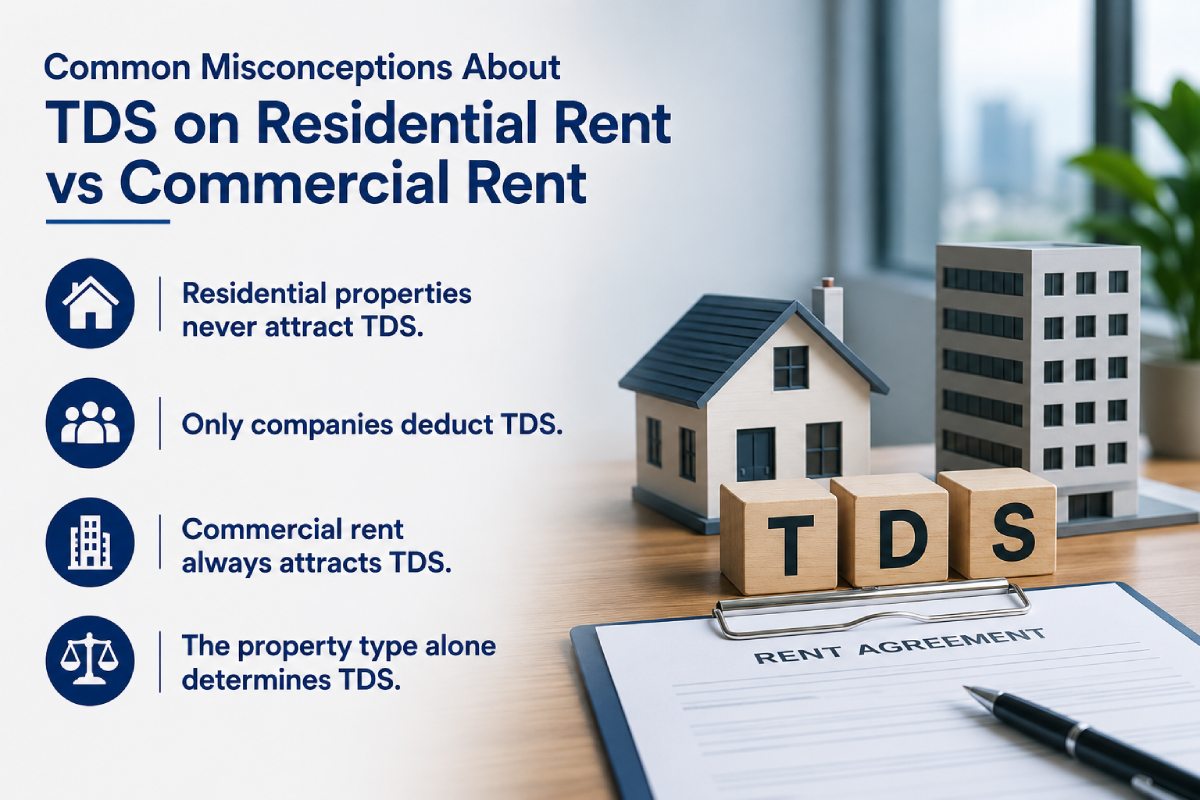
Common Misconceptions About TDS on Residential Rent vs Commercial Rent
Many taxpayers misunderstand how TDS on rent works.
Some common misconceptions include:
Residential properties never attract TDS.
Incorrect. TDS on Residential Rent may apply when the relevant legal conditions are satisfied.
Only companies deduct TDS.
Not always. Certain individuals and HUFs may also have TDS obligations depending on the applicable provisions.
Commercial rent always attracts TDS.
Not necessarily. The applicability depends on factors such as the tenant’s status, prescribed thresholds, and the relevant provisions of the Income Tax Act.
The property type alone determines TDS.
This is one of the biggest misconceptions. The applicable legal provision, tenant category, and statutory conditions are equally important when determining TDS on Residential Rent vs Commercial Rent.
Residential Rent vs Commercial Rent: Compliance Comparison
While both residential and commercial rental payments may attract TDS under the applicable provisions of the Income Tax Act, their compliance process can differ depending on the category of tenant and the relevant section.
Understanding these differences helps tenants avoid non-compliance and ensures landlords receive proper tax credit.
| Compliance Area | Residential Rent | Commercial Rent |
| Purpose of Property | Residential accommodation | Business or commercial activities |
| Typical Tenant | Individual or HUF | Company, LLP, Partnership Firm, Proprietorship, Trust |
| Applicable Income Tax Provision | Depends on the payer and prescribed conditions | Depends on the payer and prescribed conditions |
| TDS Deduction Responsibility | Tenant, where applicable | Tenant, where applicable |
| TDS Deposit | Within the prescribed due date | Within the prescribed due date |
| TDS Return / Statement | Applicable forms as prescribed | Applicable quarterly TDS returns, where applicable |
| TDS Certificate | Applicable certificate | Applicable certificate |
| Compliance Frequency | Based on applicable provision | Periodic compliance requirements |
| Common Risk | Failure to identify applicability | Delayed deduction or incorrect rate |
Businesses with multiple rented properties should maintain a centralized compliance tracker to ensure every rent payment is reviewed before release.
Documents Required for TDS Compliance
Whether you’re deducting TDS on Residential Rent or TDS on Commercial Rent, maintaining complete documentation is essential.
A well-organized record helps during:
- Income Tax assessments
- Statutory audits
- Internal audits
- Due diligence
- Financial reporting
- Tax scrutiny
Essential Documents
- Registered rent agreement
- PAN of landlord
- PAN of tenant
- Aadhaar details (where applicable)
- Monthly rent invoices
- Payment receipts
- Bank transaction records
- TDS challans
- TDS return acknowledgements
- TDS certificates
- Communication regarding rent revisions
- Security deposit records
Professional Accounting Services in Mumbai generally maintain these records digitally, making future verification much easier.
Checklist Before Paying Rent
Every finance team should verify the following before releasing rent payments.
Tenant Checklist
- Verify the rent agreement.
- Confirm whether the property is residential or commercial.
- Determine the applicable section under the Income Tax Act.
- Check whether the prescribed threshold has been crossed.
- Verify the landlord’s PAN.
- Calculate TDS correctly.
- Deduct TDS before payment.
- Deposit TDS within the due date.
- File applicable TDS statements.
- Issue the appropriate TDS certificate.
Following this checklist significantly reduces compliance errors.
Common Challenges Businesses Face
Many growing businesses encounter practical difficulties while complying with rent-related TDS provisions.
1. Multiple Rental Locations
Businesses operating across Mumbai, Thane, Navi Mumbai, Pune, or other cities may lease:
- Branch offices
- Warehouses
- Retail outlets
- Regional offices
- Manufacturing facilities
Managing TDS for multiple landlords requires a structured accounting process.
2. Different Landlords
Some businesses pay rent to:
- Individuals
- HUFs
- Partnership firms
- Companies
- Trusts
Each case may require evaluating different compliance requirements.
3. Rent Revisions
Commercial lease agreements often include annual rent escalations.
Whenever rent changes, businesses should review:
- Applicable threshold
- TDS calculation
- Lease amendments
- Accounting entries
4. Co-working and Managed Office Spaces
Modern businesses increasingly use:
- Co-working offices
- Business centres
- Managed office solutions
These arrangements may include bundled charges for facilities, utilities, maintenance, and services. Businesses should review agreements carefully to determine the appropriate tax treatment.
5. Shared Office Premises
Two or more companies may share one commercial office. Each entity should evaluate its own rental agreement and TDS obligations separately.
Accounting Entries for TDS on Rent
Businesses should ensure that rent transactions are properly recorded in their accounting system.
A typical accounting flow includes:
At the Time of Booking Rent Expense
Rent Expense Account: Debited
Landlord Account: Credited
At the Time of Deducting TDS
Landlord Account: Debited
TDS Payable Account: Credited
At the Time of Making Payment
Landlord Account: Debited
Bank Account: Credited
At the Time of Depositing TDS
TDS Payable Account: Debited
Bank Account: Credited
Maintaining accurate accounting entries simplifies reconciliation and statutory audits.
How Landlords Benefit from TDS Deduction
Many landlords initially worry when tenants deduct TDS from rent payments. However, TDS is not an additional tax; it is a tax collected in advance on behalf of the Income Tax Department.
Once the tenant deducts and deposits TDS correctly:
- The amount is reflected in the landlord’s tax records.
- The landlord can claim the credit while filing the Income Tax Return.
- It reduces the overall tax payable or may increase the refund, depending on the landlord’s tax liability.
Timely issuance of the applicable TDS certificate also helps landlords reconcile their records without difficulty.
Why Accurate TDS Compliance Matters
Correct TDS compliance offers several benefits for both tenants and landlords.
For Businesses
- Avoids interest and penalties.
- Reduces the risk of Income Tax notices.
- Ensures accounting records remain accurate.
- Improves audit readiness.
- Supports smooth statutory compliance.
- Prevents disallowance of eligible business expenses.
For Landlords
- Ensures proper tax credit.
- Simplifies Income Tax Return filing.
- Reduces disputes with tenants.
- Improves financial record keeping.
When Should You Consult a Chartered Accountant?
Although straightforward rental arrangements may be easy to manage, professional advice becomes valuable when dealing with more complex situations, such as:
- Multiple rental properties
- High-value commercial leases
- Rent revisions during the year
- Joint ownership of property
- Co-working or managed office agreements
- Mixed residential and commercial use
- TDS notices from the Income Tax Department
- Tax audits
- Corporate restructuring
Consulting the Best Chartered Accountant in Mulund or an experienced Chartered Accountant in Thane can help businesses interpret the applicable provisions correctly, establish robust compliance processes, and reduce the likelihood of future tax disputes.
Interest and Penalties for Non-Compliance
Understanding TDS on Residential Rent vs Commercial Rent is only one part of compliance. Businesses and individuals must also ensure that TDS is deducted, deposited, and reported within the prescribed timelines under the Income Tax Act. Failure to comply can result in financial penalties, interest, additional compliance requirements, and even notices from the Income Tax Department. Whether you are dealing with TDS on Residential Rent or TDS on Commercial Rent, timely compliance helps avoid unnecessary costs and legal complications.
Interest for Non-Deduction of TDS
If a tenant is required to deduct TDS but fails to do so, the Income Tax Act provides for the levy of interest from the date on which tax was deductible until the date it is actually deducted. Even if the omission is unintentional, interest may still become payable. For businesses making recurring rental payments, even a small delay can accumulate into a significant financial liability over time.
Interest for Late Deposit of TDS
Deducting TDS alone is not sufficient. After deduction, the tenant must deposit the tax with the Income Tax Department within the prescribed due date.
Delayed payment may attract:
- Interest
- Additional compliance costs
- Tax notices
- Increased scrutiny during assessments
Maintaining a compliance calendar can help businesses avoid missing statutory deadlines.
Penalties for Non-Compliance
Depending on the nature of the default, taxpayers may face consequences such as:
- Interest on delayed deduction.
- Interest on delayed deposit.
- Late filing fees.
- Penalties under the Income Tax Act.
- Disallowance of business expenditure in certain cases.
- Notices from the Income Tax Department.
- Additional documentation requirements during assessments.
For businesses with multiple rental properties or numerous landlords, these issues can quickly become difficult to manage without a structured compliance process.
Consequences of Incorrect TDS Deduction
Many taxpayers assume that deducting “some amount” of TDS is sufficient. However, deducting TDS incorrectly may create compliance issues for both the tenant and the landlord.
Common problems include:
- Deducting TDS at the wrong rate.
- Applying the wrong section of the Income Tax Act.
- Deducting TDS even when not applicable.
- Failing to deduct TDS when required.
- Incorrect PAN details.
- Filing inaccurate TDS statements.
- Delayed issue of TDS certificates.
These errors can delay tax credit for landlords and increase the likelihood of notices or demands from the Income Tax Department.
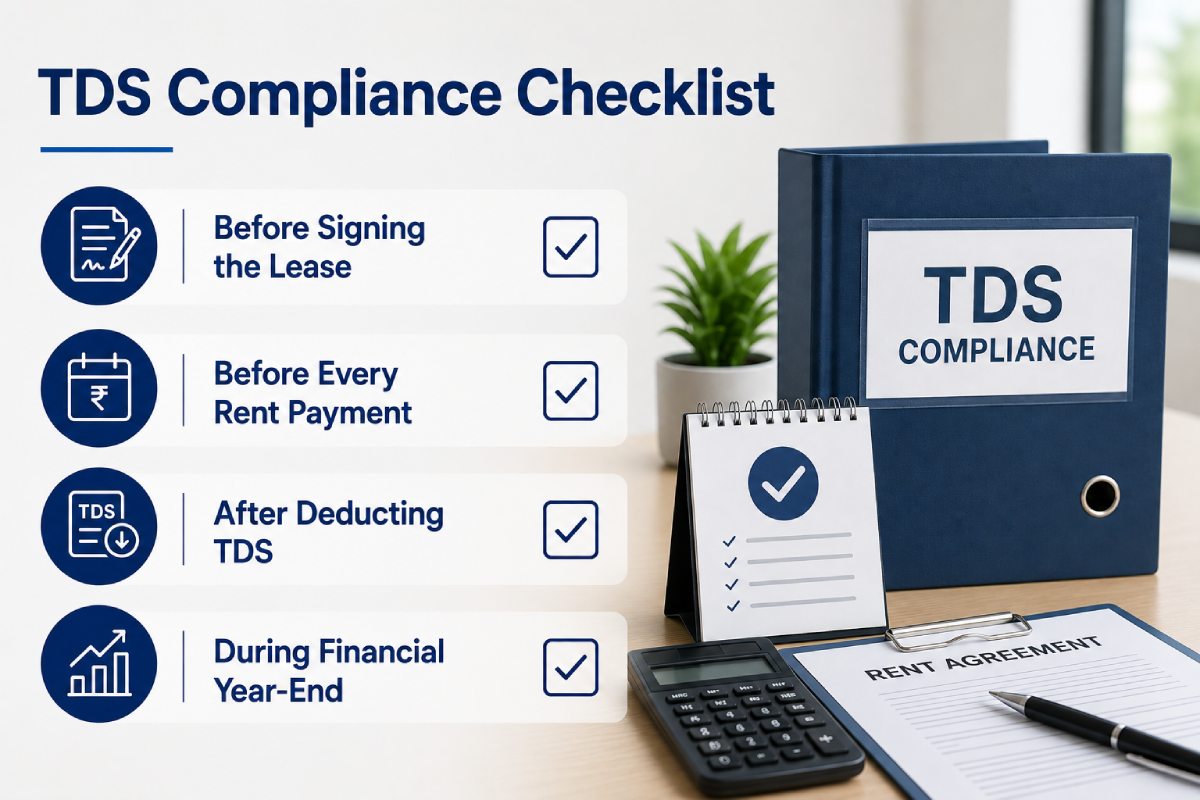
TDS Compliance Checklist
Whether you are an individual tenant, startup, SME, or large organisation, use this checklist before every rent payment.
Before Signing the Lease
- Verify the ownership of the property.
- Obtain the landlord’s PAN.
- Review the rental agreement carefully.
- Confirm whether the property is residential or commercial.
- Determine the applicable provisions of the Income Tax Act.
Before Every Rent Payment
- Verify the monthly rent amount.
- Check whether the applicable threshold has been crossed.
- Calculate TDS correctly.
- Deduct TDS before releasing payment.
- Maintain proper accounting records.
After Deducting TDS
- Deposit TDS within the prescribed due date.
- File the applicable TDS return or challan-cum-statement.
- Generate and issue the appropriate TDS certificate.
- Preserve payment challans and acknowledgement receipts.
During Financial Year-End
- Reconcile rent payments.
- Match TDS deducted with accounting records.
- Verify landlord details.
- Confirm TDS reflects correctly in tax records.
- Maintain all supporting documentation for future assessments or audits.
Residential Rent vs Commercial Rent: At a Glance
The following table summarises the key differences between TDS on Residential Rent vs Commercial Rent.
| Particular | Residential Rent | Commercial Rent |
| Primary Use | Residential accommodation | Business activities |
| Common Users | Individuals and HUFs | Companies, LLPs, Firms, Businesses |
| Typical Properties | Flats, Apartments, Houses | Offices, Shops, Warehouses, Factories |
| Applicable Provision | Depends on the tenant and transaction | Depends on the tenant and transaction |
| TDS Responsibility | Tenant, where applicable | Tenant, where applicable |
| Compliance Process | Based on applicable Income Tax provisions | Based on applicable Income Tax provisions |
| Documentation | Rent agreement, PAN, TDS forms | Rent agreement, PAN, TDS forms, accounting records |
| Professional Advice Recommended | Yes | Highly recommended |
When Should You Seek Professional Advice?
Although many rental arrangements appear straightforward, determining the correct TDS treatment is not always simple.
Professional guidance is particularly valuable when dealing with:
- High-value rental agreements.
- Multiple landlords.
- Joint ownership of property.
- Commercial lease agreements.
- Warehouses and industrial premises.
- Co-working spaces.
- Mixed-use properties.
- Rent revisions during the year.
- GST implications on rent.
- Income Tax notices.
- Tax assessments.
- Corporate restructuring.
Working with the Best Chartered Accountant in Mumbai helps businesses correctly interpret tax provisions, maintain compliance, and minimise financial risks. Businesses located in the Mumbai Metropolitan Region can also benefit from consulting an experienced Chartered Accountant in Thane for personalised tax planning and compliance support.
Why Professional Tax Planning Matters
Many taxpayers think of TDS only as a compliance requirement. In reality, proper tax planning can improve financial efficiency and reduce future tax disputes.
Experienced professionals can help businesses:
- Structure rental arrangements correctly.
- Maintain proper documentation.
- Review lease agreements.
- Improve compliance processes.
- Identify applicable TDS provisions.
- Avoid unnecessary penalties.
- Prepare for tax assessments.
- Coordinate with auditors.
- Improve financial reporting.
This proactive approach saves time, reduces compliance risks, and allows management to focus on business growth.
Why Choose Whitespace Consultancy?
Managing TDS on rent requires more than simply deducting tax before making a payment. Businesses need accurate interpretation of the Income Tax Act, timely compliance, proper documentation, and ongoing professional guidance. At Whitespace Consultancy, we help startups, SMEs, professionals, and established businesses manage their accounting and taxation responsibilities with confidence.
Our experienced team supports clients with:
- Accounting Services
- Income Tax Services
- GST Registration & Compliance
- TDS Compliance
- Payroll Services
- Audit & Assurance
- Financial Reporting
- Business Advisory Services
- Virtual CFO Services
- Tax Planning
Whether you need assistance with TDS on Residential Rent, TDS on Commercial Rent, or broader tax compliance, our professionals provide practical, business-focused solutions. If you’re searching for the Best Chartered Accountant in Mumbai, a trusted Best CA Firm in Mumbai, or a reliable Chartered Accountant in Thane, our team is committed to helping your business remain compliant while supporting long-term financial growth.
Key Takeaways
- TDS on Residential Rent vs Commercial Rent depends on the applicable provisions of the Income Tax Act, the status of the tenant, the nature of the property, and prescribed thresholds, not merely on whether the property is residential or commercial.
- Both TDS on Residential Rent and TDS on Commercial Rent require accurate deduction, timely deposit, proper documentation, and statutory reporting.
- Incorrect TDS compliance can lead to interest, penalties, delayed tax credits, and Income Tax notices.
- Businesses should maintain organised records, monitor due dates, and periodically review rental agreements to ensure compliance.
- Partnering with the Best Chartered Accountant in Mumbai or a trusted Best CA Firm in Mumbai can simplify compliance, improve tax planning, and reduce the risk of costly errors.
Conclusion
Understanding the difference between TDS on Residential Rent vs Commercial Rent is essential for every tenant, landlord, finance professional, and business owner. While both involve the deduction of tax at source, the applicable provisions depend on several factors, including the tenant’s status, the nature of the property, the amount of rent, and the relevant section of the Income Tax Act.
Rather than assuming that all residential or commercial rent payments are treated the same, businesses should carefully evaluate each rental arrangement before making payments. Timely deduction, accurate filing, and proper documentation not only ensure compliance but also help avoid unnecessary penalties and disputes.
If your business leases offices, warehouses, retail outlets, factories, or residential accommodations, or if you are unsure about your TDS obligations, professional guidance can help you stay compliant and make informed financial decisions.
Need Expert Help with TDS Compliance?
Whether you need assistance with TDS on Residential Rent, TDS on Commercial Rent, Income Tax compliance, or ongoing accounting support, the team at Whitespace Consultancy is here to help.
Our experienced professionals provide:
- Accounting Services
- Income Tax Services
- TDS Compliance & Advisory
- GST Registration & Compliance
- Audit & Assurance
- Business Advisory Services
- Virtual CFO Services
If you’re looking for the Best Chartered Accountant in Mulund, a dependable Best CA Firm in Mumbai, or an experienced Chartered Accountant in Thane, contact Whitespace Consultancy today for tailored financial and tax solutions that support your business at every stage.
Frequently Asked Questions
Is TDS applicable on residential rent?
Yes. TDS on Residential Rent may apply if the transaction satisfies the conditions prescribed under the relevant provisions of the Income Tax Act. The applicability depends on factors such as the tenant’s status, rent amount, and the relevant section.
Is TDS applicable on commercial rent?
Yes. TDS on Commercial Rent generally applies to businesses and specified taxpayers paying rent for commercial properties, subject to the applicable provisions and prescribed thresholds.
Is the TDS rate the same for residential and commercial buildings?
The applicable TDS rate depends on the relevant section of the Income Tax Act and the type of asset involved. The property being residential or commercial is not the sole determining factor.
Who is responsible for deducting TDS on rent?
Where applicable, the tenant is responsible for deducting TDS before making rent payments to the landlord and depositing it with the Income Tax Department.
What happens if TDS is not deducted?
Failure to deduct TDS may result in interest, penalties, late fees, tax notices, and additional compliance obligations under the Income Tax Act.
Can landlords claim credit for TDS?
Yes. Once TDS has been correctly deducted and deposited, landlords can generally claim the corresponding tax credit while filing their Income Tax Return.
Is TDS applicable on refundable security deposits?
A refundable security deposit that is returned without adjustment towards rent is generally not treated as rent for TDS purposes. However, the specific facts and terms of the agreement should be reviewed.
Does GST affect TDS on rent?
GST and TDS are governed by different laws. Depending on the nature of the transaction, both GST and TDS provisions may need to be considered separately.
Which documents should be maintained for TDS compliance?
Businesses should retain rent agreements, PAN details, payment records, TDS challans, TDS returns, certificates, bank statements, and other supporting documentation.
Should startups outsource TDS compliance?
Many startups prefer to outsource accounting and tax compliance to experienced professionals, allowing founders to focus on business growth while reducing compliance risks.