

When Is TDS Applicable on Rent Paid to a Landlord? (2026 Guide)
Renting office space, warehouses, factories, commercial buildings, or even residential properties for business purposes is common for growing businesses. However, many businesses are unsure whether they need to deduct Tax Deducted at Source (TDS) before making rent payments to their landlord.
One of the most frequently asked questions is: When is TDS applicable to rent paid to a landlord?
The answer depends on several factors, including:
- Who is paying the rent
- Who owns the property
- The annual rent amount
- The applicable section of the Income Tax Act
- The nature of the property being rented
Failure to deduct TDS when required can result in interest, penalties, disallowance of expenses, and notices from the Income Tax Department. In this comprehensive guide, we explain when TDS on rent is applicable, the relevant provisions of the Income Tax Act, threshold limits, TDS rates, practical examples, compliance requirements, and common mistakes businesses should avoid.
Whether you are a startup, SME, private limited company, LLP, or established business, this guide will help you understand your TDS obligations and remain compliant.
Quick Answer: When Is TDS Applicable on Rent Paid to a Landlord?
TDS on rent becomes applicable when a person or business covered under the relevant provisions of the Income Tax Act, 1961, makes rent payments exceeding the prescribed threshold limit. For businesses and entities covered under Section 194I, TDS is generally required when the total rent paid or credited to a resident landlord during a financial year exceeds the applicable threshold prescribed under the Income Tax Act.
The applicable TDS rate depends on the type of asset being rented, such as land, buildings, plant, machinery, or equipment. Timely deduction, deposit, and reporting of TDS are essential to avoid penalties and ensure tax compliance.
What is TDS?
Tax Deducted at Source (TDS) is a mechanism introduced by the Government of India to collect income tax at the source of income rather than waiting until the end of the financial year. Instead of the recipient paying tax later, the payer deducts a specified percentage before making the payment and deposits that amount with the government.
This system helps:
- Ensure timely tax collection
- Reduce tax evasion
- Improve tax compliance
- Create a transparent reporting system
- Enable advanced collection of income tax
TDS applies to several types of payments, including:
- Salaries
- Professional fees
- Contractor payments
- Commission
- Interest
- Rent
- Dividend
- Brokerage
- Certain property transactions
Rent payments are one of the most common transactions where businesses must evaluate their TDS obligations.
Why is TDS deducted from rent?
The government treats rental income as taxable income in the hands of the landlord. To ensure taxes are collected efficiently, the responsibility of deducting tax is placed on the tenant (payer) in specified situations.
This approach benefits the tax administration by:
- Improving tax collection
- Tracking rental income
- Reducing tax leakage
- Increasing reporting transparency
- Simplifying compliance monitoring
For businesses, deducting TDS correctly also helps ensure that rent expenses remain compliant with tax regulations.
Which Section Covers TDS on Rent?
The primary provision governing TDS on rent is Section 194I of the Income Tax Act, 1961. This section requires specified persons to deduct TDS before paying rent to a resident landlord if the payment exceeds the prescribed threshold during a financial year.
However, depending on the nature of the payer and the transaction, other provisions, such as those applicable to certain individuals and Hindu Undivided Families (HUFs), may also apply. Businesses should evaluate the applicable section based on their specific circumstances.
What is Considered “Rent” Under the Income Tax Act?
Many taxpayers assume rent only refers to payments for office or residential premises. However, the definition of rent under the Income Tax Act is much broader.
Rent generally includes payments made under a lease, tenancy, sub-lease, or similar arrangement for the use of:
- Land
- Buildings
- Office premises
- Commercial properties
- Warehouses
- Factories
- Industrial sheds
- Plant and machinery
- Equipment
- Furniture
- Fixtures
If a payment is made for the use of these assets under an agreement, it may fall within the scope of TDS provisions, subject to the applicable law.
When Does TDS on Rent Become Applicable?
Businesses should ask the following questions before making rent payments:
- Is the payment being made as rent?
- Is the landlord a resident?
- Does the payment exceed the prescribed threshold under the applicable section?
- Is the payer required to deduct TDS under the Income Tax Act?
- If the answer is “Yes,” TDS may be applicable.
Every rent transaction should be evaluated individually based on the relevant legal provisions and the facts of the case.
Who is Required to Deduct TDS on Rent?
The obligation to deduct TDS generally applies to specified categories of payers under the Income Tax Act.
These may include:
- Private Limited Companies
- Public Limited Companies
- Limited Liability Partnerships (LLPs)
- Partnership Firms
- Proprietorships meeting the prescribed criteria
- Trusts
- Societies
- Certain Individuals and HUFs are covered under applicable provisions
The applicability depends on the nature of the payer and the relevant statutory requirements.
TDS on Residential Rent vs Commercial Rent
One of the most common misconceptions is that TDS applies only to commercial office rent. In reality, the applicability depends on the relevant legal provisions and threshold limits rather than simply whether the property is residential or commercial.
For example:
Commercial Office
A company rents office space in Mumbai for its operations. If the applicable conditions under the Income Tax Act are satisfied, TDS obligations may arise.
Factory Premises
A manufacturing company leases an industrial warehouse. This arrangement should also be evaluated under the applicable TDS provisions.
Residential Property
A company rents an apartment to accommodate employees or directors. Depending on the applicable section and circumstances, TDS requirements may still need to be considered. The nature of the agreement and the legal provisions are more important than the type of property alone.
Practical Example 1 – Office Rent
ABC Technologies Pvt. Ltd. leases an office in Mumbai from a resident landlord. Every month, the company pays rent under a formal lease agreement. Before making the payment, the finance team reviews whether the annual rent exceeds the prescribed threshold and whether TDS must be deducted under the applicable section.
Where applicable, the company deducts TDS, deposits it with the government, issues the necessary TDS certificate, and reports the transaction in the prescribed TDS return. By following the correct process, the company avoids interest, penalties, and future tax disputes.
Practical Example 2 – Warehouse Rent
A logistics company leases a warehouse to store inventory. The warehouse owner receives periodic rent under a long-term agreement. Since the payment qualifies as rent under the Income Tax Act, the company evaluates its TDS obligations before each payment and complies with the applicable provisions.
Why Businesses Should Review Rent Agreements Carefully?
Many TDS errors arise because businesses treat rent payments as routine expenses without reviewing the underlying agreement.
Before processing rent invoices, businesses should verify:
- The type of property being rented
- The identity and residential status of the landlord
- The terms of the lease agreement
- Whether the annual payment exceeds the applicable threshold
- The relevant section of the Income Tax Act
- Whether TAN registration and TDS compliance are required
A simple review before making payments can prevent future notices and compliance issues.
Common Situations Where Businesses Forget About TDS on Rent
Businesses often overlook TDS obligations in the following situations:
- Renting a co-working office for long-term use
- Leasing warehouses or storage facilities
- Renting factory premises
- Paying rent to related parties
- Leasing equipment along with office space
- Renting furnished commercial properties
- Renewing old lease agreements without reviewing tax implications
Periodic reviews of lease agreements help ensure ongoing compliance as business operations evolve.
Threshold Limit for TDS on Rent
One of the first questions businesses ask is:
At what amount is TDS applicable on rent?
The answer depends on which provision of the Income Tax Act applies to the payer. For businesses and entities covered under Section 194I, TDS is required only when the total rent paid or credited to a resident landlord during a financial year exceeds the threshold prescribed under the Income Tax Act. Once the threshold is crossed, TDS is generally deducted on the applicable rent payments in accordance with the relevant provisions.
Important: Threshold limits are revised from time to time through Finance Acts and notifications. Businesses should always verify the latest limits before deducting TDS.
Which Rent Payments Are Covered Under Section 194I?
Section 194I applies to rent paid for the use of various assets, not just office premises.
The scope generally includes rent paid for:
- Office buildings
- Commercial shops
- Industrial sheds
- Warehouses
- Factories
- Land
- Godowns
- Plant & Machinery
- Equipment
- Furniture
- Fixtures
Many businesses mistakenly believe only commercial office rent attracts TDS. In reality, the type of asset and the applicable legal provisions determine whether TDS needs to be deducted.
Current TDS Rates on Rent
The applicable TDS rate depends on the nature of the asset being rented.
| Nature of Asset | Applicable TDS Rate* |
| Plant, Machinery & Equipment | As prescribed under Section 194I |
| Land, Building, Factory, Office, Warehouse, Furniture & Fixtures | As prescribed under Section 194I |
TDS rates may change through amendments to the Income Tax Act or Finance Acts. Always verify the latest applicable rate before deducting tax.
When Should TDS Be Deducted on Rent?
A common misconception is that TDS should be deducted only when the rent is actually paid.
Under the Income Tax Act, TDS is generally required at the earlier of:
- Credit of rent to the landlord’s account, or
- Actual payment of rent
whichever occurs first.
Example
A company records the landlord’s rent in its books on 31 March, but makes the payment on 10 April. Since the rent was credited first, TDS is generally deducted on the date of credit, not on the payment date. Understanding this principle helps businesses avoid delays in deduction and potential interest liabilities.
Step-by-Step Process for Deducting TDS on Rent
A structured process helps businesses remain compliant throughout the financial year.
Step 1: Review the Lease Agreement
Verify:
- Nature of the property
- Monthly rent
- Security deposit terms
- Duration of lease
- Landlord details
- PAN availability
- GST implications (if applicable)
Step 2: Determine Whether TDS Applies
Evaluate:
- Total annual rent
- Applicable threshold
- Relevant section of the Income Tax Act
- Status of the payer
- Residential status of the landlord
Step 3: Calculate TDS
Calculate the applicable TDS on the rent amount in accordance with the relevant provision. Ensure calculations are reviewed before processing payment.
Step 4: Deduct TDS
Deduct TDS before releasing the rent payment wherever applicable. Maintain proper accounting records of the deduction.
Step 5: Deposit TDS with the Government
After deduction, deposit the TDS within the prescribed due date through the applicable challan. Delayed deposits may attract interest and penalties.
Step 6: File TDS Returns
Report the deduction in the applicable quarterly TDS return. Accurate reporting ensures that the landlord receives appropriate tax credit.
Step 7: Issue the TDS Certificate
After filing the return, issue the applicable TDS certificate to the landlord within the prescribed timeline. This enables the landlord to claim the TDS credit while filing their Income Tax Return.
Practical Calculation Example
Scenario
XYZ Manufacturing Pvt. Ltd. leases an office building in Mumbai. The annual rent exceeds the threshold prescribed under the Income Tax Act, making TDS applicable.
The finance team:
- Reviews the lease agreement.
- Determines the applicable TDS rate.
- Calculates the TDS amount.
- Deducts TDS before releasing the payment.
- Deposits the deducted tax with the government.
- Reports the transaction in the quarterly TDS return.
- Issues the prescribed TDS certificate to the landlord.
Following this process helps the company maintain compliance and reduces the risk of notices or disallowance of rent expenses.
Does GST Affect TDS on Rent?
Businesses often ask whether GST changes the TDS calculation.
The answer depends on:
- How the invoice is raised
- Whether GST is shown separately
- The applicable Income Tax and GST provisions
- Relevant CBDT and GST guidelines
Since GST and TDS are governed by different laws, businesses should evaluate both requirements together while processing rent invoices. For transactions involving commercial properties, it is advisable to review the GST treatment before calculating TDS.
Is TAN Mandatory for Deducting TDS?
For most entities deducting TDS under Section 194I, obtaining a Tax Deduction and Collection Account Number (TAN) is mandatory before deducting and depositing tax.
TAN is used for:
- TDS payments
- TDS returns
- TDS certificates
- Income Tax reporting
Failure to obtain TAN where required may result in compliance issues and penalties.
Which Forms Are Used for TDS on Rent?
| Form | Purpose |
| TAN | Registration number required for TDS compliance |
| Form 26AS | Reflects tax deducted and deposited against PAN |
| Form 16A | TDS certificate issued to the landlord for non-salary payments |
| Quarterly TDS Return | Reports TDS deducted and deposited during the quarter |
Each form plays a specific role in the TDS compliance process, and timely filing ensures accurate tax credit for the landlord.
Interest and Penalties for Non-Compliance
Failure to comply with TDS provisions can have financial consequences.
Common situations that may attract interest or penalties include:
- Failure to deduct TDS where applicable
- Deducting TDS but not depositing it within the prescribed time
- Late filing of TDS returns
- Incorrect reporting of TDS details
- Failure to issue TDS certificates
- Incorrect PAN or TAN details
In addition to monetary consequences, businesses may receive notices from the Income Tax Department and may need to explain discrepancies during assessments. Maintaining a compliance calendar and periodic reviews can significantly reduce these risks.
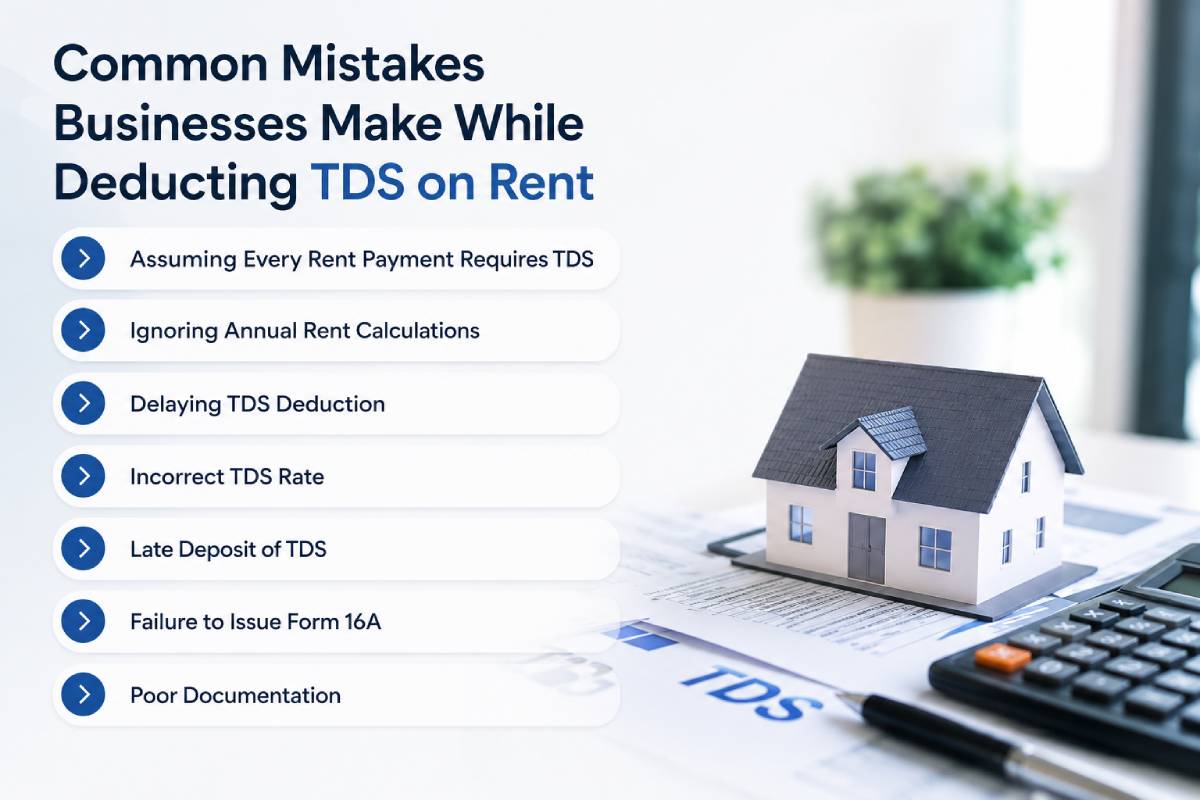
Common Mistakes Businesses Make While Deducting TDS on Rent
Even established businesses occasionally make avoidable errors.
Assuming Every Rent Payment Requires TDS
Not every rent payment automatically attracts TDS. Businesses should first evaluate the applicable threshold and legal provisions.
Ignoring Annual Rent Calculations
Some businesses review monthly rent instead of the total annual rent, leading to incorrect conclusions about TDS applicability.
Delaying TDS Deduction
Waiting until the payment date without considering the date of credit can create compliance issues.
Incorrect TDS Rate
Using an incorrect rate can lead to short deduction or excess deduction, both of which require corrective action.
Late Deposit of TDS
Deducting TDS is only one part of the process. Delayed deposits may attract interest even if the deduction itself was timely.
Failure to Issue Form 16A
The landlord requires the TDS certificate to claim tax credit. Delays can create unnecessary disputes.
Poor Documentation
Businesses should maintain:
- Lease agreements
- Rent invoices
- Payment records
- TDS challans
- TDS returns
- TDS certificates
- PAN and TAN details
Strong documentation helps during tax assessments and audits.
Expert Tips for Businesses
- Review every new lease agreement before processing payments.
- Maintain a rent register for all leased properties.
- Reconcile rent expenses with TDS deductions every month.
- Verify the PAN details of landlords.
- Maintain a compliance calendar for TDS due dates.
- Coordinate GST and TDS compliance for commercial property rentals.
- Conduct periodic reviews with your Chartered Accountant to identify potential compliance gaps before they become notices.
Explaining TDS rules. We’ll go further by covering real business scenarios, FAQs, compliance checklists, myths, and internal linking, making this article much more useful for users and AI platforms.
Practical Business Scenarios: Understanding TDS on Rent
Knowing the law is important, but applying it correctly in real business situations is what ensures compliance. Below are common scenarios that businesses frequently encounter.
Scenario 1: Renting an Office in Mumbai
ABC Technologies Pvt. Ltd. leases office premises in Mumbai under a registered lease agreement. Before processing monthly rent payments, the finance team reviews the agreement, verifies the landlord’s PAN, evaluates whether the annual rent exceeds the applicable threshold, and determines whether TDS is required under the relevant provision of the Income Tax Act.
Once the TDS obligation is identified, the company deducts tax before making the payment, deposits it with the government within the prescribed timeline, files the quarterly TDS return, and issues the applicable TDS certificate to the landlord. Following a structured process helps the company remain compliant and reduces the risk of notices during tax assessments.
Scenario 2: Startup Leasing a Co-working Office
A startup rents workspace in a managed office facility. The founders assume the monthly rent is too small to require tax compliance.
However, before making payments, the finance team reviews:
- Total annual rent
- Lease agreement
- Nature of the arrangement
- Applicable Income Tax provisions
This proactive review helps determine whether TDS obligations arise and avoids compliance issues later.
Scenario 3: Warehouse Rental
A logistics company leases multiple warehouses across different cities.
Instead of reviewing each invoice separately, the accounts department maintains a centralized rent register that tracks:
- Property location
- Annual rent
- Landlord details
- TDS deductions
- Deposit dates
- Return filing status
This centralized approach reduces errors and simplifies audits.
Scenario 4: Factory Premises
A manufacturing company leases an industrial unit. Along with rent payments, it incurs maintenance charges, common area expenses, and utility reimbursements. The finance team reviews each component separately to determine the appropriate tax treatment under the Income Tax Act and GST provisions before processing payments.
TDS on Residential Rent vs Commercial Rent
Many taxpayers believe TDS applies only to office or commercial properties. In reality, the applicability depends on the relevant legal provisions, the type of payer, and the applicable threshold, not merely on whether the property is residential or commercial.
| Residential Property | Commercial Property |
| May be used for employee accommodation or business purposes | Used for offices, shops, factories, warehouses, or industrial premises |
| TDS applicability depends on the relevant Income Tax provisions | TDS applicability also depends on the applicable provisions and thresholds |
| Review the lease agreement and legal requirements | Review the lease agreement and legal requirements |
Businesses should evaluate each arrangement individually rather than making assumptions based solely on the property type.
TDS Compliance Checklist for Businesses
A structured checklist helps finance teams ensure consistent compliance throughout the financial year.
Before making rent payments, verify:
- The lease agreement is properly executed.
- Landlord’s PAN details are available.
- Annual rent has been reviewed against the applicable threshold.
- Correct TDS provision has been identified.
- An appropriate TDS rate has been applied.
- TDS is deducted at the correct time.
- TDS is deposited within the prescribed due date.
- Quarterly TDS returns are filed accurately.
- The TDS certificate is issued to the landlord.
- All supporting documents are securely maintained.
Regular internal reviews reduce the likelihood of notices and improve audit readiness.
Common Myths About TDS on Rent
Many businesses make decisions based on incorrect assumptions. Let’s address some common myths.
Myth 1: Every Rent Payment Requires TDS
Reality
Not every rent payment attracts TDS. Applicability depends on the relevant section of the Income Tax Act, the nature of the payer, and the prescribed threshold.
Myth 2: Only Commercial Rent Attracts TDS
Reality
Residential property rented for business purposes may also require evaluation under the applicable TDS provisions.
Myth 3: TDS Needs to Be Deducted Only at Year-End
Reality
TDS is generally deducted at the earlier of credit or payment, as applicable under the law, not only at the end of the financial year.
Myth 4: GST and TDS Are the Same
Reality
GST and TDS are governed by different laws and serve different purposes. Businesses should evaluate both separately when processing rent payments.
Myth 5: Small Businesses Don’t Need to Review Rent Agreements
Reality
Startups and SMEs often receive Income Tax notices because rent agreements were never reviewed for TDS applicability.
How Whitespace Consultancy Helps Businesses with TDS Compliance
Managing TDS compliance involves more than deducting tax. Businesses must correctly interpret legal provisions, review lease agreements, maintain documentation, meet filing deadlines, and respond to changing regulations. At Whitespace Consultancy, we help startups, SMEs, LLPs, companies, and established businesses simplify TDS compliance through practical, partner-led advisory.
Our services include:
- TDS applicability review
- Lease agreement review
- TAN registration support
- TDS deduction planning
- Quarterly TDS return filing
- Form 16A assistance
- TDS reconciliations
- Interest and penalty advisory
- Income Tax notice handling
- Tax assessments and representation
- End-to-end compliance management
Our objective is to help businesses reduce compliance risks while improving the efficiency of their finance and accounting processes.
Related Services You May Find Helpful
If you’re managing business compliance, explore these related services:
- Income Tax Services – Tax planning, return filing, TDS advisory, assessments, notices, and litigation support.
- Accounting Services in Mumbai – Bookkeeping, financial reporting, accounts outsourcing, and MIS reporting.
- GST Registration & Compliance Services – GST registration, return filing, reconciliations, and advisory.
- Audit & Assurance Services – Statutory audits, internal audits, due diligence, and compliance reviews.
- Business Advisory Services – Business structuring, Virtual CFO services, budgeting, and financial planning.
- Chartered Accountants in Mumbai – Learn more about our experienced team and partner-led approach.
- Contact Us – Speak with our tax experts for personalised guidance.
Key Takeaways
TDS on rent is an important compliance requirement that businesses should evaluate before making rental payments. Understanding the applicable provisions, reviewing lease agreements, verifying threshold limits, and maintaining proper documentation help reduce the risk of interest, penalties, and Income Tax notices.
Businesses should establish a structured process for reviewing rent transactions, deducting TDS where applicable, depositing tax within prescribed timelines, and maintaining accurate records. Regular reviews by experienced tax professionals can further strengthen compliance and support smooth business operations.
Need Expert Help with TDS Compliance?
Whether you’re leasing office premises, warehouses, factories, or commercial property, understanding your TDS obligations is essential for maintaining tax compliance.
At Whitespace Consultancy, our experienced Chartered Accountants assist businesses with TDS planning, return filing, lease agreement reviews, Income Tax compliance, and tax advisory.
Talk to Our Tax Experts Today
Need guidance on TDS, Income Tax, or business compliance? Schedule a consultation with our team for practical, business-focused advice tailored to your requirements.
Frequently Asked Questions (FAQs)
Is TDS applicable to every rent payment?
No. TDS applicability depends on factors such as the applicable provision of the Income Tax Act, the type of payer, the annual rent amount, and the nature of the transaction.
Which section governs TDS on rent?
TDS on rent is primarily governed by Section 194I of the Income Tax Act, 1961, although other provisions may apply in specific situations depending on the payer and transaction.
Does TDS apply to residential property?
It can. If a residential property is rented under circumstances where the relevant TDS provisions apply, businesses should evaluate their obligations before making payments.
Is TDS applicable to office rent?
Office rent may attract TDS if the applicable legal conditions and prescribed thresholds are met.
Who deducts TDS on rent?
The responsibility generally lies with the payer who is required to deduct tax under the applicable provisions of the Income Tax Act.
When should TDS be deducted?
TDS is generally deducted at the earlier of:
- Credit of rent to the landlord’s account, or
- Actual payment
whichever occurs first.
Is PAN mandatory for TDS deduction?
Obtaining and verifying the landlord’s PAN is an important part of the TDS compliance process.
Is TAN required?
For many entities deducting TDS under Section 194I, TAN registration is mandatory before deducting and depositing tax.
What happens if TDS is not deducted?
Failure to deduct TDS where required may result in:
- Interest
- Penalties
- Disallowance of expenditure under applicable provisions
- Income Tax notices
- Assessment-related complications
Can businesses claim rent as an expense without complying with TDS provisions?
Businesses should ensure compliance with applicable TDS requirements because non-compliance may have tax implications, including the treatment of certain expenses under the Income Tax Act.
When is TDS applicable to rent paid to a landlord?
TDS on rent is applicable when rent payments satisfy the conditions prescribed under the relevant provisions of the Income Tax Act, including Section 194I for specified payers. Businesses should evaluate the annual rent amount, the type of payer, the nature of the property, and the applicable threshold before deducting TDS. Timely deduction, deposit, and reporting help ensure compliance and avoid penalties.