

What is the difference between RCM and forward charge in GST?
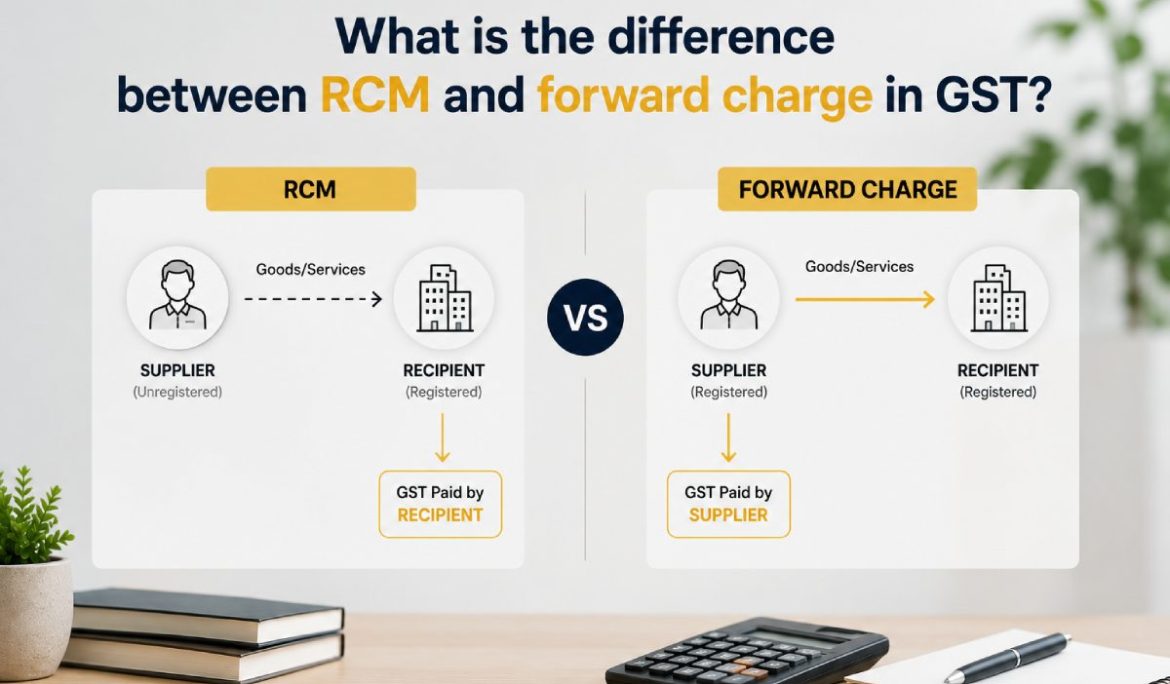
Goods and Services Tax (GST) aims to have a single unified system in place that simplifies indirect taxes and increases compliance for tax payment in the country, but there are cases where confusion can arise between how RCM GST and Forward Charge GST work.
Both mechanisms indicate who needs to pay GST to the government, but depending on the nature of the transaction, the liability will differ. Business owners, accountants, tax professionals, and startups must be aware of how both mechanisms of GST work.
In this guide, we will discuss how the RCM GST and the Forward Charge GST differ, the applicable conditions of these mechanisms, practical examples, and their compliance.
Understanding GST Tax Payment Mechanisms
Tax liability can be discharged under GST in 2 methods:
- Forward Charge Mechanism (FCM)
- Reverse Charge Mechanism (RCM)
The main difference between these methods is about who is responsible for paying tax to the Government.
What is Forward Charge GST?
In forward charge mechanisms, the supplier of the goods or services collects and deposits GST with the government from the customer/ buyer. In India, it is one of the basic mechanisms in GST
Working of the Forward Charge Mechanism:
- The supplier issues a GST invoice to the customer
- GST included on invoice, separately.
- The customer makes the payment of the amount, which includes GST
- Customer gets Input Tax Credit (ITC), eligibility to apply, as applicable. Supplier pays GST to the Government
Example of Forward Charge GST
- The software company is providing software services to a client worth ₹100,000.
- Software Value: ₹100,000
- GST @ 18%: ₹18,000
- Total Invoice Value: ₹118,000
In the present scenario, the supplier has charged GST @18% from the customer, which he pays to the government. This process of GST payment is for forward charges.
What is the Reverse Charge Mechanism (RCM) in GST?
It is an arrangement in the GST regime where tax liability for supplying specified goods or services rests with the customer (receiver) instead of the supplier. Instead of having tax collected & deposited to the government, reverse charge liability makes the customer pay tax to the government. The primary objective of the GST reverse charge mechanism is to address the issue of tax avoidance and also include some industries in the GST on reverse charge that operate informally.
Why was RCM GST introduced?
The government introduced RCM GST to:
- Minimize tax evasion or leakage.
- Increase tax compliance across the board.
- Collect taxes from sectors that are typically harder to track.
- Encourage, indirectly, unregistered suppliers to comply with tax laws.
Anyone engaged in business dealings with the mentioned goods or services needs to be aware of the RCM GST implications.
How the Reverse Charge Mechanism or RCM Works:
On the reverse charge:
- The supplier sends an invoice, usually without goods and services tax (GST).
- The recipient calculates what GST applies.
- Then, the recipient sends that GST money to the government.
- But wait, if the right boxes are ticked, they can also get some GST ITC.
Here’s an example to explain the RCM:
Let’s say a company that’s all registered for Goods and Services Tax hires an advocate who is NOT registered for GST, for some legal work. The service costs 50,000, and the GST applicable rate is 18%.
So how would this play out under RCM?
- The advocate would issue an invoice for 50,000 only. No GST!
- The company would figure out the GST – that would be 9,000 at 18%.
- This 9,000 GST is then paid by the company directly to the government.
- If the company qualifies for GST ITC, it would also claim back the 9,000. Pretty cool, right?
List of transactions to be paid under RCM
The government has given some notifications for the GST on reverse charge; the applicable categories are listed here.
List of services on which RCM is applicable
- Legal services provided by advocates
- Services by arbitral tribunals
- Sponsorship services
- Services provided by any director to a company
- Goods transport agency
List of goods for RCM
- Cashew nuts by an agriculturist
- Silk yarn
- Tobacco leaves
- Specific notified supplies
Businesses commonly ask the Best GST Consultant to see if their transaction falls into the RCM-notified categories.
So how does GST affect your ITC (input tax credit)?
For Forward Charge:
- Your supplier collects and pays GST.
- You (the buyer) then claim your ITC by presenting the GST invoice.
- This should be updated in your GSTR returns.
For Reverse Charge:
- The recipient (you, the buyer) pays GST,
- but you can later claim your ITC on that payment.
- Documentation here is crucial, and having good GST consultants would definitely be of immense help!
Advantages of the Forward Charge Mechanism
- Compliant: The concept of forward charge GST is generally known to the businesses.
- Accountant-friendly: The invoice auto-populates GST.
- Streamlined Processes: Businesses don’t have to compute, deposit, and verify GST separately per notified transaction.
Advantages of the Reverse Charge Mechanism
- Better Tax Collections: Your government will receive money directly from the registered beneficiary.
- Lower Tax Evasion: RCM GST brings down leakages from the unregistered sector.
- Improved Transaction Tracking: Your government’s tax enforcement will get stronger.
The Struggles Businesses Face With RCM
Although RCM GST comes with its set of advantages, it also results in operational hiccups of sorts, namely:
- More Compliance
Companies have to ensure RCM transactions are flagged appropriately. - Cash Flow Impact
Businesses are required to deposit a GST amount before claiming an ITC (Input Tax Credit). - Documentations
Specific record and reporting procedures will have to be followed.
This is one of the reasons why so many companies approach the leading GST consultant in Mumbai or a reliable GST consultancy for help in GST compliance.
Smart GST Compliance Strategies
Stay up-to-date with your GST compliance with these actionable tips: Always have all necessary documents available
Your essential GST paperwork should include:
- Invoice Tax
- Voucher of Payment
- If applicable, a Self-invoice
- Data about GST returns submitted
Assess Vendor Classes
Are your vendors governed by the RCM regulation? A quick check is needed! Gently Reconcile GST Returns! Performing monthly reconciliations is the best practice to reduce your compliance risk!
Opt for Professional Assistance
If you have an experienced GST consultancy firm, consult with them! They can identify if RCM is to be applied in your case!
When Do You Need to Go to a Professional GST Expert?
Keeping up with the changing dynamics of the Goods and Services Tax is a challenge. You should seek a GST expert’s help if:
- You have many vendors.
- You pay for GTA or other professional services.
- You claim input tax credit in complex cases.
- Your business runs across more than one state.
The Best GST Consultant can guide your business through the maze of GST registration, GST return filing, RCM compliance, and tax planning.
How a Top GST Consultant in Mumbai Helps with GST Compliance
Let these financial wizards handle all your GST needs.
Their services usually comprise:
- GST registration
- GST return filings
- RCM determination
- Input Tax Credit reconciliation
- GST audit support
- GST litigation support
- Strategic tax planning
This way, both startups and big businesses get a breather from the risk of compliance. Likewise, with the support of the Best GST consultant who weaves in GST planning into your overall financial planning, your business is set to soar! If you are looking for the best GST consultant near me or tax consultants near me, make sure that they not only have great knowledge of GST, but are well-versed in the industry too.
Conclusion:
There is a difference between Forward Charge GST and Reverse Charge GST. If the Forward Charge GST places a legal onus on the seller or service provider to remit tax, the reverse charge mechanism for GST places the responsibility of paying tax to the Government on the recipient or buyer of goods and services, where it’s not been notified that they can pay to the supplier. Knowing which one to charge is important for any business.
The reverse charge mechanism in India is used to bring various unregistered businesses into the tax net and to address instances of tax evasion, such as when certain businesses in sectors like GTA (Goods Transport Agency) or legal and professional services are difficult to identify and track.
RCM requires business buyers to pay taxes to the Government and report the transaction using self-invoices. This requires diligent maintenance and calculation of liability by the buyers to claim input tax credit. Meanwhile, Forward Charge GST is the standard mechanism. Under the forward charge, GST is paid by the supplier of goods or services.
All day-to-day business transactions that do not fall under the specified reverse charge notifications come under the forward charge mechanism. Any error in classifying a transaction could potentially have major implications for the input tax credit. Using the expertise of a top GST consultant in Mumbai would make these complex rules a whole lot easier to navigate. They can assist you with the classification of goods/services, vendor invoice reconciliations, tracking RCM notification changes, and proper filing of returns.
If your business deals with any services listed under the reverse charge mechanism (legal, consulting, or transportation services, etc.), partnering with a well-regarded GST consultant is essential. You can get your compliance process in order, make sure that you don’t miss out on any important input tax credits, and remain a step ahead when the regulations in GST come to change, all thanks to a qualified GST consultant.
Frequently Asked Questions
Some questions often arise regarding GST on Reverse Charge. You will get some important answers below, let’s see,
Q1: What is the key difference between Reverse Charge and Forward Charge in GST?
Forward Charge: The supplier pays GST to the Government. Reverse Charge: The receiver directly pays the GST to the Government.
Q2: Can input credit be claimed under GST on reverse charge?
Yes. Input credit can be claimed by an eligible taxpayer (after paying the RCM under GST). This is provided as per the GST law for registered taxpayers.
Q3: Do RCM rules apply to all services/goods?
No. RCM only applies to goods/services which are notified by the Government.
Q4: Why was the RCM mechanism brought into effect?
To help improve tax compliance, reduce tax evasion, and collect GST from the identified sector.
Q5: Should small taxpayers also observe the RCM procedure?
Yes, every registered taxpayer that receives the identified supplies needs to follow the prescribed RCM procedure.
Q6: Do I need to consult with a Chartered Accountant or a financial advisor to proceed with this?
It’s strongly recommended to consult with a top CA firm in Thane or a renowned business financial advisor or a financial expert to understand how your business can get rid of this compliance stress and prepare accordingly for the financial success of your business!