

How to Respond to an Income Tax Notice in India: A Complete Step-by-Step Guide (2026)
Received an Income Tax Notice? Don’t Panic.
Receiving an Income Tax Notice can be stressful, especially if it’s your first time. Many taxpayers immediately assume they have done something wrong or that legal action is about to begin. In reality, this is rarely the case.
The Income Tax Department issues notices for several reasons. Some notices simply request additional information, while others highlight mismatches between the information reported in your Income Tax Return (ITR) and the records available with the department. In many situations, responding correctly and within the specified deadline resolves the matter without further proceedings.
Whether you’re a salaried professional, business owner, startup founder, freelancer, or company director, understanding why you received an Income Tax Notice and how to respond appropriately is essential to avoiding unnecessary penalties, interest, or future complications.
In this guide, we’ll explain:
- Why Income Tax Notices are issued
- Different types of notices under the Income Tax Act
- How to verify whether the notice is genuine
- The documents you’ll need
- The step-by-step process for submitting a response online
- Common mistakes to avoid
- When it’s advisable to consult a Chartered Accountant
If you require professional assistance, our Income Tax Services team at Whitespace Consultancy helps businesses and individuals manage tax notices, assessments, and scrutiny proceedings with practical, partner-led guidance.
How Do You Respond to an Income Tax Notice?
If you’ve received an Income Tax Notice, begin by identifying the section under which it has been issued and carefully read the reason mentioned in the notice. Verify its authenticity through the Income Tax e-Filing Portal, gather all relevant documents, prepare an accurate response, and submit it before the deadline. If the notice involves scrutiny, reassessment, or complex tax issues, consult an experienced Chartered Accountant to ensure the response is complete and compliant.
What Is an Income Tax Notice?
An Income Tax Notice is an official communication issued by the Income Tax Department requesting clarification, additional information, correction of errors, payment of outstanding tax, or participation in an assessment proceeding.
Contrary to popular belief, receiving a notice does not automatically mean that you have violated tax laws or committed tax evasion.
Many notices are generated automatically due to:
- Information mismatches
- Missing details
- High-value financial transactions
- Routine verification processes
- Incorrect return filing
- Delayed responses
- Defective returns
In many cases, responding accurately within the prescribed timeline is all that’s required to close the matter.
Why Does the Income Tax Department Send Notices?
The Income Tax Department uses data from multiple sources, including:
- Banks
- Employers
- Mutual fund companies
- Stock exchanges
- Property registration authorities
- GST records
- Annual Information Statement (AIS)
- Form 26AS
- Financial institutions
If discrepancies are detected between these records and your Income Tax Return, a notice may be issued requesting clarification.
Common Reasons for Receiving an Income Tax Notice
| Reason | Explanation |
| Income mismatch | Income reported differs from AIS or Form 26AS |
| TDS mismatch | TDS claimed does not match department records |
| High-value transactions | Property purchases, investments, or large deposits require explanation |
| Defective return | Missing or incorrect information in the ITR |
| Failure to file ITR | Return not filed within the prescribed timeline |
| Incorrect deductions | Excess deductions or exemptions claimed |
| Capital gains not reported | Sale of shares, mutual funds, or property omitted |
| Scrutiny selection | Return selected for detailed examination |
Expert Tip: Receiving a notice because of an information mismatch is common and often straightforward to resolve with proper documentation.
Is Every Income Tax Notice Serious?
No. One of the biggest misconceptions is that every notice indicates fraud or tax evasion. Different notices serve different purposes.
Some notices simply ask you to:
- Correct a clerical error
- Verify information
- Submit supporting documents
- Confirm a tax credit
- Explain a financial transaction
Others, such as scrutiny or reassessment notices, require more detailed responses and may involve additional proceedings. The key is to understand the section under which the notice has been issued.
Different Types of Income Tax Notices Explained
Understanding the section number helps you determine the purpose of the notice and the action required.
| Section | Purpose | What You Should Do |
| 139(9) | Defective Return | Correct errors and submit a revised response |
| 142(1) | Inquiry Before Assessment | Provide requested documents and explanations |
| 143(1) | Intimation | Review tax computation and verify any discrepancies |
| 143(2) | Scrutiny Assessment | Prepare detailed financial records and supporting evidence |
| 148 | Income Escaping Assessment | Respond with complete documentation and professional assistance |
| 156 | Demand Notice | Review the demand, pay if correct, or file an objection if applicable |
Section 139(9): Defective Return
A notice under Section 139(9) indicates that your Income Tax Return contains errors, omissions, or incomplete information that prevent it from being processed.
Common reasons include:
- Missing financial statements
- Incorrect schedules
- Mismatched PAN details
- Missing audit reports
- Incomplete disclosures
In most cases, you’ll need to rectify the return within the time specified in the notice.
Section 142(1): Inquiry Notice
A notice under Section 142(1) requests additional information or supporting documents before completing the assessment.
You may be asked to provide:
- Bank statements
- Books of accounts
- Investment proofs
- Invoices
- GST records
- Financial statements
Responding accurately and on time is essential to avoid further proceedings.
Section 143(1): Intimation Notice
This is one of the most common notices. It is issued after the Income Tax Department processes your return.
The department compares:
- Income declared
- TDS
- Tax paid
- Deductions claimed
with its own records. If differences are identified, the intimation will explain them. Sometimes no action is required, while in other cases you may need to respond or pay additional tax.
Section 143(2): Scrutiny Notice
This notice means your return has been selected for detailed examination.
The objective is to verify:
- Income
- Expenses
- Deductions
- Investments
- Business transactions
- Tax computations
Scrutiny assessments require organized documentation and professional representation. Businesses often engage experienced Chartered Accountants at this stage to ensure proper compliance and representation.
Section 148: Income Escaping Assessment
A notice under Section 148 is issued when the department believes certain income has escaped assessment. These matters are generally more complex and should be handled carefully with appropriate professional advice.
Section 156: Demand Notice
This notice informs you that additional tax, interest, or penalties are payable.
Before making payment, carefully verify:
- Tax calculations
- TDS credits
- Challans
- Previous tax payments
If you disagree with the demand, you may be able to file an online response with supporting evidence.
How to Verify Whether Your Income Tax Notice Is Genuine
Before preparing your response, the first step is to ensure that the notice you have received is authentic. Fraudulent emails and fake notices impersonating the Income Tax Department have become increasingly common, making verification an essential part of the process.
An authentic Income Tax Notice will always include important details such as:
- Document Identification Number (DIN)
- PAN of the taxpayer
- Assessment Year (AY)
- Notice section (for example, Section 143(1) or Section 142(1))
- Date of issue
- Response due date
- Details of the issuing Income Tax authority
If you receive a notice through email or physical post, do not immediately click on links or share personal information. Instead, verify the notice by logging into the official Income Tax e-Filing Portal.
Expert Tip: Always rely on the official Income Tax e-Filing Portal rather than links received through emails or messages from unknown sources.
Step-by-Step Process to Respond to an Income Tax Notice Online
Most Income Tax Notices can now be responded to online through the Income Tax e-Filing Portal. The process is straightforward if you understand the notice and have all supporting documents ready.
Step 1: Read the Notice Carefully
Avoid the common mistake of responding immediately without understanding the notice.
Instead, carefully review:
- Notice the section number
- Reason for issuing the notice
- Information requested
- Deadline for response
- Documents required
Each notice is different, and the response depends entirely on the section under which it has been issued.
Step 2: Identify the Type of Notice
The notice section tells you what action is expected.
For example:
| Notice | Action Required |
| 139(9) | Rectify defective return |
| 143(1) | Verify tax computation |
| 142(1) | Submit documents and explanations |
| 143(2) | Prepare for the scrutiny assessment |
| 148 | Respond regarding escaped income |
| 156 | Review tax demand and respond accordingly |
Understanding the notice correctly prevents unnecessary errors during submission.
Step 3: Log In to the Income Tax e-Filing Portal
Visit the official Income Tax e-Filing Portal and log in using:
- PAN
- Aadhaar (where applicable)
- Password
After successful login, navigate to:
Pending Actions → e-Proceedings
Here you can view all active notices requiring your response.
Step 4: Download the Notice
Always download a copy before taking any action.
Review:
- Reason for notice
- Required documents
- Due date
- Officer remarks (if available)
Save the notice for future reference.
Step 5: Gather Supporting Documents
This is the most important step. Your response should always be backed by documentary evidence.
Depending on the notice, you may require:
Identity Documents
- PAN
- Aadhaar
- Passport (where applicable)
Tax Documents
- Income Tax Return
- Computation of Income
- Form 16
- Form 26AS
- Annual Information Statement (AIS)
Financial Documents
- Bank Statements
- Salary Slips
- Investment Proofs
- Capital Gain Statements
- Interest Certificates
Business Documents
- Profit & Loss Account
- Balance Sheet
- Books of Accounts
- GST Returns
- Purchase & Sales Registers
- Audit Reports
Other Supporting Documents
- Property Sale Agreement
- Mutual Fund Statements
- Loan Documents
- Rental Agreements
- Invoices
- Expense Bills
Providing complete documentation significantly improves the quality of your response and reduces the chances of follow-up notices.
Document Checklist
Before submitting your response, verify that you have:
- Income Tax Notice
- PAN Card
- Aadhaar
- Income Tax Return
- Form 26AS
- AIS
- Bank Statements
- Investment Proofs
- Books of Accounts (Business)
- GST Returns (if applicable)
- Supporting invoices
- Working papers
Step 6: Prepare Your Response
Once you understand the notice and gather the required documents, prepare your response carefully.
A good response should:
- Address every point mentioned in the notice
- Be supported by documentary evidence
- Be factually correct
- Be concise and professional
- Avoid emotional or argumentative language
Remember, your response becomes part of your tax records.
Example Structure of a Response
Subject: Response to Notice under Section 142(1)
Dear Assessing Officer,
With reference to the notice issued under Section 142(1), please find attached the requested documents and supporting explanations regarding the information sought.
The details submitted are true and complete to the best of our knowledge.
Thank you.
Regards,
Taxpayer Name
Step 7: Upload Supporting Documents
Most notices allow supporting documents to be uploaded online.
Common file formats include:
- JPEG
- PNG
Before uploading:
- Ensure documents are clear and legible.
- Merge related documents where appropriate.
- Use descriptive filenames such as:
- BankStatementFY2025.pdf
- Form26AS.pdf
- InvestmentProof.pdf
Avoid uploading blurred or password-protected files.
Step 8: Submit Your Response
Once everything has been reviewed:
- Upload documents
- Verify details
- Submit response
After submission: Download the acknowledgement receipt.
Keep both:
- Response copy
- Acknowledgement
These documents may be required during future assessments.
What Happens After You Submit?
The Income Tax Department will review your response.
Possible outcomes include:
Response Accepted
If the department is satisfied, the proceeding may be closed without further action.
Additional Clarification Requested
Sometimes additional documents or explanations may be requested. Respond within the prescribed timeline.
Assessment Continues
For scrutiny or reassessment cases, further hearings or submissions may be required. Professional representation is advisable in such situations.
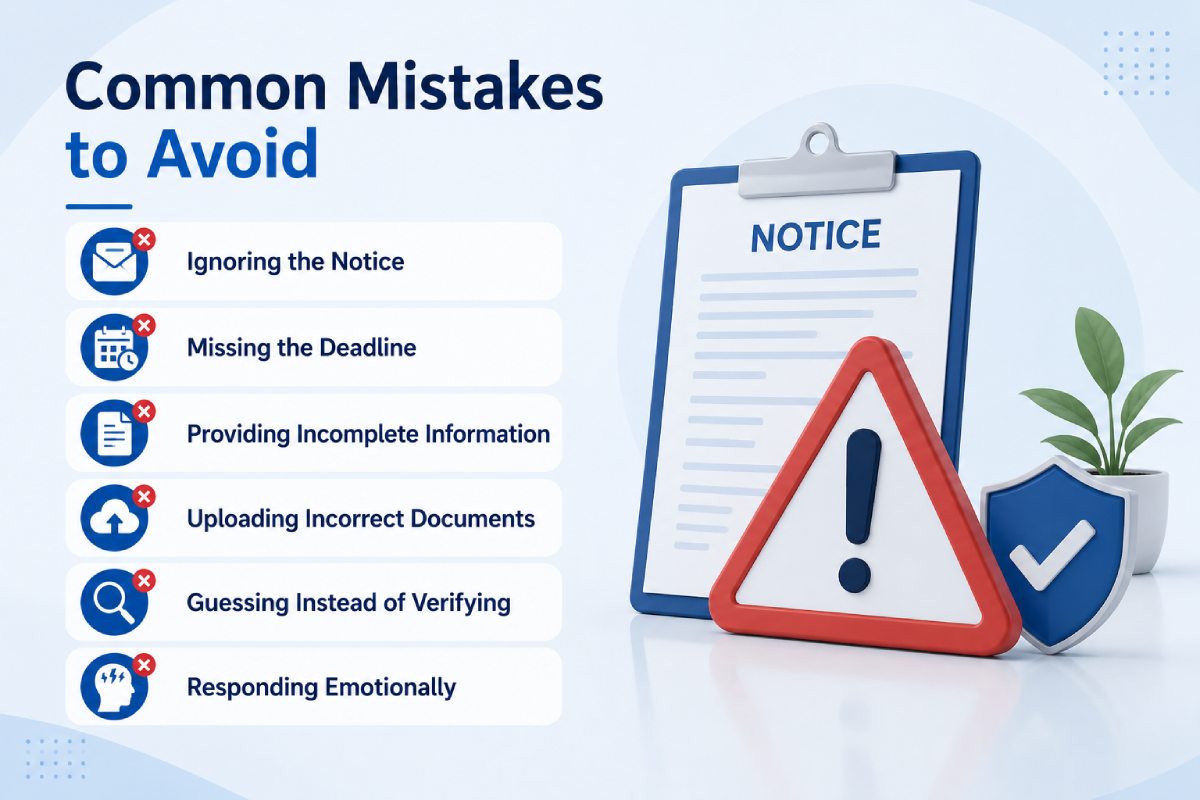
Common Mistakes to Avoid
Many taxpayers receive additional notices because of avoidable mistakes.
Ignoring the Notice
Never ignore an Income Tax Notice.
Failure to respond may result in:
- Penalties
- Best Judgment Assessment
- Additional tax demand
- Interest
- Legal proceedings
Missing the Deadline
Every notice specifies a response deadline. Late responses may not always be accepted. Respond well before the due date.
Providing Incomplete Information
Answer every point mentioned in the notice. Missing information often results in additional notices.
Uploading Incorrect Documents
Always verify:
- Correct Assessment Year
- Correct PAN
- Relevant supporting documents
Incorrect attachments can delay proceedings.
Guessing Instead of Verifying
If you’re unsure about the reason behind the notice, don’t make assumptions. Review your return carefully or seek professional advice before responding.
Responding Emotionally
Your reply should remain factual and supported by evidence.
Avoid:
- Emotional statements
- Personal opinions
- Unsupported claims
Expert Tips from Chartered Accountants
- Read the notice multiple times before responding.
- Compare your return with AIS and Form 26AS.
- Keep digital copies of every submission.
- Maintain proper documentation.
- Respond before the deadline.
- Consult a professional for scrutiny, reassessment, or litigation matters.
When Should You Contact a Chartered Accountant?
Some notices can be handled independently, but professional guidance is strongly recommended in cases involving:
- Scrutiny Assessments
- Reassessment Proceedings
- High-value transactions
- Capital Gains disputes
- Business income verification
- GST-related mismatches
- Multiple notices
- Appeals
- Tax litigation
An experienced Chartered Accountant in Mumbai can help interpret the notice, prepare a technically accurate response, organise supporting documentation, and represent you before the tax authorities where required.
If your notice relates to business income, compliance, or assessments, our Income Tax Services team can assist with preparing responses and managing proceedings. Businesses that maintain structured financial records through our Accounting Services in Mumbai often find it easier to respond to notices efficiently. For organisations requiring broader financial planning, our Business Advisory Services help strengthen reporting systems and reduce future compliance risks.
Real-Life Examples of Common Income Tax Notices
Understanding how Income Tax Notices work in real situations helps taxpayers respond more confidently. Below are some practical examples that businesses and individuals commonly face.
Example 1: Mismatch Between Income Reported and AIS
Situation
A salaried professional filed an Income Tax Return declaring salary income but forgot to include interest earned from fixed deposits. The Income Tax Department’s Annual Information Statement (AIS) reflected the interest income, resulting in a mismatch.
Notice Received
Section 143(1)
Resolution
The taxpayer reviewed Form 26AS and AIS, accepted the mismatch, and filed a revised return.
Learning
Always compare your Income Tax Return with:
- AIS
- Form 26AS
- Form 16
- Bank Interest Statements
before filing.
Example 2: GST Turnover Doesn’t Match Income Tax Return
Situation
A business reported sales of ₹2.8 crore in GST returns but declared only ₹2.45 crore turnover in the Income Tax Return. The mismatch triggered an inquiry.
Notice Received
Section 142(1) Notice
Resolution
The business submitted:
- Books of Accounts
- GST Returns
- Sales Register
- Reconciliation Statement
The matter was resolved after explaining the timing differences.
Learning
Businesses should regularly reconcile:
- GST Returns
- Financial Statements
- Income Tax Returns
to avoid unnecessary notices.
Example 3: Property Sale Not Reported
Situation
An individual sold a residential property but assumed that because the money was reinvested, reporting was unnecessary. The transaction appeared in government records.
Notice Received
Section 148 Notice
Resolution
A Chartered Accountant prepared:
- Capital Gain Computation
- Purchase & Sale Documents
- Exemption calculations
- Supporting evidence
The taxpayer responded successfully.
Learning
Even exempt transactions should generally be disclosed correctly in the Income Tax Return where applicable.
Example 4: Scrutiny Assessment for Business Expenses
Situation
A company claimed substantial marketing expenses. The Assessing Officer requested supporting documentation.
Notice Received
Section 143(2)
Resolution
The company submitted:
- Vendor invoices
- Bank statements
- Agreements
- GST invoices
The assessment concluded successfully.
Learning
Maintain organized documentation for every significant business expense.
How to Avoid Receiving Income Tax Notices
Not every notice can be avoided, but many arise because of preventable mistakes. Following good compliance practices significantly reduces the likelihood of receiving unnecessary notices.
File Your Income Tax Return on Time
Late filing increases the risk of penalties, interest, and compliance issues. Filing within the due date also provides adequate time to correct any genuine mistakes.
Verify AIS and Form 26AS Before Filing
Many notices result from differences between:
- Income Tax Return
- Annual Information Statement (AIS)
- Form 26AS
- Tax Deducted at Source (TDS) records
Reviewing these documents before filing helps identify discrepancies early.
Report Every Source of Income
Commonly overlooked income includes:
- Savings account interest
- Fixed deposit interest
- Capital gains
- Rental income
- Dividend income
- Foreign income (where applicable)
Complete disclosure reduces the chances of mismatch notices.
Maintain Proper Financial Records
Businesses should preserve:
- Books of accounts
- Purchase invoices
- Sales invoices
- Bank statements
- GST records
- Payroll records
- Investment proofs
Proper documentation makes responding to notices significantly easier.
Reconcile GST and Income Tax Data
For businesses registered under GST, turnover reported in GST returns should align with financial statements and Income Tax Returns. Any genuine differences should be documented with reconciliation statements.
Seek Professional Review Before Filing
A professional review often identifies errors before returns are submitted, reducing the likelihood of notices and future disputes.
Frequently Asked Questions (FAQ)
Is receiving an Income Tax Notice always bad?
No. Many notices are routine communications seeking clarification, correction, or verification. Receiving a notice does not automatically mean that you have committed tax fraud or will face penalties.
Can I respond to an Income Tax Notice myself?
Yes. Many notices, such as those involving minor corrections or information requests, can be handled independently. However, notices related to scrutiny assessments, reassessments, or litigation often require professional assistance.
How many days do I have to respond?
The response period varies depending on the type of notice. Always check the deadline mentioned in the notice and respond within the prescribed timeframe to avoid penalties or further proceedings.
What happens if I ignore an Income Tax Notice?
Ignoring a notice may result in:
- Penalties
- Interest
- Best Judgment Assessment
- Additional tax demand
- Recovery proceedings
- Litigation
Timely action is always advisable.
Can I revise my Income Tax Return after receiving a notice?
In certain situations, yes. If the notice relates to incorrect or incomplete information and the law permits, filing a revised or updated return may help resolve the issue. The appropriate course of action depends on the type of notice received.
Can a business receive multiple notices?
Yes. A business may receive notices related to different matters, such as GST reconciliation, TDS compliance, income tax assessments, or reporting discrepancies. Maintaining consistent financial records helps reduce such occurrences.
Should I consult a Chartered Accountant for every notice?
Not necessarily. Simple notices may be straightforward to address. However, if the notice involves complex tax matters, assessments, high-value transactions, business income, or legal proceedings, consulting an experienced Chartered Accountant is highly recommended.
How Whitespace Consultancy Helps Businesses Respond to Income Tax Notices
At Whitespace Consultancy, we work with startups, SMEs, promoters, and established businesses to simplify complex tax matters through practical, partner-led advisory.
Our team assists clients with:
- Reviewing Income Tax Notices and identifying the underlying issue
- Preparing accurate responses with supporting documentation
- Handling scrutiny assessments and reassessment proceedings
- Managing tax demand disputes and representations
- Reconciling GST, TDS, AIS, and financial records
- Providing strategic tax advisory to minimize future compliance risks
- Representing clients before the Income Tax authorities when required
Our focus extends beyond responding to notices. We help businesses build stronger compliance systems, improve financial reporting, and reduce the likelihood of future tax disputes through proactive planning and advisory.
Related Services You May Find Helpful
If you’re looking for comprehensive financial and tax support, explore these related services:
- Accounting Services in Mumbai – Maintain accurate books of accounts, improve financial reporting, and strengthen compliance with structured accounting support.
- Income Tax Services – Assistance with return filing, tax planning, assessments, scrutiny cases, notices, and litigation.
- GST Registration & Compliance Services – GST registration, return filing, reconciliations, and ongoing compliance management.
- Audit & Assurance Services – Statutory audits, internal audits, due diligence, and compliance-focused assurance services.
- Business Advisory Services – Strategic financial planning, business structuring, profitability improvement, and Virtual CFO support.
- About Our Chartered Accountants – Learn more about our experienced team of Chartered Accountants in Mumbai and our partner-led approach.
- Contact Us – Schedule a consultation to discuss your tax or compliance requirements.
Key Takeaways
If you receive an Income Tax Notice, remain calm and approach the situation systematically. Begin by verifying the notice, understanding the section under which it has been issued, and identifying the information requested. Gather all relevant documents, prepare a complete and evidence-based response, and submit it before the specified deadline.
Many notices are issued because of reporting mismatches, incomplete disclosures, or documentation gaps rather than intentional non-compliance. By maintaining accurate financial records, reconciling tax information regularly, and seeking professional advice when necessary, you can resolve notices efficiently and strengthen your overall tax compliance.
Need Help Responding to an Income Tax Notice?
Whether you’ve received a notice under Section 139(9), 142(1), 143(1), 143(2), 148, or 156, timely professional guidance can make the process smoother and reduce the risk of unnecessary disputes.
At Whitespace Consultancy, our experienced Chartered Accountants provide practical assistance with income tax notices, assessments, scrutiny proceedings, tax planning, and business compliance.
Talk to Our Tax Experts Today If you’re unsure how to respond to an Income Tax Notice or need support with tax assessments and compliance, connect with our team for a confidential consultation.