

Section 143(1) Income Tax Notice Explained: Reasons, Response Process & Solutions (2026)
If You Received a Section 143(1) Income Tax Notice, Don’t Panic
Receiving a Section 143(1) Notice from the Income Tax Department can be worrying, especially if you’re unsure why it was issued or what action you need to take. Many taxpayers immediately assume that an Income Tax Notice 143(1) means they have committed a serious mistake or that they are under scrutiny. In reality, this is not always the case.
A Section 143(1) Notice, officially known as an Intimation under Section 143(1) of the Income Tax Act, is generally the first communication sent by the Centralized Processing Centre (CPC) after your Income Tax Return (ITR) has been processed. In many cases, it simply confirms that your return has been accepted without any changes. In other situations, it may inform you about a tax refund, adjustments made to your return, or a Section 143(1) Demand Notice if additional tax is payable.
Understanding the purpose of an Income Tax Notice 143(1) is essential because the next steps depend entirely on the information contained in the notice. While some taxpayers only need to review the intimation, others may need to verify the calculations, pay outstanding tax, or understand how to respond to Section 143(1) Notice correctly to avoid future complications.
In this detailed guide, we explain everything you need to know about a Section 143(1) Notice, including why it is issued, the different types of intimations, common reasons for receiving a Section 143(1) Demand Notice, the response process, timelines, practical examples, and situations where professional assistance may be beneficial.
Whether you are a salaried employee, freelancer, business owner, startup founder, professional, or company director, this guide will help you understand your rights, responsibilities, and the appropriate response after receiving an Income Tax Notice 143(1).
Quick Answer: What Is a Section 143(1) Notice?
A Section 143(1) Notice, also known as an Intimation under Section 143(1), is an automated communication issued by the Income Tax Department after processing your Income Tax Return (ITR). The notice informs taxpayers whether their return has been accepted as filed, modified after processing, whether a refund is due, or whether additional tax is payable through a Section 143(1) Demand Notice.
Unlike scrutiny proceedings, a Section 143(1) Notice is primarily a processing intimation based on the information available with the Income Tax Department, including your Income Tax Return, Form 26AS, Annual Information Statement (AIS), Tax Deducted at Source (TDS) records, and other financial information.
Understanding Section 143(1) in Simple Words
After you file your Income Tax Return, the Income Tax Department electronically processes your return through its Centralized Processing Centre (CPC). During this automated processing, the department compares the information reported in your ITR with the tax data already available in its records.
The system checks various details, including:
- Total income declared
- Tax deducted at source (TDS)
- Advance tax payments
- Self-assessment tax
- Deductions claimed
- Exemptions claimed
- Interest calculations
- Form 26AS
- Annual Information Statement (AIS)
- Tax payment records
- Mathematical accuracy
If everything matches correctly, the department may simply issue an intimation confirming successful processing or initiate your refund if applicable.
However, if discrepancies are identified, adjustments may be made during processing. Depending on the nature of those adjustments, you may receive a Section 143(1) Demand Notice indicating additional tax payable or a revised refund amount. Understanding these adjustments is the first step in determining how to respond to Section 143(1) Notice appropriately.
Is a Section 143(1) Notice Good or Bad?
One of the most common misconceptions is that receiving an Income Tax Notice automatically means there is a problem with your Income Tax Return.
The answer is no. A Section 143(1) Notice is a routine communication sent after processing your return. In many cases, taxpayers receive this notice simply because their return has been processed successfully.
Depending on the outcome of processing, the notice may indicate one of the following:
- Your Income Tax Return has been accepted without any changes.
- You are eligible for an Income Tax refund.
- Certain adjustments have been made to your return.
- You have received a Section 143(1) Demand Notice requiring payment of additional tax.
Receiving an Income Tax Notice 143(1) should therefore be viewed as an opportunity to carefully review the department’s calculations rather than immediately assuming there is a legal issue or tax investigation.
Types of Section 143(1) Intimations
Not every Section 143(1) Notice is the same. The Income Tax Department may issue different outcomes after processing your return.
| Type of Intimation | Meaning | Action Required |
| Return Accepted | Your Income Tax Return matches the department’s records, and no changes have been made. | No action required. Keep the information for future reference. |
| Refund Issued | The department has determined that excess tax has been paid and a refund is payable. | Verify refund details and monitor your bank account. |
| Section 143(1) Demand Notice | The department has calculated additional tax payable after processing your return. | Review the adjustments carefully and determine how to respond to Section 143(1) Notice based on whether you agree or disagree with the demand. |
This classification helps taxpayers quickly understand what action, if any, is required after receiving an Income Tax Notice 143(1).
Difference Between Section 143(1) Notice and Section 143(2) Notice
Many taxpayers confuse a Section 143(1) Notice with a scrutiny notice under Section 143(2). However, these notices serve entirely different purposes.
| Particular | Section 143(1) Notice | Section 143(2) Notice |
| Purpose | Automated processing of Income Tax Return | Detailed scrutiny or assessment |
| Issued By | Centralized Processing Centre (CPC) | Assessing Officer |
| Nature | Computer-generated intimation | Manual assessment process |
| Documents Required | Usually not required initially | Supporting documents, explanations, and evidence |
| Taxpayer Interaction | Minimal unless adjustments exist | Active participation required |
| Complexity | Routine processing | Detailed examination of the return |
In most situations, a Section 143(1) Notice is not a cause for concern. However, if you receive a Section 143(1) Demand Notice, it is important to review the adjustments carefully and understand how to respond to a Section 143(1) Notice within the prescribed timelines.
Why Does the Income Tax Department Issue a Section 143(1) Notice?
The Income Tax Department issues an Income Tax Notice 143(1) after electronically processing your Income Tax Return. The objective is to inform taxpayers about the processing outcome and communicate any differences identified between the information reported on the return and the records available with the department.
A Section 143(1) Notice may be issued for several reasons, including:
- Successful processing of the Income Tax Return without any changes.
- Confirmation that an Income Tax refund is payable.
- Adjustment of arithmetic or calculation errors.
- Mismatch between TDS claimed and Form 26AS.
- Differences between the Annual Information Statement (AIS) and reported income.
- Incorrect tax calculations.
- Disallowed deductions due to missing information.
- Incorrect carry-forward of losses.
- Outstanding tax liability resulting in a Section 143(1) Demand Notice.
Understanding why you received the notice is the first and most important step before deciding how to respond to the Section 143(1) Notice. In the next section, we’ll examine each of these reasons in detail with practical examples and explain how taxpayers can verify the department’s calculations before taking any action.
Common Reasons for Receiving a Section 143(1) Notice
One of the biggest concerns taxpayers have after receiving an Income Tax Notice 143(1) is understanding why it was issued. While many Section 143(1) Notices simply confirm that your Income Tax Return has been processed successfully, others include adjustments that may result in a refund, reduced refund, or a Section 143(1) Demand Notice requiring payment of additional tax.
The Income Tax Department processes every Income Tax Return using an automated system at the Centralized Processing Centre (CPC). During this process, the information reported in your return is matched against data available from employers, banks, financial institutions, deductors, Annual Information Statement (AIS), Form 26AS, and other government databases.
If any mismatch or calculation difference is identified, adjustments may be made before issuing the Section 143(1) Notice. Below are the most common reasons taxpayers receive an Income Tax Notice 143(1).
1. TDS Mismatch Between ITR and Form 26AS
One of the most common reasons for receiving a Section 143(1) Demand Notice is a mismatch in the Tax Deducted at Source (TDS) claimed in your Income Tax Return and the TDS reflected in Form 26AS.
For example, your employer may have deducted ₹1,20,000 as TDS, but only ₹1,00,000 was deposited or reflected in Form 26AS when you filed your return. If you claim the higher amount in your ITR, the Income Tax Department may reduce the credit and calculate additional tax payable.
Example
You claimed:
- TDS: ₹75,000
Form 26AS reflects:
- TDS: ₹60,000
Difference:
₹15,000
The department may reduce your tax credit by ₹15,000 and issue a Section 143(1) Demand Notice for the outstanding tax along with applicable interest.
How to avoid it
Always verify Form 26AS before filing your Income Tax Return and ensure the TDS claimed exactly matches the records available on the Income Tax Portal.
2. Income Mismatch with AIS (Annual Information Statement)
The Annual Information Statement (AIS) has become one of the primary sources used by the Income Tax Department during return processing.
AIS captures financial transactions such as:
- Salary income
- Interest income
- Dividend income
- Mutual fund transactions
- Share trading
- Property sales
- Foreign remittances
- High-value banking transactions
If income appearing in AIS is omitted from your return, the automated processing system may make adjustments while issuing the Income Tax Notice 143(1).
Example
Your savings account earned: Interest Income
₹18,450
But you forgot to include it while filing your Income Tax Return. The CPC identifies this difference from AIS and recalculates your taxable income. As a result, you may receive a Section 143(1) Notice showing revised tax calculations or even a Section 143(1) Demand Notice if additional tax becomes payable.
3. Errors in Claiming Deductions
Many taxpayers unintentionally claim deductions that exceed the statutory limits or are not supported by available information.
Common deductions include:
- Section 80C
- Section 80D
- Section 80CCD
- Home Loan Interest
- HRA exemption
- Standard Deduction
If the claimed deduction is inconsistent with the applicable provisions or exceeds permissible limits, the processing system may automatically modify the deduction amount.
Example
Eligible deduction under Section 80C: ₹1,50,000
Claimed in ITR: ₹2,10,000
The excess deduction may be disallowed during processing, resulting in higher taxable income and potentially a Section 143(1) Demand Notice.
4. Mathematical Errors in the Income Tax Return
Although Income Tax filing software performs most calculations automatically, taxpayers sometimes manually edit figures or upload incorrect data.
Examples include:
- Incorrect tax calculations
- Wrong surcharge
- Incorrect cess calculation
- Wrong rebate
- Wrong interest computation
- Incorrect carry-forward losses
The CPC recalculates these values during processing. If discrepancies exist, the revised computation is reflected in the Income Tax Notice 143(1).
5. Incorrect Tax Credit Claimed
Apart from TDS, taxpayers may also incorrectly claim:
- Advance Tax
- Self-Assessment Tax
- Foreign Tax Credit
If the payment cannot be verified in the Income Tax Department’s records, the tax credit may be disallowed. This frequently results in a Section 143(1) Demand Notice.
6. Differences in Employer Reporting
Sometimes employers revise salary information after issuing Form 16.
Examples include:
- Revised salary
- Bonus adjustments
- Perquisite revisions
- Updated TDS returns
If you filed your Income Tax Return before these corrections were uploaded, the department’s records may differ from your filed return. The Income Tax Notice 143(1) reflects these updated figures during processing.
7. Incorrect Carry Forward of Losses
Business owners and investors often carry forward losses from previous financial years.
Examples include:
- Business Loss
- Capital Loss
- House Property Loss
If losses are carried forward incorrectly or beyond permissible limits, CPC may reject or reduce the loss. This can increase taxable income. Consequently, taxpayers may receive a Section 143(1) Demand Notice.
8. Mismatch in Capital Gains Reporting
Capital gains have become a major area of automated verification.
The department now receives transaction data from:
- Stock exchanges
- Mutual fund houses
- Registrars
- Property registration authorities
If capital gains reported by these institutions differ from your Income Tax Return, adjustments may be made while issuing the Income Tax Notice 143(1).
9. Late Filing Consequences
If you filed your Income Tax Return after the due date, certain benefits may no longer be available.
Examples include:
- Restricted loss carry-forward
- Late filing fees
- Interest under applicable sections
These adjustments may appear in the Section 143(1) Notice after processing.
10. Incorrect PAN or Personal Information
Simple mistakes such as:
- Wrong PAN
- Incorrect Aadhaar linking
- Bank account mismatch
- Invalid IFSC
- Name mismatch
may delay refunds or trigger processing adjustments. Although these errors may not always result in a Section 143(1) Demand Notice, they can still lead to communication from the Income Tax Department requiring correction.
How Long Does It Take to Receive a Section 143(1) Notice?
Many taxpayers wonder how soon they should expect an Income Tax Notice 143(1) after filing their Income Tax Return. There is no fixed timeline because processing depends on several factors, including the filing date, return complexity, verification status, and the processing workload at the Centralized Processing Centre (CPC). However, in most cases, taxpayers receive an Intimation under Section 143(1) within a few weeks to several months after successful e-verification of their return.
Generally, the sequence is as follows:
| Stage | Typical Timeline |
| Income Tax Return Filed | Day 1 |
| Return Successfully E-Verified | Within a few days |
| CPC Begins Processing | Varies based on workload |
| Section 143(1) Notice Issued | Usually, within weeks to months after verification |
| Refund or Section 143(1) Demand Notice | After processing is completed |
It is important to note that the Income Tax Department processes returns electronically, and delays do not necessarily indicate any issue with your return. You should regularly monitor your Income Tax e-Filing Portal account and registered email address for updates regarding your Income Tax Notice 143(1).
How to Check Whether You Have Received a Section 143(1) Notice
If you have recently filed your Income Tax Return, you can easily verify whether the Income Tax Department has issued an Income Tax Notice 143(1) by following these steps:
- Log in to the Income Tax e-Filing Portal using your PAN/Aadhaar credentials.
- Navigate to e-Proceedings, View Filed Returns, or the relevant section where notices and intimations are displayed.
- Select the applicable Assessment Year.
- Review the status of your return and check for any Section 143(1) Notice or Section 143(1) Demand Notice issued after processing.
- Download the intimation PDF for detailed review and compare the department’s calculations with your original Income Tax Return.
Regularly checking your e-Filing account ensures that you do not miss important communications and gives you sufficient time to understand how to respond to Section 143(1) Notice if any action is required.
What Should You Do Immediately After Receiving a Section 143(1) Notice?
Receiving an Income Tax Notice 143(1) does not mean you should immediately pay the demand or assume that the department’s calculations are correct. The first step is to carefully review the notice and compare it with your filed Income Tax Return.
As soon as you receive the notice:
- Download the complete intimation from the Income Tax e-Filing Portal.
- Compare the processed income with your original Income Tax Return.
- Verify TDS, tax payments, deductions, exemptions, and income details against Form 26AS and AIS.
- Identify whether the notice confirms acceptance, issues a refund, or includes a Section 143(1) Demand Notice.
- If the notice contains adjustments, understand the reasons before deciding how to respond to Section 143(1) Notice.
If you are unsure about the adjustments or the demand appears incorrect, seeking guidance from an experienced tax professional can help you avoid unnecessary payments and ensure that your response is accurate and submitted within the prescribed time.
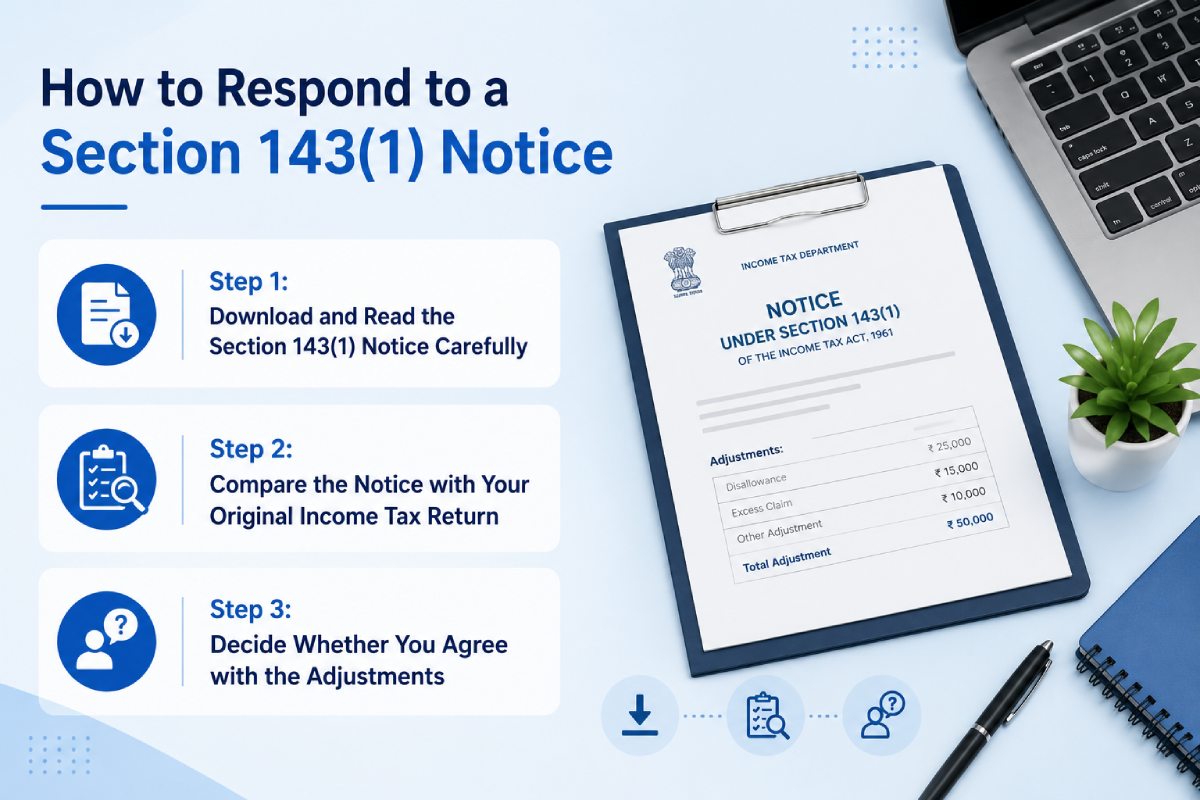
How to Respond to a Section 143(1) Notice
Receiving a Section 143(1) Notice does not always require immediate payment or legal action. The appropriate response depends on the contents of the notice and whether you agree with the adjustments made by the Income Tax Department.
Before responding, carefully review the Income Tax Notice 143(1) and compare it with the Income Tax Return you originally filed. Many taxpayers make the mistake of accepting a Section 143(1) Demand Notice without verifying the department’s calculations, while others ignore the notice altogether—both of which can create unnecessary financial and compliance issues.
If you are wondering how to respond to Section 143(1) Notice, follow the process below.
Step 1: Download and Read the Section 143(1) Notice Carefully
The first step is to download the complete Intimation under Section 143(1) from the Income Tax e-Filing Portal.
Review the notice carefully and compare the following details:
- Assessment Year
- PAN details
- Total Income reported
- Taxable Income after processing
- Tax already paid
- TDS credit
- Advance Tax
- Self-Assessment Tax
- Refund amount (if applicable)
- Additional tax demand (if applicable)
- Interest charged
- Reason for adjustments
Do not assume that every adjustment is correct. Sometimes differences occur because of delayed TDS reporting, AIS updates, or clerical mistakes.
Step 2: Compare the Notice with Your Original Income Tax Return
Once you have downloaded the Income Tax Notice 143(1), compare it line by line with the Income Tax Return you filed.
Pay special attention to:
- Income reported
- Deductions claimed
- Exemptions claimed
- TDS credit
- Form 26AS
- AIS
- Tax payments
- Capital gains
- Interest income
- Business income
If all the figures match, the department’s computation is likely correct. If differences exist, identify exactly where the mismatch has occurred before deciding how to respond to Section 143(1) Notice.
Step 3: Decide Whether You Agree with the Adjustments
There are two possible situations after reviewing the Section 143(1) Notice.
Situation 1: You Agree with the Demand
If the Income Tax Department’s calculations are correct and you agree with the adjustments, you should:
- Accept the demand.
- Pay the outstanding tax before the due date.
- Keep payment receipts for future reference.
Prompt payment helps avoid additional interest and recovery proceedings.
Situation 2: You Disagree with the Demand
If you believe the Section 143(1) Demand Notice is incorrect, do not ignore it.
Instead:
- Identify the incorrect adjustment.
- Collect supporting documents.
- Compare Form 26AS, AIS, and Form 16.
- Verify tax payment challans.
- Consult a Chartered Accountant if necessary.
- File the appropriate response or rectification request.
Many Section 143(1) Demand Notices arise because TDS credits or tax payments were not reflected correctly at the time of processing.
How to Pay a Section 143(1) Demand Notice
If you agree with the tax demand, payment should be made promptly through the Income Tax e-Filing Portal.
The general process includes:
- Log in to the Income Tax Portal.
- Open the outstanding demand section.
- Select the relevant Assessment Year.
- Choose “Pay Now.”
- Generate the challan.
- Make payment through net banking, UPI, debit card, or authorised banking channels.
- Save the challan acknowledgement.
After successful payment, retain all records for future reference.
What If You Disagree with the Section 143(1) Demand Notice?
Not every Section 143(1) Demand Notice issued by the Income Tax Department is accurate.
Taxpayers frequently encounter situations where:
- TDS has not been considered.
- Advance tax has not been reflected.
- Self-assessment tax is missing.
- Income has been duplicated.
- Incorrect interest has been charged.
- Deductions have been wrongly disallowed.
- AIS contains incorrect information.
In such situations, taxpayers should carefully review the notice and, if necessary, file a rectification request instead of accepting the demand. Understanding how to respond to Section 143(1) Notice correctly can help avoid unnecessary tax payments.
Rectification Under Section 154
If the Income Tax Notice 143(1) contains an apparent mistake, taxpayers can request correction through Section 154 of the Income Tax Act.
Rectification may be appropriate when:
- TDS credit is missing.
- Tax payments are not considered.
- Obvious calculation mistakes exist.
- Income has been reported twice.
- Clerical errors affect the tax computation.
The Income Tax Department reviews the request and, if satisfied, issues a revised order.
Documents Required Before Responding
Before submitting any response to a Section 143(1) Notice, keep the following documents ready:
- Copy of the Income Tax Return (ITR)
- Section 143(1) Intimation
- Form 26AS
- Annual Information Statement (AIS)
- Form 16 / Form 16A
- Tax payment challans
- Bank statements (if required)
- Investment proofs
- Deduction proofs
- Capital gains statements (if applicable)
- Previous correspondence with the department
Having complete documentation makes the response process faster and reduces the possibility of future disputes.
What Happens If You Ignore a Section 143(1) Notice?
Ignoring an Income Tax Notice 143(1) can create avoidable financial and compliance issues, particularly when the notice includes a Section 143(1) Demand Notice.
Possible consequences include:
- Outstanding tax demand remains unpaid.
- Interest continues to accrue.
- Future Income Tax refunds may be adjusted against the outstanding demand.
- Recovery proceedings may be initiated.
- Difficulties may arise during future Income Tax assessments.
Even if you believe the notice is incorrect, it is always advisable to review it promptly and respond appropriately.
Practical Example
Scenario
Mr. Shah files his Income Tax Return for AY 2026–27.
He claims:
- TDS Credit: ₹1,20,000
However, Form 26AS reflects:
- ₹1,00,000
The Income Tax Department processes the return and issues a Section 143(1) Demand Notice for the ₹20,000 difference along with applicable interest. After reviewing the notice, Mr. Shah discovers that his employer filed a revised TDS return after he submitted his ITR.
He obtains the updated TDS records, verifies the correction in Form 26AS, and files a rectification request under Section 154. The department accepts the correction, withdraws the demand, and updates the processing record. This example demonstrates why taxpayers should carefully understand how to respond to Section 143(1) Notice instead of immediately paying every demand.
Common Mistakes Taxpayers Make
Many taxpayers unknowingly make errors after receiving an Income Tax Notice 143(1).
Common mistakes include:
- Ignoring the notice completely.
- Paying the demand without verification.
- Not comparing Form 26AS with the notice.
- Missing the response deadline.
- Assuming every demand is correct.
- Forgetting to check AIS.
- Ignoring revised TDS returns.
- Losing payment challans.
- Filing incorrect rectification requests.
- Not seeking professional advice when adjustments are complex.
Avoiding these mistakes can save both time and money.
Tips to Avoid Receiving Future Section 143(1) Notices
While not every Section 143(1) Notice can be avoided, taxpayers can reduce the likelihood of adjustments by following good tax compliance practices.
Best practices include:
- Verify Form 26AS before filing your Income Tax Return.
- Review the Annual Information Statement (AIS).
- Match Form 16 with salary details.
- Report all sources of income accurately.
- Claim deductions only where eligible.
- Verify tax payment challans.
- File your Income Tax Return before the due date.
- Recheck calculations before submission.
- Maintain proper financial records.
- Seek professional review for complex tax situations.
When Should You Consult a Chartered Accountant?
While many Section 143(1) Notices involve straightforward processing outcomes, professional guidance is recommended when:
- The demand amount is significant.
- Income involves business or professional activities.
- Capital gains transactions are involved.
- Multiple tax deductions have been claimed.
- TDS mismatches cannot be reconciled.
- AIS contains incorrect information.
- You disagree with the department’s calculations.
- A rectification request is required.
- You are unsure how to respond to Section 143(1) Notice.
An experienced Chartered Accountant can review your return, explain the adjustments, identify errors, and help you respond accurately while ensuring compliance with Income Tax regulations.
How Whitespace Consultancy Can Help
Responding to an Income Tax Notice 143(1) requires careful review of tax calculations, supporting documents, and departmental adjustments. At Whitespace Consultancy, our experienced Chartered Accountants assist individuals, professionals, startups, SMEs, and businesses in understanding the reasons behind an Income Tax Notice 143(1), verifying tax computations, resolving Section 143(1) Demand Notices, filing rectification requests, and ensuring timely compliance with Income Tax regulations.
Whether you need assistance reviewing an intimation, responding to a tax demand, or handling more complex Income Tax matters, our team provides practical, partner-led guidance tailored to your situation.
Key Takeaways
- A Section 143(1) Notice is an automated intimation issued after your Income Tax Return is processed.
- Receiving an Income Tax Notice 143(1) does not automatically mean you are under scrutiny.
- A Section 143(1) Demand Notice should always be reviewed carefully before making any payment.
- Understanding how to respond to Section 143(1) Notice helps avoid unnecessary tax payments, penalties, and future disputes.
- Regularly reviewing Form 26AS, AIS, and your Income Tax Return before filing significantly reduces the chances of receiving processing adjustments.
Frequently Asked Questions (FAQs)
Is a Section 143(1) Notice a scrutiny notice?
No. A Section 143(1) Notice is an automated intimation issued after processing your Income Tax Return. It is different from a scrutiny notice issued under Section 143(2).
Is it compulsory to respond to a Section 143(1) Notice?
If the notice simply confirms that your return has been accepted without any changes, no response is generally required. However, if it includes a Section 143(1) Demand Notice or adjustments that you disagree with, you should review the notice carefully and take appropriate action.
Can I receive a refund after a Section 143(1) Notice?
Yes. Many Income Tax Notice 143(1) communications simply inform taxpayers that their return has been processed successfully and that an Income Tax refund has been approved.
Can I receive both Section 143(1) and Section 143(2) notices?
Yes. Receiving a Section 143(1) Notice does not prevent the Income Tax Department from selecting your return for scrutiny under Section 143(2), if applicable.
Can a Chartered Accountant respond on my behalf?
Yes. An experienced Chartered Accountant can review the Income Tax Notice 143(1), verify the department’s calculations, prepare the required documentation, and assist in submitting the appropriate response or rectification request.