

Reverse Charge (RCM) vs Forward Charge Under GST: Key Differences Explained (2026 Guide)
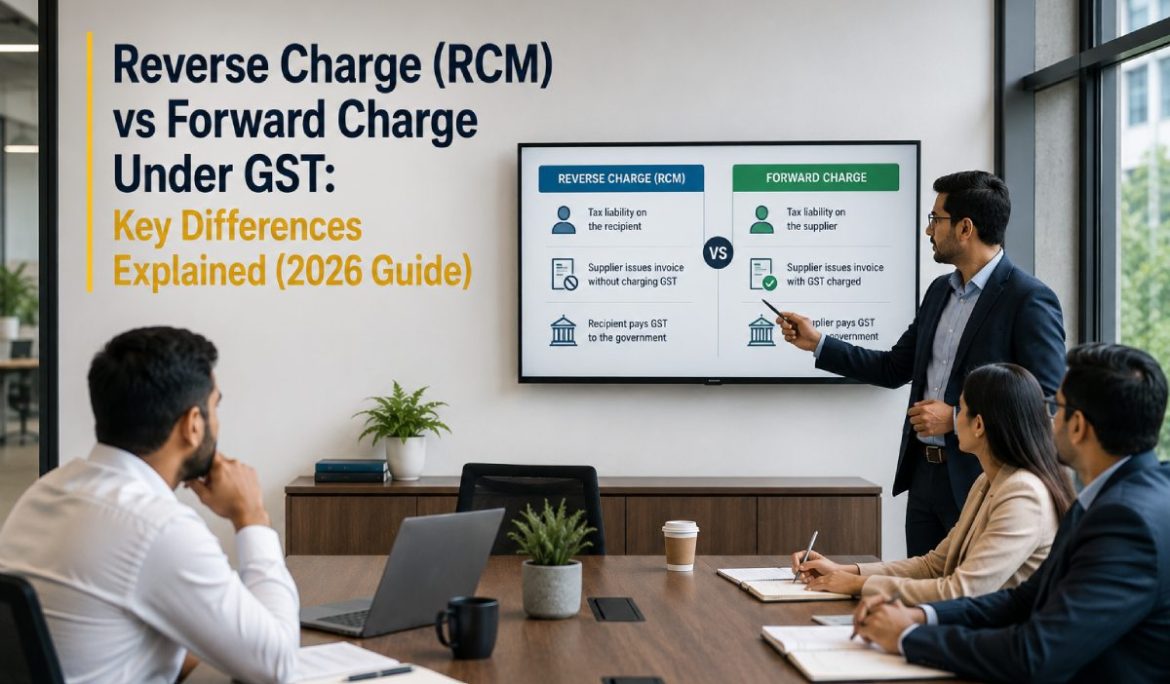
Understanding who is responsible for paying Goods and Services Tax (GST) is essential for every business operating in India. While most GST transactions follow the standard Forward Charge Mechanism (FCM), certain specified transactions fall under the Reverse Charge Mechanism (RCM), where the responsibility to pay GST shifts from the supplier to the recipient.
Many businesses confuse these two mechanisms, leading to incorrect GST filings, missed tax liabilities, penalties, or loss of Input Tax Credit (ITC). Whether you are a startup, SME, manufacturer, service provider, or established enterprise, understanding the Difference between RCM and Forward Charge is crucial for maintaining GST compliance.
In this comprehensive guide, we explain how both mechanisms work, when they apply, who is responsible for paying GST, common business examples, compliance requirements, and best practices to help businesses avoid costly mistakes.
Quick Answer: What is the Difference Between Reverse Charge (RCM) and Forward Charge Under GST?
The primary difference between the Forward Charge Mechanism (FCM) and the Reverse Charge Mechanism (RCM) is who is legally responsible for paying GST to the government.
| Forward Charge | Reverse Charge |
| The supplier collects GST from the customer. | The recipient pays GST directly to the government. |
| Supplier deposits GST. | Recipient deposits GST. |
| Used in most GST transactions. | Applicable only to specified goods, services, or notified transactions. |
| Supplier issues a GST invoice. | The recipient may be required to issue a self-invoice in specified situations. |
| Normal GST process. | Special compliance mechanism notified under the GST law. |
In simple terms:
- Under the Forward Charge under GST, the seller is responsible for collecting and depositing GST.
- Under Reverse Charge, the buyer becomes responsible for paying GST directly to the government instead of the supplier.
What is the Forward Charge Mechanism (FCM)?
The Forward Charge Mechanism (FCM) is the standard and most commonly used GST payment system in India. Nearly every day-to-day GST transaction follows this mechanism.
Under Forward Charge:
- The supplier sells goods or services.
- The supplier charges GST on the invoice.
- The customer pays the invoice value along with GST.
- The supplier deposits the collected GST with the government.
- The supplier files GST returns.
- The customer claims Input Tax Credit (ITC), subject to eligibility.
This process forms the backbone of India’s GST system and applies to the majority of registered businesses.
Example
Suppose a registered stationery supplier sells office supplies worth ₹50,000 to a GST-registered company.
Invoice:
- Goods Value: ₹50,000
- GST @18%: ₹9,000
- Total Invoice: ₹59,000
The company pays ₹59,000 to the supplier. The supplier then deposits ₹9,000 as GST while filing GST returns. The purchasing company can claim Input Tax Credit of ₹9,000, provided all GST conditions are satisfied. This is a classic example of the Forward Charge Mechanism.
What is the Reverse Charge Mechanism (RCM)?
The Reverse Charge Mechanism (RCM) is a special provision under the GST law where the liability to pay tax shifts from the supplier to the recipient of goods or services.
Instead of the supplier charging GST, the recipient becomes responsible for:
- calculating GST.
- paying GST directly to the government.
- complying with applicable GST provisions.
- maintaining required documentation.
- claiming Input Tax Credit where eligible.
RCM is applicable only in specific situations notified under the GST Act and related notifications. Its primary objective is to improve tax compliance in sectors where tax collection from suppliers may be difficult or where the government wants the recipient to bear the compliance responsibility.
Why Was Reverse Charge Introduced?
The Reverse Charge Mechanism was introduced to strengthen GST compliance and reduce tax leakage.
Certain sectors involve:
- small suppliers.
- unorganized businesses.
- independent professionals.
- transport operators.
- legal service providers.
- notified service categories.
where collecting GST directly from every supplier becomes challenging. Instead of pursuing thousands of small suppliers, the government places the tax liability on larger registered businesses receiving these services.
This improves:
- tax collection.
- reporting accuracy.
- compliance.
- audit tracking.
- Input Tax Credit verification.
How Does Forward Charge Work?
The process under Forward Charge is straightforward.
Step 1
The supplier provides goods or services.
Step 2
Supplier issues a GST invoice.
Step 3
Customer pays the invoice, including GST.
Step 4
Supplier deposits GST with the Government.
Step 5
Supplier files GST Returns.
Step 6
Customer claims Input Tax Credit.
This mechanism applies to almost every regular GST transaction unless specifically notified otherwise.
How Does Reverse Charge Work?
The workflow changes significantly under Reverse Charge.
Step 1
The supplier provides goods or services.
Step 2
The supplier generally does not charge GST (where applicable).
Step 3
Recipient calculates applicable GST.
Step 4
The recipient deposits GST with the Government.
Step 5
Recipient reports RCM liability in the GST Return.
Step 6
Recipient claims ITC if eligible.
Unlike Forward Charge, the recipient assumes the tax payment responsibility.
Forward Charge vs Reverse Charge: Detailed Comparison
| Feature | Forward Charge Mechanism | Reverse Charge Mechanism |
| Who pays GST? | Supplier | Recipient |
| Who collects GST? | Supplier | Recipient pays directly |
| Applicable to | Most GST transactions | Only notified transactions |
| GST Invoice | Issued by the supplier | Self-invoice may be required in specific cases |
| GST Return Filing | Supplier reports output tax | Recipient reports RCM liability |
| Input Tax Credit | Buyer claims ITC on the supplier’s invoice | Recipient claims ITC after paying RCM tax (subject to eligibility) |
| Government Collection | Through supplier | Directly from the recipient |
| Compliance Burden | Supplier | Recipient |
| Legal Responsibility | Supplier | Recipient |
This distinction is one of the most important concepts under GST and forms the basis for determining tax liability in business transactions.
Why Businesses Must Understand the Difference?
Many businesses assume that every GST invoice should include the tax charged by the supplier. However, this assumption can create compliance issues when dealing with transactions covered under Reverse Charge.
Understanding the distinction between Forward Charge and Reverse Charge helps businesses:
- Avoid incorrect GST payments.
- Maintain proper accounting records.
- Comply with GST regulations.
- Avoid interest and penalties.
- Accurately claim Input Tax Credit.
- Prepare correct GST returns.
- Improve internal financial controls.
For finance teams, procurement departments, and business owners, identifying whether a transaction falls under FCM or RCM is an important part of day-to-day GST compliance.
When Does the Reverse Charge Mechanism (RCM) Apply Under GST?
The Reverse Charge Mechanism does not apply to every GST transaction. Instead, it is applicable only in specific situations notified under the Central Goods and Services Tax (CGST) Act and related government notifications.
In most business transactions, the supplier collects and pays GST under the Forward Charge Mechanism (FCM). However, under RCM, the liability shifts to the recipient only when prescribed by law.
Broadly, the Reverse Charge applies in three situations:
- Supply of notified goods
- Supply of notified services
- Certain transactions involving Electronic Commerce Operators (ECOs)
Businesses should identify these transactions carefully because failing to discharge GST under RCM can result in interest, penalties, and compliance issues.
Transactions Covered Under Reverse Charge Mechanism (RCM)
1. Supply of Notified Goods
The Government has notified specific goods for which GST must be paid by the recipient instead of the supplier.
Some examples include:
- Cashew nuts (under specified conditions)
- Tobacco leaves
- Silk yarn
- Raw cotton (in notified cases)
- Lottery supplies
- Certain precious metals
These notifications may change over time, so businesses should regularly review the latest GST notifications applicable to their industry.
2. Supply of Notified Services
Most Reverse Charge transactions relate to services rather than goods.
Common services covered under RCM include:
Legal Services
When an advocate or law firm provides legal services to a business entity registered under GST, the registered recipient generally becomes liable to pay GST under Reverse Charge.
Goods Transport Agency (GTA)
Transportation services provided by a Goods Transport Agency are among the most common RCM transactions. Depending on the option exercised by the transporter and applicable GST provisions, the recipient may be liable to pay GST. Businesses dealing with freight and logistics should verify every GTA invoice carefully.
Sponsorship Services
When a registered business receives sponsorship services, GST liability generally shifts to the recipient under Reverse Charge.
Director’s Remuneration
Certain payments made by companies to directors may attract GST under Reverse Charge depending on the nature of the payment and employment relationship.
Insurance Agent Services
Services supplied by insurance agents to insurance companies are covered under Reverse Charge.
Recovery Agent Services
Banks and financial institutions receiving services from recovery agents are liable under Reverse Charge.
Copyright Services
Specified copyright-related services may also attract Reverse Charge under notified provisions.
3. Services Provided Through Electronic Commerce Operators (ECO)
Certain services supplied through electronic commerce operators are subject to special GST provisions.
Examples include:
- Passenger transport services
- Accommodation services
- Housekeeping services
- Restaurant services through notified platforms
The liability depends upon the applicable GST provisions and notified categories.
Who Pays GST Under Forward Charge?
Under the Forward Charge Mechanism, the supplier remains responsible for:
- Charging GST
- Collecting GST
- Depositing GST
- Filing GST Returns
- Maintaining tax invoices
- Reporting outward supplies
The customer simply pays the invoice amount and, if eligible, claims Input Tax Credit. This mechanism covers the majority of GST transactions in India.
Who Pays GST Under Reverse Charge?
Under Reverse Charge, the recipient assumes several compliance responsibilities.
The recipient must:
- Calculate GST liability
- Pay GST directly to the Government
- Maintain prescribed documentation
- Report RCM transactions in GST Returns
- Maintain accounting records
- Claim Input Tax Credit where eligible
This additional responsibility is one reason why businesses should maintain proper accounting systems and periodic GST reconciliations.
Forward Charge vs Reverse Charge: Practical Business Examples
Understanding real business situations makes the concept much easier to apply.
Example 1: Office Furniture Purchase
ABC Pvt. Ltd. purchases office furniture worth ₹2,00,000 from a registered furniture manufacturer.
Invoice
Furniture Value ₹2,00,000
GST @18% ₹36,000
Total Invoice- ₹2,36,000
Who pays GST? The supplier.
This is a normal Forward Charge transaction. ABC Pvt. Ltd. pays the invoice amount and claims ITC.
Example 2: Legal Consultation
XYZ Pvt. Ltd. hires a law firm for legal advice.
Professional Fee- ₹1,00,000
The advocate does not charge GST under the applicable Reverse Charge provisions.
XYZ Pvt. Ltd.
- Calculates GST
- Pays GST directly
- Reports RCM liability
- Claims ITC if eligible
This is a Reverse Charge transaction.
Example 3: Goods Transport Agency (GTA)
A manufacturing company hires a Goods Transport Agency for transporting finished goods.
Freight Charges- ₹50,000
Depending on the applicable GTA option and GST provisions, the recipient may have to pay GST under Reverse Charge. This is one of the most common RCM transactions for businesses.
Example 4: Director’s Sitting Fees
A company pays sitting fees to one of its directors. Instead of the director paying GST, the company becomes liable under Reverse Charge wherever applicable.
Reverse Charge Accounting Entry
Businesses often struggle with accounting treatment under Reverse Charge.
A simplified journal entry looks like this:
At the time of recording the expense
Expense A/c Dr.
To Vendor A/c
For GST under Reverse Charge
Input CGST A/c Dr.
Input SGST A/c Dr.
To Output CGST A/c
To Output SGST A/c
Payment of GST
Output CGST A/c Dr.
Output SGST A/c Dr.
To Bank A/c
The exact accounting treatment depends on the accounting software and the nature of the transaction.
Can You Claim Input Tax Credit (ITC) Under Reverse Charge?
Yes. One of the biggest misconceptions is that GST paid under Reverse Charge cannot be claimed as Input Tax Credit. In reality, eligible businesses can generally claim ITC after paying GST under Reverse Charge, provided all conditions prescribed under the GST law are satisfied.
Some key conditions include:
- GST must actually be paid to the Government.
- The goods or services must be used for business purposes.
- The recipient must possess the required documentation.
- The transaction must comply with GST provisions.
Proper documentation and timely compliance are essential to avoid denial of ITC.
GST Compliance Requirements Under Reverse Charge
Businesses liable under RCM should implement a structured compliance process.
A recommended checklist includes:
- Identify whether the transaction falls under Reverse Charge.
- Verify the supplier category.
- Determine the applicable GST rate.
- Calculate GST correctly.
- Pay GST within the prescribed timeline.
- Maintain tax invoices and supporting documents.
- Generate self-invoices where required.
- Prepare payment vouchers wherever applicable.
- Report RCM liability correctly in GST Returns.
- Claim eligible Input Tax Credit.
Many businesses miss one or more of these steps, resulting in avoidable compliance issues.
Common Mistakes Businesses Make Under Reverse Charge
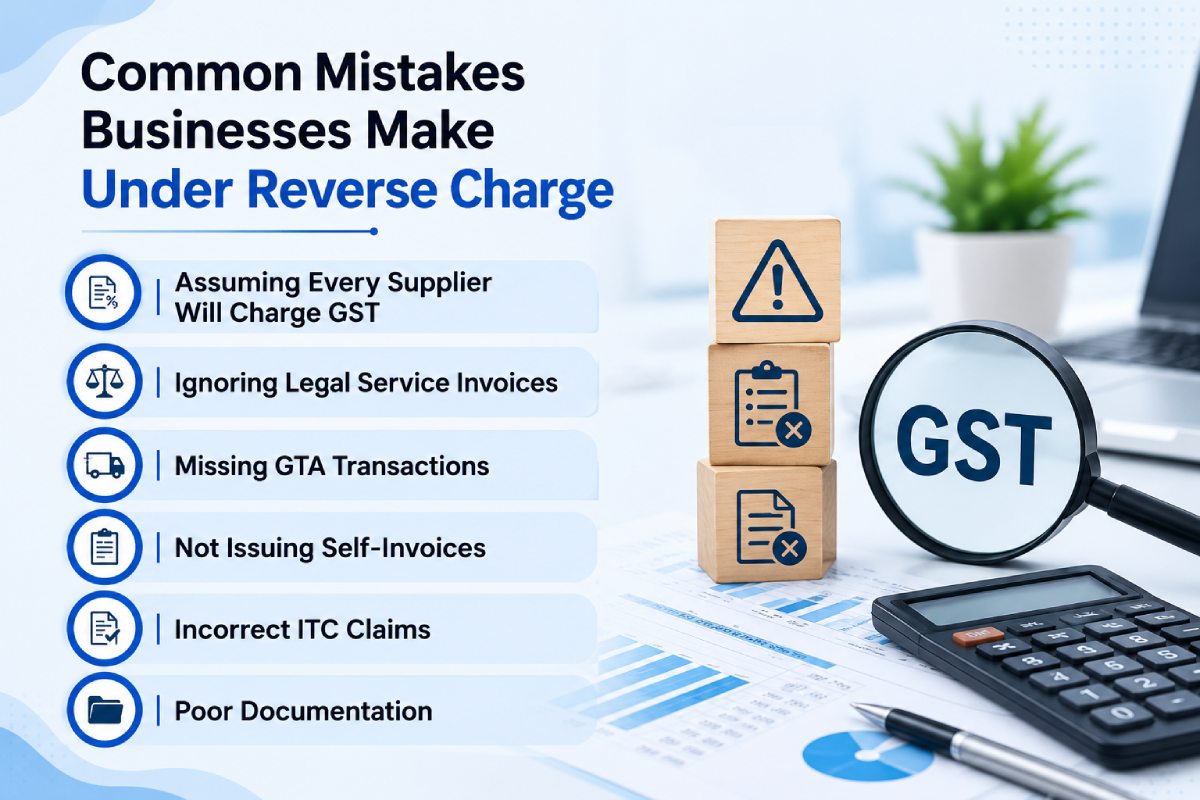
Even experienced finance teams sometimes overlook Reverse Charge transactions.
The most common mistakes include:
Assuming Every Supplier Will Charge GST
Many businesses believe that every GST invoice must include GST. Under RCM, this assumption is incorrect.
Ignoring Legal Service Invoices
Invoices received from advocates and law firms are frequently overlooked for Reverse Charge compliance.
Missing GTA Transactions
Transport-related invoices are one of the largest sources of RCM errors. Businesses should verify every freight invoice carefully.
Not Issuing Self-Invoices
Where required under GST law, recipients must generate self-invoices for Reverse Charge transactions. Failure to do so may lead to compliance issues during audits.
Incorrect ITC Claims
Some businesses claim Input Tax Credit before paying the RCM liability. This can lead to notices, interest, or reversal of ITC.
Poor Documentation
Incomplete invoices, missing payment vouchers, and inadequate supporting records often become major issues during GST assessments and audits. Maintaining organized documentation simplifies compliance and reduces litigation risk.
Why Businesses Should Regularly Review RCM Transactions
As businesses grow, procurement activities become more complex, increasing the likelihood of transactions subject to Reverse Charge.
Regular reviews help organizations:
- Identify RCM liabilities early.
- Improve GST compliance.
- Reduce audit risks.
- Avoid interest and penalties.
- Strengthen internal financial controls.
- Ensure accurate Input Tax Credit claims.
Many businesses incorporate periodic GST reviews into their monthly or quarterly compliance processes to stay up to date with changing regulations and transaction patterns.
Reverse Charge (RCM) vs Forward Charge Under GST: Industry Examples, FAQs & Expert Guidance
In the previous sections, we covered the fundamental differences between the Forward Charge Mechanism (FCM) and the Reverse Charge Mechanism (RCM), when each applies, common transactions, compliance requirements, and practical examples.
In this final section, we’ll look at how these mechanisms apply across different industries, answer the most frequently asked questions, clear up common misconceptions, and explain how businesses can simplify GST compliance through professional support.
How Reverse Charge (RCM) Applies Across Different Industries
The Reverse Charge Mechanism does not affect every business in the same way. Depending on your industry, procurement practices, and the nature of services received, RCM obligations may vary significantly.
Below are some practical examples across different industries.
Manufacturing Businesses
Manufacturing companies frequently engage with:
- Goods Transport Agencies (GTA)
- Legal professionals
- Technical consultants
- Directors
- Contractors
Many of these transactions may attract Reverse Charge under applicable GST provisions.
Example
A manufacturing company hires a Goods Transport Agency to transport finished products to distributors. Instead of the transporter paying GST, the manufacturing company may become liable to discharge GST under Reverse Charge, depending on the applicable GST provisions. Manufacturing businesses should regularly reconcile freight invoices with GST returns to ensure compliance.
Startups & Growing Businesses
Startups often focus on product development and customer acquisition, leaving tax compliance as a secondary priority.
However, startups frequently procure services such as:
- Legal advisory
- Company incorporation support
- Accounting services
- Consulting services
- Director services
Certain transactions may attract Reverse Charge liability. Implementing proper accounting processes from the beginning helps startups avoid future GST notices and compliance issues.
IT & Software Companies
Technology companies regularly purchase:
- Professional consulting
- Legal services
- Cloud advisory
- Financial consulting
- Business restructuring support
Although software sales generally follow the Forward Charge Mechanism, several professional services received by IT companies may fall under Reverse Charge. Maintaining a procurement review process helps identify such transactions accurately.
E-Commerce Businesses
Businesses operating through online marketplaces should carefully evaluate GST liability. Certain notified services supplied through Electronic Commerce Operators (ECOs) have separate GST provisions where tax liability may differ from standard transactions. E-commerce businesses should review GST notifications regularly because these provisions continue to evolve.
Exporters
Export businesses generally deal with:
- Freight services
- Customs consultants
- Legal advisors
- Chartered Accountants
- Transport agencies
Many supporting services may involve Reverse Charge implications. Proper GST documentation is particularly important because exporters also deal with refunds and Input Tax Credit claims.
Professional Service Firms
Consulting firms, architects, engineering firms, advertising agencies, and management consultants often engage advocates, auditors, and specialist advisors. Each transaction should be evaluated individually to determine whether the Reverse Charge applies.
Reverse Charge vs Forward Charge: Which One Applies to Your Business?
A simple way to determine the applicable mechanism is to ask the following questions:
Question 1:
Is the supplier charging GST on the invoice?
Yes, usually, the Forward Charge applies.
Question 2:
Is the transaction specifically notified under Reverse Charge?
Yes, the recipient becomes liable.
Question 3:
Is the supplier an advocate, GTA, director, or another notified category?
If yes, review the applicable GST notification before processing payment.
Question 4:
Are you unsure?
Consult your GST advisor before filing returns. A few minutes of review today can prevent notices and penalties later.
Common Myths About Reverse Charge Under GST
Many misconceptions exist regarding Reverse Charge. Understanding the facts helps businesses avoid compliance mistakes.
Myth 1
Every purchase from an unregistered supplier attracts the Reverse Charge.
Reality
This is incorrect. The earlier broad RCM provisions for purchases from unregistered suppliers have undergone several changes. Businesses should always refer to the latest GST notifications before assuming RCM applicability.
Myth 2
GST paid under Reverse Charge cannot be claimed as Input Tax Credit.
Reality
Eligible businesses can generally claim ITC after paying GST under Reverse Charge, provided the prescribed conditions are fulfilled.
Myth 3
Reverse Charge applies to every legal service.
Reality
Applicability depends on factors such as the nature of the service, supplier category, and recipient status under GST.
Myth 4
Small businesses don’t need to worry about the Reverse Charge.
Reality
Even startups and SMEs frequently receive services that may attract RCM. Ignoring such transactions can result in notices and additional tax liability.
Myth 5
Reverse Charge only affects large corporations.
Reality
Businesses of every size including proprietorships, partnerships, LLPs, and private limited companies may have Reverse Charge obligations.
How Whitespace Consultancy Helps Businesses Stay GST Compliant
GST compliance extends far beyond filing monthly returns. Businesses must continuously evaluate transactions, identify tax liabilities, maintain documentation, and adapt to evolving GST regulations.
At Whitespace Consultancy, we help startups, SMEs, and established businesses simplify GST compliance through practical, partner-led advisory.
Our GST services include:
- GST registration and amendments
- GST return filing
- Reverse Charge compliance review
- Forward Charge transaction review
- GST reconciliations
- Input Tax Credit verification
- GST audits
- GST assessments and notices
- Representation before GST authorities
- Litigation support
- Process improvement for GST compliance
- Advisory on complex GST transactions
Our goal is not only to help businesses remain compliant but also to strengthen internal financial systems and reduce future tax risks.
Related Services You May Find Helpful
If you’re looking to strengthen your tax and compliance framework, explore these related services:
GST Registration & Compliance Services – Assistance with GST registration, return filing, reconciliations, amendments, and ongoing compliance.
Accounting Services in Mumbai – Professional bookkeeping, financial reporting, MIS reporting, and outsourced accounting support.
Income Tax Services – Tax planning, return filing, assessments, scrutiny proceedings, and notice handling.
Audit & Assurance Services – Statutory audits, internal audits, GST audits, due diligence, and financial assurance services.
Business Advisory Services – Business structuring, Virtual CFO services, budgeting, forecasting, and strategic financial planning.
About Our Chartered Accountants – Learn more about our experienced Chartered Accountants and partner-led approach.
Contact Us – Schedule a consultation with our GST experts.
Key Takeaways
Understanding the distinction between the Forward Charge Mechanism (FCM) and the Reverse Charge Mechanism (RCM) is essential for every GST-registered business. While most transactions follow the Forward Charge process, specific goods, services, and notified transactions shift the GST liability to the recipient under Reverse Charge.
Incorrect identification of these transactions can lead to interest, penalties, delayed Input Tax Credit claims, and unnecessary GST notices. Businesses should implement regular transaction reviews, maintain proper documentation, reconcile GST records, and stay updated with changes in GST regulations.
By strengthening internal accounting processes and seeking professional guidance when needed, businesses can reduce compliance risks and make GST management more efficient.
Need Expert Guidance on GST Compliance?
Whether you’re unsure about Reverse Charge applicability, need assistance with GST registration, or require support with GST return filing, assessments, or audits, our experienced team is here to help.
At Whitespace Consultancy, we provide practical, business-focused GST advisory designed to simplify compliance and support informed financial decisions.
Schedule a GST Consultation Today
Connect with our Chartered Accountants to discuss your GST requirements and receive tailored guidance for your business.
Talk to Our GST Experts
Frequently Asked Questions (FAQs)
What is the Forward Charge Mechanism under GST?
Forward Charge is the standard GST system where the supplier collects GST from the customer and deposits it with the government.
What is the Reverse Charge Mechanism (RCM)?
Under Reverse Charge, the responsibility to pay GST shifts from the supplier to the recipient of goods or services for specified transactions.
Which is the normal GST mechanism?
Forward Charge is the default mechanism used for most GST transactions.
Who pays GST under Reverse Charge?
The recipient of the goods or services pays GST directly to the government instead of the supplier.
Can I claim Input Tax Credit on RCM transactions?
Yes, subject to compliance with GST provisions and eligibility conditions.
Is Reverse Charge applicable to every GST invoice?
No, only notified goods, services, and specified transactions attract the Reverse Charge.
Is GST charged on the supplier’s invoice under RCM?
In many RCM transactions, the supplier does not collect GST. Instead, the recipient calculates and pays the applicable GST directly.
Is Reverse Charge applicable to legal services?
Yes, certain legal services provided by advocates or law firms to registered business entities may fall under Reverse Charge provisions.
Is Reverse Charge applicable to transport services?
Certain Goods Transport Agency (GTA) services may attract Reverse Charge depending on the applicable GST provisions.
What happens if I fail to pay GST under Reverse Charge?
Failure to comply may lead to:
- Interest
- Penalties
- GST notices
- Audit observations
- Delay in claiming the eligible Input Tax Credit
Do startups need to comply with the Reverse Charge?
Yes, if a startup receives notified goods or services covered under RCM, it must comply with the applicable GST requirements.
How often should businesses review RCM transactions?
Ideally, businesses should review Reverse Charge transactions every month before filing GST returns to ensure timely compliance.
What is the difference between Reverse Charge and Forward Charge under GST?
The key difference between the Forward Charge Mechanism (FCM) and the Reverse Charge Mechanism (RCM) is who is responsible for paying GST to the government. Under Forward Charge, the supplier collects and deposits GST, whereas under Reverse Charge, the recipient is liable to pay GST directly to the government for specified goods or services. Reverse Charge applies only to notified transactions under the GST law.