

15 Questions to Ask a Chartered Accountant Before Hiring One for Your Business
Choosing a Chartered Accountant is an important decision for any business. The right professional can help with much more than annual tax filing. Depending on your requirements, a CA may become involved in accounting, GST, Income Tax, TDS, audit, financial reporting, tax planning, compliance, business advisory, and strategic financial decisions.
However, not every CA or CA firm provides the same services, works with the same types of businesses, or follows the same communication and reporting processes. That is why, before hiring one, you should ask the right questions. If you are comparing several professionals, don’t ask only: “How much do you charge?”
Instead, ask about their experience, service scope, industry knowledge, technology, communication, senior involvement, compliance process, scalability, and approach to financial advisory. This guide provides 15 questions to ask a Chartered Accountant before hiring one, along with what you should look for in the answers and the red flags that could indicate that a provider may not be the right fit.
What Questions Should You Ask a Chartered Accountant Before Hiring?
The most important questions to ask a Chartered Accountant should cover five areas:
- Experience and expertise
- Services and scope
- Account management and communication
- Technology and scalability
- Fees and long-term value
A good CA should be able to clearly explain what they can do for your business, who will handle the work, how communication will work, and what is included in the professional engagement.
Quick Checklist: 15 Questions to Ask a CA Before Hiring
| # | Question | Why It Matters |
| 1 | How many years of experience do you have? | Evaluates professional experience |
| 2 | Have you worked with businesses in my industry? | Checks industry understanding |
| 3 | What services are included in your engagement? | Prevents scope confusion |
| 4 | Do you handle accounting and bookkeeping? | Determines whether accounting is covered |
| 5 | Do you provide GST registration and compliance? | Important for GST-registered businesses |
| 6 | Do you assist with audits and assessments? | Helps evaluate compliance support |
| 7 | Who will actually manage my account? | Identifies the day-to-day contact |
| 8 | Will a senior CA review my work? | Determines level of professional oversight |
| 9 | How frequently will we communicate? | Sets communication expectations |
| 10 | Do you provide monthly financial reporting/MIS? | Determines financial visibility |
| 11 | What accounting software and technology do you use? | Evaluates efficiency |
| 12 | Can you support my business as it grows? | Checks scalability |
| 13 | How do you handle tax notices and assessments? | Evaluates problem-solving support |
| 14 | How are your fees structured? | Prevents unexpected charges |
| 15 | What makes your firm different? | Helps compare providers |
Now let’s examine each question in detail.
1. How Many Years of Experience Do You Have?
One of the first questions to ask a CA before hiring is about professional experience. Experience doesn’t automatically mean that one CA is better than another, but it can help you understand the professional’s exposure to different types of situations. Ask: “How long have you been practising, and what types of businesses have you worked with?”
You can also ask about experience with:
- Startups
- Small businesses
- SMEs
- Private companies
- Professionals
- Traders
- Manufacturers
- Service businesses
- E-commerce companies
What to Look For
Don’t focus only on the number of years. Also consider whether the experience is relevant to your business.
For example, a CA with extensive experience in individual taxation may not necessarily be the right choice for an SME requiring:
- GST
- Accounting
- Payroll
- Audit
- MIS
- Tax planning
- Business advisory
Relevant experience matters.
2. Have You Worked With Businesses in My Industry?
This is one of the most useful questions to ask a Chartered Accountant. Different industries can have very different financial and compliance requirements.
For example:
Manufacturing
May involve:
- Inventory
- Production costs
- Capital expenditure
- Vendor management
- Working capital
E-Commerce
May involve:
- Online marketplaces
- Payment gateways
- Returns
- Multiple vendors
- GST complexity
Professional Services
May focus more on:
- Service revenue
- Professional expenses
- GST
- TDS
- Income Tax
Real Estate
May involve:
- Project accounting
- Significant transactions
- Capital expenditure
- Tax considerations
A CA who understands your industry may be able to identify issues more quickly.
Ask: “Do you currently work with businesses similar to mine?”
3. What Services Are Included in Your Engagement?
Never assume that every service is automatically included. Ask for a clear written scope. For example, if the quotation says: “Monthly accounting and compliance – ₹15,000,” Ask exactly what that means.
Does it include:
- Bookkeeping?
- Bank reconciliation?
- GST?
- TDS?
- Payroll?
- Income Tax?
- Monthly MIS?
- Tax planning?
- Notice assistance?
- Financial review?
The answer can significantly change the actual value of the engagement.
Request a Written Scope of Work
Ideally, the engagement should clearly explain:
Included
- Services
- Frequency
- Deliverables
- Reporting
- Communication
Not Included
- Special assignments
- Certifications
- Additional registrations
- Tax notices
- Litigation/representation where applicable
- Additional consultations
This reduces misunderstandings later.
4. Do You Handle Accounting and Bookkeeping in Addition to Taxation?
This is particularly important for businesses.
Some CAs primarily focus on:
- Tax
- Audit
- Compliance
while accounting is maintained by an internal or external accountant.
Others offer integrated services: Accounting + GST + Tax + Audit + Advisory If you want one provider to manage your broader financial function, ask directly: “Do you provide accounting and bookkeeping services, or do I need a separate accountant?”
Accounting vs Tax Support
These are different functions.
Accounting
Maintains the financial records.
Taxation
Uses those records to determine tax obligations and compliance.
If two separate providers handle these functions, you may need to coordinate information between them. An integrated provider can sometimes simplify this process.
5. Do You Provide GST Registration and Compliance Services?
If your business is GST-registered, or expects to become GST-registered, ask specifically about GST expertise.
Your CA may potentially assist with:
- GST registration
- GST returns
- GSTR-2B reconciliation
- Input Tax Credit review
- GST classification
- RCM
- E-invoicing, where applicable
- E-way bills, where applicable
- GST notices
Ask: “Do you handle GST compliance internally, and who reviews the GST work?”
This is especially important if your business has:
- High transaction volume
- Multiple GST registrations
- Inter-state operations
- Imports
- RCM transactions
- Significant Input Tax Credit
6. Do You Assist With Audits and Assessments?
Don’t wait until an audit or tax assessment begins to find out whether your CA can help. Ask: “Do you provide audit and assessment support, and what happens if I receive a notice?”
Depending on the circumstances, a professional may assist with:
- Audit preparation
- Tax audit
- Statutory audit coordination
- Income Tax assessments
- GST proceedings
- Tax notices
- Documentation
- Reconciliation
The exact scope will depend on the assignment and applicable professional requirements.
7. Who Will Actually Manage My Account?
This is one of the most important questions to ask a Chartered Accountant before signing an engagement, especially when working with a business tax consultant Mumbai for ongoing tax support. During the sales meeting, you may speak with a senior CA or partner.
But after signing the engagement, your day-to-day work may be handled by another team member. There is nothing inherently wrong with this. The important thing is to understand the structure. Ask: “Who will be my primary point of contact?” and “Who will review my accounts?”
Ask About the Team Structure
Find out:
- Who handles bookkeeping?
- Who handles GST?
- Who handles Income Tax?
- Who reviews the accounts?
- Who handles urgent matters?
- Who is the escalation contact?
- How involved is the partner/senior CA?
This gives you a realistic understanding of the service you will receive.
8. Will a Partner or Senior Chartered Accountant Review My Work?
Not every task needs partner-level involvement. Routine bookkeeping can often be handled by an accounting team. But complex matters may require senior professional review.
Examples include:
- Tax planning
- Tax notices
- Business restructuring
- Major transactions
- Funding
- Audit matters
- Significant tax positions
Ask: “Which matters will be reviewed by a senior CA or partner?” This is an important way to evaluate the depth of professional support.
9. How Frequently Will We Communicate?
A CA relationship shouldn’t be limited to filing deadlines if your business needs ongoing financial support. Ask: “How frequently will we review my business finances?”
Depending on the business, this might be:
Monthly
Suitable for:
- Growing businesses
- SMEs
- High transaction volumes
- Businesses requiring MIS
Quarterly
Potentially suitable for:
- Smaller businesses
- Relatively stable operations
- Periodic tax planning
Annually
May be suitable for:
- Simple annual compliance
- Specific tax filing requirements
The appropriate frequency depends on the complexity of your business.
10. Do You Provide Monthly Financial Reporting or MIS?
If you are hiring a CA for a growing business, don’t focus only on compliance.
Ask whether the firm provides:
- Profit & Loss
- Balance Sheet
- Cash Flow
- Receivables
- Payables
- Expense analysis
- Budget vs actual
- Management Information System reports
A business owner shouldn’t have to wait until the end of the financial year to discover that margins have declined.
Why Monthly MIS Matters
Imagine: Revenue increased by 25%. That sounds positive.
But your:
- Receivables increased by 60%
- Inventory increased by 40%
- Cash decreased
A monthly MIS review can help management identify the underlying issue. This is where a CA can become more than a compliance provider. The role can evolve from: Record → Report → Analyse → Advise
11. What Accounting Software and Technology Do You Use?
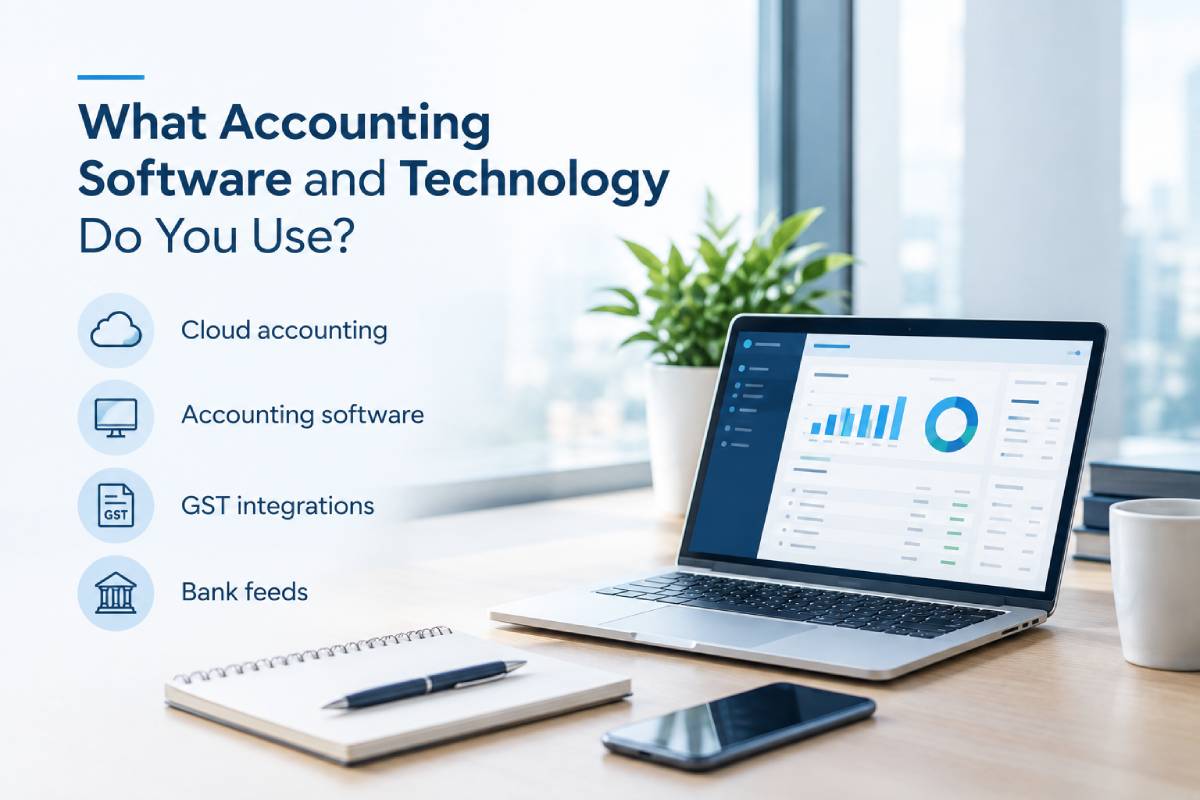
Technology is increasingly important in modern accounting. Ask: “Which accounting software and technology do you use?”
Depending on your business, the provider may use:
- Cloud accounting
- Accounting software
- GST integrations
- Bank feeds
- Digital document management
- Automated reconciliation
- Payroll software
- MIS dashboards
- Secure document sharing
Why Technology Matters
Suppose you have: 100 transactions/month. Manual processes may still be manageable. But at: 5,000 transactions/month, you need stronger systems.
Technology can help reduce:
- Manual data entry
- Reconciliation delays
- Duplicate records
- Reporting delays
However, technology is only useful when combined with accurate processes and professional review.
12. Can You Support My Business as It Grows?
This question is particularly important for startups and SMEs.
Your current requirement may be:
- Basic bookkeeping
- GST
- Income Tax
But in three years you may need:
- Multiple GST registrations
- Payroll
- MIS
- Audit
- Tax planning
- Cash-flow forecasting
- Virtual CFO
- Funding support
Ask: “How can your services scale as my business grows?”
Look for a Scalable Service Model
Ideally, the provider can support you through:
Stage 1
Accounting + Compliance
↓
Stage 2
Accounting + GST + Tax
↓
Stage 3
Financial Reporting + MIS
↓
Stage 4
Tax Planning + Advisory
↓
Stage 5
Virtual CFO + Strategic Finance
You don’t need to purchase everything immediately. The important thing is knowing whether the provider can support you when the need arises.
13. How Do You Handle Tax Notices and Assessments?
This is one of the most important questions to ask a Chartered Accountant before signing an engagement. Ask: “If I receive an Income Tax or GST notice, will you assist me?”
Then clarify:
- Is notice review included?
- Is drafting the response included?
- Is representation included?
- Are additional fees applicable?
- Who will handle the matter?
- What documentation will be required?
Why Notice Support Matters
A tax notice can create significant stress for a business owner.
You may need to:
- Understand the section mentioned
- Identify the relevant financial year
- Collect documents
- Reconcile records
- Prepare explanations
- Meet response deadlines
Having an established professional relationship can make the process more organised.
14. How Are Your Fees Structured?
This is one of the most important questions-but it should not be the first and only question. Ask for a clear breakdown.
Monthly Fees
What is included?
Annual Fees
What is included?
Additional Charges
What is charged separately?
For example:
- Tax notices
- Certifications
- Special consultations
- Additional GST registrations
- Additional returns
- Financial projections
- Due diligence
- Special assignments
Don’t Compare CA Fees Without Comparing Scope
Suppose:
Firm A
₹10,000/month
Includes:
- Basic accounting
- GST filing
Firm B
₹20,000/month
Includes:
- Accounting
- GST
- TDS
- Bank reconciliation
- Monthly MIS
- Quarterly tax review
- Financial review
Firm B is not necessarily “expensive.” It is providing a different service package. Therefore, compare: Scope + Expertise + Reporting + Communication + Advisory rather than just: Monthly Fee
15. What Makes Your Firm Different From Other CA Firms?
This is the final question-and it can reveal how the provider views its own service. Ask: “Why should I choose your firm instead of another CA firm?” Look for specific answers.
Good answers may explain:
- Industry expertise
- Service model
- Technology
- Reporting
- Senior involvement
- Response times
- Advisory
- Scalability
Be cautious of generic answers such as: “We provide the best service.” Ask for specific examples of what makes the service different.
How to Choose a Chartered Accountant: A Practical Framework
Once you have asked these questions, understanding how to choose a Chartered Accountant becomes easier. Compare the providers systematically. Use a scorecard rather than making a decision based on the first meeting.
| Evaluation Criteria | Firm A | Firm B | Firm C |
| Industry Experience | /5 | /5 | /5 |
| Service Scope | /5 | /5 | /5 |
| Accounting Capability | /5 | /5 | /5 |
| GST Expertise | /5 | /5 | /5 |
| Tax Expertise | /5 | /5 | /5 |
| Audit Capability | /5 | /5 | /5 |
| Senior CA Involvement | /5 | /5 | /5 |
| Communication | /5 | /5 | /5 |
| Technology | /5 | /5 | /5 |
| Monthly Reporting | /5 | /5 | /5 |
| Scalability | /5 | /5 | /5 |
| Notice Support | /5 | /5 | /5 |
| Pricing Transparency | /5 | /5 | /5 |
| Overall Fit | /5 | /5 | /5 |
This helps remove some of the subjectivity from the decision.
How to Choose a CA Firm
When learning how to choose a CA firm, look beyond the individual professional.
Evaluate:
Team
How many people can support your account?
Expertise
Does the team cover:
- Accounting
- GST
- Tax
- Audit
- Advisory?
Senior Involvement
Can you access experienced professionals when needed?
Technology
Is the firm using modern accounting systems?
Reporting
Will management receive useful financial information?
Scalability
Can the firm support the business as it grows?
Communication
Is there a defined communication and escalation process?
What to Ask a CA About Accounting Services
If your business needs accounting, ask:
- Who maintains the books?
- How frequently are accounts updated?
- How often are bank accounts reconciled?
- Do you reconcile receivables and payables?
- When will monthly financial statements be available?
- Who reviews the accounting records?
- Which accounting software do you use?
- Can I access the accounting data?
These questions are particularly important when outsourcing accounting.
What to Ask a CA About GST
Ask:
- Do you handle GST returns?
- Do you perform GSTR-2B reconciliation?
- How do you identify ineligible ITC?
- How do you handle RCM?
- How do you track GST notices?
- Do you review GST compliance periodically?
- Are GST advisory services included in the fee?
This can help you distinguish basic GST filing from broader GST compliance support.
What to Ask a CA About Tax Planning
If you are considering a business tax consultant Mumbai, ask:
- Do you provide proactive tax planning?
- How often do you review my tax position?
- Will you advise me before major transactions?
- Do you help with advance tax planning?
- Do you review the tax impact of business decisions?
Good tax planning should be based on applicable law and proper documentation. Be cautious if someone promises unrealistic or guaranteed tax savings.
What to Ask a CA About Communication
Communication problems can become one of the biggest frustrations in professional relationships.
Ask:
- Who should I contact for routine questions?
- How quickly are emails generally answered?
- Do you provide a dedicated contact person?
- How are compliance deadlines communicated?
- How often will we have review meetings?
- Who handles urgent matters?
Clear communication expectations should ideally be established before engagement.

Red Flags to Watch For Before Hiring a CA
Knowing what to ask a CA is important, but knowing what answers should concern you is equally important.
1. Unclear Pricing
If the provider cannot explain what the fee includes, ask for a written scope.
2. No Defined Scope of Work
Avoid vague statements such as: “We’ll handle everything.” Ask: “What exactly does everything include?”
3. Poor Communication
If the CA takes several days to respond during the sales process, consider how communication might work after onboarding.
4. No Dedicated Point of Contact
You should know who handles routine questions.
5. Limited Industry Experience
This isn’t automatically a deal-breaker, but ask how the professional will understand your industry.
6. No Documentation Process
A professional accounting relationship should have an organised process for:
- Documents
- Approvals
- Records
- Reports
7. Only Contacting You During Tax Season
A business that requires ongoing financial management may need more proactive interaction.
8. No Proactive Tax Planning
If your business is becoming financially complex, waiting until year-end may not be sufficient.
9. No Senior Review
Ask who reviews complex tax, GST, and financial matters.
10. Unrealistic Tax-Saving Promises
Be particularly cautious of statements such as: “We can guarantee that you won’t pay tax.” Professional tax planning should focus on legitimate and compliant use of applicable provisions.
How to Choose Between Two CA Firms
Suppose two firms offer similar pricing.
Firm A
- 15 years of experience
- Basic accounting
- GST
- Tax filing
- Limited reporting
Firm B
- 10 years of experience
- Accounting
- GST
- Tax
- Monthly MIS
- Senior CA review
- Tax planning
- Business advisory
Firm A isn’t automatically worse. But if your business needs monthly financial visibility and advisory, Firm B may be a better fit. The decision should be based on: Business requirements → Service scope → Expertise → Communication → Scalability → Cost
Should You Choose the Cheapest CA?
Not necessarily. The cheapest provider can be suitable when your requirements are simple.
But if your business requires:
- GST
- Accounting
- Tax planning
- Audit
- MIS
- Advisory
then choosing based only on price can result in an incomplete service model. Instead, ask: “What value and scope am I receiving for this fee?”
When Should You Consider a CA Firm Instead of an Individual CA?
An individual CA may be sufficient for focused requirements.
A CA firm may be more suitable when you need:
- Multiple services
- Larger accounting volumes
- More team capacity
- Multiple specialists
- Senior review
- Business advisory
- Scalability
For growing businesses, a firm’s team structure can become increasingly valuable.
When Should You Consider an Accounting Firm?
An accounting firm in Mumbai may be suitable when your primary requirement is:
- Bookkeeping
- Accounting
- Bank reconciliation
- Payroll
- Accounts payable
- Accounts receivable
- Monthly financial statements
If you also require tax, audit, and professional advisory, confirm that the firm has appropriately qualified professionals or works with a suitable CA.
When Should You Search for a Chartered Accountant Near Me?
A search such as “Chartered Accountant near me” usually indicates that the user wants a local professional who can provide accessible support.
Local proximity can be useful when:
- Physical meetings are important.
- Documents need to be reviewed in person.
- The business operates locally.
- You prefer face-to-face communication.
However, location should not be the only factor.
A modern CA relationship can often operate through:
- Video meetings
- Cloud accounting
- Digital document sharing
- Online approvals
- Messaging
Therefore, compare expertise and service quality alongside location.
What Should Businesses in Mumbai Look For?
If you are searching for a Chartered Accountant in Mumbai or a CA firm in Mumbai, don’t limit your evaluation to: “How close is the office?”
Also consider:
- Industry experience
- Service scope
- Tax expertise
- GST capability
- Accounting services
- Audit experience
- Reporting
- Communication
- Technology
- Senior involvement
- Scalability
What Makes a Good CA Relationship?
A strong professional relationship should ideally provide:
Accuracy
Financial records should be maintained carefully.
Timeliness
Compliance deadlines should be monitored.
Communication
Questions should receive clear responses.
Transparency
Fees and scope should be clear.
Proactive Advice
Potential issues should be identified before they become problems.
Business Understanding
The professional should understand the financial context of your business.
Scalability
The service should evolve as your business grows.
A Simple 15-Question Interview You Can Use
Before your next CA meeting, copy this list:
- How many years of experience do you have?
- Have you worked with businesses in my industry?
- What services are included in your engagement?
- Do you handle accounting and bookkeeping?
- Do you provide GST registration and compliance?
- Do you assist with audits and assessments?
- Who will actually manage my account?
- Will a senior CA review my work?
- How frequently will we communicate?
- Do you provide monthly financial reports or MIS?
- What accounting software and technology do you use?
- Can you support my business as it grows?
- How do you handle tax notices and assessments?
- How are your fees structured?
- What makes your firm different from other CA firms?
Take the answers from two or three providers and compare them side by side.
Frequently Asked Questions
What questions should I ask a Chartered Accountant before hiring?
The most important questions to ask a Chartered Accountant cover experience, industry expertise, services, accounting, GST, taxation, audit, senior involvement, communication, technology, scalability, notice support, and pricing.
Don’t limit your discussion to fees.
What questions should I ask a CA before hiring?
When deciding questions to ask a CA before hiring, ask who will manage your account, what services are included, whether GST and accounting are covered, how notices are handled, how often you receive financial reports and how the fee structure works.
What are the most important questions to ask a Chartered Accountant?
The most important questions are:
- Do you understand my industry?
- What services are included?
- Who manages my account?
- Will a senior CA review the work?
- Do you provide accounting and GST?
- How do you handle tax notices?
- How often do you communicate?
- Do you provide MIS?
- Can you scale with my business?
- How are fees structured?
How do I choose a Chartered Accountant?
To understand how to choose a Chartered Accountant, compare professionals based on relevant experience, service scope, qualifications, communication, technology, senior involvement, pricing transparency, and scalability. The best CA is not necessarily the cheapest or the largest. The best fit is the professional whose expertise matches your business requirements.
How do I choose a CA firm?
When deciding how to choose a CA firm, evaluate its team, professional expertise, accounting capabilities, GST and tax services, audit experience, reporting, technology, communication, and ability to support your business as it grows.
What should I ask a CA about fees?
Ask:
- What is included?
- What is excluded?
- Is the fee monthly or annual?
- Are GST and TDS included?
- Are notices extra?
- Are certifications extra?
- Are consultations included?
- Are special assignments billed separately?
Always request a clear scope of work.
Should I hire an individual CA or CA firm?
An individual CA can be suitable for straightforward or focused requirements. A CA firm may be more suitable when your business needs multiple services, greater team capacity, or broader advisory support.
Should a startup hire a CA?
A startup may benefit from CA support from the formation stage, particularly for business structure, accounting setup, GST, tax planning and compliance. As the startup grows, its needs may expand into financial reporting, funding support, and advisory.
What should an SME ask a Chartered Accountant?
An SME should ask about:
- Accounting
- GST
- TDS
- Income Tax
- Audit
- MIS
- Tax planning
- Cash-flow management
- Business advisory
- Senior CA involvement
How do I find a Chartered Accountant near me?
You can search for “Chartered Accountant near me” to identify local options, but don’t choose solely based on proximity.
Compare:
- Experience
- Services
- Reviews
- Communication
- Industry expertise
- Pricing
- Professional capabilities
How do I choose the best CA firm in Mumbai?
When evaluating the best CA firm in Mumbai, understanding how to choose a Chartered Accountant can help you focus on business fit rather than a generic “best” ranking.
Consider:
- Industry experience
- Service scope
- Accounting
- GST
- Tax
- Audit
- Advisory
- Technology
- Communication
- Senior involvement
- Scalability
Should I hire an accounting firm in Mumbai or a CA?
If your main requirement is bookkeeping and accounting operations, an accounting firm in Mumbai may be sufficient, while a CA firm in Mumbai may be more appropriate when you also need taxation, audit, or advisory support. If you also need taxation, audit, tax planning, or professional advisory, consider an individual CA or CA firm. Some firms can provide both accounting and CA-level services.
What does a business tax consultant in Mumbai do?
A business tax consultant Mumbai businesses work with may assist with tax compliance, tax planning, tax calculations, applicable deductions, advance tax, tax notices, and other tax-related matters depending on their professional scope.
Final Checklist Before You Sign the Engagement
Before hiring a CA, make sure you know:
- Who is responsible for my account?
- What services are included?
- What services are excluded?
- Who reviews the work?
- Is GST included?
- Is accounting included?
- Is TDS included?
- Is Income Tax included?
- Is audit included?
- Is tax planning included?
- Are notices included?
- How frequently will we communicate?
- Will I receive monthly financial reports?
- What technology is used?
- How are additional services charged?
- Can the firm scale with my business?
If these questions have clear answers, you are in a much stronger position to make an informed decision.
Conclusion
Choosing a Chartered Accountant should not be a decision based solely on a quotation. The right professional should ideally understand your business, provide the services you actually need, communicate clearly, maintain appropriate financial processes, and provide professional guidance when financial or tax decisions become more complicated. The questions to ask a Chartered Accountant should therefore go beyond: “How much do you charge?”
Ask:
- “Have you worked with businesses like mine?”
- “What exactly is included?”
- “Who will manage my account?”
- “Will a senior CA review the work?”
- “How do you handle GST and tax notices?”
- “Will I receive regular financial reporting?”
- “Can you support me as the business grows?”
- “What makes your service different?”
Once you have answers to these questions, comparing CA professionals becomes much easier. The objective isn’t necessarily to find the cheapest CA or the biggest firm. It is to find a professional or firm that provides the right combination of expertise, service, communication, technology, and long-term support for your business.
Looking for a Chartered Accountant in Mumbai?
If your business needs support with accounting, GST, Income Tax, TDS, audit, financial reporting, or business advisory, Whitespace Consultancy can help evaluate the appropriate level of professional support for your business.
Depending on your requirements, services can include:
- Accounting and bookkeeping
- GST registration and compliance
- GST ITC reconciliation
- Income Tax filing
- Tax planning
- TDS compliance
- Audit support
- Tax notice assistance
- Financial reporting
- MIS
- Business advisory
- Virtual CFO services
Whether you are a startup, small business, or growing SME, the right financial support should match your current requirements and evolve with your business. Looking for a Chartered Accountant in Mumbai? Contact Whitespace Consultancy to discuss your accounting, taxation, GST, and business advisory requirements.