

How to Choose a Chartered Accountant in Mumbai for Your Business 2026

Quick answer: How to choose a Chartered Accountant in Mumbai starts with listing what your business needs: bookkeeping, GST, income tax, TDS, audit, MIS reporting, or advisory. Then verify the CA’s ICAI membership, check experience with businesses like yours, and confirm who will actually handle your account. Ask how they communicate, which accounting software they use, and how they track compliance deadlines. Compare quotations by what is included, not by the fee alone. Finally, check whether the firm can support you as you grow, from basic compliance to tax planning, reporting, and Virtual CFO support.
Why Choosing the Right CA Matters for a Business
For many business owners, the CA is the person who files the income tax return once a year. In practice, a CA firm often touches almost every financial process in the business.
A typical engagement with a tax consultant Mumbai service or CA firm may cover:
- Day-to-day accounting and bookkeeping
- Monthly GST returns and input tax credit reconciliation
- TDS deduction, deposit and quarterly returns
- Income tax returns and advance tax
- Statutory, tax or internal audit
- Tax planning for business decisions
- Monthly financial reports and cash-flow tracking
- Business advisory, Virtual CFO support and corporate compliance
When this work is handled well, you rarely notice it. When it is not, the problems show up months later: a GST notice because purchase invoices were not reconciled, interest on late TDS deposits, a loan application delayed because the books are not up to date, or a year-end surprise on tax that nobody planned for. That is why how to choose a Chartered Accountant in Mumbai deserves more thought than picking the nearest office or the lowest quotation.
Start by Identifying What Your Business Actually Needs
Before you speak to any CA firm, write down what you need help with today and what you expect to need in the next two to three years. A business looking for a business accountant Mumbai service with heavy GST work needs something different from a consulting firm with five employees or a startup preparing for its first investor.
Use this table as a starting point:
| What your business needs | The CA support to look for |
| Books kept up to date every month | Accounting services or outsourced bookkeeping |
| Monthly or quarterly GST returns | GST registration and compliance |
| Business and partner income tax returns | Income tax services |
| Lower tax outgoings within the law | Tax planning and advisory |
| TDS on salaries, rent, contractors and professionals | TDS compliance |
| Annual audit under company or tax law | Audit and assurance |
| Monthly numbers to run the business | Financial reporting and MIS |
| Cash-flow problems or growth decisions | Business advisory or Virtual CFO |
| Starting a new company or LLP | Company formation and ROC compliance |
| Raising funds or selling a stake | Corporate finance, valuation and due diligence |
Once you know which rows apply to you, it becomes much easier to judge whether a CA firm is a good fit or is simply offering what it happens to do.
Check the CA’s Professional Credentials
Only a member of the Institute of Chartered Accountants of India (ICAI) holding a certificate of practice can call themselves a practising Chartered Accountant and sign audit reports. Checking this takes a few minutes.
- Ask for the membership number of the Chartered Accountant in Mumbai who will sign your work, and the firm registration number (FRN) if it is a firm.
- Check ICAI’s own listings. ICAI’s CA Connect portal lists practising CAs and CA firms by state, city, and service area.
- One of the most useful questions to ask a CA is about relevant experience, not just years in practice. Ten years of individual tax returns is different from ten years of GST and audit work for manufacturers.
- Understand the structure. Is it a sole practitioner, a partnership, or a larger firm? Who are the partners, and what does each one handle?
Additional qualifications such as CS, DISA, or a certificate course in GST or valuation can be useful, but they matter only if they relate to the work you need.
Look for Relevant Industry Experience
Industry experience is not compulsory, but it shortens the learning curve. A CA who has worked with similar businesses already knows the common problems and the questions to ask.
A few examples:
- Startups: founder equity, ESOPs, valuation for share issues, investor reporting, and early compliance setup.
- SMEs and traders: GST reconciliation with GSTR-2B, stock valuation, credit control and bank limits.
- Manufacturing: costing, inventory, job work under GST and capital expenditure planning.
- E-commerce: marketplace settlements, TCS under GST, returns and multi-state registrations.
- Professional services: TDS on receipts, advance tax and partner remuneration.
- Real estate and construction: project accounting, GST on under-construction property and TDS on property transactions.
If a firm has not worked in your sector, that is not a deal-breaker. What matters is whether they ask sensible questions about how your business earns and spends money.
Compare Services, Not Just Fees
Two CA firm in Mumbai can quote similar fees and still offer very different scopes. One may only file returns from the data you send. Another may maintain your books, reconcile GST every month, and send you a short monthly report.
When comparing proposals, check which of these are included, charged separately or not offered at all:
- Accounting and bookkeeping, including outsourced accounting services if you do not have an in-house accountant
- GST registration and compliance, plus GST advisory on input tax credit and classification
- Income tax services, including TDS returns and advance tax
- Audit, where applicable
- Tax planning and advisory
- Monthly MIS and financial reporting
- Business advisory and Virtual CFO services
Working with one firm for most of these usually means fewer handovers, one set of numbers, and less chasing between your accountant, tax consultant, and auditor.
Understand Who Will Actually Work on Your Account
Many business owners meet a senior partner at the first meeting and then deal with a junior staff member for the rest of the year. That is normal in larger practices, but you should know it upfront.
Ask directly:
- Who is my primary contact for day-to-day questions?
- Who prepares the work, for example, your books, GST returns, and TDS returns?
- Who reviews it before it is filed?
- How often will a senior CA look at my account, and in what situations?
- What is the escalation route if something goes wrong or a notice arrives?
A clear answer here is a good sign. A vague answer (“our team will take care of everything”) usually means nobody owns your account.
Evaluate Communication and Response Times
Most friction with a CA is not about technical skill. It is about unanswered calls in the week before a deadline, or learning about a notice only after the reply date has passed.
Before you sign, agree on the practical details:
- Channels: email for documents and approvals, phone for urgent matters, WhatsApp for quick queries, or a client portal.
- Response time: for example, routine queries answered within one or two working days, urgent matters the same day.
- Urgent issues: who to call when a GST notice, income tax notice or bank query needs a same-day answer.
- Reminders: whether the firm sends advance reminders for documents and payments, or waits for you to ask.
A simple way to test this is to note how quickly and clearly the firm responds while you are still evaluating them. It is usually the best version of their service you will see.
Check Whether the Firm Uses Modern Accounting Technology
Technology matters here for one reason: it decides how quickly you can see your own numbers and how much of your time goes into sending documents.
Questions worth asking:
- Which accounting software do you use? Tally Prime, Zoho Books and similar tools are common. If you already use one, check whether the firm can work on it.
- Can I see my books at any time, or only when you send reports?
- How are documents collected? A shared folder or portal is easier than sending bills on WhatsApp every month.
- How are approvals handled? For example, digital approval of GST returns before filing.
- How is my data protected? Ask about access controls and who within the firm can see your files.
- Do you provide dashboards or only PDF reports?
An accounting firm Mumbai provider that works digitally can usually close your books faster each month, which means you get reports while they are still useful.
Ask About Monthly Financial Reporting
If the only financial statements you see are the ones prepared for the income tax return, you are running the business on numbers that are six to eighteen months old. A good CA firm can send a short monthly or quarterly pack, often called MIS (management information system) reports.
Depending on your business, this may include:
- Profit and loss for the month and year to date
- Balance sheet
- Cash flow and bank position
- Receivables ageing, showing who owes you and for how long
- Payables due in the next few weeks
- Expense trends by category
- Budget versus actual
- Working capital position
- GST reconciliation status, including input tax credit at risk
If you are comparing a business accountant Mumbai service, ask to see a sample report with client names removed. It will tell you more about the firm’s approach than any brochure.
Ask How the CA Handles Compliance Deadlines
Indian businesses deal with a steady calendar of due dates: monthly GST returns, monthly TDS deposits, quarterly TDS returns, advance tax instalments, annual income tax returns and, for companies, annual ROC filings.
Ask the firm to explain its process:
- Calendar: Do they maintain a compliance calendar for each client?
- Document collection: When do they ask for data, and how?
- Reminders: How early do they remind you about payments due from your side?
- Responsibility: Who does what? A simple responsibility matrix (for example, you share sales and purchase data by the 5th, they file by the due date) avoids arguments later.
- Late information: What happens if your data arrives late? Who bears the interest or late fee?
Missed deadlines lead to interest, late fees, and sometimes blocked input tax credit. A firm that answers these questions clearly usually has a working system behind it.
Don’t Choose a CA Only Because They Are Nearby
Searching for a “Chartered Accountant near me” or “tax consultant near me” is a sensible first step. A CA in your area is easier to meet, and for some work (physical records, bank visits, sitting with your accountant during the audit), being close by genuinely helps.
But distance should be one factor, not the deciding one. A firm fifteen minutes away is not a good fit if it does not handle GST for your type of business or cannot give you monthly reports. Much of the work is now done digitally, so a firm in Mulund can serve a business in Thane, Navi Mumbai or Andheri as easily as one next door.
When comparing nearby options, also weigh:
- Expertise in the work you need
- How they communicate and how quickly they respond
- Breadth of services
- The technology they use
- Availability of senior people during peak periods
- How well they understand your business
For some owners, face-to-face meetings every month are important. For others, a quarterly meeting and regular calls are enough. Decide which one you are before proximity decides for you.
Local CA Firm vs Larger Accounting Firm
Neither is better by default. The right choice depends on your size, complexity, and how much direct access you want. (For a detailed comparison of an individual CA and a firm, see Chartered Accountant vs accounting firm.)
| Factor | Local or boutique CA firm | Larger accounting organisation |
| Personal attention | Often more direct | Usually more structured |
| Access to senior CAs | Can be direct | May pass through several levels |
| Range of services | Depends on the firm | Often broader |
| Flexibility | Often adapts to your way of working | Tends to follow standard processes |
| Geographic reach | Focused on a city or region | Often multi-city or national |
| Focus on SMEs | Frequently a core client group | Depends on the client segment |
| Handling large, complex structures | Depends on team size | Usually built for it |
A growing SME in Mumbai that values quick access to a partner may prefer a CA firm in Mumbai with a boutique structure. A group with several entities across states may need the broader systems and resources of an accounting firm Mumbai provider or larger organisation. Many businesses start with one and move to the other as they grow.
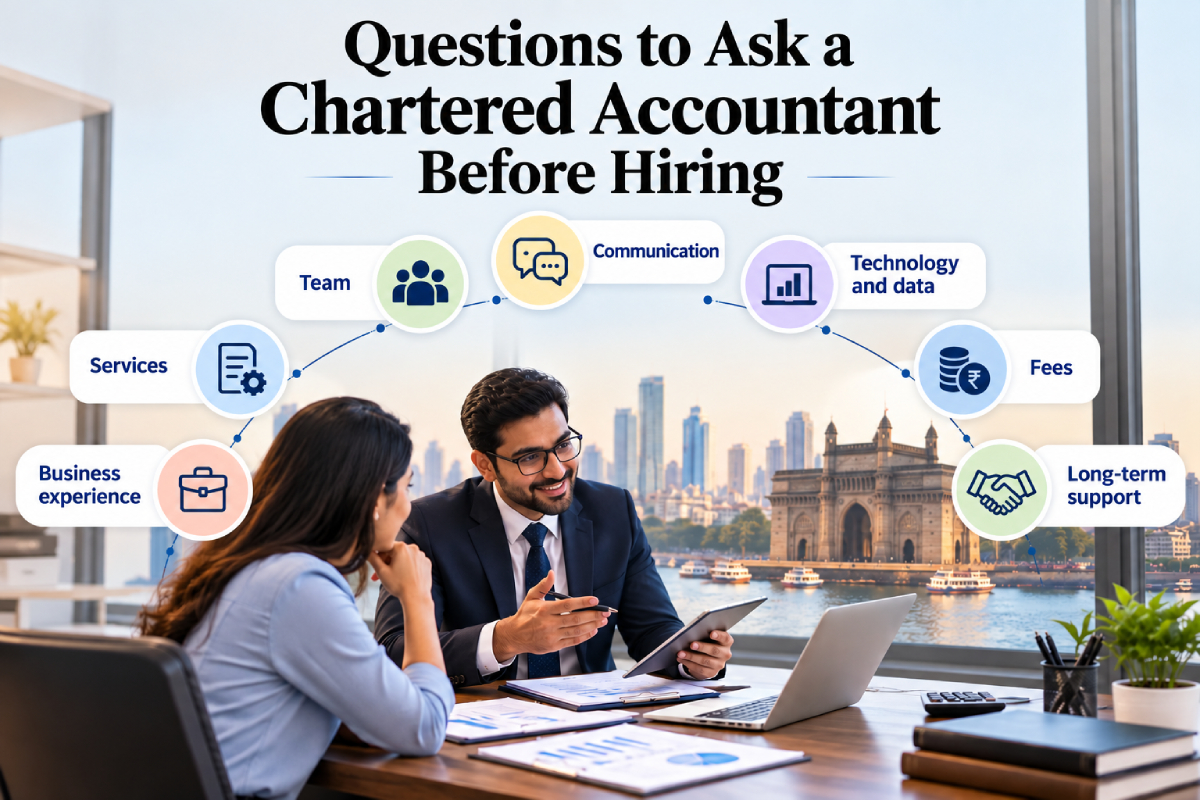
Questions to Ask a Chartered Accountant Before Hiring
These questions are an important part of how to choose a Chartered Accountant in Mumbai, because they help you compare the actual service you will receive. Take them to your first meeting and note the answers side by side for each firm. (For a longer version with guidance on what good answers sound like, see 15 questions to ask a Chartered Accountant.)
Business experience
- Have you worked with businesses in my industry and of my size?
- What types of clients make up most of your practice?
- What problems do you most commonly fix for new clients?
Services
- Which of these do you handle: accounting, GST, income tax, TDS, audit, tax planning, MIS, business advisory, Virtual CFO?
- Which of these would be done by your team, and which would you expect my staff to do?
Team
- Who will manage my account day-to-day?
- Who reviews the work before it is filed?
- When will a senior CA be involved?
Communication
- How quickly do you usually respond to queries?
- Who do I contact for urgent matters, such as a tax notice?
Technology and data
- Which accounting software do you use, and can I access my books directly?
- How are documents exchanged, and how is my financial information protected?
Fees
- What exactly is included in the quotation?
- What is billed separately, such as notices, assessments or extra registrations?
- Are government fees and late fees included or charged at actuals?
Long-term support
- Can you support us if we raise funds, need a valuation or go through due diligence?
- Do you offer Virtual CFO or advisory support as we grow?
Understand the CA’s Fee Structure Before You Sign
CA fees in Mumbai are not fixed. ICAI has issued recommended minimum fee guidelines, but actual quotations vary widely from firm to firm.
The fee for your business will usually depend on:
- Annual turnover
- Number of transactions and invoices each month
- Number of employees (for payroll and TDS)
- Number of GST registrations and states
- Number of entities in the group
- How organised your records are today
- Whether an audit is required
- How much reporting you want
- How much advisory time you expect
The most useful thing you can do is ask for a written scope with the quotation. It should list each service, how often it is done, what you must provide, and what falls outside the fee. (For indicative ranges, see our guide to CA fees in Mumbai.)
Avoid Choosing Solely on the Lowest Fee
The lowest quotation is not always the lowest cost. Consider a simple example. A trading business chooses a CA who charges ₹4,000 a month less than the next option. The GST returns are filed on time, but purchase invoices are not reconciled with GSTR-2B. Nobody reviews the books between returns. Eighteen months later, the business receives a notice about mismatched input tax credit, has to reverse part of the credit with interest, and spends several weeks rebuilding its records for a bank loan.
The saving of ₹48,000 a year is quickly wiped out. This does not mean low-cost providers are poor. Many small practices offer excellent value. The point is to compare what you get: reconciliation, review, reporting and responsiveness, not just the monthly number.
Look for Tax Planning, Not Just Tax Filing
Tax compliance and tax planning are different jobs, and it helps to know which one you are paying for.
- Tax compliance means meeting your reporting and filing obligations correctly and on time: income tax returns, GST returns, TDS returns, and advance tax.
- Tax planning means looking at the tax impact of business decisions before you make them, within applicable tax laws and professional requirements.
Planning conversations usually come up around:
- Business structure: proprietorship, partnership, LLP or private limited company
- Deductions and allowances available to your business
- Timing of income, expenses and large purchases
- Capital expenditure: buying versus leasing, and depreciation
- GST implications of new products, locations or contracts
- TDS obligations when you start new vendor or rental arrangements
- Expansion into new states or new lines of business
- Investments of surplus funds from the business
A CA who only files returns will see these decisions after they are made. A CA who plans with you sees them before. Be cautious of anyone promising unusually large tax savings. Good planning is about structure and timing, not aggressive positions that may not hold up in an assessment. Whitespace offers tax planning and advisory alongside compliance for this reason.
Check Whether the CA Can Grow With Your Business
Changing your CA every few years is disruptive. Records move, history is lost, and a new team has to learn your business. So it is worth asking whether a firm can handle what you will need next, not just what you need today.
For many businesses, the need grows in roughly this order:
Accounting → GST → TDS → Income tax → Audit → MIS reporting → Tax planning → Business advisory → Virtual CFO
A five-person startup working with a business accountant Mumbai service may only need bookkeeping and GST today. In three years, the same company may need monthly board reports, a statutory audit, a valuation for a fundraise, and someone to own cash-flow planning. Firms that offer business advisory and Virtual CFO support can take on that work without you having to find a new adviser at every stage.
Red Flags When Choosing a CA Firm
Watch for these during your conversations:
- Unrealistic tax-saving promises, especially ones that depend on bogus expenses or undisclosed income.
- Unclear pricing, or a refusal to put the scope in writing.
- No clear point of contact, or a different person every time you call.
- Poor communication during the evaluation stage itself.
- Little interest in how your business works, with questions only about documents and deadlines.
- Reactive-only compliance: they file what you send but never flag risks or opportunities.
- No defined review process before returns are filed.
One red flag is not always a reason to walk away. Two or three together usually are.
How to Compare Two CA Firms in Mumbai
After meeting two or three firms, use this comparison to understand how to choose a Chartered Accountant in Mumbai based on your actual business requirements. Write short notes rather than scores, because the right answer depends on what matters most to your business.
| Evaluation area | Firm A | Firm B |
| Industry experience | ||
| Accounting and bookkeeping | ||
| GST | ||
| Income tax | ||
| TDS | ||
| Audit | ||
| Tax planning | ||
| MIS and reporting | ||
| Business advisory | ||
| Senior CA involvement | ||
| Communication and response time | ||
| Technology and data access | ||
| Pricing and what is included | ||
| Ability to scale with you |
If one firm is stronger in the areas you marked as critical in your needs list, that usually settles the decision, even if its fee is slightly higher.
What Type of CA Does Your Business Need?
Your stage of growth changes what you should look for in a Chartered Accountant in Mumbai. Use the list that matches your business today, and glance at the next one.
Startup
- Company or LLP formation and early ROC compliance
- Accounting setup from day one
- GST registration and returns
- Income tax and TDS
- Tax planning around founder salaries and structure
- Clean financial reporting for investors
- Support during fundraising
Small business
- Monthly accounting
- GST returns and reconciliation
- TDS on rent, contractors and professionals
- Income tax returns and advance tax
- Payroll accounting
- Annual financial statements
Growing SME
- Monthly MIS
- Budgeting and cash-flow forecasting
- Business advisory
- Internal controls
- Statutory, tax or internal audit
- Working capital management
- Virtual CFO support
Established business
- Detailed financial reporting
- Internal audit
- Due diligence for acquisitions or investors
- Business valuation
- Corporate finance and M&A advisory
- Strategic financial planning
If you are not sure whether you need a CA yet, read when to hire a Chartered Accountant.
How Whitespace Consultancy Supports Businesses
Whitespace Consultancy Pvt. Ltd. is a Chartered Accountant and business advisory firm based in Mulund West, Mumbai. It works with businesses across Mumbai, Thane and Navi Mumbai, and with clients elsewhere in India where the work allows. The firm was set up by three Chartered Accountants whose practice areas cover direct tax, audit and financial reporting, and GST and regulatory compliance.
Whitespace provides accounting, taxation, GST, audit and business advisory services for businesses at different stages of growth:
- Accounting: business accounting support, outsourced accounting, financial reporting and MIS
- Tax: income tax, TDS compliance, tax planning and advisory, and representation on tax notices
- GST: registration, returns, reconciliation and input tax credit advisory
- Audit: audit and assurance, internal audit and due diligence
- Corporate: company formation and ROC compliance
- Advisory: business advisory, business valuation, corporate finance and strategic financial support through Virtual
- CFO services
The questions in this guide apply to Whitespace as much as to any other firm. If you are evaluating CA firms, use them in your first conversation with us too.
Frequently Asked Questions
How do I choose a Chartered Accountant in Mumbai?
List the services your business needs, then shortlist two or three CA firms that offer them. Verify ICAI membership, ask about experience with similar businesses, and confirm who will handle your account. Compare written scopes rather than headline fees, and check whether the firm can support you as the business grows.
What should I ask a CA before hiring them?
The questions to ask a CA should cover industry experience, services handled, who prepares and reviews your work, response times, and the software they use. On fees, ask what is included, what is billed separately, and whether government fees are extra. Also ask whether they can support fundraising, valuation, or Virtual CFO needs later.
How much does a Chartered Accountant charge in Mumbai?
There is no fixed rate. Fees charged by a tax consultant Mumbai service or CA firm depend on turnover, transaction volume, number of employees, GST registrations, audit requirements, and how much reporting or advisory you need. A small business needing only returns will pay far less than a company wanting monthly accounting, MIS and an audit. Always ask for a written scope with the quotation.
Should I hire an individual CA or a CA firm?
An individual CA can suit a small business with simple needs and a preference for one point of contact. A CA firm in Mumbai is often useful when you need several services together, such as accounting, GST, audit and advisory, such as accounting, GST, audit and advisory, or when continuity matters if one person is unavailable. Compare the actual team, not just the label.
Can a Chartered Accountant help with business decisions?
Many CAs and business accountant Mumbai service providers do much more than compliance. They can help with budgeting, cash-flow planning, pricing, business structure, expansion plans, fundraising, and valuation. This work usually comes under business advisory or Virtual CFO services, and it depends on the CA having regular, accurate financial data about your business.
How can I verify a Chartered Accountant in India?
Ask for the CA’s ICAI membership number and, for a firm, its firm registration number. ICAI’s CA Connect portal lists practising CAs and firms by city and service. You can also check that the person signing audit reports holds a certificate of practice.
Is a Chartered Accountant near me always the right choice?
Not always. Someone searching for a Chartered Accountant near me may value convenient meetings and physical records, but expertise, services, communication and technology matter too. With digital accounting and document sharing, a firm in a neighbouring area can often serve you just as well. Shortlist on fit first, then consider distance.
When should a business hire a Chartered Accountant?
Ideally before you register the business, so the structure, GST registration and accounting setup are right from the start. At the latest, hire one when you cross GST or audit thresholds, take on employees, receive a tax notice or start planning to raise funds.
Key Takeaways
When considering how to choose a Chartered Accountant in Mumbai, compare firms on:
- Credentials and ICAI verification
- Experience with businesses like yours
- Coverage of the services you need: accounting, GST, TDS, income tax and audit
- Senior CA involvement and a clear point of contact
- Communication and response times
- Monthly reporting, not just year-end filings
- Technology and access to your own data
- Transparent pricing with a written scope
- The ability to grow with your business
If you would like to talk through your requirements, you can contact Whitespace Consultancy for an initial conversation. Bring this checklist.