

GST Input Tax Credit Rules: Eligibility, Claim Process, Time Limit & Latest Compliance Guide (2026)
Businesses registered under GST often treat Input Tax Credit as a routine part of their monthly tax compliance. However, GST input tax credit rules contain several conditions that businesses must satisfy before claiming and retaining ITC. Simply having a GST invoice does not automatically mean that the entire GST amount can be claimed as credit.
A business also needs to consider whether the goods or services are used for business purposes, whether the required documents are available, whether the supplier has furnished the relevant invoice details, whether the return requirements have been met, whether the credit falls within the prescribed time limit, and whether the credit is blocked or requires reversal. The statutory framework for ITC is primarily contained in Section 16 and Section 17 of the CGST Act, which deal with eligibility, conditions, apportionment and blocked credits.
This guide explains the GST ITC rules applicable to businesses in 2026, including eligibility, documentation, supplier compliance, GSTR-2B, reconciliation, time limits, blocked credits, reversals, reverse charge transactions, imports and common mistakes.
Important: GST rules can change through amendments, notifications and circulars. This article is an educational guide and businesses should verify the provisions applicable to their specific transactions before claiming ITC.
What Are the GST Input Tax Credit Rules?
The GST input tax credit rules determine when a registered taxpayer can claim GST paid on purchases as credit against its output GST liability.
In simple terms:
GST paid on eligible business purchases
↓
Input Tax Credit
↓
Credit available in the electronic credit ledger
↓
Eligible ITC can be used toward output GST liability, subject to applicable rules
Under Section 16, a registered person can claim input tax credit on goods or services used or intended to be used in the course or furtherance of business, subject to the prescribed conditions and restrictions.
GST ITC Rules: Quick Answer
For a business to claim ITC, the major compliance checks generally include:
- The recipient should be eligible to claim ITC and the purchase should relate to business use.
- The recipient should possess the required tax invoice, debit note or prescribed tax document.
- The goods or services should have been received.
- The supplier should have furnished the relevant invoice details as required under GST provisions.
- The recipient should comply with the applicable GST return requirements.
- The ITC should not be blocked under Section 17(5).
- Where goods or services are used partly for business and partly for other purposes, the applicable credit restrictions need to be considered.
- Where supplies are used partly for taxable and partly for exempt supplies, applicable apportionment rules need to be considered.
- The ITC should be claimed within the applicable statutory time limit.
- The credit should be reviewed and reconciled with the relevant GST records before being claimed.
Section 16 establishes the core eligibility and conditions, while Section 17 deals with apportionment and blocked credits.
Understanding GST Input Tax Credit Eligibility
One of the most important GST input tax credit eligibility requirements is that the goods or services must be used, or intended to be used, in the course or furtherance of business.
For example:
Eligible Business Purchase
A company purchases computers for employees who work on business operations. The computers are being used for business purposes, so the purchase may qualify for ITC subject to the other applicable conditions.
Potentially Ineligible Personal Purchase
A business purchases goods exclusively for the personal use of its owner. The business-use condition is not satisfied, so ITC should not simply be claimed because GST appears on the invoice.
This is why businesses should examine the purpose and use of the purchase, not just the invoice.
Section 16: The Core of GST ITC Rules
Section 16 of the CGST Act is central to understanding ITC. It establishes the basic entitlement of a registered person to claim input tax credit on eligible goods or services used or intended to be used in the course or furtherance of business, subject to the conditions and restrictions prescribed under GST law.
The section also contains important documentary, supplier-reporting and time-limit requirements. Therefore, businesses should not view ITC as: Invoice received = ITC automatically available
Instead, think of it as: Eligible business purchase + required document + receipt + supplier reporting requirements + return compliance + no applicable restriction + within time limit = ITC that can potentially be claimed
Condition 1: You Must Have the Required Tax Document
One of the fundamental GST ITC claim rules is possession of an appropriate tax document. Section 16 specifically refers to possession of a tax invoice or debit note issued by a registered supplier, or other prescribed tax-paying documents.
Depending on the transaction, relevant documentation may include:
- Tax invoice
- Debit note
- Other prescribed documents
Businesses should verify that the document contains the required information and relates to the actual supply.
What Should Businesses Check on an ITC Invoice?
Before claiming credit, review details such as:
- Supplier GSTIN
- Recipient GSTIN
- Invoice number
- Invoice date
- Description of goods/services
- Taxable value
- CGST
- SGST/UTGST
- IGST, where applicable
- Place of supply, where relevant
- Appropriate tax information
An incorrect GSTIN or material invoice error can create reconciliation and compliance problems.
Condition 2: Goods or Services Must Be Received
Another important requirement under Section 16 is that the recipient should have received the goods or services. For goods, businesses should maintain appropriate evidence of receipt where necessary.
For services, documentation may include:
- Service agreement
- Invoice
- Work completion evidence
- Correspondence
- Payment records
- Other supporting documents
The exact evidence required will depend on the nature of the transaction.
Example: Goods Not Yet Received
Suppose a company receives an invoice for machinery in March. However, the machinery is delivered only in April. The business should not automatically treat the March invoice as sufficient evidence that all conditions for ITC are satisfied. The receipt condition needs to be considered before claiming the credit.
Condition 3: Supplier Reporting Matters
Modern GST compliance makes supplier-reported invoice information particularly important. Section 16 requires the relevant invoice/debit note details to be furnished by the supplier in the outward-supplies statement and communicated to the recipient through the prescribed system. This is one reason businesses should regularly monitor their purchase records against GST portal data.
GSTR-2B and ITC
GSTR-2B is an important tool for ITC reconciliation. The GST portal’s GSTR-2B guidance explains that supplier-filed records are considered for the generation of GSTR-2B, and certain records can appear under ITC Not Available depending on the relevant conditions.
The portal’s Invoice Management System (IMS) guidance also explains how supplier-filed records and recipient actions interact with the generation of GSTR-2B. Therefore, businesses should not treat GSTR-2B as merely a report to download and ignore. It should form part of the monthly ITC review process.
GST ITC Reconciliation: Why It Matters
GST ITC reconciliation involves comparing purchase and tax information across different records.
A business may compare:
Purchase Register
↓
Accounting Records
↓
Supplier Invoices
↓
GSTR-2B
↓
GST Return
The objective is to identify differences before ITC is claimed or retained. An ITC claim under GST should follow a clear reconciliation process to avoid reporting errors.
Common ITC Reconciliation Differences
Businesses may encounter:
Invoice Missing From GSTR-2B
The supplier may not have furnished the invoice correctly or within the relevant reporting period.
Incorrect GSTIN
The supplier may have reported the recipient’s GSTIN incorrectly.
Invoice Value Difference
The accounting record and GST portal data may show different taxable values or tax amounts.
Duplicate Invoice
The same invoice may have been recorded more than once.
Credit Note Not Considered
A supplier credit note may reduce the eligible credit.
Wrong Tax Type
For example, the tax may be reported differently because of a place-of-supply or other reporting issue.
These differences should be investigated rather than simply ignored.
GST ITC Claim Rules and Return Compliance
The GST ITC claim rules should be considered together with GST return compliance.
Businesses should ensure that:
- Purchase records are updated.
- Relevant supplier data is reviewed.
- GSTR-2B is reconciled.
- Eligible ITC is identified.
- Ineligible ITC is excluded.
- Reversals are recorded where required.
- GSTR-3B is prepared accurately.
A timely ITC claim under GST can help businesses maintain accurate monthly tax reporting. A monthly compliance process is generally more reliable than trying to reconstruct ITC records at the end of the financial year.
GST ITC Time Limit
One of the most important questions businesses ask is: What is the GST ITC time limit?
Under Section 16(4), a registered person generally cannot avail ITC on an invoice or debit note after the 30th of November following the end of the financial year to which the invoice/debit note pertains, or the date of furnishing the relevant annual return, whichever is earlier.
For example, for an invoice belonging to FY 2025–26, the general statutory cut-off under Section 16(4) would be linked to: 30 November 2026 or the date of furnishing the relevant annual return, whichever is earlier. However, businesses should check whether any specific statutory exception or special provision applies to their circumstances.
The Finance (No. 2) Act, 2024 introduced retrospective provisions under Section 16(5) and 16(6) for specified historical circumstances, and CBIC issued Circular No. 237/31/2024-GST explaining their implementation.
Therefore, old-period ITC questions should not be answered solely using the current general deadline.
Why the GST ITC Time Limit Is Important
Missing the applicable deadline can result in the business losing the opportunity to claim otherwise eligible credit. For this reason, businesses should maintain a year-wise ITC tracker.
For example:
| Financial Year | Invoice Period | General Section 16(4) Cut-Off |
| FY 2024–25 | Apr 2024–Mar 2025 | 30 Nov 2025 |
| FY 2025–26 | Apr 2025–Mar 2026 | 30 Nov 2026 |
| FY 2026–27 | Apr 2026–Mar 2027 | 30 Nov 2027 |
Subject to the statutory provision that the relevant annual return filing date may result in an earlier cut-off and subject to applicable exceptions/special provisions.
GST ITC Rules – Blocked Credit, Reversal, Capital Goods, RCM & Imports
Understanding the basic eligibility conditions is only the first step. Many ITC disputes and mismatches arise because businesses claim credit that is blocked, partly restricted, required to be reversed, or not properly reconciled.
The most important provisions after Section 16 are found in Section 17 of the CGST Act, which deals with apportionment and blocked credits.
What Is Ineligible or Blocked ITC Under GST?
Not every GST amount paid on a business expense can automatically become Input Tax Credit.
ITC may be restricted or unavailable because of:
- Personal or non-business use
- Exempt supplies
- Specifically blocked goods or services
- Failure to satisfy documentary requirements
- Failure to receive goods or services
- Non-compliance with applicable conditions
- Credit requiring reversal
- Expiry of the applicable time limit
This is why businesses should distinguish between GST Paid and GST Actually Eligible as ITC. These are not always the same.
1. ITC for Business Use vs Personal Use
Section 17(1) provides that where goods or services are used partly for business and partly for other purposes, ITC is restricted to the portion attributable to business use.
Example
A business purchases a vehicle that is used:
- 70% for business
- 30% for personal purposes
The ITC treatment cannot simply assume that the entire GST amount is business-related. The applicable apportionment and any specific restriction under Section 17(5) must also be considered.
The key principle is: ITC should correspond to eligible business use.
2. Taxable Supplies vs Exempt Supplies
Businesses sometimes make both taxable and exempt supplies. Section 17(2) provides that where goods or services are used partly for taxable supplies, including zero-rated supplies, and partly for exempt supplies, the eligible credit is restricted to the portion attributable to taxable supplies.
Example
Suppose a business uses a common service for:
- Taxable business activity
- Exempt business activity
The entire GST paid on that common input may not necessarily be available as ITC. The business needs to apply the relevant apportionment provisions.
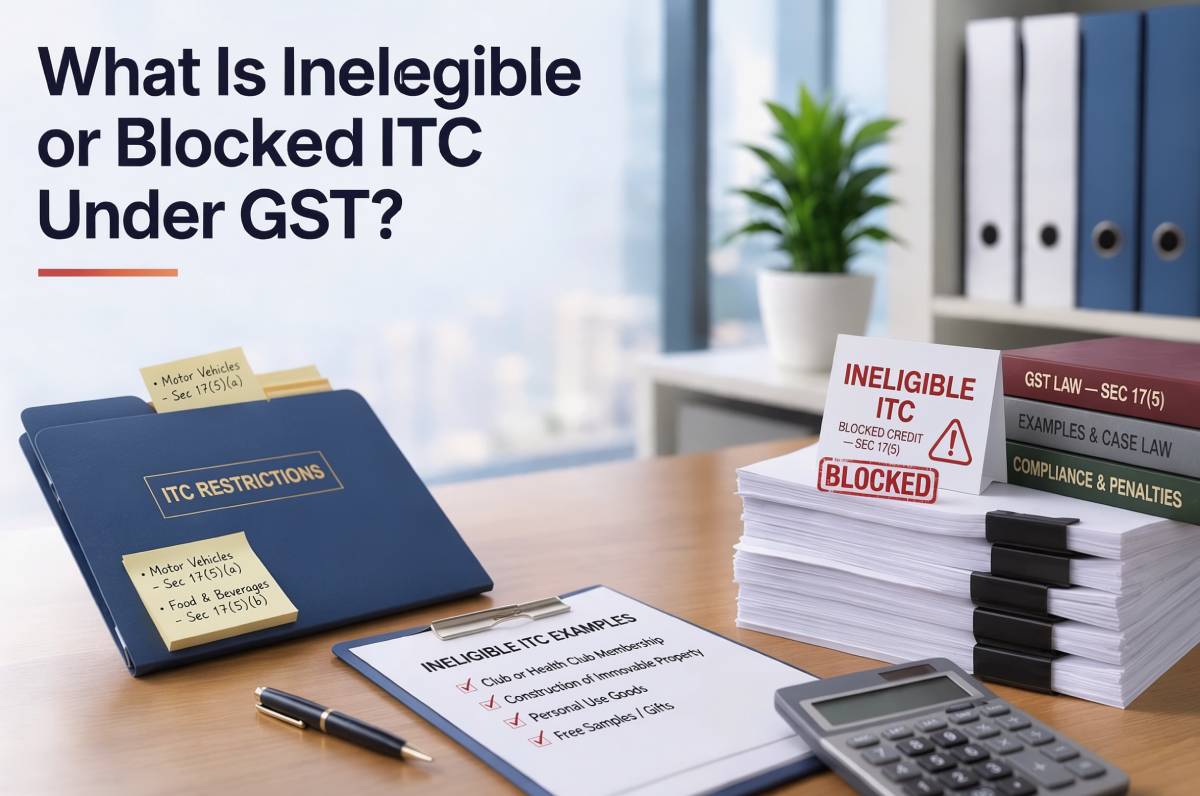
3. Blocked ITC Under Section 17(5)
Section 17(5) contains specific categories where ITC is blocked, subject to the exceptions and conditions provided in the law. This is one of the most important areas businesses should review before claiming ITC.
Common categories covered by the blocked-credit provisions include:
- Motor vehicles
- Vessels and aircraft
- Food and beverages
- Outdoor catering
- Beauty treatment
- Health services
- Memberships
- Employee vacation travel benefits
- Works contract services
- Construction-related goods/services for immovable property
However, the law contains specific exceptions and conditions, so businesses should not apply a blanket “no ITC” rule to an entire expense category.
For example, CBIC has issued specific clarification regarding motor vehicles and the circumstances in which ITC may or may not be blocked.
Blocked ITC Does Not Mean Every Expense in That Category Is Always Ineligible
This is an important distinction. Consider motor vehicles.
The GST treatment can depend on:
- Type of vehicle
- Seating capacity
- Business activity
- How the vehicle is used
- Whether it is supplied further
- Whether the taxpayer falls within a specified exception
Therefore, businesses should examine the actual transaction and applicable statutory exception instead of relying on a generic list found online.
4. Food, Beverages and Employee-Related Expenses
Certain food, beverages and employee-related supplies can fall within blocked-credit provisions. However, exceptions may apply in specified circumstances, including where providing certain goods or services is obligatory for an employer under applicable law.
This means the correct approach is:
Expense category
↓
Section 17(5) review
↓
Check applicable exception
↓
Determine eligible ITC
Rather than: “It’s a business expense, so ITC is available.”
5. Works Contract and Construction-Related ITC
Construction-related ITC requires particular attention. Certain works contract services and goods/services used for construction of immovable property can fall within Section 17(5) restrictions, subject to the statutory provisions and exceptions.
Businesses involved in:
- Office construction
- Commercial property
- Factory construction
- Renovation
- Property development
should therefore review the specific nature and purpose of the expenditure before claiming ITC.
6. ITC Reversal When Payment Is Not Made Within 180 Days
Another important GST ITC rule relates to payment to suppliers. Where a recipient has availed ITC on a supply but fails to pay the supplier the value of the supply along with the tax within 180 days from the invoice date, the applicable ITC is required to be dealt with under the reversal mechanism.
Section 16 specifically excludes supplies where tax is payable under reverse charge from this particular 180-day condition. The rules also provide for reversal/payment treatment in proportion to the amount remaining unpaid.
Example
Suppose:
- Invoice value: ₹1,00,000
- GST: ₹18,000
The business claims ₹18,000 ITC.
If the required payment to the supplier is not made within the prescribed 180-day period, the applicable ITC may need to be reversed/paid back under the relevant provisions. When payment is subsequently made, the credit can generally be re-availed subject to the applicable conditions.
7. Important: The 180-Day Rule Does Not Apply in the Same Way to RCM Supplies
Section 16’s 180-day supplier-payment proviso specifically excludes supplies on which tax is payable under reverse charge.
This distinction matters when businesses maintain vendor ageing reports and ITC reversal schedules. Therefore, don’t automatically apply the 180-day ITC reversal rule to every purchase.
8. Capital Goods and ITC
GST paid on eligible capital goods can generally qualify for ITC, subject to the applicable conditions and restrictions.
Examples of capital goods may include:
- Machinery
- Equipment
- Production systems
- Certain business-use assets
CBIC’s GST FAQ confirms that input tax includes tax on capital goods and that credit on eligible capital goods can be availed subject to the applicable conditions.
Can You Claim ITC on the Same GST Amount and Depreciation?
Businesses need to be careful about claiming both benefits on the same tax component. Section 16 provides that where depreciation is claimed under the Income-tax Act on the tax component of the cost of capital goods or plant and machinery, ITC on that tax component is not allowed. Therefore, accounting and tax teams should coordinate when capital assets are recorded.
9. ITC on Imported Goods
Import-related GST has a different documentation trail from domestic purchases. For eligible imports, IGST paid on imported goods can form part of input tax, subject to the applicable ITC conditions. CBIC’s GST FAQ specifically recognises IGST charged on imports of goods as part of input tax.
Businesses should maintain appropriate import documentation, including the relevant Bill of Entry and associated records.
Import ITC Review
Check:
- Import documentation
- Importer GSTIN
- IGST amount
- Bill of Entry
- Accounting entry
- GST records
This should be reconciled as part of the regular ITC process.
10. ITC Under Reverse Charge Mechanism
Reverse Charge Mechanism (RCM) is another area that businesses need to understand separately. Under RCM, the recipient is responsible for paying GST on specified supplies rather than the supplier charging and collecting GST in the usual manner.
GST paid under reverse charge can form part of input tax, subject to the applicable conditions. CBIC’s GST FAQ specifically confirms that tax payable under reverse charge is included in the definition of input tax.
The basic flow can be understood as:
Eligible RCM Supply
↓
Recipient determines GST liability
↓
GST paid under RCM
↓
ITC considered separately subject to eligibility
The business should not simply offset the RCM liability against ITC without following the applicable reporting and payment requirements.
11. ITC on RCM: Common Mistake
A common mistake is treating RCM as if it were a normal supplier invoice.
For RCM transactions, businesses should separately track:
- Nature of supply
- RCM applicability
- Tax calculation
- Payment of RCM liability
- Accounting entry
- Eligible ITC
- Return reporting
This makes RCM reconciliation much easier. Internal Link → Reverse Charge Mechanism (RCM) Under GST: Complete Guide for Businesses
12. ITC Reversal: Why Businesses Need a System
ITC reversal is not limited to one situation.
A business may need to examine reversal requirements because of:
- Non-payment to suppliers within the applicable period
- Personal/non-business use
- Exempt supplies
- Blocked credits
- Credit notes
- Changes in eligibility
- Specific statutory provisions
A good accounting system should therefore track both: ITC Claimed and ITC Reversed
ITC Claim vs ITC Reversal
| Situation | Possible Treatment |
| Eligible business purchase | ITC may be claimed |
| Personal use | Restricted/ineligible |
| Exempt supplies | Apportionment may apply |
| Blocked credit | ITC not available, subject to exceptions |
| Supplier payment not made within applicable 180 days | Reversal/payment mechanism may apply |
| Credit note received | ITC may need adjustment |
| Import with eligible IGST | ITC may be available subject to conditions |
| Eligible RCM tax paid | ITC may be available subject to conditions |
The actual treatment should always be checked against the applicable provision.
13. Supplier Does Not File the Required Return
Businesses also need to monitor supplier compliance. Rule 37A provides a mechanism concerning ITC availed on invoices reported by suppliers where the supplier subsequently does not furnish the corresponding GSTR-3B within the specified period.
The rule includes a reversal deadline and provisions for subsequent re-availment in specified circumstances. This is one reason vendor compliance has become an important component of modern GST ITC reconciliation.
Your business may have:
- A genuine invoice
- A genuine purchase
- A genuine payment
and still need to monitor whether the supplier has completed the relevant GST compliance.
14. Eligible vs Ineligible ITC: Quick Comparison
| Purchase/Transaction | ITC Treatment |
| Raw materials used for taxable business | Generally eligible subject to conditions |
| Office software used for business | Generally eligible subject to conditions |
| Business-use professional services | Generally eligible subject to conditions |
| Personal expenses | Not eligible for business portion |
| Goods/services used for exempt supplies | Subject to applicable restriction/apportionment |
| Certain motor vehicles | Restricted/blocked subject to exceptions |
| Certain food/beverage expenses | Restricted/blocked subject to exceptions |
| Certain employee-related benefits | Restricted/blocked subject to exceptions |
| Certain construction-related expenses | Restricted/blocked subject to exceptions |
| Eligible imported goods | ITC may be available on eligible IGST |
| Eligible RCM supplies | ITC may be available after satisfying applicable requirements |
| Supplier invoice not appropriately reported | Requires reconciliation/action |
| Invoice beyond statutory time limit | Generally cannot be claimed, subject to exceptions |
This table should be used as a high-level guide, not as a substitute for transaction-specific GST analysis.
15. Common GST ITC Mistakes Businesses Make
Mistake 1: Claiming ITC Solely Because GST Appears on the Invoice
- A GST invoice does not automatically make credit available.
- Other eligibility conditions must also be satisfied.
Mistake 2: Ignoring GSTR-2B
- Businesses sometimes claim ITC based solely on their purchase register.
- The purchase register should be reconciled with the relevant GST portal data.
Mistake 3: Claiming Blocked Credit
- Some expenses have specific ITC restrictions.
- Businesses should review Section 17(5) before claiming credit.
Mistake 4: Ignoring Personal Use
If a purchase is partly personal and partly business-related, the business-use portion needs to be considered under the applicable provisions.
Mistake 5: Forgetting ITC Reversal
- Credit may need to be reversed in certain situations.
- Claiming ITC once does not necessarily mean it can be retained permanently without further review.
Mistake 6: Not Monitoring Supplier Compliance
Supplier reporting and compliance can affect ITC reconciliation.
Mistake 7: Missing the ITC Time Limit
Businesses should maintain an invoice-ageing report so eligible credits are not lost because of statutory deadlines.
Mistake 8: Mixing RCM With Normal Purchases
RCM transactions should be separately identified and reconciled.
Mistake 9: Poor Documentation
If supporting documents are missing, demonstrating ITC eligibility can become difficult.
Mistake 10: No Monthly Reconciliation
Waiting until year-end can turn small differences into large reconciliation problems.
16. Monthly GST ITC Checklist
A business can use the following checklist every month.
Step 1: Collect Purchase Data
- Download/compile purchase invoices
- Record all eligible purchases
- Verify supplier GSTIN
- Verify invoice numbers
- Verify tax amounts
Step 2: Reconcile With Accounting Records
- Match invoices with purchase register
- Match invoices with accounting entries
- Identify duplicate invoices
- Identify missing invoices
Step 3: Review GST Portal Data
- Review GSTR-2B
- Identify invoices not appearing
- Check differences
- Follow up with suppliers where required
Step 4: Check Eligibility
- Business-use test
- Taxable/exempt-use test
- Section 17(5) review
- RCM review
- Import review
- Capital-goods review
Step 5: Check Reversal Requirements
- Credit notes
- Supplier-payment ageing
- Exempt-use apportionment
- Personal/non-business use
- Other applicable reversal requirements
Step 6: Review Time Limits
- Identify old invoices
- Track financial-year-wise ITC
- Review approaching deadlines
- Take action before the statutory cut-off
Step 7: Finalise ITC
- Eligible ITC identified
- Ineligible ITC excluded
- Reversal calculated
- Reconciliation completed
- Return reporting reviewed
17. Example: How Monthly ITC Reconciliation Works
Consider an SME with the following monthly purchase records:
| Particular | GST in Books | GSTR-2B | Initial Assessment |
| Raw materials | ₹1,20,000 | ₹1,20,000 | Potentially eligible |
| Office software | ₹18,000 | ₹18,000 | Potentially eligible |
| Personal expense | ₹5,000 | ₹5,000 | Ineligible |
| Supplier mismatch | ₹25,000 | ₹0 | Investigate |
| Blocked expense | ₹12,000 | ₹12,000 | Review Section 17(5) |
The business should not simply claim ₹ 1,80,000 because that is the total GST appearing in the books. It needs to assess each category and determine the amount that actually satisfies the applicable ITC conditions.
18. Why GST ITC Reconciliation Should Be Monthly
Monthly reconciliation helps identify problems while they are still manageable.
For example:
April
Supplier invoice missing
↓
May
Follow up with supplier
↓
June
Invoice correctly reported
↓
June
ITC becomes available subject to applicable conditions
This is much easier than discovering a large number of missing invoices at year-end.
19. What Records Should a Business Maintain for ITC?
Businesses should maintain appropriate supporting records, which may include:
- Purchase invoices
- Debit notes
- Credit notes
- Purchase register
- GSTR-2B records
- GST returns
- Bank/payment records
- Goods receipt records
- Service completion evidence
- Import documentation
- RCM records
- ITC reversal workings
- Supplier correspondence
- The exact documentation should be appropriate to the transaction and applicable requirements.
20. When Should a Business Get Professional GST/ITC Advice?
Professional assistance becomes particularly useful when a business has:
- High purchase volumes
- Multiple GST registrations
- Multiple states
- Significant ITC
- Imports
- RCM transactions
- Exempt and taxable supplies
- Large capital expenditure
- Frequent supplier mismatches
- GST notices
- Significant ITC reversals
A Chartered Accountant in Mumbai can help establish an ITC review and reconciliation process suited to the business.
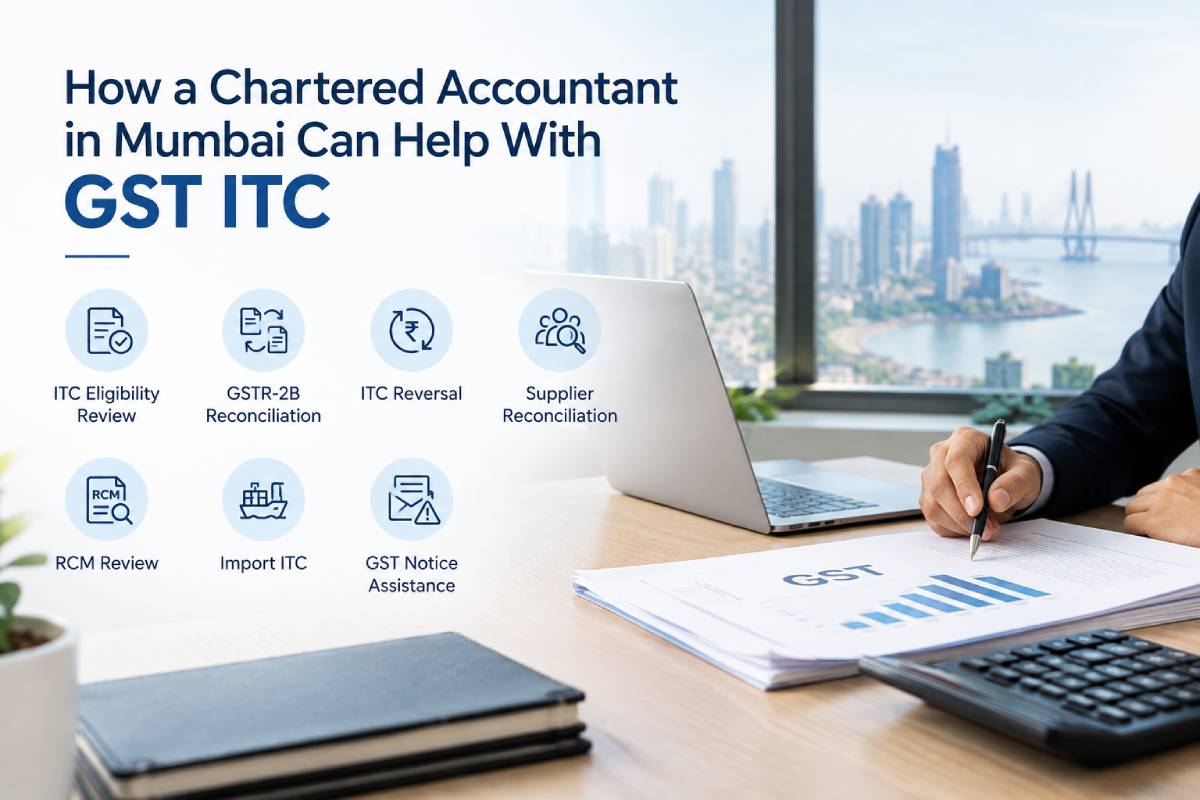
How a Chartered Accountant in Mumbai Can Help With GST ITC
A Chartered Accountant in Mumbai can assist businesses with more than GST return filing.
Professional support may include:
ITC Eligibility Review
Review whether particular expenses qualify for ITC.
GSTR-2B Reconciliation
Compare: Books → Purchase Register → GSTR-2B → GST Return
ITC Reversal
Identify applicable reversals and maintain supporting calculations.
Supplier Reconciliation
Identify mismatches and coordinate follow-up.
RCM Review
Identify applicable RCM transactions and related ITC treatment.
Import ITC
Review import documentation and IGST credit.
GST Notice Assistance
Help review and respond to GST-related notices where appropriate.
Why Professional ITC Management Matters
ITC can have a significant impact on a business’s effective GST cost. Consider a company with:
₹20 lakh annual eligible purchases and ₹3.6 lakh GST paid. Even a small percentage of incorrect or missed ITC can have a meaningful financial impact.
Professional ITC management therefore focuses on two objectives:
Don’t Claim What You Aren’t Entitled To
This reduces compliance risk.
Don’t Miss Credit You Are Entitled To
This improves tax efficiency.
The goal is accurate and compliant ITC, not simply maximum ITC.
GST ITC Rules – Practical Workflow, Business Examples, FAQs & Compliance Guide
Understanding the GST input tax credit rules is only useful if a business can apply them consistently during its monthly GST process. The safest approach is to treat ITC as a controlled accounting and compliance process, rather than simply taking the GST amount appearing on purchase invoices.
A practical workflow looks like this: Purchase Invoice → Accounting Entry → Eligibility Check → GSTR-2B Reconciliation → Reversal Check → Time-Limit Check → GSTR-3B Reporting → Documentation
This process can help businesses identify eligible credit, exclude blocked or ineligible credit, and address mismatches before they become larger compliance issues.
GST ITC Rules: Complete Compliance Summary
Before claiming ITC, a business should review the following:
| GST ITC Rule | What the Business Should Check |
| Business Use | Is the purchase used or intended for business? |
| Tax Document | Is the required invoice/debit note or prescribed document available? |
| Receipt | Have the goods or services been received? |
| Supplier Reporting | Has the relevant invoice information been furnished as required? |
| GSTR-2B | Does the invoice appear correctly in the relevant GST data? |
| Return Compliance | Have applicable GST return requirements been satisfied? |
| Section 17 | Is apportionment or restriction required? |
| Section 17(5) | Is the credit blocked or subject to an exception? |
| Reversal | Does any reversal requirement apply? |
| Payment | Has the supplier-payment condition been considered where applicable? |
| Time Limit | Is the ITC being claimed within the applicable statutory period? |
| Documentation | Can the business support the claim with appropriate records? |
This checklist covers the major areas businesses should review, but transaction-specific GST provisions can create additional requirements.
Practical ITC Claim Process Under GST
A business can structure its monthly ITC claim under the GST process into eight steps.
Step 1: Record the Purchase
Enter the purchase invoice correctly into the accounting system.
Check:
- Supplier name
- GSTIN
- Invoice number
- Invoice date
- Taxable value
- GST amount
- Nature of purchase
- Place of supply, where relevant
Step 2: Determine Whether the Purchase Is Business-Related
Ask: Is this purchase being used for the business? If yes, continue to the next review.
If the purchase is personal or unrelated to business, ITC should not simply be claimed. For mixed-use expenses, the applicable apportionment rules should be considered.
Step 3: Check the Invoice
Verify that the required tax document is available and contains the relevant details. Errors should be corrected or investigated before the business relies on the document for ITC.
Step 4: Verify Receipt
Confirm that the goods or services have actually been received.
For goods, this may be supported by:
- Delivery records
- Goods receipt notes
- Transport documents
For services, supporting evidence could include:
- Contracts
- Work completion records
- Service reports
- Correspondence
The appropriate evidence depends on the nature of the transaction.
Step 5: Reconcile With GSTR-2B
Compare the purchase register against GSTR-2B.
Classify invoices as:
Matched
Purchase records and GST data agree.
Missing
Invoice exists in books but does not appear in the relevant GST data.
Mismatched
Invoice appears, but details differ.
Ineligible
Invoice appears, but the underlying ITC is blocked or otherwise unavailable.
Step 6: Check for Reversal
Before finalising ITC, review whether any reversal applies because of:
- Personal/non-business use
- Exempt supplies
- Blocked credit
- Credit notes
- Supplier-payment requirements
- Other applicable provisions
Step 7: Check the Time Limit
Review the financial year of each invoice and determine whether the applicable statutory deadline has been met. This is particularly important for older invoices.
Step 8: Report the Correct Amount
Only after the above checks should the business finalise the ITC amount for GST return reporting. A proper ITC claim under GST should be finalised only after all eligibility and compliance checks are completed.
GST ITC Rules for Different Types of Businesses
The same basic framework applies across GST-registered businesses, but the practical ITC issues can differ significantly.
ITC for Manufacturers
Manufacturers may have substantial ITC related to:
- Raw materials
- Packaging
- Machinery
- Repairs
- Professional services
- Utilities
- Logistics
Their major challenges can include:
- High transaction volumes
- Vendor reconciliation
- Capital goods
- Stock records
- Input-output mapping
Regular GST ITC reconciliation is particularly important when the number of suppliers is large.
ITC for Traders
Traders may claim eligible ITC on purchases used for taxable business activities, subject to the applicable conditions.
Common challenges include:
- Large numbers of purchase invoices
- Supplier mismatches
- Credit notes
- Stock-related reconciliation
- Multiple vendors
A monthly purchase-to-GSTR-2B reconciliation can help identify issues early.
ITC for Service Businesses
Service providers may have ITC relating to:
- Software
- Professional services
- Office rent
- Business subscriptions
- Marketing
- Consultancy
- Employee-related expenses, where eligible
However, businesses should pay particular attention to blocked-credit provisions and mixed business/personal use.
ITC for E-Commerce Businesses
E-commerce businesses may have more complex transaction flows involving:
- Payment gateways
- Multiple vendors
- Marketplace transactions
- Returns
- Credit notes
- Logistics providers
- Advertising services
- Multiple GST registrations
Accurate reconciliation between accounting records and GST data becomes especially important.
ITC for Businesses Making Taxable and Exempt Supplies
Businesses with both taxable and exempt supplies need to consider the apportionment rules under Section 17.
The business should identify:
- Common Inputs
↓
Taxable Use
- Exempt Use
↓
Determine Eligible Portion
The entire ITC amount should not automatically be treated as available merely because the purchase relates to business operations.
ITC and Capital Goods: Practical Example
Suppose a manufacturing business purchases eligible machinery for ₹10,00,000 + ₹1,80,000 GST. If the relevant conditions are satisfied and no restriction applies, the GST component may qualify for ITC.
However, the business should separately consider the Income Tax treatment of the tax component when calculating depreciation. The GST and Income Tax treatment should therefore be coordinated.
ITC and Reverse Charge: Practical Example
Suppose a business receives a service on which GST is payable under RCM.
The business should:
- Identify the RCM transaction.
- Determine the applicable GST liability.
- Pay the GST under RCM as required.
- Report the transaction correctly.
- Evaluate the corresponding ITC separately based on the applicable conditions.
The RCM liability and ITC should therefore be tracked separately in the accounting system. Internal Link → Reverse Charge Mechanism (RCM) Under GST: Complete Guide for Businesses
ITC and Imports: Practical Example
Suppose a company imports machinery and pays IGST at the time of import.
The business should maintain:
- Bill of Entry
- Import documentation
- IGST details
- Accounting records
- GST records
The eligible import-related ITC should then be reconciled with the relevant GST information.
GST ITC Time Limit: Practical Example
Suppose an eligible invoice belongs to FY 2025–26. Under the general Section 16(4) rule, the relevant cut-off is generally: 30 November 2026 or the date of furnishing the relevant annual return, whichever is earlier.
The applicable exceptions and special provisions must also be considered. Therefore, businesses should not wait until the last month to identify old invoices. A year-wise ITC tracker can help.
GST ITC Time-Limit Tracker
A business can maintain a simple internal report:
| Invoice | Supplier | FY | ITC | Status | Action |
| INV-101 | Supplier A | 2025–26 | ₹18,000 | Matched | Claim |
| INV-115 | Supplier B | 2025–26 | ₹24,000 | Missing | Follow up |
| INV-121 | Supplier C | 2025–26 | ₹12,000 | Blocked | Do not claim |
| INV-135 | Supplier D | 2025–26 | ₹8,000 | Mismatch | Investigate |
This makes the GST ITC time limit easier to manage.
Eligible vs Ineligible ITC: Detailed Examples
Example 1: Office Computer
A company purchases computers for employees performing business activities.
Potential treatment: Eligible, subject to applicable conditions.
Example 2: Personal Purchase
The owner purchases a personal-use item through the business.
Potential treatment: Not eligible as business ITC.
Example 3: Office Software
A company purchases accounting software for business operations.
Potential treatment: Generally eligible, subject to applicable conditions.
Example 4: Mixed Business and Personal Use
A service is used partly for business and partly for personal purposes.
Potential treatment: Relevant apportionment/restriction needs to be considered.
Example 5: Blocked Expense
A business incurs an expense covered by Section 17(5).
Potential treatment: ITC may be blocked unless a specific statutory exception applies.
Example 6: Supplier Mismatch
The purchase appears in the accounting system but not in the relevant GST data.
Potential treatment: Investigate the mismatch before relying on the credit.
Example 7: Old Invoice
An eligible invoice is approaching the applicable Section 16(4) deadline.
Potential treatment: Review and claim within the statutory time limit if all conditions are satisfied.
What Happens If ITC Is Claimed Incorrectly?
Incorrect ITC claims can result in:
- Reversal
- Tax liability
- Interest
- Additional compliance
- Notices
- Scrutiny
- Reconciliation issues
The consequences depend on the nature of the error and the applicable GST provisions.
This is why the objective should not be: “Claim as much ITC as possible.” The objective should be: “Claim the ITC that is legally eligible and properly supported.”
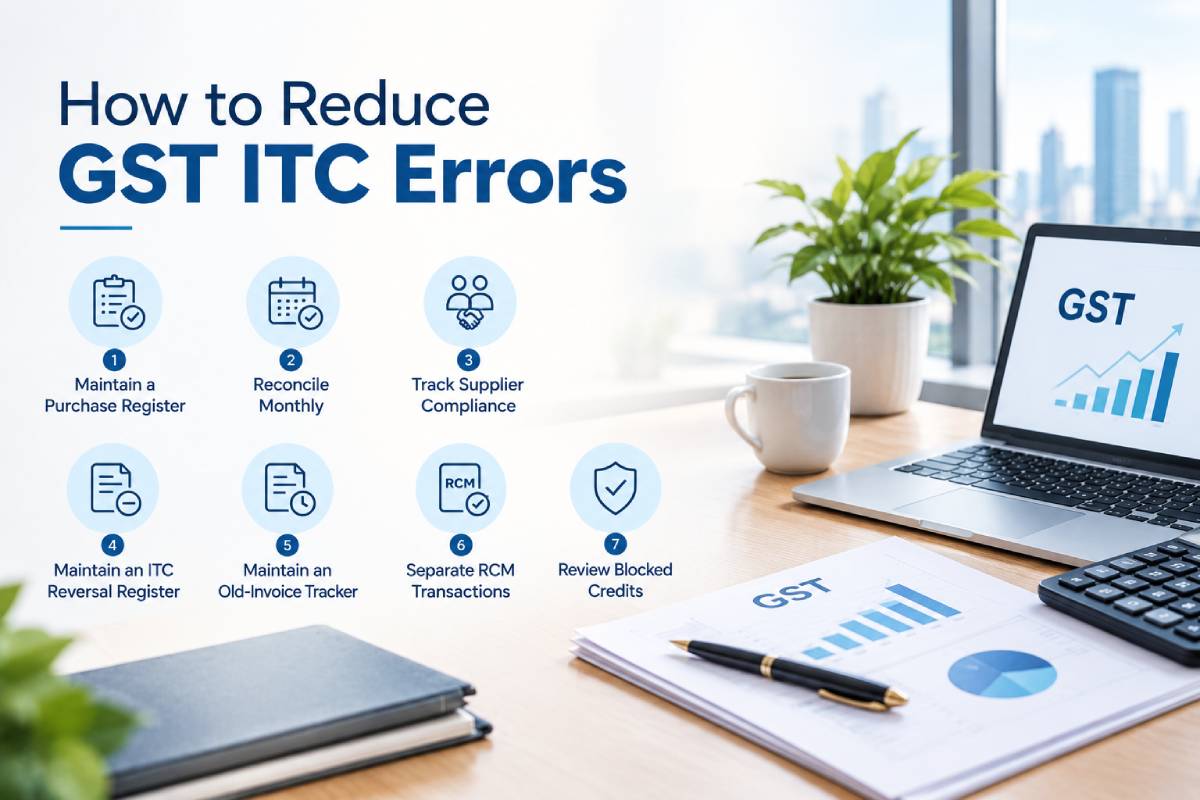
How to Reduce GST ITC Errors
Businesses can establish several simple controls.
1. Maintain a Purchase Register
Every purchase should be properly recorded.
2. Reconcile Monthly
Don’t wait until year-end.
3. Track Supplier Compliance
Follow up on missing or incorrect invoices.
4. Maintain an ITC Reversal Register
Track:
- Reason for reversal
- Amount
- Financial year
- Re-availment status, where applicable
5. Maintain an Old-Invoice Tracker
Identify invoices approaching the statutory deadline.
6. Separate RCM Transactions
Maintain a dedicated RCM reconciliation.
7. Review Blocked Credits
Build a Section 17(5) review into the monthly process.
Monthly GST ITC Compliance Workflow
A practical monthly system can look like this:
Collect Purchase Invoices
↓
Update Accounting Records
↓
Download/Review GSTR-2B
↓
Reconcile Purchase Register
↓
Identify Missing/Mismatched Invoices
↓
Check Eligibility
↓
Review Blocked ITC
↓
Calculate Reversals
↓
Review RCM & Imports
↓
Check Old Invoices
↓
Finalise Eligible ITC
↓
Prepare GST Return
↓
Maintain Supporting Records
This process can make monthly GST compliance considerably more structured.
When Should You Consult a Chartered Accountant in Mumbai for ITC?
Professional GST assistance becomes particularly valuable when:
- ITC amounts are substantial.
- The business has many vendors.
- Multiple GST registrations are involved.
- The business operates across multiple states.
- Imports are involved.
- RCM transactions are frequent.
- The business makes taxable and exempt supplies.
- There are frequent GSTR-2B mismatches.
- Large capital purchases are made.
- ITC reversals are significant.
- The business receives GST notices.
- Management wants a formal GST compliance review.
A Chartered Accountant in Mumbai can help businesses develop a structured ITC process instead of treating reconciliation as a year-end exercise.
What Can a Chartered Accountant in Mumbai Do for GST ITC?
Depending on the engagement, professional support may include:
ITC Eligibility Review
Review purchase categories and identify potentially eligible and blocked credits.
GST ITC Reconciliation
Compare accounting records with relevant GST data and identify mismatches.
ITC Reversal Review
Identify situations requiring reversal and maintain supporting workings.
Vendor Reconciliation
Help identify supplier-related mismatches requiring follow-up.
RCM Review
Check applicable RCM transactions and related reporting.
Import Review
Review import documentation and IGST-related ITC.
GST Notice Assistance
Help analyse GST notices and prepare appropriate responses.
Compliance Review
Perform periodic reviews of GST processes and documentation.
Frequently Asked Questions
What are the GST input tax credit rules?
The GST input tax credit rules establish the conditions and restrictions under which a registered taxpayer can claim GST paid on eligible business purchases. Key considerations include the required tax document, receipt of goods or services, supplier reporting requirements, return compliance, business use, applicable restrictions, reversal requirements, and the statutory time limit.
What are the GST ITC rules in 2026?
The GST ITC rules in 2026 continue to require businesses to evaluate eligibility under Section 16 and restrictions/apportionment under Section 17, including blocked credits. Businesses should also consider current GST return, supplier-reporting, reconciliation and time-limit requirements applicable to the relevant transaction.
Because GST provisions can be amended, businesses should verify the rules applicable to the specific period and transaction.
What are the GST ITC claim rules?
The GST ITC claim rules require businesses to satisfy the applicable statutory conditions before claiming credit. These include appropriate documentation, receipt of goods/services, relevant supplier reporting, return compliance, business use and compliance with applicable restrictions and time limits.
What is GST input tax credit eligibility?
GST input tax credit eligibility refers to whether the GST paid on a particular purchase qualifies for credit under the applicable GST provisions.
The business should consider:
- Business use
- Documentation
- Receipt
- Supplier reporting
- Return compliance
- Section 17 restrictions
- Blocked credits
- Time limits
What are the Input Tax Credit rules for businesses?
The Input Tax Credit rules require businesses to establish whether purchases qualify for credit and whether any restrictions, reversals or time limits apply. Businesses should maintain proper invoices, reconcile GST data, review blocked credits and monitor the applicable statutory deadlines.
What is the time limit for claiming GST ITC?
Under the general Section 16(4) rule, ITC cannot ordinarily be availed after 30 November following the end of the relevant financial year, or the date of furnishing the relevant annual return, whichever is earlier. Specific statutory exceptions and special provisions can apply, so the exact transaction and financial year should be reviewed before determining whether a credit has expired.
What is GST ITC reconciliation?
GST ITC reconciliation is the process of comparing purchase/accounting records with GST portal data, including relevant supplier-reported information, to identify matched invoices, missing invoices, mismatches, duplicate entries, blocked credits and other differences before finalising ITC.
Is GSTR-2B enough to claim ITC?
No. GSTR-2B is an important reconciliation and compliance tool, but businesses must consider the complete statutory eligibility conditions. An invoice appearing in GST data does not automatically mean that every condition for ITC is satisfied.
Can ITC be claimed on personal expenses?
Generally, GST input credit cannot simply be claimed for personal or non-business use. Where goods or services are used partly for business and partly for other purposes, the applicable apportionment rules should be considered.
Can ITC be claimed on capital goods?
Eligible capital goods can qualify for ITC subject to the applicable GST conditions and restrictions. Businesses should also ensure that the tax component is not simultaneously treated in a manner that would conflict with the applicable Income Tax depreciation provisions.
Can ITC be claimed on RCM transactions?
GST paid under eligible reverse-charge transactions can potentially qualify as ITC subject to the applicable conditions. The RCM liability and subsequent ITC should be properly accounted for and reported.
What happens if a supplier does not report an invoice?
The business should investigate the mismatch and follow up with the supplier. Supplier reporting can affect the availability and reconciliation of ITC. The applicable GST provisions and reporting period should be reviewed before claiming or retaining the credit.
What happens if a business misses the GST ITC time limit?
If an ITC claim falls outside the applicable statutory time limit, the credit may no longer be available, subject to any applicable exception or special provision. Businesses should therefore track old invoices throughout the year rather than waiting for annual return preparation.
Why should I hire a Chartered Accountant in Mumbai for GST ITC?
A Chartered Accountant in Mumbai can help businesses review ITC eligibility, reconcile purchase records with GST data, identify reversals, review blocked credits, manage RCM and import-related issues, and establish a structured GST compliance process.
Final GST ITC Compliance Checklist
Before finalising monthly ITC, ask:
- Is the purchase for business purposes?
- Is the required tax document available?
- Have the goods/services been received?
- Is the supplier information correctly reported?
- Does the relevant invoice appear correctly in GSTR-2B/GST records?
- Is the credit blocked under Section 17(5)?
- Does apportionment apply?
- Is any reversal required?
- Has the supplier-payment requirement been reviewed where applicable?
- Have RCM transactions been separately reviewed?
- Have imports and capital goods been checked?
- Is the invoice within the applicable statutory time limit?
- Are supporting documents available?
- Has the final ITC amount been reconciled before GST return filing?
If the answer to these questions is clear, the business has a much stronger foundation for accurate ITC reporting.
Conclusion
GST input tax credit rules are not simply about matching GST amounts on purchase invoices.
Businesses need to consider the complete chain:
Eligible Business Purchase
↓
Correct Documentation
↓
Receipt of Goods/Services
↓
Supplier Reporting
↓
GSTR-2B Reconciliation
↓
Eligibility & Blocked-Credit Review
↓
Reversal Check
↓
Time-Limit Check
↓
Accurate GST Return Reporting
A strong ITC process can help businesses avoid two opposite problems:
- Claiming credit that is not legally available
- Missing credit that could legitimately be claimed.
For businesses with high transaction volumes, multiple GST registrations, imports, RCM transactions, exempt supplies, or significant ITC, professional review can be particularly valuable. A Chartered Accountant in Mumbai can help establish a structured GST ITC reconciliation and compliance process suited to the business’s operations.
Need Help With GST ITC Compliance?
Whitespace Consultancy helps businesses with GST registration, GST return compliance, ITC reconciliation, GST advisory, and related taxation and accounting requirements.
Our team can assist businesses with:
- GST registration
- GST return filing
- GST ITC reconciliation
- ITC eligibility review
- ITC reversal
- RCM compliance
- GST notices
- Accounting
- Income Tax
- Business advisory
If your business is facing recurring ITC mismatches or wants to establish a more structured GST compliance process, a professional review can help identify areas that require attention.
Looking for a Chartered Accountant for GST and ITC support? Contact us at Whitespace Consultancy in Mumbai to discuss your business’s GST compliance requirements.