

Section 142(1) Notice Explained: Documents Required & How to Respond
Received a Notice Under Section 142(1)? Here’s What It Means and What You Should Do
Receiving an email or notification from the Income Tax Department can be stressful, especially when it mentions Section 142(1) of the Income-tax Act. Many taxpayers immediately assume they are under investigation or have committed a serious tax violation. In reality, receiving a notice under Section 142(1) does not automatically mean you’ve done anything wrong.
A notice under Section 142(1) is generally issued by the Assessing Officer (AO) to obtain additional information, documents, books of accounts, or explanations required to complete an income tax assessment. In some cases, it may also require a taxpayer who has not filed an income tax return to furnish one within the prescribed time.
Whether you’re a salaried employee, freelancer, consultant, business owner, startup founder, partnership firm, or company, it’s important to understand why the notice has been issued and respond accurately within the specified timeline. Ignoring the notice or submitting incomplete information can result in unnecessary complications, including a best judgment assessment, penalties, and prolonged correspondence with the Income Tax Department.
In this comprehensive guide, we’ll explain everything you need to know about Section 142(1), including why it is issued, whether it is an income tax scrutiny notice, the types of information requested, timelines for responding, and how professional guidance from experienced chartered accountant firms near me can help ensure an accurate and timely response.
Quick Answer What Is a Notice Under Section 142(1)?
A notice under Section 142(1) is issued by the Assessing Officer to request an income tax return (where applicable), books of account, documents, or additional information necessary to complete an assessment. It may be issued to verify income, deductions, exemptions, business transactions, investments, or other financial information relevant to your tax return.
If you receive a Section 142(1) notice, you should:
- Read the notice carefully.
- Understand the specific information requested.
- Gather the required documents.
- Respond within the prescribed deadline.
- Seek professional advice if the notice involves complex financial matters.
A timely and accurate response can help avoid unnecessary disputes and facilitate a smoother assessment process.
What Is Section 142(1) of the Income-tax Act?
Section 142(1) empowers the Assessing Officer (AO) to request information required for making an assessment under the Income-tax Act.
Depending on the circumstances, the notice may require the taxpayer to:
- Furnish an income tax return if one has not been filed.
- Produce books of account.
- Submit supporting financial documents.
- Provide explanations regarding specific transactions.
- Furnish additional information relevant to the assessment.
The objective is to enable the Assessing Officer to examine the taxpayer’s financial position before completing the assessment. Unlike demand notices, a notice under Section 142(1) primarily seeks information rather than demanding immediate payment of tax.
Why Is a Notice Under Section 142(1) Issued?
The Income Tax Department may issue a Section 142(1) notice for several reasons. In many cases, the department simply requires clarification or supporting documentation before finalising the assessment.
Common reasons include:
Income Tax Return Not Filed
If a taxpayer has not filed a return despite being required to do so, the Assessing Officer may issue a notice requesting the return.
Verification of Income
The department may seek clarification regarding:
- Salary income
- Business income
- Professional receipts
- Rental income
- Capital gains
- Interest income
- Foreign income
Verification of Deductions
If substantial deductions or exemptions have been claimed, supporting evidence may be requested. Examples include deductions under various provisions of the Income-tax Act, investment-related deductions, or business expenditure claims.
Mismatch in Information
A notice may also be issued when information available with the department differs from the details reported by the taxpayer.
Such differences may arise from:
- Annual Information Statement (AIS)
- Tax Deducted at Source (TDS) records
- Statement of Financial Transactions (SFT)
- Employer reporting
- Bank reporting
- Property transaction records
Examination of Business Records
Business taxpayers may be asked to submit:
- Books of accounts
- Purchase records
- Sales registers
- Expense details
- Bank statements
- Supporting invoices
This helps the Assessing Officer verify the accuracy of reported business income.
Is Section 142(1) an Income Tax Scrutiny Notice?
This is one of the most common questions taxpayers ask. The answer requires understanding the purpose of different income tax notices. A notice under Section 142(1) is generally issued to collect information necessary for completing an assessment.
While it may form part of an assessment process, it should not automatically be treated as a finding of tax evasion or wrongdoing. Many taxpayers receive Section 142(1) notices simply because the department requires additional documentation or clarification. The notice provides an opportunity to explain transactions and submit supporting evidence. Responding accurately and within the prescribed timeline is often the best approach.
Section 142(1) vs Section 143(1)
Many taxpayers confuse these two provisions. They serve very different purposes.
| Section 142(1) | Section 143(1) |
| Issued by the Assessing Officer during the assessment process | Computerised processing of the income tax return |
| Requests documents or additional information | Communicates the result of return processing |
| May require books of account and explanations | Usually reflects tax payable, refund, or adjustments after processing |
| Requires a response from the taxpayer | May not require any action unless adjustments are disputed |
| Can apply even if a return has not been filed (subject to applicable law) | Applies after a return has been processed |
Understanding the distinction helps taxpayers respond appropriately.
Common Reasons Taxpayers Receive a Section 142(1) Notice
The exact reason varies depending on the taxpayer’s circumstances.
Some of the most common situations include:
High-Value Financial Transactions
Large transactions may prompt the department to seek clarification.
Examples include:
- Purchase of immovable property
- Sale of property
- Significant bank deposits
- High-value investments
- Large cash transactions
Business Income Verification
- Business owners may receive notices requesting:
- Profit & Loss Statements
- Balance Sheets
- Sales records
- Purchase records
- Expense details
- GST reconciliation
Capital Gains Verification
If a taxpayer reports gains from:
- Shares
- Mutual Funds
- Property
- Gold
- Other investments
the department may request supporting documentation.
Mismatch Between Reported Income and Available Data
Information reported by employers, banks, financial institutions, registrars, or other reporting entities may differ from the taxpayer’s return. The notice allows the taxpayer to clarify these differences.
Large Deduction Claims
Significant deductions may require supporting evidence.
Examples include:
- Housing loan deductions
- Business expenditure
- Depreciation
- Investment-related deductions
- Professional expenses
Foreign Income or Overseas Assets
Taxpayers with international transactions or overseas assets may receive requests for additional information where relevant under applicable tax laws.
What Information Can the Assessing Officer Ask For?
The Assessing Officer may request information relevant to your assessment.
Depending on the case, this may include:
Personal Information
- PAN
- Aadhaar
- Address proof
- Contact details
Income Details
- Salary income
- Business income
- Professional income
- Rental income
- Capital gains
- Interest income
- Dividend income
Financial Information
- Bank account details
- Investment statements
- Loan information
- Property transactions
- Foreign income (where applicable)
Business Information
Businesses may be required to provide:
- Books of account
- GST records
- Sales invoices
- Purchase invoices
- Expense registers
- Stock records
- Ledger accounts
Supporting Documents
The department may request documents supporting deductions, exemptions, or reported transactions. The exact Section 142(1) documents required depend entirely on the issues identified in the notice.
How Much Time Do You Get to Respond?
Every notice under Section 142(1) specifies a response deadline.
The exact time available may vary depending on the facts of the case and the directions contained in the notice.
It is important to:
- Read the notice immediately after receiving it.
- Note the response deadline.
- Begin collecting documents without delay.
- Seek professional assistance if additional time or clarification is required.
Waiting until the last date may increase the risk of submitting incomplete or inaccurate information.

What Should You Do Immediately After Receiving a Notice?
Many taxpayers panic when they receive an income tax scrutiny notice, but a structured approach can make the process much easier.
Follow these immediate steps:
Step 1: Read the Notice Carefully
Understand:
- Assessment Year
- PAN
- Name of the Assessing Officer
- Specific information requested
- Response deadline
Step 2: Identify the Purpose
Determine whether the notice relates to:
- Return filing
- Income verification
- Business records
- Investments
- Property
- Deductions
- Other financial transactions
Step 3: Do Not Ignore the Notice
Ignoring the notice can complicate the assessment process and may lead to adverse consequences under the Income-tax Act.
Step 4: Gather Relevant Records
Begin collecting all documents related to the information requested. Maintaining organised records will make the response process much easier.
Step 5: Consult a Professional if Needed
If the notice involves business income, complex financial transactions, capital gains, or substantial documentation, consulting experienced chartered accountant firms near me can help ensure that the response is complete, accurate, and submitted within the prescribed timeline.
Section 142(1) Documents Required
One of the first questions taxpayers ask after receiving a notice under Section 142(1) is: “What documents do I need to submit?”
The answer depends entirely on the nature of the notice and the issues the Assessing Officer (AO) wants to verify.
Some notices require only a few supporting documents, while others may request detailed financial records covering an entire financial year. The key is to submit only the documents specifically requested, ensuring they are accurate, complete, and properly organised.
Documents Commonly Requested Under Section 142(1)
Although every case is different, the following Section 142(1) documents are frequently requested during an assessment.
1. Income Tax Return (ITR)
If the notice requires you to furnish a return that has not yet been filed, you may need to provide:
- Income Tax Return (ITR)
- Acknowledgement Receipt
- Computation of Income
This forms the foundation of the assessment process.
2. PAN & Aadhaar
Basic identity documents may include:
- PAN Card
- Aadhaar Card
- Updated Contact Details
- Address Proof
These help verify taxpayer information.
3. Bank Statements
Bank statements are among the most commonly requested Section 142(1) documents.
The Assessing Officer may review them to verify:
- Salary credits
- Business receipts
- Cash deposits
- High-value transactions
- Interest income
- Loan credits
- Investment payments
Businesses should generally provide statements for all business bank accounts specified in the notice.
4. Form 16 or Salary Documents
For salaried taxpayers, supporting documents may include:
- Form 16
- Salary Slips
- Employment Letter
- Bonus Details
- Perquisite Statements
- Other Employer Certificates
These documents help reconcile salary income with the income reported in the tax return.
5. Books of Account
Businesses and professionals may be asked to produce books of accounts.
These may include:
- Cash Book
- Ledger
- Journal
- Trial Balance
- Profit & Loss Statement
- Balance Sheet
- General Ledger
Proper accounting records significantly simplify the assessment process.
6. Purchase and Sales Records
Business taxpayers may also need to provide:
- Sales Register
- Purchase Register
- GST Invoices
- Credit Notes
- Debit Notes
- Customer Invoices
- Vendor Invoices
These records help verify turnover and reported business income.
7. GST Records
Where applicable, the Assessing Officer may request GST-related information, such as:
- GST Registration Certificate
- GST Returns
- GSTR-1
- GSTR-3B
- Annual Return
- Input Tax Credit Working
- GST Reconciliation Statements
Businesses should ensure consistency between GST filings and income tax records.
8. Investment Documents
If deductions or investment income are under review, documents may include:
- Mutual Fund Statements
- Share Trading Statements
- Fixed Deposit Receipts
- Bond Investments
- Insurance Premium Receipts
- ELSS Investments
- PPF Contributions
- NPS Statements
These help verify both investment income and deduction claims.
9. Property Documents
For taxpayers involved in property transactions, supporting documents may include:
- Sale Deed
- Purchase Agreement
- Stamp Duty Receipts
- Property Registration Documents
- Home Loan Statement
- Rental Agreements
- Municipal Tax Receipts
These documents assist in verifying capital gains, rental income, and related deductions.
10. Capital Gains Documents
Where capital gains are reported, taxpayers may be required to provide:
- Purchase Cost Details
- Sale Consideration
- Brokerage Statements
- Contract Notes
- Demat Statements
- Capital Gains Working
Proper documentation supports accurate computation of gains or losses.
11. Loan Documents
Where loans impact the tax computation, the Assessing Officer may request:
- Loan Agreements
- EMI Statements
- Interest Certificates
- Repayment Schedules
- Bank Loan Statements
12. Business Expense Proofs
Business owners may need to justify expenses claimed in their tax return.
Examples include:
- Office Rent Agreements
- Utility Bills
- Employee Salary Records
- Professional Fee Invoices
- Marketing Expenses
- Software Subscription Bills
- Travel Expenses
- Freight Charges
Supporting evidence strengthens the credibility of expense claims.
Documents Required Based on Taxpayer Type
Different taxpayers generally require different supporting documents.
| Taxpayer | Common Documents Required |
| Salaried Employee | Form 16, Salary Slips, Bank Statements, Investment Proofs |
| Freelancer | Bank Statements, Client Invoices, Expense Records, Books of Account |
| Consultant | Income Records, Expense Proofs, GST Returns, Professional Receipts |
| Business Owner | Financial Statements, GST Records, Books of Accounts, Purchase & Sales Registers |
| Partnership Firm | Partnership Deed, Financial Statements, Audit Reports |
| Company | Financial Statements, Board Resolutions (where relevant), Audit Reports, GST Records |
The exact Section 142(1) documents depend on the issues mentioned in the notice.
Step-by-Step Process to Respond to a Notice Under Section 142(1)
Receiving a notice can feel overwhelming, but following a structured process helps ensure that your response is complete and accurate.
Step 1: Read Every Requirement Carefully
Don’t assume the department requires every financial document you possess.
Read each point carefully and identify:
- Information requested
- Documents required
- Assessment Year
- Response deadline
Prepare a checklist before gathering records.
Step 2: Organise Supporting Documents
Arrange documents in a logical sequence.
For example:
- Identity Documents
- Income Documents
- Bank Statements
- Investment Proofs
- Expense Records
- Property Documents
- Business Records
Well-organised submissions make it easier for the Assessing Officer to review your response.
Step 3: Verify the Accuracy of Information
Before submitting any document:
- Verify names.
- Check PAN details.
- Confirm Assessment Year.
- Review financial figures.
- Match supporting documents with your tax return.
Even small inconsistencies may result in further queries.
Step 4: Prepare Written Explanations
Certain transactions may require clarification.
Examples include:
- Large cash deposits
- High-value property purchases
- Capital gains
- Business losses
- Unusual deductions
- Foreign income
Provide concise, factual explanations supported by relevant documents. Avoid making assumptions or including unnecessary information.
Step 5: Submit the Response Within the Deadline
Responding within the timeline specified in the notice demonstrates cooperation and helps prevent avoidable procedural complications. Where additional time is genuinely required, professional advice may help you understand the appropriate course of action under the applicable tax procedures.
Practical Examples
Understanding real-life situations makes Section 142(1) easier to understand.
Example 1 – Salaried Employee
Rahul receives a notice under Section 142(1) requesting clarification regarding investment deductions.
He submits:
- Form 16
- ELSS Investment Proof
- PPF Passbook
- Home Loan Interest Certificate
The documents support the deductions claimed in his return.
Example 2 – Freelancer
Priya works as a freelance graphic designer.
The Assessing Officer requests information regarding professional receipts.
She provides:
- Client Invoices
- Bank Statements
- Income Summary
- Expense Register
These records help explain the income reported in her return.
Example 3 – Business Owner
A manufacturing company receives an income tax scrutiny notice seeking verification of business turnover and expenses.
The company submits:
- Profit & Loss Statement
- Balance Sheet
- GST Returns
- Sales Register
- Purchase Register
- Bank Statements
These records support the financial information reported in the return.
Example 4 – Property Investor
A taxpayer sells a residential property during the financial year. The department requests supporting documents relating to the capital gains reported.
The taxpayer provides:
- Purchase Deed
- Sale Deed
- Stamp Duty Documents
- Capital Gains Calculation
- Payment Receipts
Common Mistakes While Responding to Section 142(1)
Many taxpayers unintentionally make mistakes that delay the assessment or lead to additional notices.
Avoid these common errors.
Ignoring the Notice
- Ignoring a notice under Section 142(1) can have significant consequences.
- Always respond within the prescribed timeline.
Missing Documents
- Submitting incomplete documentation often results in additional clarification requests.
- Prepare a document checklist before responding.
Incorrect Financial Information
Figures submitted should match:
- Income Tax Return
- Bank Statements
- Financial Statements
- GST Records
Consistency is essential.
Poorly Organised Submissions
- Randomly uploading documents without proper naming or sequencing makes the review process more difficult.
- Use descriptive file names and organise documents logically.
Responding Without Understanding the Notice
- Every notice is different.
- Before preparing your response, understand exactly what information the Assessing Officer is requesting.
Attempting to Hide Information
- Providing incomplete or misleading information can create additional legal and compliance issues.
- Always provide truthful, well-supported responses.
Best Practices Before Responding
Follow these practical tips to improve the quality of your response:
- Read the notice multiple times.
- Prepare a document checklist.
- Verify all financial figures.
- Organise supporting documents clearly.
- Maintain copies of everything submitted.
- Ensure consistency across all records.
- Seek professional guidance for complex matters.
- Respond well before the deadline whenever possible.
What Happens If You Ignore a Notice Under Section 142(1)?
Ignoring a notice under Section 142(1) is one of the biggest mistakes a taxpayer can make during the assessment process. Many individuals assume that if they do not respond, the matter will automatically close or that the Income Tax Department will issue another reminder. However, this is generally not the case.
A notice under Section 142(1) is a statutory communication issued by the Assessing Officer requiring specific information or documents. Failure to comply may result in the assessment proceeding without your explanation or supporting evidence. Responding accurately and within the prescribed timeline demonstrates cooperation and provides an opportunity to explain your financial position before the assessment is completed.
Best Judgment Assessment
One of the most significant consequences of not responding to a notice under Section 142(1) is the possibility of a Best Judgment Assessment. In such situations, the Assessing Officer may complete the assessment using the information available with the Income Tax Department and other relevant material, without considering explanations or documents that the taxpayer failed to provide.
This may result in:
- Estimated income being assessed.
- Certain deductions or exemptions not being accepted due to lack of supporting evidence.
- Additional tax demands, where applicable.
- Further correspondence or proceedings.
Responding to the notice with complete and accurate information helps reduce the likelihood of such outcomes.
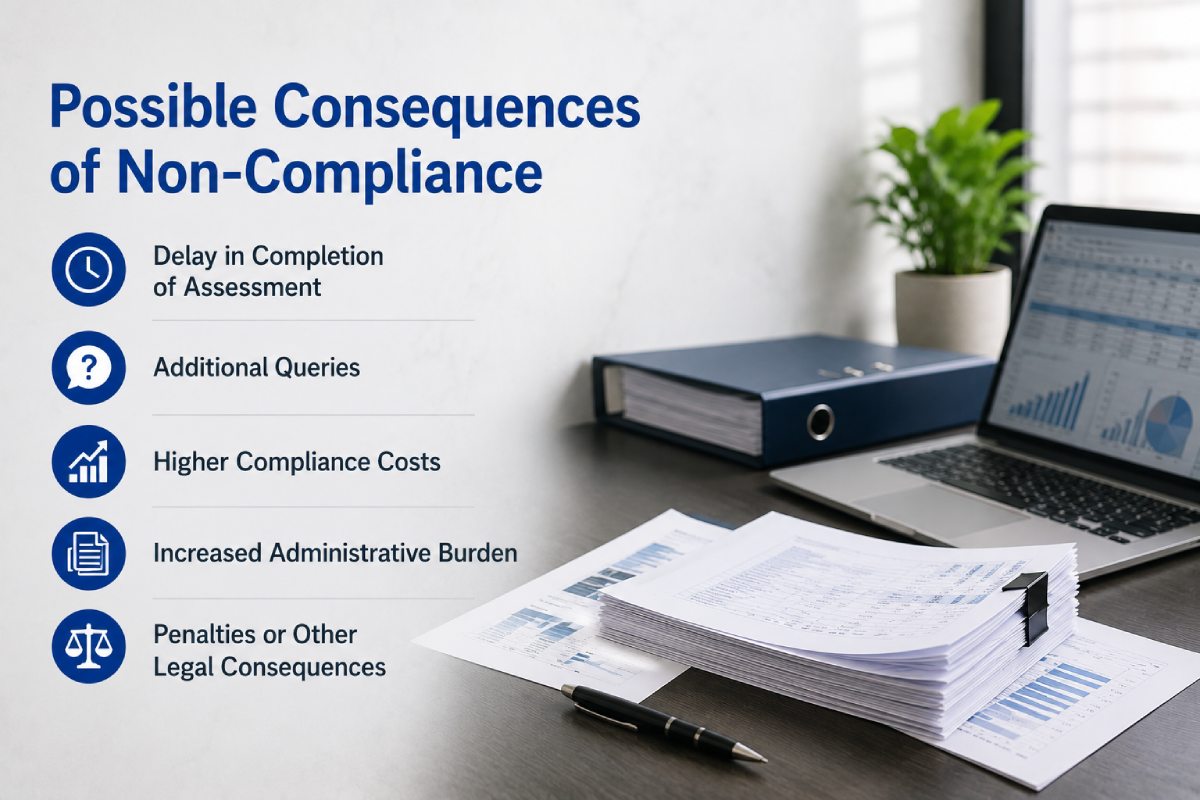
Possible Consequences of Non-Compliance
Depending on the facts of the case and the applicable provisions of the Income-tax Act, failure to comply with a notice under Section 142(1) may lead to several consequences.
These may include:
Delay in Completion of Assessment
Incomplete responses often result in additional notices and a longer assessment process.
Additional Queries
If supporting documents are missing or explanations are unclear, the Assessing Officer may request further clarification.
Higher Compliance Costs
Resolving issues after prolonged non-compliance often requires more time, professional assistance, and additional documentation.
Increased Administrative Burden
Repeated correspondence with the department can consume valuable business time and resources.
Penalties or Other Legal Consequences
Depending on the nature of the non-compliance and the applicable legal provisions, penalties or other consequences may arise.
Because each case is different, taxpayers should seek professional advice if they are unable to comply with the notice within the prescribed timeline.
Can You Correct or Supplement Your Response?
Many taxpayers worry after submitting a response because they later discover that:
- A document was missed.
- An incorrect file was uploaded.
- A financial figure needs clarification.
- Additional supporting evidence has become available.
The appropriate course of action depends on the stage of the assessment and the specific facts of the case. If you realise that additional information needs to be provided, it is advisable to act promptly and seek professional guidance where necessary. Timely clarification often helps avoid unnecessary misunderstandings during the assessment process.
Can a Chartered Accountant Respond on Your Behalf?
Yes. Many taxpayers appoint a Chartered Accountant or authorised tax professional to assist with responding to a notice under Section 142(1).
Professional assistance can be particularly valuable in cases involving:
- Business income
- Multiple sources of income
- Capital gains
- Property transactions
- Partnership firms
- Companies
- GST reconciliations
- Large financial transactions
- International income
- Complex accounting records
An experienced Chartered Accountant can help:
- Review the notice carefully.
- Identify the information requested.
- Prepare supporting documentation.
- Draft appropriate explanations.
- Ensure consistency between financial records and tax filings.
- Communicate with the department where authorised.
If you’re searching for chartered accountant firms near me, choosing a firm experienced in income tax assessments can make the response process more organised and efficient.
Why Professional Guidance Matters
Income tax assessments often involve more than simply submitting documents.
Professionals help businesses and individuals by:
Understanding the Notice
Every notice is unique.
A Chartered Accountant can explain:
Why the notice was issued.
Which documents are relevant.
Which issues require clarification.
How the response should be structured.
Reviewing Financial Records
Professionals verify consistency between:
- Income Tax Return
- Financial Statements
- Bank Statements
- GST Returns
- TDS Records
- Investment Statements
This reduces the risk of inconsistencies.
Preparing a Complete Response
A structured response supported by appropriate documentation is generally easier for the Assessing Officer to review.
Professionals help ensure that:
- Documents are complete.
- Financial figures are accurate.
- Explanations are clear.
- Supporting evidence is properly organised.
Managing Complex Assessments
Businesses with:
- Multiple branches
- High transaction volumes
- Foreign transactions
- Partnership structures
- Corporate entities
often benefit from professional representation throughout the assessment process.
Why Choose Whitespace Consultancy?
Responding to an income tax scrutiny notice requires careful attention to detail, proper documentation, and a clear understanding of the Income-tax Act. At Whitespace Consultancy, we assist individuals, professionals, startups, SMEs, partnership firms, and companies with comprehensive income tax compliance and assessment support.
Our services include:
- Income Tax Return Filing
- Income Tax Notice Response
- Section 142(1) Notice Assistance
- Section 143(1) & Section 143(2) Notice Support
- Tax Planning
- Accounting Services
- Audit & Assurance
- GST Compliance
- Business Advisory
- Financial Reporting
Why Clients Choose Us?
Experienced Chartered Accountants
Our team provides practical advice based on current tax laws and established compliance practices. Whether you are an individual taxpayer or a growing business, we help you prepare accurate responses and maintain organised documentation.
Comprehensive Tax Support
Instead of addressing only the immediate notice, we review your overall tax position to identify potential compliance gaps and improve future reporting.
Technology-Driven Processes
We use secure digital workflows to organise documents, simplify communication, and ensure timely submission of information.
Proactive Compliance
Our goal is not only to respond to notices but also to help businesses strengthen accounting systems and reduce the likelihood of future compliance issues.
Support for Individuals and Businesses
Whether you are a salaried employee, freelancer, consultant, startup, partnership firm, or company, our solutions are tailored to your specific tax requirements.
Key Takeaways
- A notice under Section 142(1) is issued to obtain information, books of account, or documents required for completing an income tax assessment.
- Receiving a Section 142(1) notice does not automatically indicate tax evasion or wrongdoing, but it should always be taken seriously.
- Understanding the required Section 142(1) documents, responding within the prescribed timeline, and maintaining organised records can help ensure a smoother assessment process.
- Ignoring the notice may result in a Best Judgment Assessment, additional correspondence, or other consequences under the Income-tax Act.
- Consulting experienced chartered accountant firms near me can help taxpayers prepare accurate, complete, and well-supported responses.
Conclusion
Receiving a Section 142(1) notice can be concerning, but it is also an opportunity to clarify your tax position and provide the information required by the Income Tax Department. By carefully reviewing the notice, gathering the relevant documents, submitting accurate responses, and maintaining transparent communication, taxpayers can navigate the assessment process more confidently.
Whether you’re a salaried individual, freelancer, business owner, or company, timely compliance and proper documentation are key to avoiding unnecessary complications and ensuring a fair assessment.
Need Help Responding to a Section 142(1) Notice?
If you’ve received a notice under Section 142(1) and are unsure how to proceed, Whitespace Consultancy can help.
Our experienced professionals provide assistance with:
- Income Tax Notice Responses
- Section 142(1) Notice Assistance
- Income Tax Return Filing
- Accounting Services
- Audit & Assurance
- GST Compliance
- Business Advisory
- Tax Planning
If you’re searching for chartered accountant firms near me, our team can help you understand the notice, organise the required documents, and prepare a professional response that supports timely and accurate compliance.
Frequently Asked Questions
What is Section 142(1)?
Section 142(1) empowers the Assessing Officer to request an income tax return (where applicable), books of account, documents, or additional information required to complete an assessment.
Why did I receive a notice under Section 142(1)?
A notice under Section 142(1) may be issued when the Income Tax Department requires clarification, supporting documents, books of account, or additional information relevant to your tax assessment.
Does receiving a Section 142(1) notice mean I have done something wrong?
Not necessarily. Many notices are issued simply to verify information or obtain additional documentation before completing an assessment.
Is Section 142(1) an income tax scrutiny notice?
A Section 142(1) notice is commonly associated with the assessment process because it seeks information from the taxpayer. However, its purpose is to obtain information or documents required by the Assessing Officer rather than to imply wrongdoing.
Can I respond to a Section 142(1) notice online?
The response process depends on the instructions provided in the notice. Follow the specified procedure and submit the requested information in the manner directed by the Income Tax Department.
What are the common Section 142(1) documents?
Commonly requested Section 142(1) documents include bank statements, Form 16, books of account, GST records, investment proofs, property documents, financial statements, and supporting records relevant to the issues raised in the notice.
How much time do I have to respond?
The response deadline is specified in the notice itself. Taxpayers should review the notice immediately and begin preparing the required information without delay.
What happens if I ignore the notice?
Ignoring a notice under Section 142(1) may result in the assessment proceeding based on the information available with the department and could lead to further consequences under the Income-tax Act.
Can a Chartered Accountant respond on my behalf?
Yes. Subject to applicable authorisation requirements, a Chartered Accountant can assist with preparing and submitting responses to the Income Tax Department.
Can I submit additional documents later?
If additional information becomes available after submission, the appropriate course of action depends on the stage of the assessment and the applicable procedures. Professional guidance can help determine the best approach.
What if I cannot arrange all the documents before the deadline?
You should avoid ignoring the notice. Review the instructions carefully and seek professional advice promptly if you anticipate difficulty in gathering the required information within the specified timeline.
Should businesses respond differently from salaried individuals?
Yes. Business taxpayers are often required to provide additional records such as books of account, GST documents, financial statements, purchase registers, and other business-related documentation.
How can I prepare for an income tax assessment?
Maintain organised financial records, preserve supporting documents, reconcile income and deductions regularly, and seek professional advice whenever complex transactions are involved.
When should I contact a Chartered Accountant?
It is advisable to consult a professional whenever the notice involves business income, high-value transactions, capital gains, complex deductions, or extensive documentation.
What is Section 142(1)?
A Section 142(1) notice is issued by the Assessing Officer during the assessment process to request an income tax return (where applicable), books of account, documents, or additional information needed to complete an assessment. It can be issued even if a return has not been filed within the prescribed time.
Why is a Notice Under Section 142(1) Issued?
A notice under Section 142(1) may be issued when the Income Tax Department needs additional information, supporting documents, books of account, or clarifications to verify the taxpayer’s income, deductions, exemptions, or other tax-related details before completing the assessment.
What Documents Are Required for Section 142(1)?
The required documents vary depending on the notice but may include bank statements, Form 16, books of account, invoices, investment proofs, property records, capital gains statements, loan documents, and other supporting evidence specifically requested by the Assessing Officer.